On Site Process FMEA and Process Control Plan Workshops

Before starting production of a new product, you should plan ahead to avoid problems. Unfortunately, your supplier/factory may not have the experience or the bandwidth to analyze risks and implement preventive actions.

There are 2 scenarios where process improvement & stabilization tools are really needed:

  1. A new product is in its industrialization (new product introduction) phase and widespread quality issues cannot be tolerated.
  2. An ongoing production has inconsistent quality even though the factory should be familiar with the product and processes.

Sofeast steps in to support you in implementing key process improvement tools, the Process FMEA and the Process Control Plan, by sending our engineers to the factory to run workshops with their staff who are involved with engineering, production, and quality, and get them up to speed.

Putting in place the Process FMEA and Control Plan is beneficial because they prevent a lot of potential issues. They aim to ensure that products are manufactured at the desired quality. They also minimize the risk of manufacturing issues that have a negative impact on cost and timely delivery.

In the case of a new production or an ongoing production that has recurring issues, implementing these tools will help to ensure that processes run smoothly and correctly much earlier – typically from the first or second mass production run, rather than after the third or fourth run.

How much does running these workshops for your business cost?
Pricing is tailored to each project based on its scope and complexity. Typical costs vary depending on product type, supplier location, and required support.

Every business has its own needs, so we need to consult on your product, factory, and goals first. Then, we will plan the structure and timescale of the workshops and give you the draft plan and quotation.

Tell us about your project

Please provide as much detail as possible, our project managers will review your information and get back to you.

Please enter your contact information and tell us about your project. We will reach out to you shortly to discuss this solution and arrange a quotation.

"*" indicates required fields

Personal data

Project data

Please attach any files that you need us to see (optional).
Drop files here or
Max. file size: 128 MB.
    Opt into emails*
    By checking this box you consent to us replying to you by email & joining our email newsletter so you're first to receive new resources in future (you can easily opt-out in future emails). Your data is stored securely and not shared with third parties.

    On Site Process FMEA and Process Control Plan Workshops FAQs

    We usually focus on the following two tools:
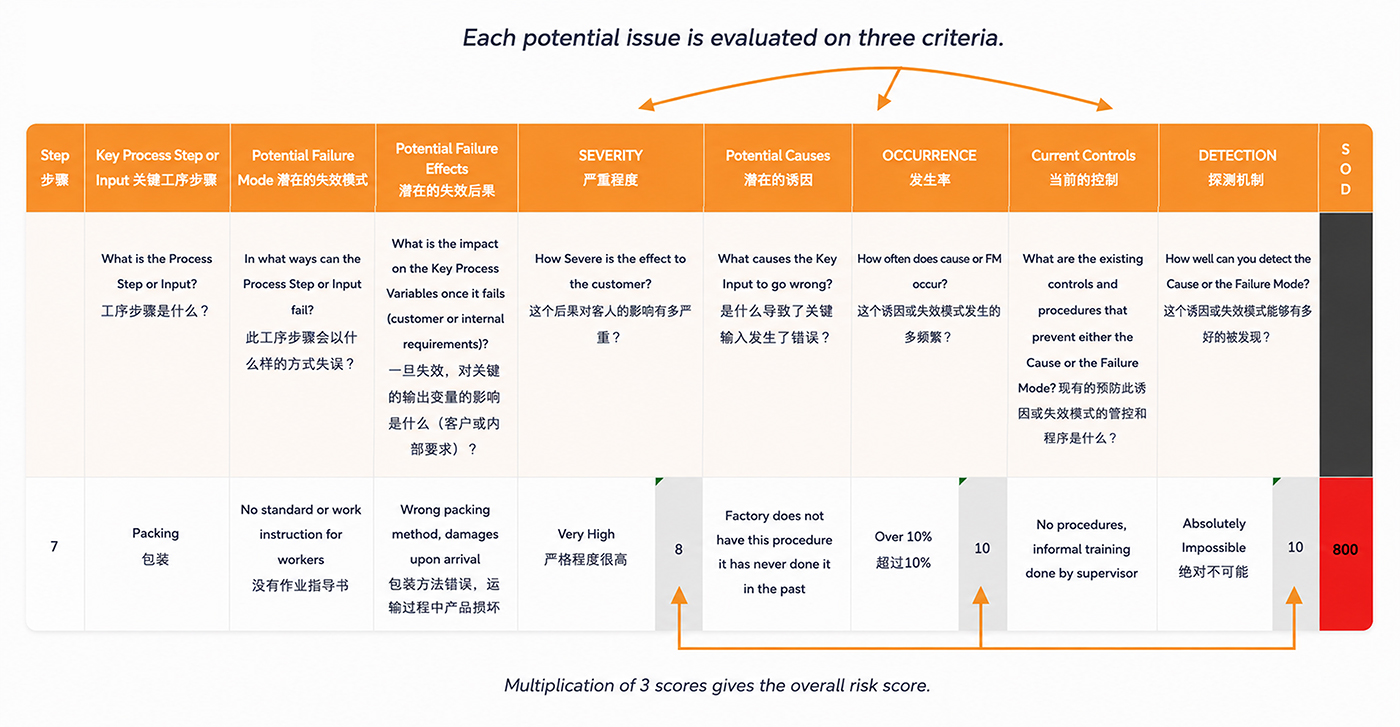
    • Process FMEA – The process Failure Modes and Effects Analysis is a systematic method used to identify and assess potential failures in a manufacturing or assembly process. This has to be done based on the factory’s plan if the product has not been industrialized yet.
      If production is already underway, our engineer will walk the factory floor with relevant stakeholders from the manufacturer to observe and evaluate each step, finding potential issues. They will rank them by severity, possible rate of occurrence, and how likely detection will be. The factory can then concentrate on fixes for the most serious issues.
      You can see an example process FMEA here that shows the process, failure modes, and risk assessment for each:
    • Control Plan – This plan collects and shows the steps needed for consistent quality and results from the production process. It includes process controls such as checking that a machine is operating properly, product controls such as performing incoming QC, what needs to be measured, and more.
      The plan will be a foundation of the work instructions given to operators. It also feeds the factory’s plan for quality checks throughout the manufacturing cycle.
      Here’s an example of part of a control plan, in this case for machined parts:

    The process FMEA is started first, and then if time and our client’s budget allow we start documenting the control plan. In a way, these two tools feed into each other.

    • It can be very intensive, every morning for 3 to 5 days in a row, or less intensive with 1 or 2 days between each workshop.
    • The following people typically need to attend and actively participate: a quality engineer, a process engineer, the salesperson and/or project manager, someone from the manufacturing team, and if possible someone from purchasing (or, ideally, a supplier quality engineer)
    • To be provided before the first day, in case there were already pilot runs or mass production batches: list of the main quality issues that were found so far
    • To be provided before the first day, in case there is information about a relatively similar type of product made at that same factory: a list & analysis of the main quality issues in that other product
    • First day: visit the manufacturing area for 30 to 60 minutes, then short training and workshop to start filling out the process FMEA form. In the afternoon (after the workshop), more information-gathering and documentation work
    • Following days: workshop on the process FMEA analysis and its associated to-do list, and start on a process control plan as time permits (note: the collaboration and support from the manufacturer’s side determine the amount of progress that can be made, for the most part)
    • Gradual transition into defining the control plan, depending on progress made on the FMEA

    Check Related Services

    We’ve made it easy to find the right quality assurance service for your project

    Quality Assurance (QA)

    Production Monitoring & Reporting (PMR)

    Production Monitoring & Reporting (PMR)

    Quality issue visibility

    Supplier accountability

    Find Out More

    Production Monitoring & Reporting (PMR)

    Stay informed with clear production updates, quality findings, and corrective action tracking throughout manufacturing.

    Find Out More

    Quality Assurance (QA)

    Final Random Inspection

    Pre-shipment quality check

    Random sampling method

    Defect rate evaluation

    Find Out More

    Final Random Inspection

    Verify finished goods quality before shipment based on statistically valid sampling.

    Find Out More

    Quality Assurance (QA)

    Full Production Check (FPC)

    Production quality verification

    Sampling & defect analysis

    Shipment readiness approval

    Find Out More

    Full Production Check (FPC)

    Inspect output across the full production run to identify systemic quality issues.

    Find Out More

    Quality Assurance (QA)

    Container Packing & Loading Supervision

    Container loading supervision

    Quantity & packing verification

    Shipment risk prevention

    Find Out More

    Container Packing & Loading Supervision

    Supervise loading to ensure correct quantities, packaging integrity, and container security.

    Find Out More

    Quality Assurance (QA)

    Supplier & Production Overview Inspection (SPOI)

    Supplier capability overview 

    Production status review

    Risk & readiness snapshot

    Find Out More

    Supplier & Production Overview Inspection (SPOI)

    Get a rapid, high-level snapshot of supplier capability and production status.

    Find Out More

    Quality Assurance (QA)

    Process Management Audit

    Process performance review

    Workflow risk analysis

    Continuous improvement plan

    Find Out More

    Process Management Audit

    We assess your factory’s processes, identify operational risks, and provide clear recommendations to improve efficiency, consistency, and quality performance.

    Find Out More

    Explore more Services in Quality Assurance ↓