What Are TRL (Technology Readiness Levels)?

What are TRL? Short for Technology Readiness Levels, the TRLs are a measurement system developed by NASA in the 1970s:

“used to assess the maturity level of a particular technology. Each technology project is evaluated against the parameters for each technology level and is then assigned a TRL rating based on the project’s progress. There are nine technology readiness levels. TRL 1 is the lowest and TRL 9 is the highest.”

NASA also created a chart that provides a handy visual representation of the different TRLs:
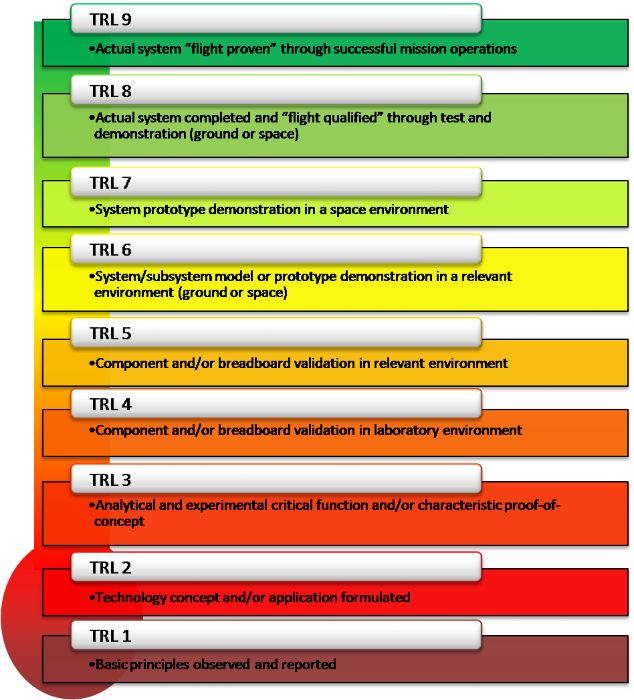
NASA TRL chart

You can see that it includes jargon specific to the development of equipment used for space exploration, but if you consider the Technology Readiness Levels as a framework for everyday product development they’re also valid for any number of today’s products and are easily related to the NPI process.

How can today’s importers utilize the TRL framework to guide product development and manufacturing?

Importers of, say, consumer products, can consider the different TRLs as ‘technology milestones’ that help demonstrate how far a new product is through the development process.

The difference between NASA’s TRLs and using TRLs for consumer or medical devices is, NASA didn’t mass-produce its components. They had an approach much closer to one-at-a-time crafting of their modules. As a consequence, the manufacturing process validation work was overlooked in their model.

Based on NASA’s original framework, a more general-purpose TRL framework we use at Sofeast includes the following 6 phases and incorporates the TRLs:

  1. Specification
  2. Feasibility study
  3. Prototyping
  4. Tooling (and other process validation work)
  5. Pre-production preparation
  6. Mass production and ongoing improvement efforts

This video explains how Sofeast’s TRLs work and correspond with NASA’s original framework:

Conclusion

As discussed in this podcast episode: The NPI Process: Trouble Awaits You If You Skip Its Steps!, it’s important to follow a logical process when launching a new product in order to get products that reach your expectations.

NASA, who wanted visibility on the progress and readiness of their new systems, developed the TRLs for just this reason, and today’s companies who’re manufacturing new products, requiring good quality, safe, and compliant products to hit the market, can also implement the TRLs to act as milestones that reduce risks caused by missing certain key actions, such as not creating and ‘freezing’ clear and thorough product specifications.

P.S.

Read about what the TRL are in more detail in this blog post: Technology Readiness Levels: A Better Product Development Framework?

Reaction Injection Molding Compared To Other Manufacturing Processes

Let’s review reaction injection molding (RIM) and compare that to other manufacturing processes used to manufacture products from a polymer material (plastic), some of which are fully automated and others that are very labor-intensive.

Another factor to consider is the level of complexity that can be achieved with the different processes and what degree of detail can be produced. One other major factor is the cost of both the tooling and the final part. All these factors, when combined, will determine what is the best process to be used for the production of a production part.

What is RIM?

Reaction Injection Molding (RIM) uses two-part thermoset liquid polymers which are lightweight and cost-effective. These thermoset polymers start as a liquid pumped into a mixing head which then injects the mixed liquid polymers into the tool cavity.

As liquid polymers require less heat and pressure to fill the cavity, tooling can be manufactured from lower-cost ‘softer’ materials such as aluminum rather than hardened steel.

The liquid polymer cures inside the tool at low pressures and a tool temperature of around 80 Degrees Celsius.

The term reaction injection molding comes from the fact that the polymer is a two-part liquid that has a chemical reaction when mixed which is then injected into the mold tool.

What are the Benefits of Reaction Injection Molding?

The benefits of reaction injection molding are as follows:

  • Large lightweight parts can be produced
  • Parts can be produced with variable wall thicknesses
  • Low-cost tooling due to low injection pressure and low tool temperature requirements
  • A variety of inserts can be placed in the mold prior to injection
  • Dimensional stability over a large dimension
  • High complexity and detail achievable
  • Semi-automated process giving a low to medium cost production part

Comparison of RIM Against Other Molding Processes

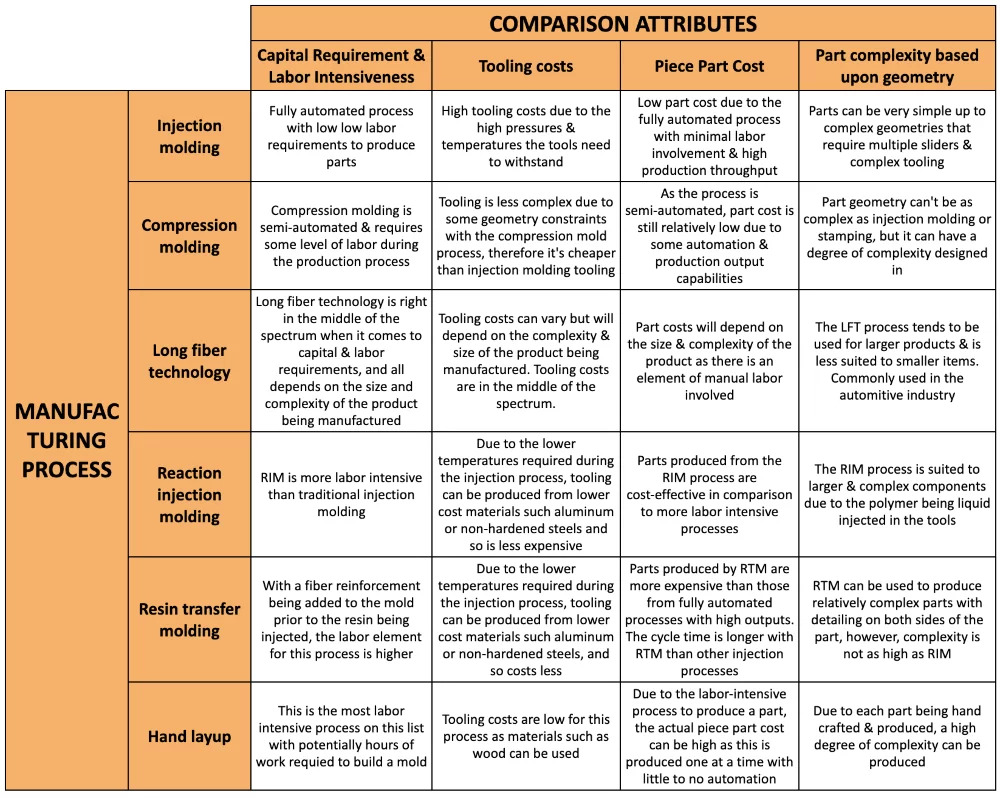
The following table shows a comparison of the different manufacturing processes for polymers and the following attributes:

  • capital requirements and labor intensity,
  • tooling costs,
  • piece part costs,
  • part complexity based upon geometry

comparison of different molding processes

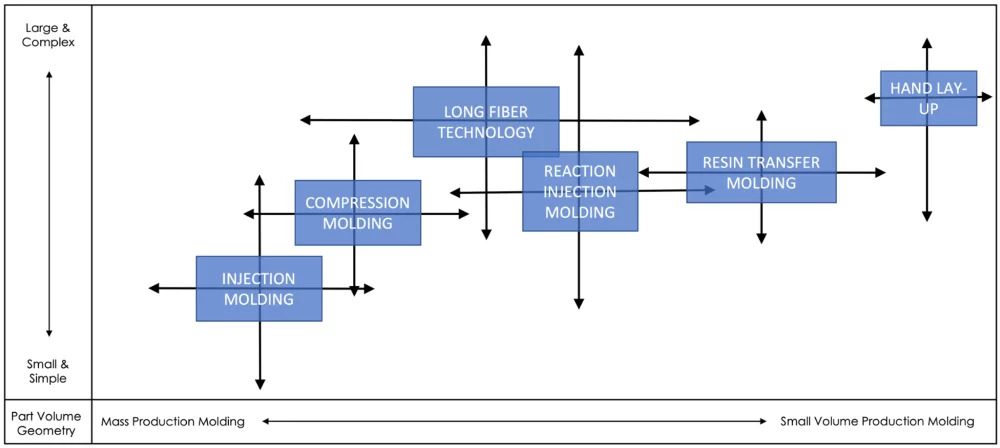
A similar comparison where you can see the suitability of each molding process for either mass production or small volumes and complex parts can be seen in this chart (based on a publication from https://romeorim.com/):

comparison of molding processes for small and large volumes

Learn even more about the plastic injection molding production process in this collection of resources.

Production part examples

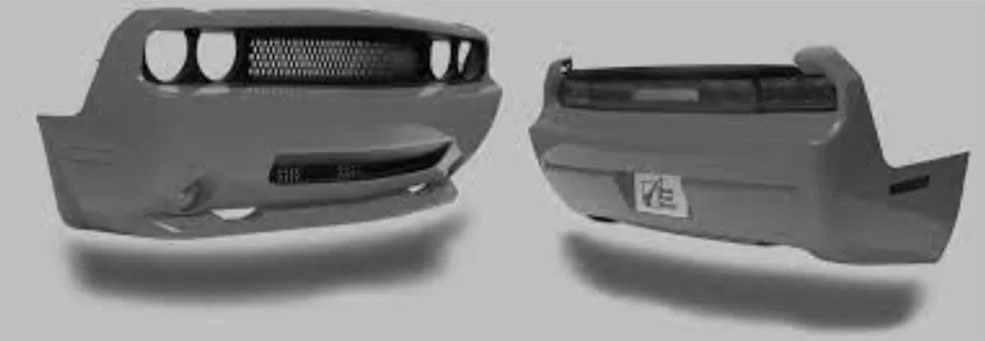
Reaction Injection Molding has been used extensively in the automotive industry for decades to produce bumpers and fenders, internal trim, and other decorative trim.

RIM automotive bumpers
Image source: https://3dimensional.com/services/reactionary-injection-molding/

Another industry sector to utilize reaction injection molding as a manufacturing process is the healthcare industry. Parts include housings for medical devices such as DNA analyzers, analysis machines, and sides for medical beds.

reaction injection molded medical devices
Image source: https://goformold.com/th-reaction-injection-molding/

Conclusion

RIM as a process is ideal for the production of large lightweight complex parts manufactured from a thermoset polymer. The process is semi-automated, therefore, part costs are not as low cost as fully automated injection mold processes, however, the tooling cost will be a lot lower than those harder injection mold tools due to the lower temperature requirements and lower pressure during the production process.

What Is Product Engineering?

Product engineering is the process of turning an idea into a fully manufacturable product. The process is normally split into different phases with different project team members working on specific aspects of the product development. The hardware design would typically be completed by CAD development engineers, whereas the software would be completed by software engineers.

Take an electro-mechanical product, something like a DSLR camera, for example. The development of this would be planned out in the different phases of the development. Product engineering is the overall term used to bring that new camera to market.

The new product development process

The phases of a new product development could be something like the following:

  1. Idea Generation
  2. Idea Screening
  3. Concept Testing
  4. Business Analysis
  5. Product Development
  6. Test Marketing
  7. Commercialization
  8. Review of Market Performance

As you can see, product engineering is not only about product design; there are multiple tasks required throughout this process which demand specific sets of skills, such as:

  • Statistical data analysis
  • Cost analysis
  • Manufacturing process knowledge
  • Software programming and development
  • System integration and implementation
  • 3D CAD product design
  • Simulation software
  • Product reliability and qualification
  • Physical product testing and analysis
  • Product-specific technology knowledge
  • Analytical and problem-solving skills
  • Continuous product improvement
  • Total quality management
  • Customer usability and serviceability knowledge

How organizations handle product engineering

Often, there is a dedicated product engineer assigned to each project and it would be their responsibility for taking the product concept through the different product development phases and launch the product into mass production ready for sale. In some organizations, a project manager who may not be an engineer by training assumes that role.

That central person would not have to know every skill or to carry out every part of the development themselves. As we said earlier, each specific task should be assigned to the correct resources within the project team who are experts in their field. The project manager must, however, be very familiar with the product development cycle and every element within each of the phases.

Need assistance with bringing your new product to market?

If you need more help with product engineering or would like to discuss your product development, reach out to our product development team who would be more than happy to discuss your projects, we may even be able to help you with resources and implementation.

We provide these solutions for people in your position which will organize your new product development up to the point where mass production begins:

  • New product industrial design support – we assist with product design and find the right solutions at the right cost for you.
  • New product introduction (NPI) – our engineers design & implement a new product introduction process to get your new product mass-produced without delay, within budget, and at the required quality level.
  • Prototype development – we quickly produce your prototype to test and validate your design, adding feedback and improvements to enhance ease of manufacturing.

Our wholly foreign-owned manufacturing subsidiary, Agilian Technology, can also provide you with contract manufacturing, warehousing, and fulfilment, too.

Read these resources before you get started…

If you’re planning on developing and manufacturing your new product in China, you need to read this guide: An Importer’s Guide to New Product Manufacturing in China

What is NPI for hardware startups? This eBook uncovers the process in great detail: The New Product Introduction Process Guide for Hardware Startups

What does a proven new product launch roadmap look like? Find out here: New Product Launch Roadmap [Excel Sheet + Exclusive Explainer Video]

New Product Launch Process

The new product launch process for importers who are manufacturing products in China or Asia is the process of coming up with your product idea, and taking it through to mass production and eventual importing and sales.

Breaking down the new product launch process

It is a complex process that can be broken down into the following stages:

Phase 1 – Partner Selection

Phase 2 – Non-Recurring Engineering & Sampling

Phase 3 – Pre Production

Phase 4 – Production

Phase 5 – Continuous Improvement

You can learn more about these stages in this blog post.

Phase 1 – Partner Selection

Creating a shortlist of potential suppliers and doing due diligence on them to assure that they can produce your goods at the correct quality, cost, and deliver on time. A factory audit is also essential here on the supplier you finally decide upon.

Phase 2 – Non-Recurring Engineering & Sampling

These tasks put you in a position to produce goods with your supplier. Tooling is commissioned, and prototypes and samples are created. Your manufacturing contract with the supplier will also be finalized and then a deposit paid. The goal is to be ‘production-ready.’

Phase 3 – Pre Production

In this phase, you will go through your manufacturing agreement with the supplier and cover all the critical elements and deliverables and set expectations for production. Your initial order will be placed, and pilot run/s need to happen before mass production.

Phase 4 – Production

Now you will mass produce your products, assure their quality, and prepare them to be shipped. Product inspections should occur at this point, and if all is well, the balance can be paid when goods are shipped.

Phase 5 – Continuous Improvement

Let’s assume that you have good results and want to continue working with your supplier, you’ll work with them to devise KPIs that govern production, processes, and procedures with the aim of improving quality, performance, lead times, and more. A supplier improvement audit will assist with this.

How is Sofeast’s new product launch process structured?

The diagram below demonstrates how we usually structure our clients’ new product launch projects, and the different stages are named differently.

new product launch process diagram

At Sofeast we also provide an accelerator program. Rather than a final stage, it is extra planning & expediting throughout the project, and for extra safety (e.g. backups in order to afford a few setbacks). It often makes sense for hardware startups to pay extra and be on the market a few weeks earlier!

Launching new products – expert commentary video

Sofeast CEO Renaud Anjoran and senior engineer Paul Adams talk you through new product launches in this video:


P.S.

Stuck with launching your new product?
Take a quick look at our product engineering solutions and get help from our experienced design and production engineers to get your product to market quickly!

What is an NRE Cost (Non-Recurring Engineering)?

What is NRE? The term NRE cost (non-recurring engineering) refers to any cost that needs to be spent as a one-off cost on a new product development project. These up-front expenses are the cost of getting a product from a conceptual idea to the point it can start production.

These costs will need to be planned and budgeted for in the project plan and include project staff wages, all materials for prototypes, production of prototypes, manufacture of test products, testing the products, and any jigs and fixtures dedicated to testing.

  Related: Listen to this podcast episode about NRE costs for more detailed information as we take a deep dive into these one-time expenses (investment) that you need to pay in order to get your product into production:

What is a typical non-recurring engineering charge?

NRE costs also include all pre-production activities and requirements such as production line tooling, jigs and fixtures, production tooling like injection molding tools or die casting tooling, any test rigs that need to be developed to ensure quality control measures are in place throughout mass production. It also covers all the electronics and software development, and not forgetting factory visits to suppliers to ensure they are capable of producing the components you subcontract out for manufacture.

How are costs factored into a new product development project?

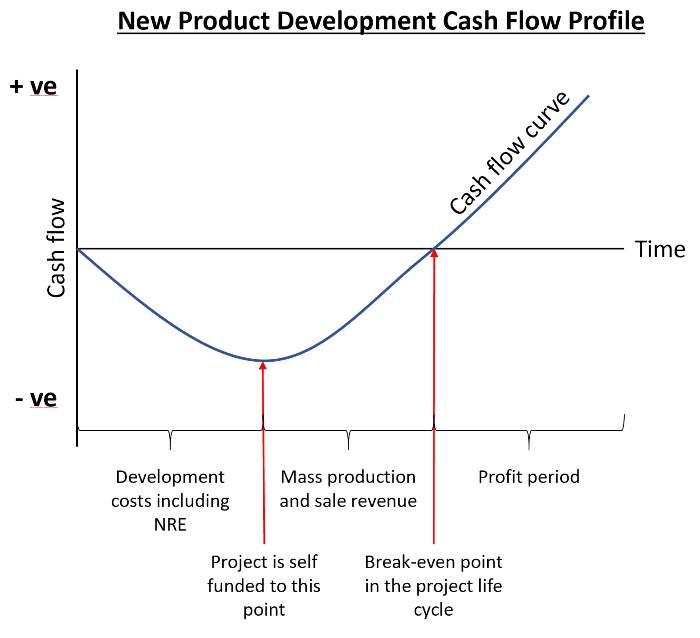
All these up-front costs in a new product development project must be factored into every project as there will be zero revenue from this project until products start to sell as a result of bringing the product to production. In fact, there will not be any profit until the project hits the breakeven point. This can be seen in the New Product Development cash flow curve graph below:

new product development cash flow profile with nre costsAs you can see, the first section of the curve up to the point where the project is self-funded, each NRE cost is included, past that point revenue is being generated through sales.

If you are unsure what NRE fees you need to include in your project planning, you can contact us to discuss your project and we can help you generate a project plan and identify potential non-recurring engineering costs.

Further reading…

Read even more on this topic in this blog post: What Are Your Non-Recurring Engineering Costs for Production in China?