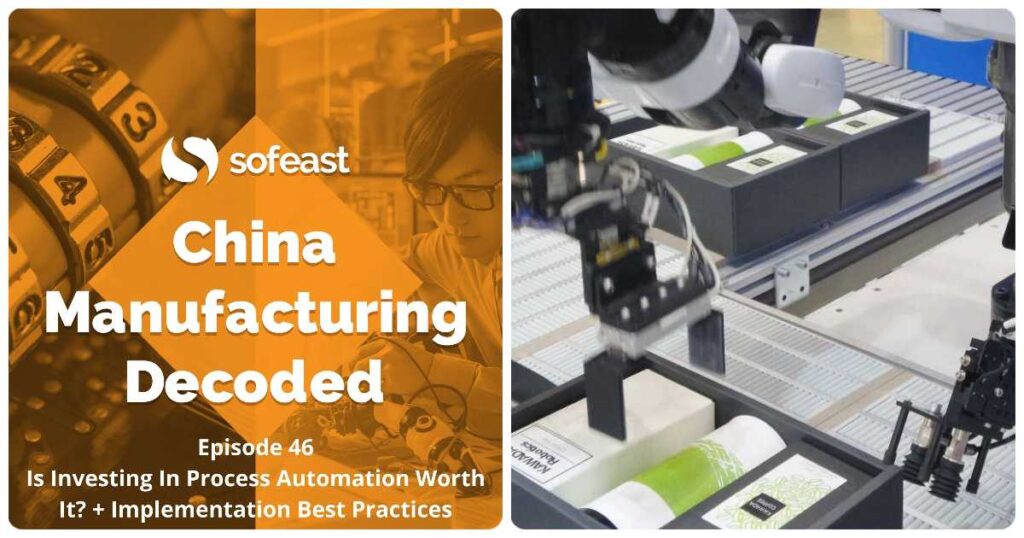
Is Investing In Process Automation In The Factory Worth It? + Implementation Best Practices [Podcast]

Is Investing In Process Automation In The Factory Worth It + Implementation Best Practices -podcast

Automation is a major focus of the Chinese government and many manufacturers here, but can it really reduce costs..?

Renaud will answer the questions: “Is Investing In Process Automation In The Factory Worth It?” and “What are the best practices to follow to smoothly transition into more automation?”

Without a doubt, increasingly automating processes features highly in the future of manufacturing, but there are right and wrong ways to implement automation. Also, while replacing multiple staff with one or two pieces of equipment may seem financially astute, there are numerous ‘hidden costs’ to machinery that sales reps won’t tell you. In this episode, we’ll dispel the myths surrounding automation and also provide a solid blueprint to follow in order to improve your process efficiency and start implementing automation in a steady and methodical way.


Just hit the play button to start listening..!

Listen to the episode right here 👇👇👇

🎧 Is Investing In Process Automation In The Factory Worth It? (+ Implementation Best Practices) 🎧

Here’s a summary of key sections of this episode:

✅ What is process automation in the factory? 

✅ Are Chinese manufacturers guilty of rushing into automation too quickly? 

✅ The benefits & drawbacks of automation in the factory:

Benefits that affect equipment costs positively

  • Lower costs of equipment in comparison to employing numerous operators over time (labor cost/social insurance/holidays/etc)
  • Equipment reduces defects over operators (human error) and removes the need for expensive rework
  • Reducing management overheads due to having fewer staff to manage

Drawbacks that affect equipment costs negatively

  • Interest on capital expenditure in China is high
  • Specialized staff required to run and maintain the equipment could cost more than the operators being replaced by the equipment
  • The cost of getting the machinery to working and up-to-speed
  • Maintenance – a large driver of costs (parts, downtime, training skilled staff, etc) and really important for highly automated factories (listen to more about preventive maintenance here)
  • Automation leads to higher MOQs which rules out smaller orders which can be more profitable
  • Lead times could be reduced by equipment, but often it’s not the case

✅ Talking about Toyota’s approach to automation to weed out DDD processes

✅ The wrong way to implement automation

Before implementing full automation, you should try… 

✅ Re-engineering human operations – use process engineers to re-engineer human operations to reduce ‘waste’ and increase the seconds per minute that they are physically working on transforming each piece, for example, through improving the layout of and logistics around the production line and providing enhanced training to the operators and their group leader.

✅ Semi-automating some of the operations – the next step is to implement some semi-automation to assist operators to become even more productive, for example, a machine that delivers a part into place for them to transform and then ejects it, reducing their time spent not transforming parts.

✅ What happens if an automated line goes down – hint: it’s not good

✅ What to be mindful of if your supplier tells you that they’re implementing automation

✅ Renaud’s blueprint to implementing automation smoothly –

  • Assess whether re-engineering human processes more valuable than implementing tools for you at this point in time (it is often the case)
  • Start with semi-automation to make the operators’ routines more efficient. This also familiarizes your staff with working with and maintaining machines.
  • Set up an automated pilot line that is insulated from the other lines.
  • As you go along, more and more processes can be automated step-by-step, and this will be accompanied by a reduction in staff required.

✅ Automation is NOT just robots – Michel Baudin wrote in this blog post that PLCs (programmable logic controllers) outsell industrial robots by millions to one each year.


Additional content related to today’s episode…

What are your thoughts on implementing automation in your Chinese/Asian factory? Let us know by leaving a comment, please.


Listen, rate, & subscribe to the ‘China Manufacturing Decoded’ podcast on your favorite provider 👍

There are more episodes to come, so remember to rate us and subscribe! You can find us on:

Don’t forget to give us a ⭐️⭐️⭐️⭐️⭐️ rating and share it with your network if you enjoy listening! 😊
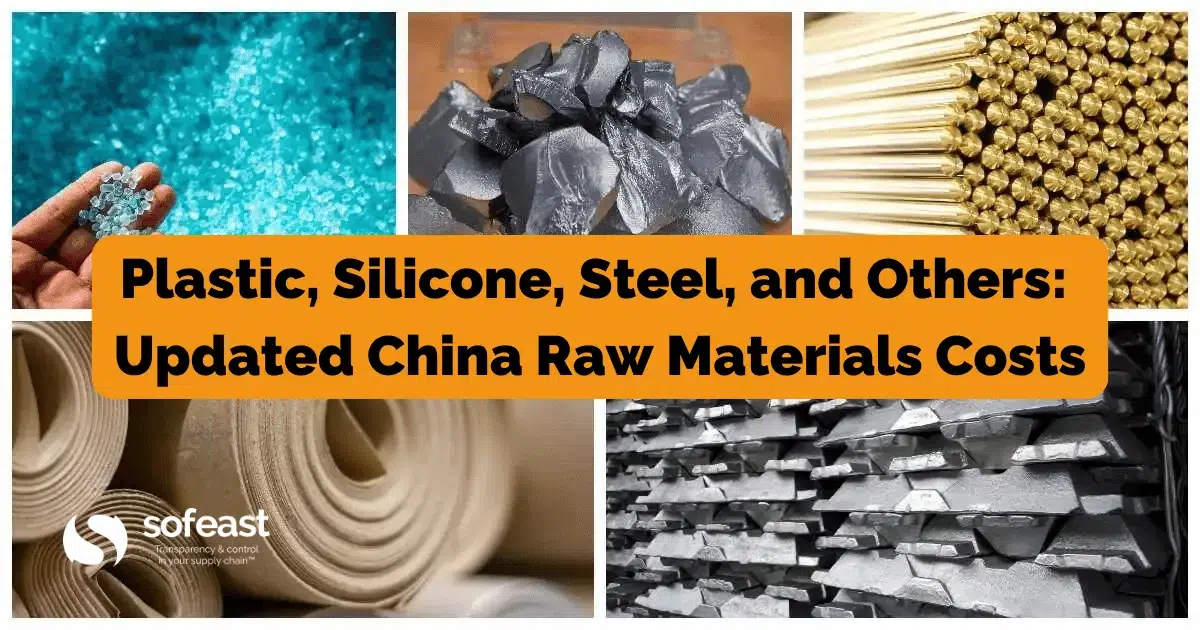
Plastic, Silicone, Steel, and Others: Updated China Raw Materials Costs (March ’21)

If you have been buying products from China, you have probably had bad experiences with pricing. Manufacturers often raise the price once a year,  when their costs have gone up, or when the exchange rate got less favorable. The most common justification for price rises is: “China raw materials have gotten more expensive”.
But they don’t tell you what part of their cost comes for each material, so you are left negotiating with no visibility.

Continue reading “Plastic, Silicone, Steel, and Others: Updated China Raw Materials Costs (March ’21)”

Exploring Manufacturing and New Product Development in Vietnam [Podcast]

Exploring Manufacturing and New Product Development in Vietnam Podcast

Vietnam continues to be a popular alternative to China for today’s importers. Let’s explore it…

Renaud interviews Simon Caballero, a Hanoi-based purchasing manager and expert on manufacturing in Vietnam, to discuss the manufacturing industry in Vietnam, common risks and issues you will face when manufacturing garments there, and the relationship between developing new products and manufacturing in Vietnam and China.

Simon, originally from Barcelona, Spain, has a background in logistics and over a decade of experience in sourcing all kinds of products in Asia, with particular expertise in China and Vietnam (a growing manufacturing hub and popular alternative to China). In recent years he has been focused on the garment industry (specifically workwear).

If you’re interested in learning more about manufacturing in Vietnam, Simon’s insight directly from the ground there in this episode is going to be fascinating!


Just hit the play button to start listening..!

Listen to the episode right here 👇👇👇

🎧 Simon Caballero | Common Risks & Issues When Making Garments In Vietnam 🎧

Here’s a summary of key sections of this episode:

✅ How workwear has evolved to become more technical garments.
✅ Categories and features of different factories in Vietnam and who they’re most suitable for – typically 3 types: Foreign-owned/Locally-owned/State-owned.
✅ The impact of Tet/CNY on material and logistics prices in early 2021 – similar to China, raw material and logistics cost increases.
✅ What the different areas of Vietnam are, and the specialties of each in terms of industries and materials – these vary from North to South, with the North having more raw materials and the South having more specialized and technical manufacturing.
✅ The differences between North and South Vietnam.
✅ Is developing new products in Vietnam feasible right now? – interesting insight here into the maturity of Vietnam for NPD and its strong links to China for materials and components amongst other things.
✅ Performing QC in Vietnam and its challenges – compared to China, Vietnam has fewer experienced QC inspectors which can lead to challenges when trying to manage quality there.


Additional content related to today’s episode…

Does Vietnam play a part in your supply chain, or are you planning to move some production there in 2021 and beyond? Let us know by leaving a comment, please.


Listen, rate, & subscribe to the ‘China Manufacturing Decoded’ podcast on your favorite provider 👍

There are more episodes to come, so remember to rate us and subscribe! You can find us on:

Don’t forget to give us a ⭐️⭐️⭐️⭐️⭐️ rating and share it with your network if you enjoy listening! 😊

How To Switch To A Newer, Better Chinese Manufacturer? [eBook]

Agilian How To Switch To A New Chinese Manufacturer And Or Develop A Backup eBook
Our contract manufacturing subsidiary, Agilian Technology which is based just a little north of Shenzhen airport, has just launched this new eBook which guides you through how and why you may want to switch away from your current Chinese manufacturer to a new one.

Also, in case sourcing a new manufacturing partner from scratch isn’t practical, it includes suggestions on how to create and nurture a backup supplier whom you can turn to quickly if you begin having trouble with your current choice.

If you’re tired of your current Chinese manufacturer failing to deliver the products on time, at the right cost, or quality, too, then it may be time to make the change. This eBook shows you how!

Agilian How To Switch To A New Chinese Manufacturer And Or Develop A Backup
 

Do you need this eBook?

If you are currently using a Chinese manufacturer to supply your products it makes good business sense to be prepared to move to a new manufacturer if you start to have problems. This eBook will help you prepare.


Surely switching from one manufacturer to another is a lot of trouble?

Switching has its risks, such as your current supplier refusing to hand over your tooling. However, how difficult the process depends a great deal on how your relationship with the supplier is set up.

A key question is whether you signed a legally enforceable Chinese manufacturing agreement? If so, this will reduce the risks of your manufacturer ‘misbehaving’, and we’ve got a whole section in the eBook that deals with supplier management in terms of agreements, IP ownership, and more.

If you have a secure relationship with your current supplier and are equipped to do proper due diligence on your new options, there’s no reason to delay switching once you’ve found a more suitable manufacturer to supply you. After reading this eBook, you will see that it’s far more damaging to your business to stay with a manufacturer who isn’t delivering than to go through the process of switching.


What’s in the eBook?

Here are the various chapters of the eBook:

  1. Introduction – learn why switching to a new supplier can be a valuable activity.
  2. 7 Reasons that show it’s time to switch suppliers – these are the red flags that hopefully you won’t see from your manufacturer. But if you do…
  3. How to plan to source a new supplier and make the switch – here you’ll explore some of the key knowledge you’ll need to plan and execute your move, including the role of IP ownership, manufacturing agreements, how to source a great new manufacturer, transferring tooling, and more.
  4. A thorough checklist (we use this process ourselves with customers) to help guide you through the process of switching from old to the new supplier – covers all the technical details that need to be handled during the switch, an example of this is assuring you have obtained the engineering design files required for custom components from your old supplier before leaving them.
  5. How to safely transfer tooling between old and new supplier – tooling is one of the more expensive pieces of equipment you have and in order to reduce costs and delays you can follow this guidance which explains how to securely remove it from your old supplier and deliver it to the new one without a hitch.
  6. How and why to develop a backup supplier – there’s no need to source a new manufacturer from scratch. Some importers choose to develop a backup and keep them up-to-speed with occasional smaller orders so they can step in if anything happens with your ‘main’ manufacturer. This section covers how to do this.


How do I get a copy?

To get your copy just hit this link and fill out the form on the page you go to (note, you will be directed Agilian’s website).

This video from Agilian explains how to go through the process to download your eBook.


Dissatisfied with your manufacturer? Read this eBook and get one step closer to a solution

You don’t need to put up with quality problems, unauthorized subcontracting, shoddy treatment of your IP, late deliveries, unexpected and unwelcome price rises, and more, which are all red flags that your manufacturer isn’t reaching

Fabien and Renaud (Agilian/Sofeast CEOs) have decades in dealing with Chinese suppliers and manufacturing in China for various customers, and this eBook shares their insight and experience with you by explaining why you will benefit from switching and how to make the transition smoothly.

Agilian How To Switch To A New Chinese Manufacturer And Or Develop A Backup

Improving Worsening Product & Packaging Quality – Disputes With Chinese Suppliers: Q&A (Volume 5)

Disputes with Chinese suppliers Volume 5Q: We use a manufacturer in China for our products and packaging and have had a good relationship for years, but recently product and packaging quality has gone downhill. What can we do?

We’re supplied by a Hong Kong company that has their factory across the border in Shenzhen.

Overall we’ve had a good relationship for the past couple of years, but the last order was terrible as product quality had really suffered and it’s almost like they didn’t perform QC at all.

To make matters worse, they’re also using thin and flimsy cardboard for the product’s outer packages and we’re getting a lot of damage to the products by the time we receive them, too. This is unacceptable as we’ve requested them to stop doing this and use more suitable packaging on a number of occasions.

In addition, even our logistics company is making mistakes when shipping the products, too.

I know the owner and have spoken directly with him and have placed a new order in the hope that they now start getting it right.

What should we be doing to improve the situation?

Answer:

Yes, poor product quality and bad packaging that ruins the products is a major source of frustration for many importers!

Here are a couple of questions:

  • Could it be that they are subcontracting the production of your products to a different factory (perhaps a friend of theirs) without your knowledge? This would explain why errors that should be easy to fix are being made despite you having a good relationship with the supplier.
  • Are the owner and the top management in Hong Kong right now?
    Due to COVID travel restrictions, it’s very difficult to go between Hong Kong and China these days, and we’ve seen many factories run into issues when their top management became unable to travel there to keep an eye on things.

Based on your situation here are some suggestions about how to put the situation right

Project Management

Sending someone in to manage your project on the ground in Shenzhen will help find, analyze, and correct the issues.

How Sofeast can help 👉 Supplier Management:
We can have one of our supply chain management technicians communicate directly with the people at the factory, repeat your requirements, request photos in order to ensure things are well addressed, etc. We invoice 38 USD per hour for that (consumed in small increments, but invoiced in blocks of a minimum of 5 hours).

Product Inspections

To take control of the product and packaging quality problems it’s wise to send in a quality inspector when production is well underway or products are being packed before shipping. The inspector will alert you as to whether it is not good before it’s too late to make changes, and you can request improvements to the product quality or new outer cartons (which should be both strong and dry).

How Sofeast can help 👉 Product Inspections:
In Shenzhen, the price is 299 USD for 1 man-day of work for product inspections.

Off-Site QC and Fulfilment

Another approach to solve all of the issues would be to send your products to a separate 3rd party facility, where the QC, packing, and fulfilment are managed by specialists without the involvement of your suppliers. Your supplier often wants to ship ASAP to get payment, whereas a third party is being paid to get the packing and fulfilment right and doesn’t have external pressures to skip the time it takes to be extra careful.

How Sofeast can help 👉 100% inspection, repacking, and shipping:
Your supplier delivers products (usually without final packing) to our facility, we check these products and sort out the ‘bad ones’, we pack them, and we ship them to you.
We can also kit or assemble several components together. We provide a quote based on your specific situation.
Other services from our China 3PL may also be suitable here, for instance, if you do not need to perform 100% inspections, but do want co-packing of your products at our 3rd party facility.


Are you designing, or developing a new product that will be manufactured in China?

Sofeast has created An Importer’s Guide to New Product Manufacturing in China for entrepreneurs, hardware startups, and SMEs which gives you advance warning about the 3 most common pitfalls that can catch you out, and the best practices that the ‘large companies’ follow that YOU can adopt for a successful project.

It includes:

  • The 3 deadly mistakes that will hurt your ability to manufacture a new product in China effectively
  • Assessing if you’re China-ready
  • How to define an informed strategy and a realistic plan
  • How to structure your supply chain on a solid foundation
  • How to set the right expectations from the start
  • How to get the design and engineering right

Just hit the button below to get your copy:

An Importers Guide to New Product Manufacturing in China Guide

How A DFQ Review Designs Quality INTO Your Product At An Early Stage [Podcast]

How A DFQ Review Designs Quality INTO Your Product At An Early Stage [Podcast]What if you could reduce the chances of quality problems long before your product goes into production? A DFQ review can help you achieve this!


What is DFQ?

Design For Quality is where we review a number of factors that affect quality at the early stages of the new product introduction process, so that’s your concept and prototypes.

Not every Chinese manufacturer will do this, and while it may be tempting to power through to production to get to market, it’s risky to do so (could your company afford a lawsuit from end-users who were injured by a defect you didn’t see coming?). But as Renaud explains in this episode of the podcast, DFQ reviews are really important to reduce delays, costs, scrap, rework, compliance, customer safety, and more.

Your team will take into account factors like mistake-proofing production processes, leaving no stone unturned to anticipate and identify possible problems in the design, reducing reliance on custom parts that are hard to source, and more, but we’ll get into all of this in the episode and, hopefully, you’ll see how useful DFQ is for optimizing your product’s quality!


Just hit the play button to start listening..!

Listen to the episode right here 👇👇👇

🎧 The Concept Of ‘Design For Quality’ (DFQ) 🎧

Here’s a summary of key sections of this episode:

✅ Why is the design stage of the new product introduction process so important?
✅ A DFQ review often happens before you invest in the tooling. Here’s why…
✅ Design changes are quick and cheap at the concept stage, but later on, are an expensive problem
✅ What are the principles in DFQ that we follow when reviewing our product and its design?
✅ Some common mistakes that cause poor-quality products
✅ Some examples of how DFQ reviews have improved products before they went into production


Additional content related to today’s episode…

*******

Do you use DFQ reviews when you’re designing new products and manufacturing them in China or Asia? Let us know by leaving a comment, please.


Listen, rate, & subscribe to the ‘China Manufacturing Decoded’ podcast on your favorite provider 👍

There are more episodes to come, so remember to rate us and subscribe! You can find us on:

Don’t forget to give us a ⭐️⭐️⭐️⭐️⭐️ rating and share it with your network if you enjoy listening! 😊

6 Advantages Of Conducting An Off-Site Product Inspection

6 Advantages Of Conducting An Off-Site Product Inspection

Most product inspections take place at your supplier’s factory which makes sense as that’s where the products are being made, allowing a QC inspector to go in there and check during production, for example. But there are times when you may conduct an off-site product inspection. Let’s explore what this inspection is, its advantages, and some drawbacks, too.

Continue reading “6 Advantages Of Conducting An Off-Site Product Inspection”

The Many Benefits Of Preventive Maintenance [Podcast]

The Many Benefits Of Preventive Maintenance [Podcast]

Listen to this episode, where Renaud introduces why preventive maintenance is important and shares some examples to help illustrate how it all works and its many benefits. If you’re interested in implementing a preventive maintenance plan of your own, we also provide a free template that you can download and work from, too.

Preventive maintenance plan?

A plan for maintaining equipment/machinery preventatively eases the smooth running of operations by using scheduled activities to maintain and repair equipment to keep it in great condition and replace parts before they become a problem.

reactive maintenance problems

The alternative is allowing equipment to break down and then scrambling to repair it before it causes too much trouble (there’s a lot more on the problems this ‘reactive maintenance’ causes in the episode). 🔥


Just hit the play button to start listening..!

Listen to the episode right here 👇👇👇

🎧 Preventive Maintenance And Its Many Benefits 🎧

Here’s a summary of key sections of this episode:

✅ What do ‘bad factories’ do regarding equipment maintenance? (hint: don’t follow this example)

✅ Introduction to what preventive maintenance and why it is important

✅ How PM and 5S overlap

✅ Is it expensive to implement preventative maintenance in comparison to repairing equipment as and when it breaks down?

✅ Examples of PM to help you visualize how it’s used

✅ Will there be challenges and pushback when trying to implement a preventive maintenance plan?

✅ Why an increase in automation in factories makes PM more important than ever

✅ Listing PM’s numerous benefits


Additional content related to today’s episode…

*******

Is preventive maintenance important for your business? How do you utilize it now? Are you interested in implementing it soon? Let us know by leaving a comment, please.


Listen, rate, & subscribe to the ‘China Manufacturing Decoded’ podcast on your favorite provider 👍

There are more episodes to come, so remember to rate us and subscribe! You can find us on:

Don’t forget to give us a ⭐️⭐️⭐️⭐️⭐️ rating and share with your network if you enjoy listening! 😊

How To Find Trustworthy Suppliers In China In 2021

How To Find Trustworthy Suppliers In China In 2021

In the wake of the coronavirus pandemic, we have had numerous customers who are sourcing new components, materials, and products come to us requesting our help with how to find trustworthy suppliers in China.

There are 2 key reasons for this:

  1. They lost suppliers who either folded or were unable to continue delivering expected results due to the virus’ effects on their businesses (lockdown in China, loss of revenue and deep internal changes, the disappearance of key sub-suppliers, etc).
  2. Foreign importers are almost completely unable to visit China and conduct their own supplier visits these days and there’s no indication as to when that might change.

Sofeast is and has always been on the ground here in China throughout the pandemic. So, if you’re in this position, here’s how we have helped customers like you find trustworthy suppliers in China.

Continue reading “How To Find Trustworthy Suppliers In China In 2021”