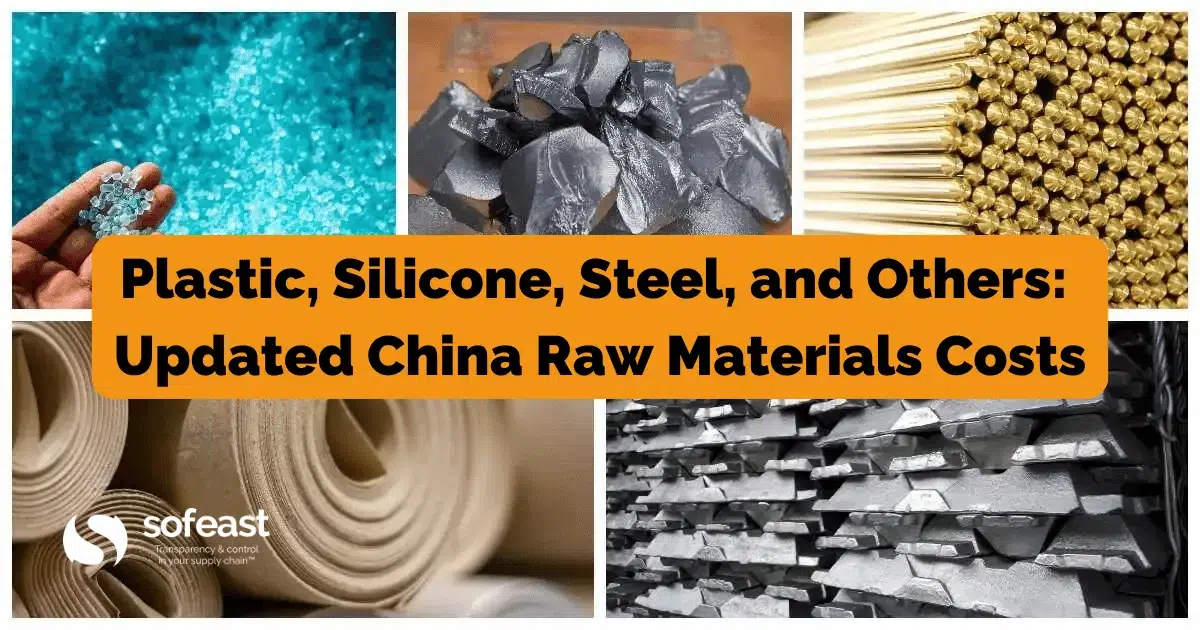
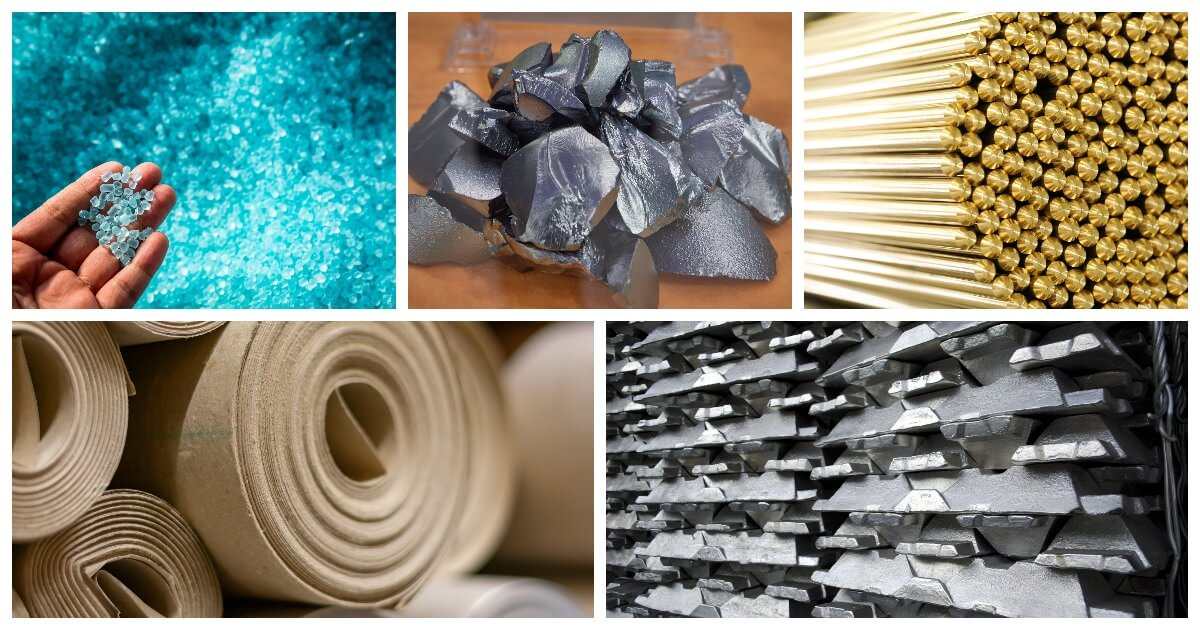
Plastic, Silicone, Steel, and Others: Updated China Raw Materials Costs (late Feb ’23)

sofeast china raw materials price indicesHere’s the monthly update from Sofeast’s sourcing team who has been tracking the costs of commonly used raw materials from China since January 2021 to help you understand where the market is right now. If you or your supplier are purchasing materials from China for your products the cost changes that you see here do have an impact on your bottom line!

Here’s the up-to-date material cost data from China for you as of late February 2023 and the price evolution since Jan ’21. Note the monthly cost change, in particular:
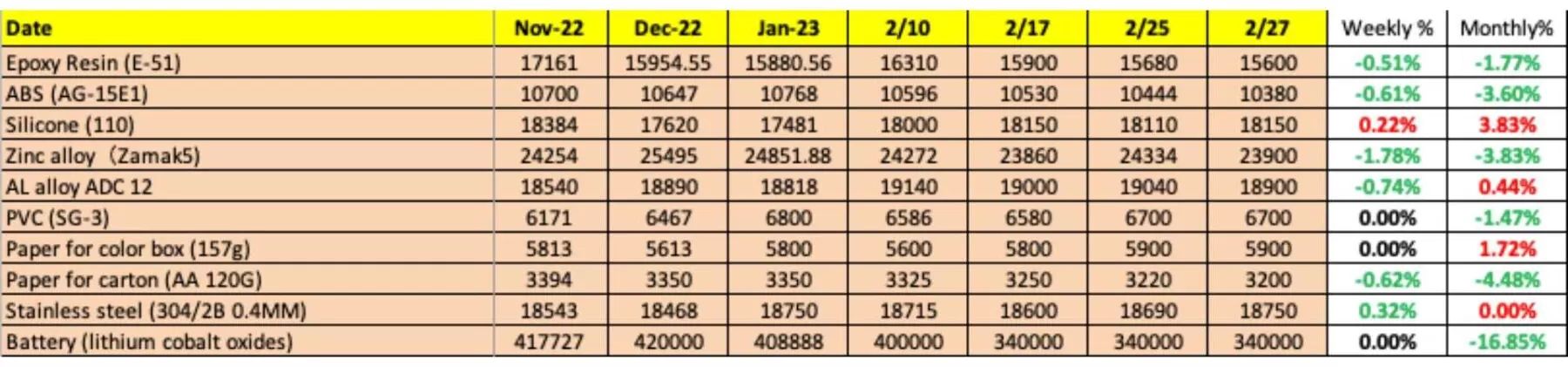
china raw material costs late jan 23You can see a snapshot of the past few month’s cost evolution here – you’ll notice that cost trends have stabilized, but many are running at a higher level now than when we started this monthly analysis; batteries, AL alloy, and PVC, to name three examples of this:
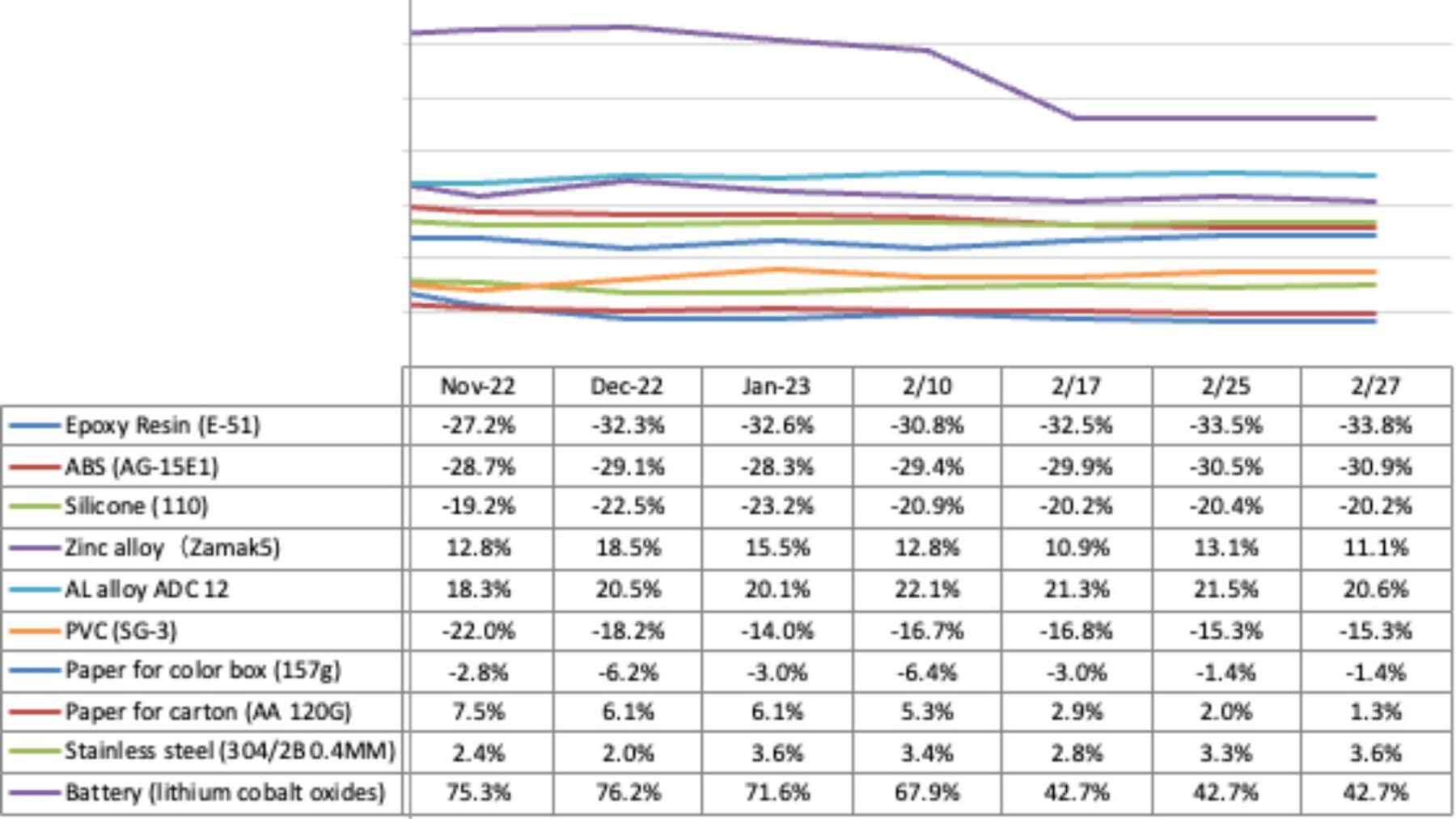
china-raw-materials-cost-evolution-since-jan-21-in-late-feb-23


This graph shows the cost evolution from early 2021 until the present day. You will notice the costs have stabilized over the past year.
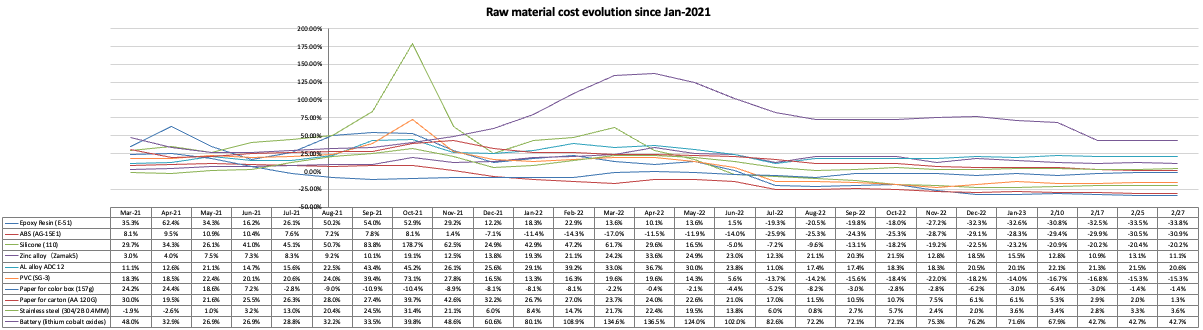
material_cost_evolution

In this next graph, we can see the individual material fluctuation over the same period of time.

material_fluctuation


Here is what market analysts attribute these changes to:

Epoxy resin (epoxy refers to E-51) – decreased 1.77%

The epoxy resin market is weaker this month. This month we saw a fluctuation in bisphenol A, which was minimal, the fluctuation of epichlorohydrin was narrow, and the cost of raw materials did not change much. Any positive news in the epoxy resin and raw material market is hard to find, industry confidence is at a current low with resin shipments not being as smooth as they could be. Some manufacturers are under inventory pressure and are being affected but narrow margins, they seem to be holding out for profit negotiation in any large orders.


ABS(AG-15E1) – decreased 3.60%

The ABS market had a relatively large decrease in February. With the high cost and high supply, the market is slightly stagnant. In order to obtain a deal, some producers still have a reduction in the factory price. Mainstream market trading is relatively flat, spot negotiations are focused on the small order and demand. Traders are hedging operations, the actual price reduction intention is strong but still needs to come to fruition.

Silicone (110) – increased 3.38%

The reason we are seeing the price rebound of silicone is mainly driven by the price increase of its raw material DMC. At present, the domestic and foreign trade demand of the downstream rubber market has not been significantly improved, and the raw rubber market is in a ‘general demand’ environment. The rubber manufacturers have covered positions in advance before and after the Spring Festival, therefore, we are currently seeing an inventory digestion stage.


Zinc alloy (Zamak5) – decreased 3.83%

With the increase in the supply of zinc ingots, the smelters’ raw material inventory is sufficient, however, zinc concentrate processing fees rose resulting in profit repair for the industry. The smelter operation enthusiasm is higher, zinc output is set to increase.


AL alloy (ADC 12) – increased 0.44%

Current domestic aluminum prices showed a weak trend in February, the main reason is that demand recovery is less than expected and inventory accumulation is dragging.


Paper for cartons (AA 120G) – decreased 4.48%

Raw material waste paper prices fell, and the cost of the fall aggravates a bearish market expectation. The release of most terminal orders is limited, superimposed import sources have arrived in Hong Kong, increasing market supply pressure, the market is in a pattern of oversupply, causing cautious bearish expectations.


Stainless steel (304/2B 0.04mm) – no change in price

The Stainless steel market fluctuated through the month but finished with no change in price. The market for trading is waiting to see what will happen with some traders testing the market on spot deals with others holding tight.


How to combat the rising costs?

Explore cost-reducing tips in this post: Rising Raw Material Prices: What Strategy To Follow? (6 Approaches).

What to do if your Chinese supplier suddenly tells you that material costs have risen: How To Cooperate With Your Chinese Supplier, Part 16: Bad News from China, Raw Material Prices Just Increased!

If your supplier just isn’t working out, maybe sourcing a new supplier will help you find one who can offer you better prices and more. If so, there’s no need to fear switching from your current supplier to a new one if you’re prepared: How To Switch To A Newer, Better Chinese Manufacturer? [eBook].


We hope this is helpful. Our mission at Sofeast is to help importers have transparency in their supply chain and to give them more control. And this information is critical to have some visibility into your manufacturer’s costing.

By the way, you can always contact us if you have any questions about whether a manufacturer’s quote is reasonable.

What to do if you have recurring quality problems from your factory? [Podcast]

What to do if you have recurring quality problems from your factoryRenaud and Adrian discuss the unwelcome scenario of recurring quality problems from your outsourced supplier who’s handling your manufacturing in China. They cover your quality standard, 6 tips on how to handle common recurring quality problems, and several reasons WHY these issues might be happening in the first place.


Listen to the episode about recurring quality problems here 👇

Listen: to the podcast episode

Watch: on Youtube


Episode sections

  • 00:00 – Greetings and introducing the topic: What happens if you have repeated quality issues from your manufacturing supplier?
  • 01:57 – YOU need to make sure that the supplier understands your quality standard first.
  • 03:46 – Tip 1. Always inform the supplier clearly how and why they went wrong.
  • 08:18 – Tip 2. Give feedback on issues as early as possible during production.
  • 10:44 – Tip 3. NEVER accept quality lower than your standard, including making an exception.
  • 14:00 – Tip 4. Clearly define your quality standard including critical, major, minor, and non-defects.
  • 22:01 – Tip 5. Set AQL limits (i.e. tolerances for defects) that correspond to your quality standard.
  • 26:09 – Tip 6. Switch to a newer better supplier.
  • 31:46 – Why product design issues could actually be the cause of your troubles.
  • 33:43 – Why poor manufacturing might be the cause.
  • 37:08 – Why your supplier’s suppliers might be the cause.
  • 41:27 – Wrapping up.


Related content…


Listen, rate, & subscribe to the ‘China Manufacturing Decoded’ podcast on your favorite provider

More episodes are coming, so remember to rate us and subscribe! You can find us on:

If you enjoyed this episode, don’t forget to give us a 5* rating and share it with your network if you enjoy listening!

3D Printed Circuit Boards: What They Are & How Fast They’re Made

3D Printed Circuit Boards What They Are & How Fast They're MadeDid you know that printed circuit boards (PCBs) may also be created via 3D printing? 3D printing has transformed the production of a vast array of goods, from toys and household goods to medical gadgets and aerospace components, and it’s so fast that it’s possible to get 3D printed circuit boards in fewer than 24 hours. 

PCBs are crucial components of many electronic devices, providing a foundation for mounting and interconnecting electrical components. PCBs may now be swiftly prototyped and customized using 3D printing, enabling faster design iterations and more agile manufacturing processes. 

In this blog article, we will delve into the realm of 3D printed circuit boards, addressing the various types of conductive materials utilized, the benefits and drawbacks of 3D printed PCBs, and the most interesting applications of this cutting-edge technology. Read on to explore the amazing potential of 3D printed circuit boards, whether you are an electronics enthusiast, a product designer, or a manufacturing specialist.

Continue reading “3D Printed Circuit Boards: What They Are & How Fast They’re Made”

ISTA Standards for Testing Packaging Reliability [Podcast]

ISTA Standards for Testing Packaging Reliability [Podcast]Sofeast’s head of New Product Development, Andrew Amirnovin, talks about ISTA standards for testing packaging like shipping cartons.

Any importer shipping product from country to country by road, rail, air, or sea needs to consider the impact that transit will have on shipping cartons. Luckily, the ISTA standards and their sequences of tests allow importers to gain valuable peace of mind that their cartons are up to the task of protecting their valuable products.


Listen here to our discussion about ISTA standards and testing!

Listen: to the podcast episode

Watch: on Youtube


Episode sections

  • 00:00 – Greetings and introducing the topic of ISTA package testing.
  • 03:02 – Who is ISTA and what testing standards do they offer?
  • 09:28 – ISTA-1a.
  • 10:34 – ISTA-2a.
  • 15:46 – ISTA-3a.
  • 18:49 – Is ISTA testing mandatory?
  • 19:47 – What does it cost?
  • 22:26 – What does an ISTA test pass actually mean?
  • 24:28 – What if your package fails the test?
  • 26:01 – When should importers start thinking about packaging options?
  • 29:33 – Do the tests require real product samples to be used?
  • 31:19 – Wrapping up.


Related content…


Listen, rate, & subscribe to the ‘China Manufacturing Decoded’ podcast on your favorite provider

More episodes are coming, so remember to rate us and subscribe! You can find us on:

If you enjoyed this episode, don’t forget to give us a 5* rating and share it with your network if you enjoy listening!

Our Supplier Refuses To Ship The Goods We Paid For! | Disputes With Chinese Suppliers Q&A (Volume 21)

Disputes With Chinese Suppliers Volume 21This dispute is a really serious situation that importers outsourcing manufacturing to Chinese suppliers pray that they never get into.
This company (who became our client when asking us for help), unfortunately, paid a large downpayment on goods which, over a year later, haven’t been shipped. Are they being scammed or is something else going on? Let’s look at the situation and our suggestions on how to improve it or avoid it in future.

Continue reading “Our Supplier Refuses To Ship The Goods We Paid For! | Disputes With Chinese Suppliers Q&A (Volume 21)”

When to get a patent for your new product?

Inventors: When to get a patent for your new product

Inventors with a new product concept are rightly concerned with IP protection. They sometimes ask if they should invest in a patent for their new idea ASAP. Renaud and Andrew join Adrian to cover this topic here.

You’ll learn about types of patents, their cost, when a product is most likely to benefit from being patented, best practices for protecting your IP that you can follow before you file a patent, and plenty of examples of real businesses that had legal issues related to patents or who got to market successfully by being smart and careful about IP.


Listen here!

Listen: to the podcast episode

Watch: on Youtube


Episode sections

  • 00:00 – Greetings & today’s topic: Patents for new hardware products.
  • 03:33 – IP protection Basics 1: Always sign an NDA when disclosing the product concept to people in the industry.
  • 04:58 – IP protection Basics 2: These actions will get your product idea copied early.
  • 07:14 – The different types of patents.
  • 10:39 – Approximate costs for patent applications and PPA timeline.
  • 17:24 – If patents are too expensive, what alternatives are there for protecting IP?
  • 22:04 – The 2 main fears of people launching a new product.
  • 33:32 – The dangers of going to investors and pitching your new product idea.
  • 36:37 – What to do if you have a ‘home run?’
  • 39:17 – What if your product is not a home run?
  • 41:14 – Which version of the new product really needs a patent?
  • 46:20 – The dilemmas you face: To patent or not, and when to get a patent?
  • 50:39 – Summary and wrapping up.


Related content…

Get help from Sofeast to check that potential manufacturers are trustworthy: Combined Supplier Due Diligence Checks (Best Results & Value)


Listen, rate, & subscribe to the ‘China Manufacturing Decoded’ podcast on your favorite provider

More episodes are coming, so remember to rate us and subscribe! You can find us on:

If you enjoyed this episode, don’t forget to give us a 5* rating and share it with your network if you enjoy listening!

HS vs HTS Codes: How to Find the Right Code for your Product? (incl. Links to Official Sources)

[vc_row][vc_column][vc_single_image image=”17594″ img_size=”full” alignment=”center”][vc_column_text]Importers who outsource manufacturing in Asia need to ship their goods around the world to where they’re being sold. Understanding the difference between HS vs HTS codes could be the difference between paying higher or lower import duties, fees, and tariffs because adding the wrong one to your products’ shipment could cost you!

Here is a guide covering (almost) everything you’ll need to know about HS vs HTS codes, including which might be right for you and where to find them…

Continue reading “HS vs HTS Codes: How to Find the Right Code for your Product? (incl. Links to Official Sources)”

11 Questions to Answer when Sourcing Chinese Contract Manufacturers for Electronics

When sourcing a new contract manufacturer in China, what are the main questions buyers need to answer before agreeing to work together?

Renaud and Adrian cover 11 questions for buyers in this episode, especially those making electronic products (although much of this advice is relevant to many hard goods in general and suppliers in other Asian countries, too), in order to help you find a reliable and capable manufacturing partner.


Listen here!

Listen: to the podcast episode

Watch: on Youtube


Episode sections

  • 00:00 – Greetings & today’s topic: Sourcing a CM in China for manufacturing electronic products.
  • 02:10 – What is a contract manufacturer in comparison to other supplier types?
  • 06:55 – 1. What will your order quantity be? (This influences the type of CM that is suitable)
  • 09:43 – 2. Will you order a high-volume, low product mix setup, or the opposite?
  • 12:24 – 3. Do you have visibility and transparency over the supply chain?
  • 19:14 – 4. Will your Intellectual Property be protected, and how?
  • 20:48 – 5. Will they be helping to develop your product and make it compliant?
  • 23:51 – 6. What manufacturing processes does the CM have in-house?
  • 27:45 – 7. What is the CM’s QC capability?
  • 28:35 – 8. What kinds of tooling, fixtures, and jigs does the CM have for in-line testing?
  • 29:37 – 9. Who has liability for safety and compliance issues?
  • 31:00 – 10. What payment terms can they accept?
  • 32:01 – 11. What delivery terms do they provide (incoterms)?
  • 34:56 – Summary and wrapping up.


Related content…


Listen, rate, & subscribe to the ‘China Manufacturing Decoded’ podcast on your favorite provider

More episodes are coming, so remember to rate us and subscribe! You can find us on:

If you enjoyed this episode, don’t forget to give us a 5* rating and share it with your network if you enjoy listening!