9 Things Small Importers Can’t Negotiate With Chinese & SE Asian Suppliers [Podcast]

9 things small importers can't negotiate with suppliers podcast

In This Episode…

Renaud is joined by Adrian for a conversation about some of the things that smaller companies who are getting products manufactured abroad either cannot or will have great difficulty negotiating with suppliers in China, Vietnam, or other popular manufacturing destinations in Asia.

This list of 9 items will give you some idea about what is realistic if you’re manufacturing lower volumes.


Just hit the play button to start listening..!

Listen to the episode right here 👇👇👇

🎧 9 Things Small Importers Can’t Negotiate With Chinese & SE Asian Suppliers 🎧

Or, watch on YouTube ▶️


Show Notes

✅ Introduction – are we seeing progress on vaccinations? Could it be possible for importers to visit China later this year (2021)?

✅ How do you define what a small importer is? – this is relative to supplier size. If your supplier is a micro company then you’re a significant customer of theirs, but on the other hand, if the supplier has tens of thousands of staff and high output then you’re probably a ‘small’ customer. If you place orders in the tens of thousands of dollars, that would also place you in the smaller bracket, whereas large importers are placing orders in the millions of dollars.

A list of 9 things small importers can’t negotiate with suppliers in China & SE Asia

✅ 1. Negotiating with large contract manufacturers – Renaud explains the benefits of the large Taiwanese CMs such as Foxconn who Apple uses, for example, such as their great supply chain management abilities and their ability to negotiate good material or component prices. But despite media attention, these CMs are too large to pay attention to small buyers, and, even if you can work with them, they may not offer as good a level of service as a smaller CM due to you being far from a priority…

✅ 2. Reserving production capacity for the mid- or even the long-term – larger companies have the reputation and orders to reserve capacity with their suppliers, but smaller buyers will face a lot of scrutiny about if their demands are possible. Suppliers will need to be convinced that your forecasts are trustworthy, otherwise, they may consider your business to be too much of a risk for them to set aside capacity just for you.

✅ 3. Negotiating directly with large sub-suppliers – a sub-supplier could be a huge company, like Panasonic or Samsung for batteries or Dupont or Chimei for polymers. For smaller buyers, it’s likely you’ll have to deal with an authorized distributor, although large importers may have the sway to approach them directly and apply for good terms. It may also be that the largest companies swallow up a lot of the capacity and inventory for certain materials and you will simply need to wait for their needs to be fulfilled before you can order materials.

✅ 4. Gaining open-book visibility about the supplier and their costs, facility, etc – understanding a supplier’s cost structure is important in order to make them accountable for cost rises, etc. Asian suppliers will be reluctant to tell smaller buyers information that makes pricing more transparent, such as the number of operators working on your project, material costs, warehouse size, rental costs, staff salaries, etc. Larger importers have the volumes to demand this information in their manufacturing agreement and it’s take-it-or-leave-it for the supplier, but for smaller buyers, they will not wish to be so transparent in order to retain control over prices.
Therefore, for small buyers, doing your own homework about material costs and wages in their area, for instance, is a key way to getting the information you need to fight back if a supplier drops a surprise cost increase on you.

✅ 5. Forcing the factory to use your own ERP system – very large buyers want the suppliers to feed multiple pieces of information into their own ERP system in order to track production progress, analyze, know about delays, how much inventory is on the way, etc. Small importers often don’t even use an ERP, but even if they do, they should only put very simple demands on the suppliers due to their size. Renaud gives an example of a customer who gave suppliers a simple 4-point system to implement in return for faster payments which was a successful way of approaching this.

✅ 6. Negotiating ‘open account’ payment terms – suppliers are more likely to produce their products for large customers with a 30/60/90 day later payment schedule, whereas most smaller buyers will need to pay 30% in advance and then a balance payment of 70% after inspection or, at best, after shipping. It’s very hard for smaller buyers to negotiate better payment terms than this from Asian suppliers.

✅ 7. Negotiating product warranty & liability from the supplier – large companies will negotiate refunds for manufacturing defects, etc, in advance as a part of their contract and suppliers will try to build this into their prices. But smaller buyers will find that requests for any kind of liability from a supplier will fall on deaf ears. Therefore, performing product inspections is a critical way to protect yourself from receiving defective products if you’re buying smaller volumes.

✅ 8. The ability to physically shape the supply chain – a very large buyer may be able to influence their supplier to open a new facility in a different country. An example of this is Apple whose CM opened a North Vietnam facility so products can be assembled there to avoid American tariffs on China-made goods, while still being close enough to China in order to obtain components from there. Of course, smaller buyers will not be giving suppliers enough business for them to undertake this huge investment in time and manpower to set up operations in a different location or country, so your option is to source an existing supplier in that location.

✅ 9. Having their own teams on site all the time – large companies have staff based in China, for example, who travel around the country checking on production, quality, etc, in suppliers’ facilities. However, small importers simply won’t be able to sustain this level of staff based abroad and, in ay case, for smaller organizations, it makes more sense to outsource auditing, inspections, supplier management, etc, to specialists who are already based in your supplier’s country (like our own company, Sofeast!) as and when you need it.


Related content…


Listen, rate, & subscribe to the ‘China Manufacturing Decoded’ podcast on your favorite provider 👍

There are more episodes to come, so remember to rate us and subscribe! You can find us on:

Don’t forget to give us a ⭐️⭐️⭐️⭐️⭐️ rating and share it with your network if you enjoy listening! 😊

How To Choose The Right 3PL Logistics Company?

How To Choose The Right 3PL Logistics Company?
Do you have trouble getting answers from your freight forwarder when there are issues? Do you even have an account manager with them? Is your current system creaking under the strain? If so, it’s probably time to invest in assistance from a 3PL logistics company.

For growing businesses, a 3PL (third-party logistics warehouse) is a convenient partner as they step in to handle the logistics and supply chain process that can be such a drain on your time and money if you choose to go it alone.

These days, post-COVID, companies have increasingly taken to selling online, therefore the role of a 3PL has increased in importance for many vendors. So, how do you pick the right 3PL for your needs?

Continue reading “How To Choose The Right 3PL Logistics Company?”

ISO 9001 QMS Features, Benefits, & Implementation Tips [Podcast]

ISO 9001 QMS Features, Benefits, & Implementation Tips

In This Episode…

Phil Brown, owner of Phil Brown Consultancy, who is an ISO 9001 and 14001 consultant in the UK joins us in this episode of the China manufacturing decoded podcast.

Phil talks us through the ISO 9001 QMS, the requirements that make up this standard, benefits, the difference between good and bad implementations, and some tips from him to follow if you’re implementing the QMS sometime soon.


Just hit the play button to start listening..!

Listen to the episode right here 👇👇👇

🎧 ISO 9001 QMS Features, Benefits, & Implementation Tips 🎧

Or, watch on YouTube ▶️ 


Show Notes

 Introducing the episode and introducing Phil and his business

 Explaining the ISO 9001 QMS and its requirements – ISO 9001 is a standard designed to assure that companies deliver their customers’ expectations and requirements. Phil goes through the different requirements for the standard:

  • Leadership: A commitment from senior management to observe the requirements of the standard and commit the entire company to reach them.
  • The way inquiries, quotations, and orders are handled, recorded, and orders linked back to the original inquiry.
  • Using approved suppliers: These suppliers are assessed as meeting the businesses’ requirements, this helps if they are also ISO 9001 accredited. Records kept of how the supplier is approved. The business should only use these approved suppliers for purchasing manufacturing materials etc moving forward.
  • Noncomformances: These may be internal or external. How are they recorded, investigated, and root causes identified? Actions must be taken to put them right. An internal nonconformance could be a defect in a product, whereas an external one could be where a product is damaged in transit and causes a customer complaint.
  • Records of employee competencies: This includes their ability to do their assigned tasks, knowledge of the processes, and skills in operating them. Phil uses a skills matrix to assess employees’ abilities to carry out tasks. A traffic light system may be used where red means they’re incapable of performing this task, amber where they are undergoing training, and green where they’re fully trained and approved to carry out the task. This is helpful for manufacturers who may need to move staff around and quickly need to see who is qualified.
  • Setting targets for improvement: They must be meaningful, measurable, and achievable. This could be things like delivery on time (which customers expect) and reducing scrap and rework. These need to be communicated to the stakeholders (operators, team leaders, etc) and regularly reviewed so everyone knows how they are performing.
  • Regular review of the business systems: Companies need to maintain and continuously improve their systems.
  • Management review: Companies review how they are doing at least annually against the various requirements of the standard. This may include performance targets, productivity, and more.
  • Production planning and scheduling: When orders are received what’s the plan to manufacture the goods and what will the load on the factory be? This should be identified and communicated to the workforce. A situation where people who shout loudest get their production done is contrary to the aim of this requirement.
  • Control of design and development: This has to be done in an organized way. Records of product designs need to be kept, properly documented, and meet the requirements of specific customers and product ranges.
  • Documented information (and analysis of it): Information recorded needs to be readily accessible, meaningful, measurable, and analyzed. Actions need to also be agreed upon based on the information, carried out, and monitor the effects. Most companies that need the ISO 9001 QMS keep a lot of information, but seldom analyze and use it to improve processes, productivity, and product generation.
  • Identification and traceability: When the finished product is ready for dispatch it carries identification marks which make it possible to trace it back through the entire production process and provide information about the machine used, operator who made it, the batch of materials or parts used and where they were sourced from, etc. So if there are issues with a product, the others in its batch can be found quickly in the case of a recall, and/or the cause of the issue can be investigated. This is especially important for automated production lines because care needs to be taken to record the parts used in a particular area.
  • Control and measuring equipment: Measuring equipment may be used to measure thickness, tolerances, etc. The manufacturer also needs to assure that the equipment is calibrated regularly and the calibrations recorded in a log.
  • Continual improvement: The business strives to improve the products, processes, speed, quality, etc. A QMS is live and must evolve and be used over time.

 Drawbacks of implementing a QMS – ISO 9001 accreditation can sometimes be used as a ‘badge’ by management rather than a means for real improvement of the business. An example is an MD who congratulates himself on implementing ISO 9001, but then doesn’t follow through on the internal audits of management systems, management review, continuing to look at nonconformances, achieving objectives, and committing to continuous improvement. When the annual audit takes place, they probably will not pass!

 The importance of everyone being involved in ISO 9001 QMS implementation – this is from top management down to the individual operator. Renaud recently wrote about the mistake some management make by relying solely on a quality manager to implement the QMS and otherwise not getting involved. Phil also agreed that this isn’t acceptable. He stressed that factory workers are equally as interested in if the company is achieving its targets and how they are contributing.

 Communication’s role in staff retention – a dialogue between workforce and management is far better for the company than if workers are kept in a vacuum and unaware of how the business is doing. Senior management needs to demonstrate that operators are a vital cog in the running of the QMS, not just a means to an end.

 What’s the difference between ‘good’ and ‘bad’ ISO 9001 implementations? – a good implementation is where (in the case of a 3rd party consultant) the person/s implementing the QMS becomes like a part of the company, gets involved in the ISO systems, but also helps encourage operators to do what the system requires.
Bad implementations are often where a company uses a software package to implement ISO 9001, but there’s no real personal involvement in it. This is not a real live operation and can allow various nonconformances to creep through which will be found by the auditor and can cost the company its accreditation.

 Some real examples of QMS implementations that Phil has been involved in – good examples are:

  • A company had ISO 9001 put in by a non-approved body and was not actually meeting the requirements of the standard because it was poorly implemented. Phil had to explain the requirements and make sure everyone was working towards them, understood why, and the benefits of what they were doing.
  • A supplier to the auto trade required ISO 9001 and 14001 accreditations in order to be considered a tier-one supplier and have the upper hand over competing companies who do not have the certifications.
  • A company supplying the UK health service was told at short notice that their contract would not be renewed and so it was necessary to gain the certification as quickly as possible in order to retain their business.

 Some tips from Phil for manufacturing companies who are planning to implement ISO 9001 – ensure that you communicate every piece of information about how the company is doing to the people involved in manufacturing the product as they will become far more involved in the business. Also, take note of customer complaints as they’re a source of valuable information and, if handled professionally, will win turn the customers into advocates for your business.

 Wrapping up


Related content…

Listen, rate, & subscribe to the ‘China Manufacturing Decoded’ podcast on your favorite provider 👍

There are more episodes to come, so remember to rate us and subscribe! You can find us on:

Don’t forget to give us a ⭐️⭐️⭐️⭐️⭐️ rating and share it with your network if you enjoy listening! 😊

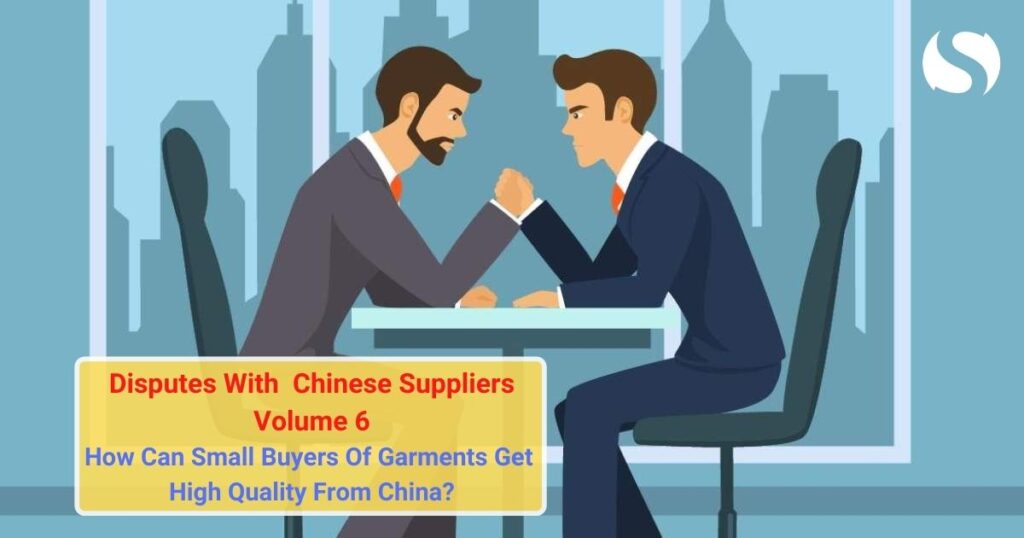
How Can Small Buyers Of Garments Get High Quality From China? – Disputes With Chinese Suppliers Q&A (Volume 6)

How Can Small Buyers Of Garments Get High Quality From China?
This blog post is about issues with quality from an apparel supplier and is based on a real Sofeast customer’s experiences (with no identifying information given). We’re going to explain how to assure you’ll get high-quality garments from your Chinese supplier even if you are only a ‘small buyer.’


Q: My supplier is providing me with quite a lot of defective garments, even though they claim that the errors found are ‘under the AQL limits’ and ‘only about 3% of the total’. That’s equivalent to around 60 pieces out of every 2,000 I order. This seems a lot and hurts my brand. Is this normal?

In the apparel trade, yes, a 3% AQL is to be expected (not ‘normal’, but expected if you work with a relatively average or unsophisticated supplier). So, the factory salesperson is actually being honest about the 3%. In garments, I don’t think any buyer is happy about that proportion of defectives, but you will need to look for a better factory if you want a lower percentage.


Q: I paid for a final inspection which was not cheap, it failed due to puckering on 100% of the garments, but my factory doesn’t seem willing to take action to fix the issues and I’m struggling to negotiate with them from overseas. How do other companies handle this?

So, this factory sees a failed report with a very serious issue (very visible puckering along some seams) and they won’t do anything? That’s the sign of a bad factory. That’s quite unreasonable on their side, but not atypical, unfortunately. That’s why we usually suggest doing an earlier inspection, such as a pre-production meeting and/or inspection during production, to catch such issues before all is made and packed (at least the factory usually tries to minimize the damage on what they still have to sew).


Q: Are these errors and this behavior typical from a garment factory?

I think their errors are typical, yes. But their behavior is poor. One might say their behavior is typical, too, if they see you as a small customer and they believe you are not going to leave them over this type of issue. If they cannot or will not change their ways, it may be time to consider switching to a new supplier altogether or work on improving your supplier’s quality processes.


Q: How do large apparel companies like Nike manage to prevent any defective garments from reaching consumers?

Huge companies like Nike work with large (often > 5,000 people), very organized factories. They hold a lot of sway over their suppliers as they buy massive quantities. They have pushed those factories to work a LOT on process improvement, even introducing a lean manufacturing approach. That’s another world that is atypical in the garment trade…

If like Nike, you can work with a factory over which you have a lot of purchasing power (ideally, some of their lines work for your company continuously), certain things become possible:

  • Forcing them to do small pilot runs before launching mass production.
  • Not cutting all the fabric & accessories in advance (so cutting or fabric issues don’t impact large batches in their entirety).
  • Paying a lot of attention to the first bundles sewn, with a special process.

But, I am afraid this is not realistic for buyers who are purchasing smaller volumes, unfortunately.


Q: Would a 100% inspection be a possible solution for me to stop these quality problems and what would it cost?

Very few garment buyers arrange for a 100% inspection (apart from some Japanese companies). It adds quite a bit of cost.

However, we are able to perform a Full Production Check (FPC) on batches from your supplier keeping in mind specific problems that have been repeatedly occurring to give you peace of mind that defective garments won’t be shipped.

In terms of cost, the FPC is US$299 per man-day and it could be several man days to check, say, a couple of thousand garments. However, this type of quotation has to be done on a case-by-case basis, based on the ease of checking the garment and the types of defects that we have to catch.


What is the minimum we suggest ‘small buyers’ do to assure good quality products?

  1. Be very clear about the types of defects can and cannot tolerate, and in what maximum proportion
  2. Make sure any potential supplier is made aware of this
  3. Document your inspection checklist and the lists of issues you will count as defects
  4. Have the supplier sign a manufacturing agreement that stipulates what happens if too many defects are found
  5. Send an inspector at different times during the production of the first batch with a new supplier. And keep doing at least a final random inspection after that.


How about you?

Are you also having difficulties with a Chinese apparel supplier? Let us know what’s happening and we will try to offer some advice.


Get expert help to improve YOUR product quality from suppliers in China or Vietnam. Read: Quality Assurance In China Or Vietnam For Beginners

Grab your free copy and learn the common traps new importers from China or Vietnam fall into, and how to avoid or overcome them in order to get the best possible production results. It also outlines a proven quality assurance strategy that you can follow in order to have better control over your product quality, covering:

  • Finding Suitable Suppliers
  • Defining your Requirements before Production Starts
  • Don’t Skip the New Product Introduction Process
  • Regular Quality Inspections (Trust but Verify)
  • Tying Payments to Quality Approvals

Sounds good? Hit the button below to get your copy now:

quality assurance in china or vietnam ebook

Getting To Grips With Non-Recurring Engineering Costs (NRE) [Podcast]

Getting To Grips With Non-Recurring Engineering Costs (NRE) [Podcast]In this episode of the podcast, we discuss Non-Recurring Engineering costs for manufacturers. As the name suggests, these costs are usually one-off and are what it takes to get your product into production. These costs are perhaps better known as R&D costs, and it’s important to get to grips with them as they have a great impact on your product’s sale price, as well as the feasibility of manufacturing it in the first place.

It’s fair to say that the NRE costs often turn out to be more than initially estimated, so being able to accurately calculate them starts with understanding the many things that can be accounted for which can be everything from product design, to prototyping costs, certifications, wages for development staff, tooling costs, and much more.

Caution is required, too, as when working with a Chinese supplier they may swallow some of the NRE costs themselves, which sounds good, but they may expect something more in return than you’re willing to give up!

So, let’s get to grips with NRE costs in this episode.


Just hit the play button to start listening..!

Listen to the episode right here 👇👇👇

🎧 Getting To Grips With Non-Recurring Engineering Costs 🎧

Watch on YouTube ▶️  youtu.be/jQkDIcJ_y_I

Here’s a summary of key sections of this episode:

✅ What are NRE costs? (A brief summary) – essentially NRE costs are all of the one-time expenses (investment) that you need to pay in order to get your product into production. A lot of it is engineering work, but not all. When planning your expenses, you will calculate the one-time NRE costs against the unit cost and cost of sales and distribution and decide how much to add to the unit sales cost in order to cover the NRE costs plus interest. This tends to be true for electrical/mechanical products. For apparel and shoes, it is usually simpler. There are NRE costs such as design and samples and checking the start of production, but then it is mainly recurring production work.

✅ Some examples of common NRE costs for the different production processes:

  • Plastic injection molding – industrial designed parts in CAD, DFM review, rapid prototyping, tooling design and fabrication, trials to approve tooling, etc
  • Metal parts – as above, but also cast molds, clipping tools
  • Electronics – unique PCBA needs to be designed, stencils, artwork, outline guides, programming setup, drill profile, visual inspection, etc

✅ Going through some of the other processes and materials, and their costs – extrusion (plastic or aluminum), compression molding, silicone tends to be cheaper. Creating plastic parts can be done via 3D printing, CNC machining, or injection molding – each increasing in cost and also suitability for high volumes. Processes used are dependant on volumes required, so that should be taken into account.

✅ Why your NRE costs are probably higher than you’re initially anticipating – Renaud shares an example of real Sofeast customers who believed that their NRE costs were fairly modest and tried to keep them low by approaching upworkers, trading companies, etc, to handle the design and sourcing, but finally, have to accept that the NRE costs are far higher than they anticipated if they want to get the product made at the standard they require.

✅ Do some suppliers pay the NRE costs for you? – it may be that when purchasing very standard products, or white labeling products which have already been developed, that you won’t need to pay NRE costs as they have already been paid by the manufacturer who supplies them.

  • The difference between standard ‘off-the-shelf’ products (little NRE cost), custom ‘off-the-shelf’ products (little NRE costs, but beware of ODM manufacturers selling these without actually owning the IP), and fully custom components, like a unique enclosure (higher NRE costs that you will need to pay for).
  • Who will own the IP of the product if a manufacturer offers to share or take care of the NRE costs? This can happen as manufacturers try to lock you in by refusing to give you designs, BOM, etc, because ‘they developed it.’ You need to be wary of this. At the least, a manufacturer will probably try to claw back the NRE costs by charging you a higher per-unit price if they do work on the R&D side but grant you ownership of the IP.

✅ Using a development or development & manufacturing agreement to protect yourself – this sort of agreement will spell out who will own the IP, what information should be accessible to the buyer, and who is responsible for paying NRE costs. Some manufacturers in Asia will do this work with the expectation of retaining ownership of IP, etc, as standard practice, therefore an agreement protects against this happening.

✅ Most manufacturers are more interested in mass production rather than product development, so how does this impact you during the R&D stage? – in this case, the manufacturer doesn’t want to get involved with activities that accrue NRE costs such as product design, sourcing, etc. In this case, you may need to hire an engineering team or work with a company like us (Sofeast) who can help with the product engineering, supply chain side of things, compliance and testing, etc.

✅ How to gauge what the manufacturer is comfortable with doing for you – in general, the closer you are to production the more appealing a prospect you are to manufacturers, but you should look into their capabilities while sourcing suppliers and performing due diligence, as well as simply asking what they can do on the R&D side.

✅ If you have a prototype that is fully functional, you’re ready to give it to a factory and go into mass production, right? – No. This would indicate that you aren’t even halfway yet! Sourcing work, qualification of suppliers, DFM review, certifications, tooling design and fabrication, testing, and more, are still to be done. So, you can see how the NRE costs add up quickly.

✅ NRE costs you need to consider when projecting your costs – these activities typically full under the umbrella of NRE costs: design work, sourcing, supplier qualification, reliability and compliance testing, producing prototypes, getting customer feedback on the prototypes and making changes to them, creating the quality plan, fabricating tooling, putting in place testing stations and special checking fixtures, sourcing your assembly supplier, and negotiating a good manufacturing contract with them with a lawyer. Also for products with software, the firmware and app production tends to be created at an early stage as an NRE cost (although it will be updated later which also adds to it over time).

✅ Typical recurring costs – for comparison, here are some of the typical recurring costs you will also need to consider when developing and manufacturing a new product: the parts used to manufacture products, amortized tooling cost for custom parts in the per-unit cost (in some cases), material and processing costs for the parts, assembly costs (labor/factory overheads), scrap and rework, packaging, shipping, import duties and tariffs, dropshipping costs, returns and replacements, and warranty costs.

*****

What are your experiences with Non-Recurring Engineering Costs? Did yours turn out to be higher than you’d initially estimated for? What, in particular, came as a surprise? Please share your experiences or advice by leaving a comment.


Additional content related to today’s episode…


Listen, rate, & subscribe to the ‘China Manufacturing Decoded’ podcast on your favorite provider 👍

There are more episodes to come, so remember to rate us and subscribe! You can find us on:

Don’t forget to give us a ⭐️⭐️⭐️⭐️⭐️ rating and share it with your network if you enjoy listening! 😊

How To Create A New Product Inspired By An Existing Design?

How To Create A New Product Inspired By An Existing Design?
Sometimes customers ask us: “How to create a new product based on a product that’s already on the market?” While it is possible to do this, and we can help, we have to tread the line between what is and isn’t ethical.

Let’s explore how this process would work… Continue reading “How To Create A New Product Inspired By An Existing Design?”

Tooling Management for Plastic Injection Molds in China

[vc_row][vc_column][vc_column_text]Tooling Management for Plastic Injection Molds in China

What are the best practices for tooling management (specifically for plastic injection molds) in China?

Closely following up on the design & fabrication of molds for your plastic injection molded products is often necessary for a number of reasons:

  • It is often a significant investment, and it is not always easy & cheap to fix;
  • Delays at this stage will certainly cause delays for your entire project;
  • Good tooling that is properly validated goes a long way toward good quality production.

In this post, we’ll outline some of the key risks you face when manufacturing and managing your tooling for plastic injection molds.

Continue reading “Tooling Management for Plastic Injection Molds in China”

Why Are Pilot Runs So Important When Launching New Products? [Podcast]

Why Are Pilot Runs So Important When Launching New Products? [Podcast]

Pilot runs aren’t just a ‘good idea,’ they’re a must when manufacturing new products as you are about to find out…

Renaud and Adrian from the team explore an important part of the new product launch process: pilot runs.

In this episode, they’ll be exploring the following questions: What is a pilot run, why is it so important when bringing new products to market, and what are the benefits we can expect when performing them before going into full production?

After listening you will see why pilot runs are such an important tool in order to minimize the risks you face when launching a new product, in particular.


Just hit the play button to start listening..!

Listen to the episode right here 👇👇👇

🎧 Why Pilot Runs Are A ‘Must-Do’ When Launching New Products 🎧

Here’s a summary of key sections of this episode:

✅ Why PRs are such an important activity
✅ PRs as a tool to validate the workshop’s capability to mass-produce the products
✅ How many PRs to perform before starting mass-production
✅ How PRs are conducted in different industries
✅ Do smaller production runs still need a pilot?
✅ Why Chinese manufacturers often don’t like PRs
✅ A list of benefits the PR will give to you


Additional content related to today’s episode…

Do you perform pilot runs before mass-production? What benefits have you gained from them? Let us know by leaving a comment, please.


Listen, rate, & subscribe to the ‘China Manufacturing Decoded’ podcast on your favorite provider 👍

There are more episodes to come, so remember to rate us and subscribe! You can find us on:

Don’t forget to give us a ⭐️⭐️⭐️⭐️⭐️ rating and share it with your network if you enjoy listening! 😊