Traceability In Manufacturing: Far More Than Just A Safety Net [Podcast]

Adrian and Renaud are talking about traceability for manufacturers which provides a detailed record of how the products are manufactured and the supply chain, from raw materials to finished products. Having this mindset and system can help you to reduce risks and deal with problems quickly by pinpointing where they arise. It can also help you be a more compliant business. Plenty of benefits, but it takes a cultural shift to put in place, so Renaud will explain how.


Listen to the episode here 👇

Listen: to the podcast episode

Watch: on Youtube


Episode sections

  • 00:00 – Greetings and introduction
  • 03:53 – Traceability takes a conscious effort to put in place.
  • 06:07 – Introducing traceability and the difference between batch level and unit level.
  • 12:06 – Benefits.
  • 24:01 – Is it expensive to run a traceability initiative?
  • 25:35 – How does traceability relate to product passports in the EU?
  • 27:44 – How to implement it?
  • 35:41 – How to audit a supplier’s traceability system?
  • 40:47 – Wrapping up.


Related content…


Listen, rate, & subscribe to the ‘China Manufacturing Decoded’ podcast on your favorite provider

More episodes are coming, so remember to rate us and subscribe! You can find us on:

If you enjoyed this episode, don’t forget to give us a 5* rating and share it with your network if you enjoy listening!

Plastic, Silicone, Steel, and Others: Updated China Raw Materials Costs (late March ’24)

Here’s the monthly update from Sofeast’s sourcing team, tracking the costs of commonly used raw materials from China for the past year to help you understand where the market is right now. If you or your supplier are purchasing materials from China for your products, the cost changes you see here impact your bottom line!

Here’s the up-to-date material cost data from China for you as of late March 2024 and the price evolution over the past twelve months – the good news here is we’re in a period of relative stability:
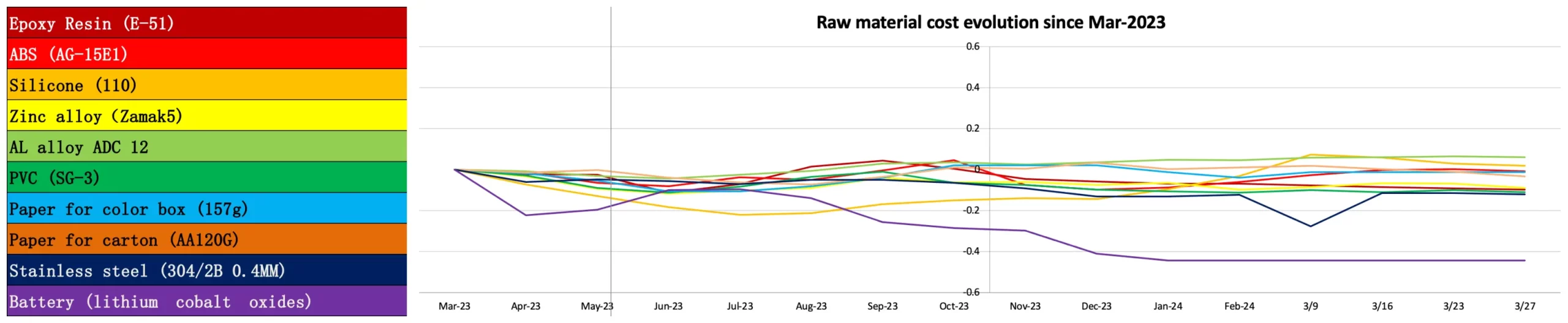
china raw material cost changes mar 23 to mar 24Here you can see the individual cost evolution per material over the past year, including the weekly and monthly change for March 2024:

raw materials cost evolution up to mar 24

Here is what our market analysts attribute these changes to during this past month:

Epoxy Resin (E-51) – Decrease of 3.30%

  • Supply: Certain factories are holding excessive spot inventories right now, leading to a surplus.
  • Demand: The buying trend is to use the raw materials that are already in stock, with the market mainly focusing on replenishing supplies.
  • Cost: Support has weakened due to a decrease in the negotiation price of bisphenol A, while the price of the raw material epichlorohydrin remains stable but minimal.

ABS AG-15E1 – Increase of 5.49%

Industry production is down, but ABS manufacturers are fulfilling previous orders and reducing their inventory which has peaked recently compared to recent years.

Silicone (110) – Increase of 5.08%

Domestic factories are shipping more products, and market prices have slightly dropped due to competitive bidding among enterprises. Downstream demand is weak, though, with only small on-demand orders being placed. Raw material costs like silicon metal are slightly decreasing, while methyl chloride prices are rebounding, leading to some price volatility.

Zinc Alloy (Zamak5) – Increase of 0.89%

Despite fluctuating zinc spot prices, market demand has been respectable. Lower zinc prices have encouraged downstream enterprises to buy more, improving market transactions and the trading atmosphere among traders.

AL Alloy ADC 12 – Increase of 1.23%

The domestic spot market is characterized by local manufacturers selling off stock, traders buying moderately, and downstream processing plants increasing their purchases, leading to a more active trading atmosphere.

PVC (SG-3) – Increase of 0.24%

The market price of PVC powder has slightly decreased, with futures showing a downward trend. Traders have lowered their price offers compared to recent times, resulting in fewer high-priced transactions. The mainstream price remains stable, with transactions focusing on specific prices. Downstream procurement shows moderate enthusiasm, with some low-price orders being placed out of necessity.

Paper for Color Box (157g) – Increase of 2.76%

  • Demand: The market is adopting a steady approach, with downstream buyers mainly just replenishing as needed, and only a few new orders coming in.
  • Cost: The cost side continues to support the market despite a slight decrease in the spot market price of imported wood pulp and some decreases in individual pulp prices.

Paper for Carton (AA120G) – Decrease of 4.36%

March 2024 saw the corrugated paper market in China impacted by weak demand and an excess of supply. This has increased pressure on paper mills and put downward pressure on prices. The main raw material, waste yellowboard paper, saw a decrease in purchase prices by paper mills to ease some of their operational pressure.

Stainless Steel (304/2B 0.4MM) – Increase of 0.26%

The stainless steel spot market has shown some stability with a weak futures market continuing. Profitable shipments from the spot market are unchanged, with some prices being reduced. However, buyers remain cautious, resulting in a fairly slow trading atmosphere.


How to combat rising costs?

Explore cost-reducing tips in this post: Rising Raw Material Prices: What Strategy To Follow? (6 Approaches).

What to do if your Chinese supplier suddenly tells you that material costs have risen: How To Cooperate With Your Chinese Supplier, Part 16: Bad News from China, Raw Material Prices Just Increased!

If your supplier just isn’t working out, maybe sourcing a new supplier will help you find one who can offer you better prices and more. If so, there’s no need to fear switching from your current supplier to a new one if you’re prepared: How To Switch To A Newer, Better Chinese Manufacturer? [eBook].


We hope this is helpful. Our mission at Sofeast is to help importers have transparency in their supply chain and to give them more control. And this information is critical to have some visibility into your manufacturer’s costing.

By the way, you can always contact us if you have any questions about whether a manufacturer’s quote is reasonable.

Boeing’s Serious Issue: Bad Manufacturing Habits [Podcast]

Air travel requires an extremely high level of safety, so it’s very embarrassing for Boeing that they have been dogged by quality and reliability issues lately, resulting in a near-disaster on a brand new Alaska Airlines 737 Max.

Renaud and Paul look at Boeing’s recent troubles, based on information from news reports, that seem to have been caused by bad manufacturing habits such as accepting sub-standard parts from suppliers without pushing them to improve, not fixing issues in-process and ‘leaving them for later,’ an over-reliance on inspections and rework when planes were complete, and a business culture which placed financial results above quality.

They also explain the best practices that good manufacturers follow to reduce risks as your key takeaway from the episode.


Listen to the episode here 👇

Listen: to the podcast episode

Watch: on Youtube


Episode sections

  • 00:00 – Greetings and introduction – where is Boeing going wrong?
  • 06:15 – What do good factories do to avoid problems like travelled work?
  • 10:08 – Investing time for training suppliers in the upstream supply chain to reduce quality risks
  • 18:24 – What can we learn about dealing with in-process issues from the automotive industry?
  • 27:14 – Why a focus on inspection and rework later increases risks.
  • 33:32 – Summary: Good manufacturers’ best practices.
  • 37:46 – Wrapping up.


Related content…


Listen, rate, & subscribe to the ‘China Manufacturing Decoded’ podcast on your favorite provider

More episodes are coming, so remember to rate us and subscribe! You can find us on:

If you enjoyed this episode, don’t forget to give us a 5* rating and share it with your network if you enjoy listening!

Possible Risks and Insurance Manufacturers and Buyers need in China [Podcast]

Renaud hosts and welcomes special guests Marc Burban and Amanda Han, insurance brokers from Asian Risks Management Services. We get advice from these two China insurance experts, explore the typical risks that manufacturers and buyers in China face, and learn how you can use insurance and risk management to mitigate them. For anyone manufacturing in China, this information will help you understand your best options moving forward and how an insurance broker can assist you in making the right choices.


Listen to the episode here 👇

Listen: to the podcast episode

Watch: on Youtube


Episode sections

  • 00:00 – Greetings and introduction.
  • 01:54 – What are the major risks that companies who are manufacturing or buyers having products manufactured in China need to keep in mind?
  • 06:04 – How can these risks be mitigated?
  • 10:02 – How does insurance work?
  • 15:07 – Why national safety regulatory compliance is not necessarily enough to save a business when the worst happens?
  • 20:30 –  What kind of insurance policies are available in China for manufacturers and buyers?
  • 25:12 – Changing EU liability laws will mean product liability insurance will be even more important in Europe.
  • 26:34 – Why work with an insurance broker instead of going direct?
  • 31:35 – Amanda introduces Asian Risks Management Services & wrapping up.


Related content…


Listen, rate, & subscribe to the ‘China Manufacturing Decoded’ podcast on your favorite provider

More episodes are coming, so remember to rate us and subscribe! You can find us on:

If you enjoyed this episode, don’t forget to give us a 5* rating and share it with your network if you enjoy listening!

A Supplier Won’t Release Tooling AGAIN | Disputes With Chinese Suppliers Q&A (Volume 24)

A customer came to us because they have had a BIG disagreement with a Chinese supplier and want to remove their tooling to go to a new manufacturer…what could go wrong?

Continue reading “A Supplier Won’t Release Tooling AGAIN | Disputes With Chinese Suppliers Q&A (Volume 24)”

Chinese e-Bike/Scooter Battery Fire Risks Are No Joke! [Podcast]

Renaud is joined by regular guest, Clive Greenwood, an international product compliance expert based in China. They talk about the growing risks of Li-ion batteries used in Chinese e-bikes and scooters amid many high-profile fires in China, deaths in the West, and grave warnings from the FDNY. Clive also makes suggestions about how legislation can change to improve safety moving forward.

As these personal vehicles become more popular and importers around the world source them from China, it pays to understand the risks…spoiler alert, they’re no joke!


Listen to the episode here 👇

Listen: to the podcast episode

Watch: on Youtube


Episode sections

  • 00:00 – Greetings and introduction.
  • 03:57 – Looking at the risks of Li-ion batteries used in micro-mobility in China.
  • 09:21 – What is the Chinese government doing to combat the dangers of batteries?
  • 17:53 – What if you’re buying e-bikes and scooters, or batteries for them, from China now?
  • 21:22 – Does China need new battery regulations to make them safer, or to just enforce the current ones?
  • 25:42 –  Safety tips for battery buyers.
  • 28:46 – E-bikes and scooters are a new source of risk people need to adapt to.
  • 33:01 – Wrapping up.


Related content…


Listen, rate, & subscribe to the ‘China Manufacturing Decoded’ podcast on your favorite provider

More episodes are coming, so remember to rate us and subscribe! You can find us on:

If you enjoyed this episode, don’t forget to give us a 5* rating and share it with your network if you enjoy listening!

Apple Vision Pro Cracks! Reliability Problems Already? [Bonus Podcast]

Our CEO Renaud chats with reliability and durability expert, Andrew Amirnovin, about Apple’s recent bad news about cracks appearing in their much-hyped Vision Pro headset just weeks after its release to the public. They explore the reliability and durability problems rearing their heads only a month or so into the product’s general release in early February 2024, based on information found in online news articles and videos, and make some predictions about how this can be fixed and what customers should do.


Listen to the episode here 👇

Listen: to the podcast episode

Watch: on Youtube


Episode sections

  • 00:00 – Introduction, what is the Vision Pro?
  • 02:29 – Uh-oh, cracks to the headset!
  • 04:04 – How would an engineer start diagnosing this case?
  • 06:40 – Is the return or repair policy straightforward? What should Apple customers do if they’re affected?
  • 08:48 – Is it likely Apple’s engineers missed this issue and never saw it during product testing and development?
  • 11:29 – We all know that an iPhone is likely to suffer damage when dropped from 6ft, should we be surprised that the Vision Pro seems similarly fragile?
  • 13:27 – Wrapping up.


Related content…


Listen, rate, & subscribe to the ‘China Manufacturing Decoded’ podcast on your favorite provider

More episodes are coming, so remember to rate us and subscribe! You can find us on:

If you enjoyed this episode, don’t forget to give us a 5* rating and share it with your network if you enjoy listening!

Plastic & Metal Development Prototypes: Uses & Limitations [Podcast]

Adrian hosts and is joined by Sofeast Group senior engineer, Paul Adams, and they talk about the uses and limitations of the metal and plastic ‘development prototypes,’ that is to say, product prototypes made during the development process and before mass production. Remember, these are not production-standard prototypes, but that doesn’t mean that they aren’t important as you will find out…it’s all about controlling expectations.


Listen to the episode here 👇

Listen: to the podcast episode

Watch: on Youtube


Episode sections

  • 00:00 – Greetings and introduction
  • 02:06 – Why are we producing prototypes to start with?
  • 04:09 – Plastic prototyping processes.
  • 07:02 – 3D-Printed plastic development prototype limitations.
  • 12:10 – The trade-off between quality and cost when it comes to prototypes.
  • 15:34 – Metal prototyping processes.
  • 18:18 – Metal development prototype limitations.
  • 22:48 – Key limitations of development prototypes.
  • 29:35 – Considerations for you regarding prototypes.
  • 32:56 – Wrapping up.


Related content…


Listen, rate, & subscribe to the ‘China Manufacturing Decoded’ podcast on your favorite provider

More episodes are coming, so remember to rate us and subscribe! You can find us on:

If you enjoyed this episode, don’t forget to give us a 5* rating and share it with your network if you enjoy listening!