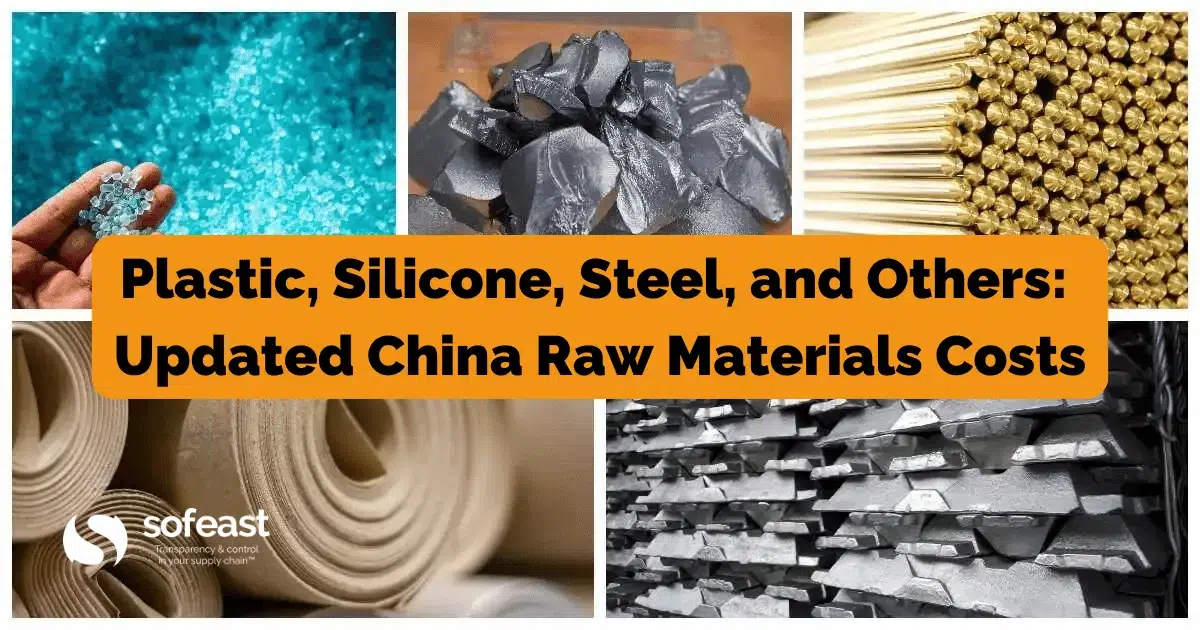
Plastic, Silicone, Steel, and Others: Updated China Raw Materials Costs (late April ’24)

Here’s the monthly update from Sofeast’s sourcing team, tracking the costs of commonly used raw materials from China for the past year to help you understand where the market is right now. If you or your supplier are purchasing materials from China for your products, the cost changes you see here impact your bottom line!

Here’s the up-to-date material cost data from China for you as of late April 2024 and the price evolution over the past twelve months – the cost of Li-ion batteries has fallen and stayed low, which is perhaps unsurprising given China’s dominance in their manufacture. In contrast, other raw materials have been somewhat stable:
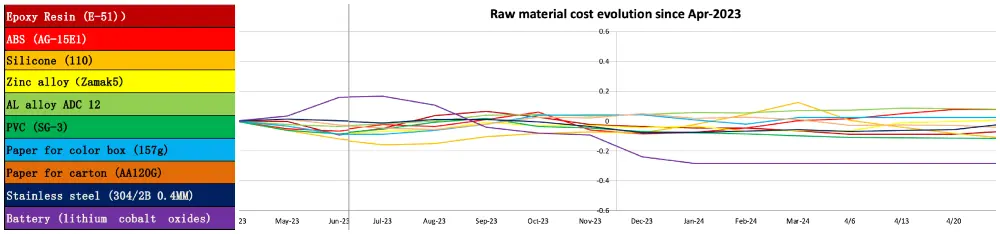
china raw material cost evolution up to Apr 23 to 24Here you can see the individual cost evolution per material over the past year, including the weekly and monthly change for April 2024:

china raw material costs and recent changes april 24

Here is what our market analysts attribute these changes to during this past month:

Epoxy Resin (E-51) – Decrease of 0.19%

This week, the epoxy resin industry chain faces several challenges. There is a general lack of cost support for most products, cautious market demand, and a tendency for prices to fall rather than rise. The impact is more significant on upstream products, where losses are more noticeable.

Specific price movements of key materials and products are as follows:

  • Phenol: The price of phenol, a key raw material, has slightly decreased. This drop is mainly due to the falling prices of pure benzene. Traders have been able to profit from this decline.
  • Intermediate Products (Bisphenol A and ECH): Prices for these intermediate products have also fallen over the week. The main reasons are weak demand for downstream epoxy resins and an oversupply in the market that has led to lower selling prices.
  • Downstream Products (PC): Prices for downstream polycarbonate (PC) are relatively stable with minimal fluctuations. The market for PC lacks significant news, with stable factory offers and demand-driven purchases.

In terms of market drivers, the primary factor influencing the industry this week is the balance of supply and demand. The prices for key materials like phenol, bisphenol A, and epoxy resins are dragging down due to their costs and shifts in market demand.

ABS AG-15E1 – Increase of 7.32%

This week, prices in the ABS (Acrylonitrile Butadiene Styrene) market initially increased but later stabilized. This initial rise was due to a decrease in the availability of standard materials, which positively influenced market sentiment and prompted middlemen to focus on pricing strategies.

In terms of raw materials:

  • The price of upstream styrene increased initially but then decreased.
  • Acrylonitrile prices rose slightly.
  • Butadiene prices saw limited changes.

These fluctuations led to a slight weakening in the cost pressures that typically push prices up. Additionally, the industry is currently facing losses, which have resulted in a reduction in overall production.

On the demand side, there is a lack of strong replenishment needs from downstream sectors like home appliances, despite it being their peak season. This mismatch has resulted in mixed market activity, with some strong and some weak sales.

Silicone (110) – Decrease of 21.26%

This week, prices in the 110 raw silicone rubber market continued to drop. The decline in prices was influenced by several factors:

  • Increased Resistance to New Orders: There’s been a growing reluctance in the raw rubber market to place new orders, primarily due to weak demand for rubber mixing from downstream sectors.
  • Profit-driven Shipments: Some companies with high inventory levels decided to sell their excess stock at lower prices to make quick profits, which pulled the overall market prices down.
  • Price Reductions by Leading Companies: The major players in the market reduced their prices by 400 yuan per ton, prompting other domestic manufacturers to follow suit and lower their prices as well.

After these price reductions, the response from the downstream buyers was that the price drop was less than they expected. This has led to a continued pessimistic outlook among them. In response to the falling prices, businesses with low inventory are taking advantage by buying up stock at these lower prices to cover their positions.

Overall, this paints a picture of a market where prices are falling, but not enough to satisfy downstream expectations, leading to ongoing caution and strategic purchasing among buyers.

Zinc Alloy (Zamak5) – Increase of 7.59%

This week, spot prices for zinc experienced a significant increase. Despite the rise, the overall market sentiment regarding shipments remained positive. Downstream buyers continued purchasing only what was necessary, indicating that the overall demand has remained limited.

Some businesses opted to stock up on inventory before the holiday, which helped drive a few more transactions than usual. Despite these fluctuations, zinc supplies remained readily available throughout the month, suggesting a steady market supply.

AL Alloy ADC 12 – Increase of 0.92%

On the supply side, major aluminum production facilities are operating smoothly. In Yunnan, over 500,000 tons of aluminum production capacity that had been halted has now been resumed. Despite this resumption, the increase in aluminum ingot availability in the short term is expected to be limited, and there is currently no significant pressure on supply.

PVC (SG-3) – Decrease of 2.12%

Here are the expected market dynamics for PVC powder next week:

  • Impact of May Day Holiday: Due to the May Day holiday, some companies that use PVC powder in their products will be closed. This break could lead to a regular increase in the amount of PVC powder available in social inventories, as fewer businesses will be using the material, creating some pressure on spot markets.
  • Support from Other Markets: Despite the pressure from increased inventories, the market sentiment for related products, often referred to as ‘black products’, is currently strong. This positive atmosphere in related markets might provide some support to PVC powder prices.
  • Market Expectations: Fundamentally, the PVC powder market lacks a clear direction driving it strongly in either an upward or downward trend. Therefore, it is expected that PVC powder prices will continue to fluctuate within a certain range over the next week. However, the general trend for prices is expected to shift slightly upward.

Overall, while the holiday might lead to an increase in stock levels temporarily impacting prices, the strong performance in related markets and the expected slight upward movement in prices suggest a stable yet cautiously optimistic outlook for PVC powder in the short term.

Paper for Color Box (157g) – No change

Paper for Carton (AA120G) – Decrease of 5.38%

As we approach the May Day holiday next week, here’s what’s expected in the paper industry:

  • Shutdowns and Supply: Some paper mills have announced plans to shut down temporarily, which is anticipated to reduce the supply of paper on the market.
  • Downstream Demand: Conversely, downstream packaging plants are preparing for the holiday by storing up supplies. This action is likely to reduce the consumption of finished paper products such as corrugated and boxboard paper.
  • Inventory Pressure: Despite the reduced supply from shutdowns, upstream paper mills are facing high inventory pressures. This situation might lead them to implement profit promotion policies to clear out excess stock.
  • Market Outlook: Given these dynamics, the market for corrugated and boxboard paper is expected to continue its downward trend in prices.

Overall, while supply might tighten due to mill shutdowns, reduced demand from packaging plants and high inventory levels at paper mills are likely to drive a continued decrease in market prices for corrugated and boxboard paper.

Stainless Steel (304/2B 0.4MM) – Increase of 4.07%

The current performance and expectations for the stainless steel market next week:

  • Profit and Supply Growth: Profits in the stainless steel market continue to evolve and may drive further increases in supply. However, since existing inventories have been substantially reduced, supply pressures are generally not significant at this time.
  • Demand and Market Sentiment: There’s an optimistic outlook on demand, especially around the holiday period, with expectations for continued terminal replenishment. This anticipation helps maintain a positive market atmosphere.
  • Raw Material Costs: Support from the cost of raw materials remains strong, likely contributing to rising costs in the production of stainless steel.
  • Market Forecast: Taking all these factors into account, it is expected that the stainless steel market will show some strength next week, with the potential for price increases.

Overall, a combination of reduced inventory pressures, optimistic demand forecasts, and rising raw material costs sets the stage for a positive outlook in the stainless steel market in the near term.

Lithium-Ion Batteries – No change


How to combat rising costs?

Explore cost-reducing tips in this post: Rising Raw Material Prices: What Strategy To Follow? (6 Approaches).

What to do if your Chinese supplier suddenly tells you that material costs have risen: How To Cooperate With Your Chinese Supplier, Part 16: Bad News from China, Raw Material Prices Just Increased!

If your supplier just isn’t working out, maybe sourcing a new supplier will help you find one who can offer you better prices and more. If so, there’s no need to fear switching from your current supplier to a new one if you’re prepared: How To Switch To A Newer, Better Chinese Manufacturer? [eBook].


We hope this is helpful. Our mission at Sofeast is to help importers have transparency in their supply chain and to give them more control. And this information is critical to have some visibility into your manufacturer’s costing.

By the way, you can always contact us if you have any questions about whether a manufacturer’s quote is reasonable.

Major Indian Exports (Early ’24) – Hottest Product Categories?

As buyers start focusing more on sourcing from India it makes sense to understand what the major Indian exports are. Is your product type something that is commonly manufactured there? If so, there must be suitable manufacturers there and it’s something for you to look into. But where to start?

Continue reading “Major Indian Exports (Early ’24) – Hottest Product Categories?”

The Rise Of The Dragon: Exploring China’s Technology Dominance [Podcast]

Today Adrian and Andrew Amirnovin, our reliability and testing head, look at some of China’s recent technology successes, what fuels China’s tech dominance, and how technology is caught up in the middle of the US-China trade war.


Listen to the episode here 👇

Listen: to the podcast episode

Watch: on Youtube


Episode sections

  • 00:00 – Greetings and introduction
  • 03:22 – 1. If your supplier refuses to ship the goods you paid for.
  • 09:40 – 2. Your manufacturer tries to force you to accept poor quality that you’re uncomfortable with.
  • 16:00 – 3. If the supplier has failed to prepare export packaging of your products for your scheduled quality inspection.
  • 21:41 – 4. When your supplier has disappeared with your tooling and/or inventory.
  • 25:33 – 5. Your supplier won’t provide important supply chain information.
  • 29:30 – 6. You catch your supplier selling your products as their own!
  • 34:59 – 7. Your ‘factory’ turns out to be a trading company.
  • 39:00 – 8. Coping with an unexpected price increase from suppliers.
  • 41:50 – 9. Your current supplier blocks the transfer of your mold tooling to a new supplier.
  • 46:09 – 10. Worries about keeping sensitive product information secure.
  • 48:26 – Wrapping up.


Related content…


Listen, rate, & subscribe to the ‘China Manufacturing Decoded’ podcast on your favorite provider

More episodes are coming, so remember to rate us and subscribe! You can find us on:

If you enjoyed this episode, don’t forget to give us a 5* rating and share it with your network if you enjoy listening!

Plastic Injection Pilot Runs: How To Use them To Mitigate Quality Issues

In plastic injection molding, pilot runs are a standard practice employed by manufacturers to evaluate the feasibility and quality of a design before transitioning to full-scale production. However, these initial pilot runs can sometimes reveal inconsistencies or quality issues. For importers, minimizing such problems is paramount to ensure a smooth transition to mass production and reduce the risk of receiving parts that deviate from their specifications.

This article explores key strategies to mitigate quality issues during plastic injection molding pilot runs.

Continue reading “Plastic Injection Pilot Runs: How To Use them To Mitigate Quality Issues”

10 Common Problems From Chinese Suppliers & How To Deal With Them [Podcast]

Adrian and Renaud get together to talk about 10 common problems that companies with Chinese manufacturing suppliers often face, AND how you can deal with them. Hopefully, you are not one of the unlucky ones, but being prepared with the knowledge to avoid issues is always helpful!


Listen to the episode here 👇

Listen: to the podcast episode

Watch: on Youtube


Episode sections

  • 00:00 – Greetings and introduction
  • 03:22 – 1. If your supplier refuses to ship the goods you paid for.
  • 09:40 – 2. Your manufacturer tries to force you to accept poor quality that you’re uncomfortable with.
  • 16:00 – 3. If the supplier has failed to prepare export packaging of your products for your scheduled quality inspection.
  • 21:41 – 4. When your supplier has disappeared with your tooling and/or inventory.
  • 25:33 – 5. Your supplier won’t provide important supply chain information.
  • 29:30 – 6. You catch your supplier selling your products as their own!
  • 34:59 – 7. Your ‘factory’ turns out to be a trading company.
  • 39:00 – 8. Coping with an unexpected price increase from suppliers.
  • 41:50 – 9. Your current supplier blocks the transfer of your mold tooling to a new supplier.
  • 46:09 – 10. Worries about keeping sensitive product information secure.
  • 48:26 – Wrapping up.


Related content…


Listen, rate, & subscribe to the ‘China Manufacturing Decoded’ podcast on your favorite provider

More episodes are coming, so remember to rate us and subscribe! You can find us on:

If you enjoyed this episode, don’t forget to give us a 5* rating and share it with your network if you enjoy listening!

Common LVD, RED, and EMC Compliance & Recall Risks for Electrical Products Sold in the EU & UK [Research]

Sofeast commissioned some research recently on which electrical products being imported into the EU fell foul of the LVD, RED, and EMC regulations over a recent 6-month period, what the issues were, and what actions were taken by market surveillance authorities.

By seeing the issues, you will get an insight into what market surveillance authorities are looking for so you can ensure your manufacturers focus on not making the same mistakes.


[ez-toc]


What are the key applicable regulations & directives?

In general, we investigated these common regulations and standards that market surveillance authorities tend to check products against:

  • LVD
    The Low Voltage Directive (LVD) is an EU regulation put in place to ensure that electrical equipment between certain voltages (50-1000 AC and 75-1500 DC) imported into the EU reaches certain safety requirements, such as reducing the risk of fires, shocks, chemical problems, and more.
    We explain the Low Voltage Directive in this video:

  • RED
    The Radio Equipment Directive (RED) governs radio equipment safety, ensuring that products imported into the EU are safe, use permitted RF signals, and don’t interfere with other devices.
  • EMC
    The Electromagnetic Compatibility (EMC) Directive is there to ensure that electrical and electronic products brought inot the EU do not emit an unauthorized level of electromagnetic interference that could affect other products and that they are in turn unaffected by it themselves.
    We go through RED and EMC in this video:

Incidents occurring in electrical products

During 6 months in 2023 (April to October), we found that there were around 180 cases where electronic products didn’t comply with LVD, RED, or EMC.

Countries of origin

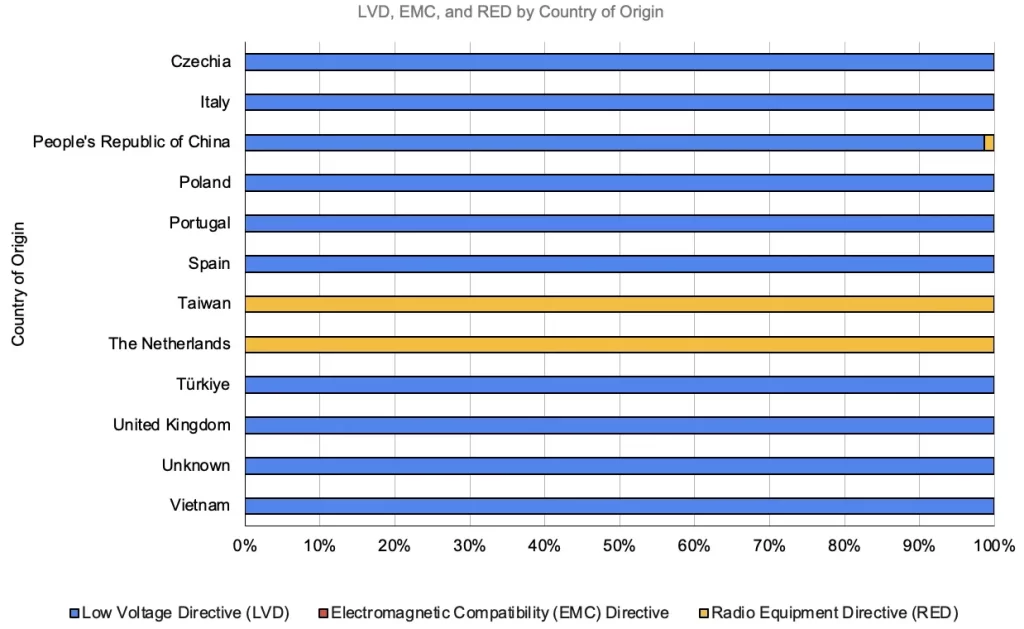
The countries of origin were varied and not only the PRC was responsible for manufacturing the products, although 142 cases were from China. Many incidents were recorded in products from other European and Asian countries, too:

  • Czechia 1
  • Italy 2
  • People’s Republic of China 142
  • Poland 3
  • Portugal 1
  • Spain 1
  • Taiwan 1
  • The Netherlands 1
  • Türkiye 2
  • United Kingdom 1
  • Unknown 25
  • Vietnam 1
    Grand Total 181

electrical product incidents origin

What types of products were found to be problematic?

There were actually 75 different kinds of electronic products flagged by the authorities. The top 12 that didn’t comply with LVD were:

  1. USB chargers (28 incidents)
  2. Lighting chains (16)
  3. Extension leads (11)
  4. Travel adaptors (9)
  5. Hair dryers (9)
  6. Air humidifiers (9)
  7. Soldering iron (3)
  8. Portable power station (3)
  9. Multiplug socket (3)
  10. Hot plate (3)
  11. Cord extension set (3)
  12. Aroma diffuser (3)

The product type that didn’t comply with RED was:

  • Lamp holders (4)

Nature of the non-compliance

The vast majority of products caught by market surveillance authorities did not comply with LVD and a few were also found in breach of RED. In this period, we didn’t find any reports of EMC issues.

Not complying with LVD is a problem, not only from a market-access point of view, but also because the products could be a risk of fire, electric shock, or other harm such as releasing chemicals. Importers could very easily find themselves in legal trouble if a non-compliant product later caused a user to be injured.

Although only a few products didn’t comply with RED, let’s look at why that’s an issue. First, the products could interfere with other products leading to disruption of, for example, radio equipment. In addition, these products could also be a risk of malfunction, shock, or even exposure to unsafe levels of radiation.

Which countries reported the most issues?

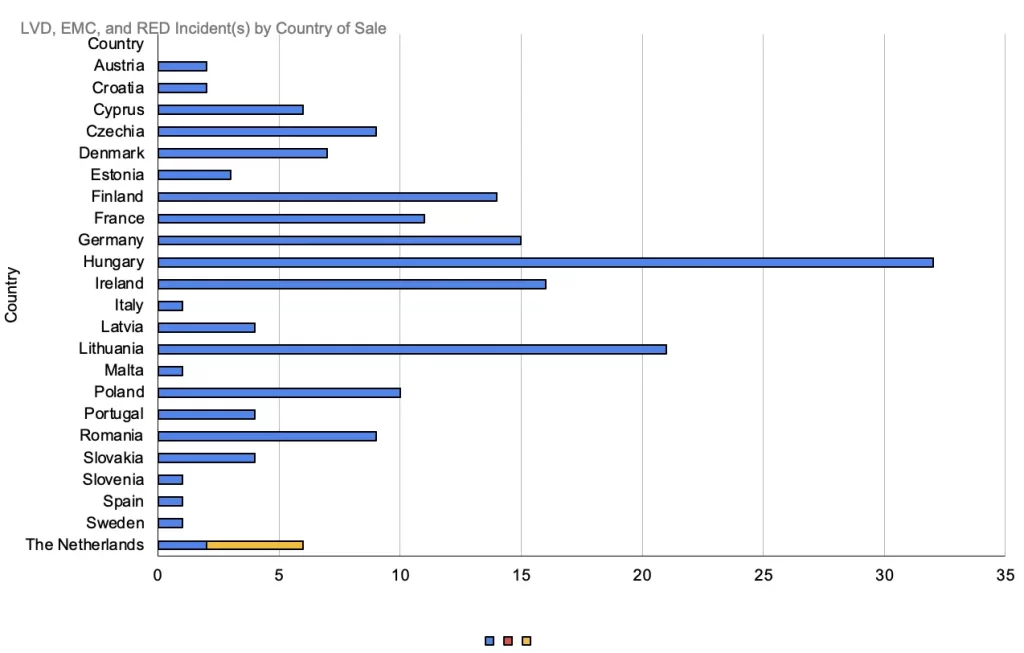
Hungary (by far), Lithuania, Estonia, and Germany reported the most cases of LVD breaches, and The Netherlands was responsible for reporting products that didn’t comply with RED. If you import into the countries in the graph below this can give you some idea about how zealous they are in enforcing these regulations.

What steps did the authorities take?

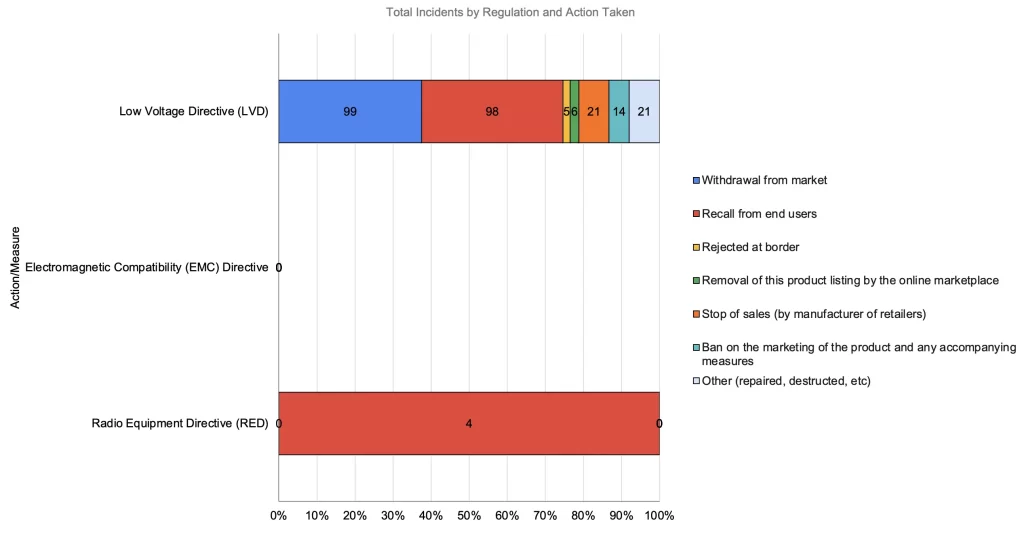
There were a number of different actions taken by different countries:

The most common was to recall the product from end users, followed by demanding that the product be completely withdrawn from the market. The actions depend on different factors, such as how serious a hazard the product was deemed to be, however, you will note that all actions taken involve the products no longer being sold because non-compliance with LVD and RED means that products cannot legally be sold in the EU.


General advice to reduce such risks

Make sure you work with suppliers who are aware of the LVD, EMC, and RED regulations. Perhaps they can show you compliant products that they made in the past and you should be able to get a feel for if they truly understand the regulation when you speak with them.

There are a number of requirements. Some of them are listed in the text (available for free on the EU Commission’s website) of those directives. Others are in the technical standards relevant to your product. It can get complex, but make sure you identify and address risks. 

Even if your supplier runs their own lab tests and provides you with a report, unless they’re proven to be capable and trustworthy beyond doubt it’s advisable for you to run your own laboratory tests, at least initially.

Quality Fade: Silent AND Deadly! [Podcast]

Adrian and Renaud discuss Quality Fade. This bad practice from suppliers sees them put their profits before your product quality, but the big problem is that you may not even know it is happening as it’s a gradual process where quality declines over time, bit by bit.

Are you at risk, how do you identify it, and what can you do to combat it? We reveal all in this episode!


Listen to the episode here 👇

Listen: to the podcast episode

Watch: on Youtube


Episode sections

  • 00:00 – Greetings and introduction
  • 02:27 – What is Quality Fade?
  • 09:25 – Is it still happening today?
  • 12:15 – Actions to help you avoid quality fade.
  • 18:30 – If you are a victim of quality fade, how can you catch it?
  • 23:44 – Examples of products affected by quality fade.
  • 28:51 – Ongoing reliability testing: Warn the supplier, or do it secretly?
  • 35:28 – Wrapping up.


Related content…


Listen, rate, & subscribe to the ‘China Manufacturing Decoded’ podcast on your favorite provider

More episodes are coming, so remember to rate us and subscribe! You can find us on:

If you enjoyed this episode, don’t forget to give us a 5* rating and share it with your network if you enjoy listening!

PCBA Protection: How to Care for the Heart of your Electronic Product [Podcast]

On this episode of the China Manufacturing Decoded Podcast, Adrian hosts and is joined by Andrew, our reliability and testing head who is going to explain why the PCBA in your electronic product is critical, and how to protect it both physically and through product design.


Listen to the episode here 👇

Listen: to the podcast episode

Watch: on Youtube


Episode sections

  • 00:00 – Greetings and introduction.
  • 01:45 – What is the PCB and why is it so important?
  • 03:04 – How and why do we protect the PCB?
  • 04:40 – Conformal coating.
  • 08:51 – Other PCB protection options.
  • 14:14 – The process of protecting a product from the inside out.
  • 18:42 – The costs of protecting PCBs.
  • 23:44 – The coating process.
  • 25:05 – Wrapping up.


Related content…


Listen, rate, & subscribe to the ‘China Manufacturing Decoded’ podcast on your favorite provider

More episodes are coming, so remember to rate us and subscribe! You can find us on:

If you enjoyed this episode, don’t forget to give us a 5* rating and share it with your network if you enjoy listening!

AI Product Design: How to use AI early during Industrial Design (Examples)

AI product design appeals to today’s industrial designers who are looking for improvements in efficiency and creativity.

We’re going to explore how combining two innovative AI tools, ChatGPT and Midjourney, could change the way designers approach the early concept discovery phase of Industrial Design, providing compelling ideas that they otherwise may not have come up with.

Continue reading “AI Product Design: How to use AI early during Industrial Design (Examples)”