In this post, we interview an experienced product designer to get his tips for new product launches.
Why?
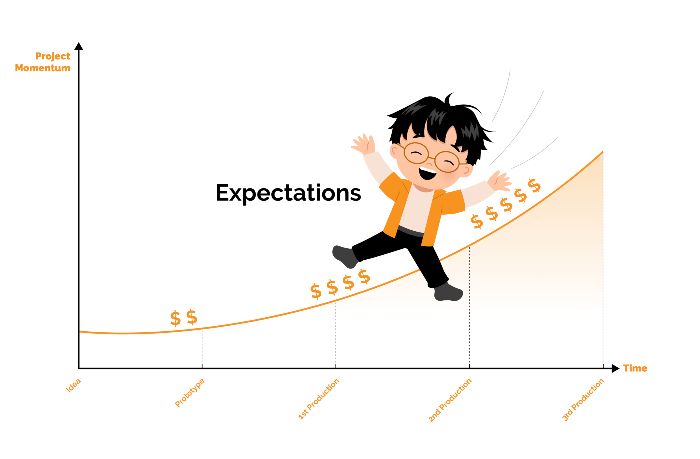
A lot of people who come up with an innovative product idea think that the new product launch process goes something like this:
- I come up with a design
- Someone makes the prototype for me and I sign off on it
- It goes into mass production
- I find customers and makes sales
- I reorder more of the product
- I keep selling and progressively making more money
- …and so on
This graph would represent their assumption on how the new product launch process goes:
However, is this realistic?
British product designer Andy Bartlett knows a thing or two about launching new products, and he has some thoughts on the process and will dispel some assumptions. Here are a series of questions about new product launches and his tips to help you:
Is the new product launch process usually fairly straightforward if you’ve got a unique, cool product that will sell?
Some entrepreneurs and companies who come up with an admittedly innovative and cool product idea get sucked into this assumption that a new product launch will go smoothly and doesn’t have numerous stages to follow. This is because we’re all consumers at heart, so we all love and buy stuff in our everyday lives and much of the time we never really stop to consider the energy, effort and human endeavor that sits behind a beautiful, simple, elegant product that we love.
I particularly think the process requires a great deal of investment when you’re doing something new. If you’re doing something for the first time it generally takes much more effort than the second, third, and fourth. The payoff is that as you get better and better at doing it you use some of that previous investment of knowledge and wisdom and skill and bring it to the next development.
How important is the pre-production work?
Another area that gets overlooked is the product’s concept and early design stages. Just getting to the point where you have a great product concept that works well is a huge step.
Related 👉 We’ve written about the importance of going to a manufacturer with mature designs before.
I worked for Panasonic and for the first three years not one of my concepts ever went to market! So you can imagine how many concepts are developed by Apple, Microsoft, or HP that never go anywhere, and how many years of work go into them. To get to a green-lit concept where the user is happy, we can make our market projections, the cost and brand guys are happy, it takes an enormous amount of work and sometimes the market’s moved on and the product’s no longer relevant.
The early design work determines so much of everything else in the project, so that’s why it’s so important to get that right and work with good people. Someone did a study (mentioned in the graph here) and found that the cost of the design itself when you compare it to the cost of tooling, purchasing the components, manufacturing, distributing, and everything is somewhere around three to five per cent of the total, however, it determines something like 70 per cent of the total cost.
This is because during the early design stages you define the materials, the technology, how it works, how simple or complicated the product’s going to be, and more. If you look at the number of decisions you make in a new product development, many of the core decisions are made really early on and the whole project stacks and builds on those decisions about things like material and processes and because they’re made so early in the development process you know the consequences of going back and changing them if you get them wrong or if they prove to be flawed later on are huge.
That being said, the early design work before pre-tooling can really be the tip of the iceberg with most of the effort still to be done in terms of signing the tooling off, the tooling validation process, developing packaging, developing assets for your online presence, distribution, and so on and so forth. Maybe as a consumer you never consider all of those, too.
Any tips to control the project?
Avoid selecting an immature technology where the manufacturing readiness level is pretty low as this will give your manufacturer a lot of headaches. It’s very easy to be seduced by certain processes or finishes or technologies that will just draw in so much time and effort, requiring lots of other people to do R&D, but consider if features are truly fundamental to your product offering.
Related 👉 We wrote about avoiding feature-creep before.
It’s really important that you’re not wasting energy on niche processes as they may not be worth it. The skill in the process of taking a product to market is to say no to dead ends early on and not go too far down a route that’s likely to cause pain.
Let’s look at the ‘sunk cost fallacy’ which is also known as the ‘Concorde fallacy.’ The Concorde was a supersonic passenger plane and the concept was to fly people very quickly across the Atlantic and basically, the project ran 10 times over cost and it’s a really interesting analogy here because they carried on ploughing the money in because they’d already invested so much energy, time, and money that they couldn’t possibly walk away from it.
This is a trap we can all fall into when we develop a new product; it’s wise to know when to say no to new technologies, custom parts, complex features, and so on, rather than stubbornly carrying on. There were some studies that showed that the bigger the project and the more complex the elements going into it, the more likely it is to run over cost. So you should really focus on what creates value for the users and try to make the product relatively simple, then not only would it be faster and less risky to develop, but there’s a lower risk of you going over your budget, too. Back during my days in the toy industry, we used to have to be able to describe a new toy concept in one sentence. If we failed it was deemed to be too complex and an idea that would need to be refined before it could be further developed.
I should also stress the importance of procurement and sourcing the right suppliers for critical components, because that also can derail the entire project if, for example, a supplier suddenly raises the price massively or simply says that it’s no longer available.
How does design relate to reliability?
Reliability is largely determined by design. People often think of quality and they think of the guys doing the assembly on the line, but then if they want the product to keep working for two or three years the design itself has to be reliable and that comes from making sure that you consider the stress points and the redundancy if needed and things like that, and also choosing the right component suppliers that already come with proven reliability levels.
When do design changes become impractical?
Exploring ideas and making some changes during the concept and early design stages is cost-effective. Doing so once you’ve made a tool and it becomes slow, painful, and costs escalate quickly (e.g. making changes to tooling is slow and expensive) over simply tweaking a CAD drawing. It’s even worse if production has already begun. Therefore being thorough and making sure that designs are mature is critical.
What is ‘agile prototyping?’
Let’s say product development is to get all the way to a prototype that is approved and looks and works as you need it to. This can be a ton of work. Sometimes it takes more than 10 prototypes for complex electronic products and the process kind of starts again after tooling is made if you have very high expectations for the finish. The point is, it’s unrealistic to just create one good prototype and then go into production. To coin Mark Zuckerberg’s phrase, ‘move fast and break things’ when prototyping by accepting ‘good enough’ to move quickly because searching for perfection will slow you down and prevent you from learning things quickly which may be really important, particularly when doing something for the first time.
Having that sort of quick agile mindset helps, so favor sketching over CAD in order to move quickly and utilize 3D printing to get prototypes really quickly that are good enough to put in front of customers you may be selling to so you can show them physical properties, because if it’s a new product you need to get feedback from typical users during development. Would you rather spend six months to get a perfect prototype only to find out that maybe you went in the wrong direction, or would you rather do some quick iterations to show the product to some people once a month and get valuable feedback that keeps you on track?
When to go into mass production?
Let’s say you’ve done the engineering of your new product that you designed from the ground up, selected relatively high-quality components and tested the prototypes like crazy for a month. The manufacturer might say that the next step is to wire them a thirty per cent deposit and go straight into mass production. Some entrepreneurs do this and that’s a mistake.
There are still plenty of steps to undertake and decisions to make:
What’s the quality standard? Where’s the testing plan? Has the product been certified for your market (you shouldn’t wait for the product to be mass-produced before checking that it’s compliant for obvious reasons)? Are you performing any pilot runs? If not, how have you validated that everything can be made properly?
The typical Chinese manufacturer wants to go into production and get paid. They don’t want the hassle of the testing and validation I mentioned as this slows them down from arriving at their goal. So a manufacturer that pushes you to pay and not worry, claiming that they’re experienced in producing your type of product even though it’s new and has been designed from the ground up is exhibiting major red flags.
Fundamentally, using them is a bad sourcing decision right there, but on the other hand, the entrepreneur didn’t plan for a lot of important pre-production steps either and didn’t communicate what their process is to the supplier, so some of the blame has to be shared.
It’s very tempting to expedite a development process and bypass certain stage gateways, particularly if you’re under time and budgetary pressure. Not every product needs a very long and full development path. It is possible to have a quick development path depending on the nature, complexity, and challenges of the product you’re making, but there are certain stages that shouldn’t be skipped, such as pilot runs for EVT, DVT, and PVT.
You don’t just jump from a prototype to mass production, you tentatively go through three or four different development gateways at each time pausing, reflecting, reviewing, testing, and checking. Otherwise, your risks of problems occurring during the production and ending up with defective or sub-standard products that require expensive rework and even being shipped back to the manufacturer from abroad are greatly increased.
If problems are found during inspections on finished products, the pre-production work to iron out and avoid them probably hasn’t been thorough enough, therefore the development process is an investment that will save you a lot of heartache, money, and time, even if it does feel somewhat laborious or slow whilst you’re doing it.
Having an auditable trail in the development process is very valuable and reassuring because if you are importing and developing a new product and putting it into the market in significant numbers, you will sleep better at night knowing that you followed the correct development process and haven’t skipped anything critical. Let’s take an extreme example: there’s a recall on your product as it has caused injuries or death. You’re in court and a judge is asking you questions about how well-tested the product was before it went into mass production. If you cannot answer the questions they will say you were negligent and then if you say “I didn’t know that people usually do that,” this is no defence, but if you say “this is our risk analysis and you see that we covered the foreseeable safety failures and we identified ways to address them, we did some reliability testing, to address some issues found we made some engineering changes, and we purchased this component here and the battery from fully certified manufacturers, etc,” they will see that you were unlucky but not negligent.
Do you have a key takeaway for entrepreneurs planning to go to market with a new product idea?
It’s really hard getting your first product to market, but it gets easier and easier especially with the next versions of the same product. Getting bogged down with trying to be perfect or include too many features is a mistake.
There’s nothing wrong with having a road map where you initially go to market with your minimal viable proposition knowing that version two is on the road map.
A really valid way of putting your product out there and sustaining and growing your brand is to get to market quickly with existing technology that only allows you to achieve say 80 per cent of what you want, but allows you to build momentum and later go back and explore the new technologies that are available in version 2.0 with the time, energy, and resources to do so.
Conclusion
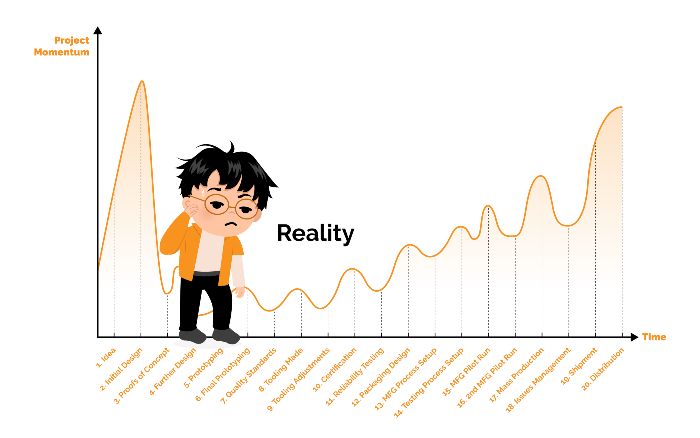
So, you can see from Andy’s tips for new product launches, the process is complex and can lead you into trouble if certain stages or activities are skipped. Take moving from prototype to mass production as one of the examples of this. The average Chinese manufacturer may suggest doing this, but there’s a huge amount of testing and validation to be done in order to assure that issues are avoided or minimized during production so you end up with quality and compliant products ready for the market.
With this being said, a more realistic representation of the new product launch process will look more like this:
Do Andy’s points about the complexity of launching products resonate with you? Were you surprised by the process? Perhaps you suffered from issues because of going into production too soon? Please let us know your thoughts or your own tips for new product launches by commenting below!
Are you designing, or developing a new product that will be manufactured in China?
Sofeast has created An Importer’s Guide to New Product Manufacturing in China for entrepreneurs, hardware startups, and SMEs which gives you advance warning about the 3 most common pitfalls that can catch you out, and the best practices that the ‘large companies’ follow that YOU can adopt for a successful project.
It includes:
- The 3 deadly mistakes that will hurt your ability to manufacture a new product in China effectively
- Assessing if you’re China-ready
- How to define an informed strategy and a realistic plan
- How to structure your supply chain on a solid foundation
- How to set the right expectations from the start
- How to get the design and engineering right
Just hit the button below to get your copy:



![Right To Repair: Blessing or Curse for Manufacturers? [Podcast]](https://artbyraksha.sofeast.com/wp-content/uploads/2021/10/Right-To-Repair_-Blessing-or-Curse-for-Manufacturers_-Podcast.jpeg)

![DIY Sourcing From China Part 2: Negotiations, Terms, Leverage, & Quality Standards [Podcast]](https://artbyraksha.sofeast.com/wp-content/uploads/2021/10/Sourcing-From-China-Guide-Part-2_-Negotiations-Terms-Leverage-and-Quality-Standards-Podcast.jpeg)


![What’s The Cost Of Quality? [Podcast]](https://artbyraksha.sofeast.com/wp-content/uploads/2021/10/Whats-The-Cost-Of-Quality_-Podcast.jpeg)