
Plastic, Silicone, Steel, and Others: Updated China Raw Materials Costs (late Feb ’26)

Sofeast’s team continues to monitor the cost evolution of key raw materials in China, helping importers and manufacturers stay informed. This latest update from the market analysts we work with reflects changes (RMB costs and %) over the past year through Feb 26, 2026. (Click the charts to expand them)

china raw material cost evolution feb 26

china raw material cost change feb 25 to 26 in rmb

Monthly China Raw Material Cost Changes – February 2026

Epoxy Resin (E-51) +4.22% monthly change

This week, epoxy resin prices showed a slight recovery after several months of decline.

  • Drivers
    Upstream raw material costs stabilized, while downstream buyers resumed small-volume purchasing after the holiday period. This helped support prices but did not create strong upward momentum.
  • Outlook (next week)
    Prices may continue to fluctuate within a narrow range as demand remains cautious and cost pressure is moderate.

ABS (AG-15E1) +5.08% monthly change

ABS prices softened slightly this month after a period of steady declines.

  • Drivers
    Demand from downstream injection molding and consumer goods manufacturers remains weak, and suppliers continue to compete on price to secure orders.
  • Outlook (next week)
    ABS prices are expected to remain under pressure unless downstream demand improves.

Silicone (110) −1.68% monthly change

Silicone rubber prices stayed relatively stable but edged slightly downward.

  • Drivers
    Producers focused on clearing inventory accumulated before the holiday period, while downstream buyers purchased only as needed.
  • Outlook (next week)
    Prices are expected to remain stable with small fluctuations depending on upstream DMC cost movements.

Zinc Alloy (Zamak 5) +0.34% monthly change

Zinc alloy prices remained broadly stable this month.

  • Drivers
    Base metal prices fluctuated but stayed within a limited range, while demand from hardware and die-casting factories recovered slowly after the holiday.
  • Outlook (next week)
    Short-term price movement is expected to stay range-bound, following zinc market trends.

Aluminum Alloy (ADC 12, Jiangsu) -0.48% monthly change

Aluminum alloy prices continued to rise moderately.

  • Drivers
    Aluminum futures remained relatively strong, and restocking activity after the holiday period supported spot prices.
  • Outlook (next week)
    Prices may remain firm, although volatility is possible depending on macroeconomic sentiment.

Paper for Color Box (157 g double-coated) 0.0% monthly change

Coated paper prices remained at low levels with little change.

  • Drivers
    Supply remains high while demand from the packaging and printing sectors is still recovering after the holiday period.
  • Outlook (next week)
    Prices are likely to stay weak unless order volume increases.

Stainless Steel (304/2B 0.4 mm, Taiyuan) +1.38% monthly change

Stainless steel prices continued to increase gradually.

  • Drivers
    Nickel prices stayed relatively strong, and mills raised quotations after the holiday restart. Demand improved slightly from machinery and appliance manufacturers.
  • Outlook (next week)
    Prices may remain firm, but further increases will depend on the nickel market direction.

Battery Material (Lithium Cobalt Oxides) +1.43% monthly change

Battery material prices remain at historically high levels.

  • Drivers
    Lithium and cobalt supply remains tight, while demand from EV and energy storage industries continues to grow. Market sentiment remains bullish despite short-term fluctuations.
  • Outlook (next month’s orders)
    Prices are expected to stay elevated, with possible volatility depending on policy changes and export demand.

How to combat rising costs?

Explore cost-reducing tips in this post: Rising Raw Material Prices: What Strategy To Follow? (6 Approaches).

What to do if your Chinese supplier suddenly tells you that material costs have risen: How To Cooperate With Your Chinese Supplier, Part 16: Bad News from China, Raw Material Prices Just Increased!

If your supplier just isn’t working out, maybe sourcing a new supplier will help you find one who can offer you better prices and more. If so, there’s no need to fear switching from your current supplier to a new one if you’re prepared: How To Switch To A Newer, Better Chinese Manufacturer? [eBook].


We hope this is helpful. Our mission at Sofeast is to provide importers with transparency in their supply chain and to give them greater control. And this information is crucial for gaining visibility into your manufacturer’s costing.

By the way, you can always contact us if you have any questions about whether a manufacturer’s quote is reasonable or not.

Manufacturing in China for the U.S. in 2026: Tariffs, China+1, and the Real Cost of Moving Production [Podcast]

Recently, Fabien Gaussorgues, CEO of Agilian Technology (part of the Sofeast Group), gave a presentation titled:

“Made in China for the USA Market: Risks & Opportunities – 2026 Reality Check.”

Instead of political commentary, the focus was on operational reality:

  • What tariffs actually mean today

  • How they affect landed cost

  • Whether China+1 works in practice

  • And when it truly makes sense to move production

Listen here

Listen to the episode or watch on YouTube

Episode Sections:

  • 02:42 – Manufacturing Risks and Opportunities
  • 08:25 – Navigating Tariff Challenges
  • 11:23 – China Plus One Strategy
  • 13:20 – Substantial Transformation Explained
  • 15:06 – Final Assembly Considerations
  • 21:13 – Moving Production Out of China
  • 22:32 – Risks of Full Decoupling
  • 25:19 – Key Takeaways for Businesses
  • 28:07 – Audience Questions and Insights
  • 53:52 – Closing Remarks and Future Insights

Further content

🎧 Listen, rate, & subscribe to the ‘China Manufacturing Decoded’ podcast on your favorite provider
More episodes are on the way, so remember to rate us and subscribe! You can find us on:

Choosing the Right Manufacturing Process & Avoiding Production Bottlenecks [Podcast]

One of the most important, and most misunderstood, decisions in new product development is choosing the right manufacturing process.

Should your plastic parts be injection molded or CNC machined? Should metal components be die cast? And even if you pick the right process, what happens when production slows down due to supplier limits, component shortages, or bottlenecks on the assembly line?

In this episode, Adriand and Paul explain how manufacturers determine the most suitable processes for your product and identify the most common production bottlenecks, so you can avoid costly mistakes and scale production with confidence.

Listen here

Listen to the episode or watch on YouTube

Episode Sections:

  • 01:02 – The core question: choosing the right manufacturing process and avoiding bottlenecks
  • 02:16 – Why the answer depends on your product, volume, and requirements
  • 03:57 – Injection molding vs CNC machining: when each process makes sense
  • 07:07 – How product materials and operating conditions affect process selection
  • 09:24 – Real example: smartwatch housings and choosing between CNC and die casting
  • 12:12 – How Design for Manufacturing (DFM) helps determine the right process early
  • 16:07 – Where production bottlenecks usually begin: supplier and subcontractor capacity
  • 19:07 – Why factory capacity and growth planning matter for long-term production
  • 20:45 – Skilled labor risks and the impact of worker turnover on quality and output
  • 23:39 – Component shortages and how incorrect part selection can delay production by months
  • 26:24 – Assembly line bottlenecks and how unbalanced production slows output
  • 28:14 – How manufacturers fix bottlenecks with line balancing and automation
  • 30:30 – Why visiting your factory helps identify risks and improve production efficiency
  • 31:03 – Key takeaways: process selection, DFM, supplier capacity, and bottleneck prevention

Further reading

🎧 Listen, rate, & subscribe to the ‘China Manufacturing Decoded’ podcast on your favorite provider

More episodes are on the way, so remember to rate us and subscribe! You can find us on:

Are You Building What People Will Actually Buy? How to Validate Demand, Customers, and Features [Podcast]

Many hardware teams don’t fail because their engineering is weak. They fail because they misread the market.
It’s easy to fall in love with a clever solution, a beautiful prototype, or a smart technical idea. The hard part is proving that real customers actually care enough to pay for it.
Adrian speaks with Renaud Anjoran about how product teams can answer three critical questions before investing heavily in tooling, molds, and production:
1. Is there real demand?
2. Who is the target customer?
3. What features do customers truly want?
Here’s what teams need to get right.


Listen here

Listen to the episode or watch on YouTube

Episode Sections:

  • 00:00 – Intro: The big question — are you building what people will actually buy?
  • 01:04 – Is there real demand? (customer discovery first)
  • 09:40 – Who is the target customer? (segmentation beats ‘everyone’)
  • 15:35 – What features do customers actually want? (listen for patterns)
  • 24:30 – Three lessons before you spend on tooling.
  • 25:25 – Close & resources.

Further reading

🎧 Listen, rate, & subscribe to the ‘China Manufacturing Decoded’ podcast on your favorite provider

More episodes are on the way, so remember to rate us and subscribe! You can find us on:

Designing for Sustainability Is the Easy Part. Making It Work Is Harder.

I recently read the Punctuate Design article on sustainable product design practices for a circular economy, and it got me thinking about designing for sustainability. Their article does a good job of reframing sustainability as part of good design, not simply a bolt-on. The focus on disassembly, modularity, repairability, and long-term value retention is sound, and in principle, few product teams would disagree with it.

However, I feel that where things get more interesting is when these ideas leave the design studio and meet component suppliers, tooling constraints, production schedules, and cost pressure.

That is usually where sustainability ambitions are tested…


What they said about Designing for Sustainability

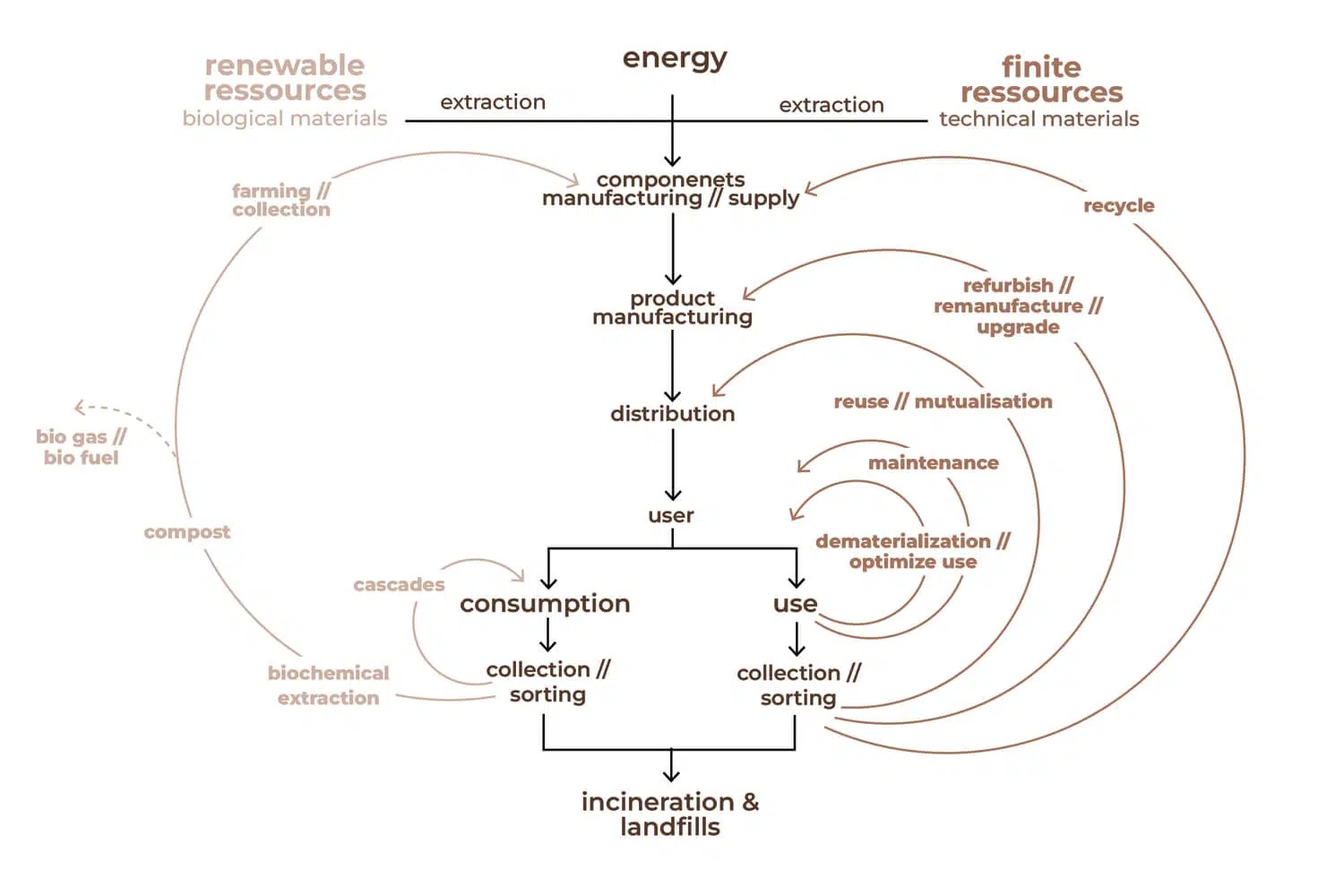
At a high level, the article outlines a set of design-led strategies aimed at preserving product value for as long as possible, rather than treating sustainability as an end-of-life issue. (Click to expand the graphic)

Designing for Sustainability practices graphicThe emphasis is on decisions made early in the design phase that allow products to stay in use, be adapted, or be recovered instead of being discarded and ending up being burned or in landfills (brown lines). It highlights:

  • Design for disassembly, so products can be taken apart efficiently for repair, adaptation, or material separation
  • Modular product architectures, allowing upgrades or partial replacement rather than full product scrapping
  • Repairability and user participation, with clear pathways for maintenance that extend product life
  • Multifunctional and multigenerational use, reducing the need for additional products over time
  • Cascading material use, where resources flow through successive applications rather than becoming immediate waste

Taken together, these ideas highlight sustainability as a question of value retention and adaptability, not just material choice or recycling rates. They make a compelling case for why sustainability must be designed in from the start (and these ideas closely align with cradle-to-cradle thinking, by the way).

Where the discussion becomes more difficult, and more interesting, is when these principles move beyond design intent and into real-world manufacturing. I’ll now share some thoughts on this…


Circular design starts with intent, but survives on execution

Concepts like design for disassembly or modularity are not new. Many product teams already discuss them early in development. The challenge is that intent alone rarely survives first contact with manufacturing.

A product designed to be disassembled only delivers sustainability benefits if:

  • Fasteners remain accessible after cosmetic parts are added
  • Components survive repeated disassembly and reassembly
  • Factories follow the intended assembly sequence rather than shortcuts
  • Cost-down exercises do not quietly replace screws with glue

In practice, we often see products that could be repairable in theory but are not repairable in reality because these downstream decisions were never controlled. That makes sense; it’s often cheaper and easier not to follow through.

This may be a design failure; it may also be a process failure.


Modularity and repairability can increase complexity and risk

Modular design and user-repairable products sound attractive, and they can be powerful. But they also introduce real engineering and quality challenges, which can be off-putting for manufacturers.

Every module interface is a potential failure point. Every repeated assembly cycle stresses plastics, threads, seals, and connectors. Products designed to be opened must be validated differently from sealed products, not just once, but repeatedly.

When repairability is introduced without updated validation strategies, tighter tolerances, and clearer assembly standards, the result is often higher field failure rates rather than improved sustainability.

This is a common disconnect we see: sustainability features are added, but the engineering and quality systems remain unchanged, resulting in a high return rate.


Sustainability is locked in early, but enforced later

One point the Punctuate Design article makes, and that we see very clearly in practice, is that sustainability outcomes are largely locked in during early design decisions.

Material selection, product architecture, part count, and fastening methods determine what is possible later. Once steel tooling is cut and suppliers are selected, your options quickly become limited.

However, early intent only becomes real outcomes if it is enforced later through:

  • Supplier capability assessment and alignment
  • Tooling and assembly process reviews
  • Test criteria that go beyond basic function
  • Documentation that explains why certain design choices must not be changed

Without this enforcement, designing for sustainability’s intentions can be quietly swept under the rug during production ramp-up.

If you’re interested in how these ideas play out on the buyer and supplier side, Sofeast has a useful overview of how procurement decisions shape real sustainability outcomes in their article on responsible and sustainable purchasing practices.


Factories tend to do just what they are measured on

Factories do not necessarily ignore sustainability, but they optimize for what they are measured on.

If lead time, yield, and unit cost are the only metrics that matter, sustainability features that might slow assembly, require additional care, or increase inspection time will likely be treated as problems to be removed at the DFM stage — unless specified as critical.

This is why sustainable product design cannot be separated from supplier alignment and quality & reliability management. Factories must understand not just how to build a product, but what must not be changed, and why.

When that understanding is missing, even well-designed products drift away from their original sustainability goals.


Sustainability is not the same as compliance

There is also an important distinction between sustainability and compliance.

Passing environmental regulations or material standards does not guarantee that a product is durable, repairable, or long-lived. A compliant product that fails prematurely still generates waste, often more waste than a non-certified product that lasts twice as long.

From a real-world perspective, product reliability is one of the strongest sustainability levers available, yet it is often discussed separately from sustainability initiatives.

For readers wanting more context on how regulators are now pushing sustainability into product requirements, Sofeast has a clear primer on the EU’s Ecodesign for Sustainable Products Regulation.


Final thought

The value of the Punctuate Design article is that it reminds us that sustainability is primarily in the realm of product design.

But in manufacturing, design intent is only the starting point.

Sustainable products emerge when design, engineering, suppliers, and quality systems are aligned, and when sustainability is treated as a performance requirement, not a slogan.

Good design makes sustainability possible.
Good execution is what makes it real.

China & India IN. The USA OUT? Tariffs, Alliances & Supply Chains [Podcast]

Global manufacturing is entering a more volatile era. Tariffs are changing with little warning, political alliances are becoming less predictable, and supply chains that once felt stable now carry real strategic risk. In this episode of China Manufacturing Decoded, Adrian and Renaud discuss what these shifts mean in practice for companies that actually make physical products. Using the latest U.S.–India tariff deal as a case study, they explain why China still matters, why India is becoming increasingly important, and how smart manufacturers should think about “China + 1,” not as a political statement, but as a practical way to reduce risk, control costs, and keep products flowing to market.

Listen here

Listen to the episode or watch on YouTube

Episode Sections:

  • 01:07 – The big question: are U.S. allies turning toward China, or simply hedging?
  • 07:29 – Evidence that many countries are deepening economic ties with China — and why China’s export machine keeps getting stronger.
  • 15:21 – Economics vs. defense: why Europe can engage China commercially while still relying heavily on the U.S. and NATO for security.
  • 19:07 – Why India is the most interesting case after its border clash with China and its earlier “de-risking” push.
  • 24:27 – How the U.S.–India negotiation unfolded and what led to the flat 18% tariff deal.
  • 26:10 – What the deal means for electronics and why India becomes a serious “China + 1” assembly option.
  • 30:08 – India’s new trade win with the EU — zero tariffs for many goods, and why opening will stay gradual.
  • 32:04 – Signs of an India–China thaw: faster customs, pressure to buy Chinese machinery, and the looming EV debate.
  • 34:42 – Practical takeaway for manufacturers: keep China for depth, add India for resilience (and Sofeast’s India capability)

Further reading

Image credit

“Prime Minister Keir Starmer visits China” by Simon Dawson / No 10 Downing Street on Flickr (https://flickr.com/photos/49707497@N06/55065624892), licensed under CC BY 4.0 (https://creativecommons.org/licenses/by/4.0/)