Disputes With Chinese Suppliers: Q&A (Volume 3)

[vc_row][vc_column][vc_single_image image=”9865″ img_size=”full” onclick=”custom_link” link=”https://www.sofeast.com/knowledgebase/disputes-with-chinese-suppliers-qa-volume-3/”][vc_column_text]In this volume, we discuss an unfortunate situation – what happens when your Chinese supplier disappears with tooling or inventory belonging to you! 😱

Continue reading “Disputes With Chinese Suppliers: Q&A (Volume 3)”

3 Key Process Improvement Tools You Need To Start Using: Flow Chart, FMEA, Control Plan

3 Process Improvement Tools Flow Chart, FMEA, Control PlanDo you wonder why you still suffer from quality issues, even though the process is quite mature and seems to be well understood?

Or are you preparing to launch the production of a new product… or production of an existing product in a new factory? And you want to plan ahead to avoid missteps that might be quite costly?

There are 3 key process improvement tools that you can use:

  1. The Process flow chart
  2. The Process FMEA (Failure Mode & Effects Analysis)
  3. The control plan (both for product and for the process)

And there is a logical order that you can follow. Let’s go through these documents one by one…


1. The Process Flow Chart

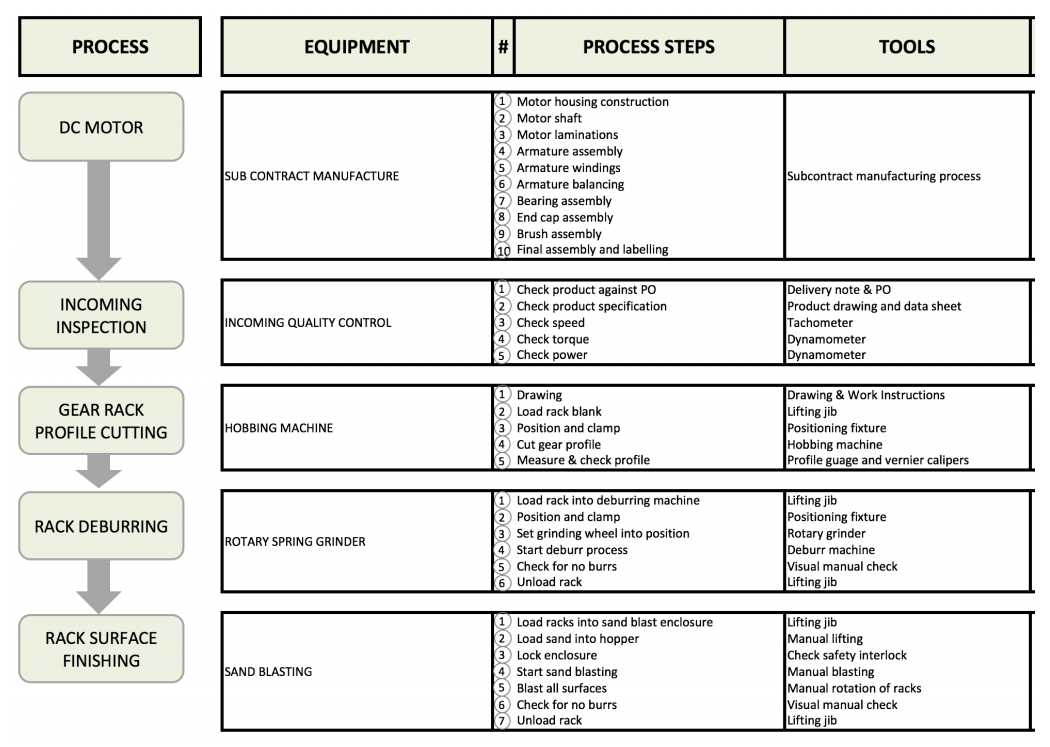
This is simply the mapping of the process steps. There are many templates you can follow, and here is an example of a process flowchart:

process flowchart example

Take a step back and look at this process. What steps can be combined (less picking & stacking, fewer mistakes, higher productivity)? Are there ways to eliminate one step (e.g. by clipping rather than positioning and then screwing)?


2. The Process FMEA

With the process map in hand, walk on the factory floor and observe each step. for each process, make a list of things that might go wrong (the “failure modes”). Bring in people from different teams and backgrounds if possible.

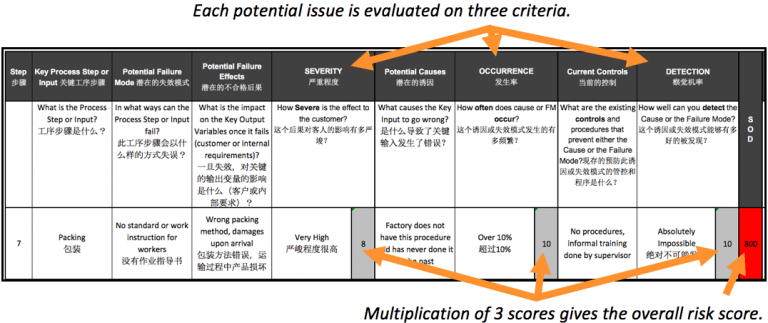
The FMEA is a great way to assess the risks and to rank them. The 3 components of risk in this form are:

  • The severity of the impact (on the customer, on the downstream process…) if it happens
  • Occurrence — how often it is expected to happen
  • Detection — how likely is it to be caught before it has an impact?


FMEA Risk Assessment

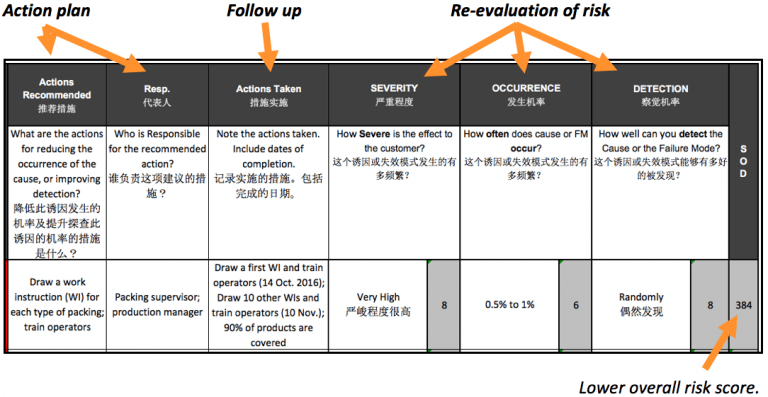
And then, for each failure mode, it drives an action plan. It is a living document and should be updated often.

FMEA Countermeasures Followup

👉 Read more about the Process FMEA, when to use it, and get a FREE template

A word of caution. It is not an easy exercise. Don’t expect a production supervisor or a quality auditor to do it nicely without prior training and experience.

In theory, it is a tool to think of issues that might come up in the future. But an easier way to start is to include the issues that came up in the past… if that process has been in place for some time.


3. The control plan

Based on the above documents, you have:

  1. A map of the process steps
  2. A ranking of the highest risks to watch out for

This the basis for a good process control plan — the central document that the factory should use to drive the process’ capability up (in other words, improve process controls so as to get better product quality).

A good control plan includes:

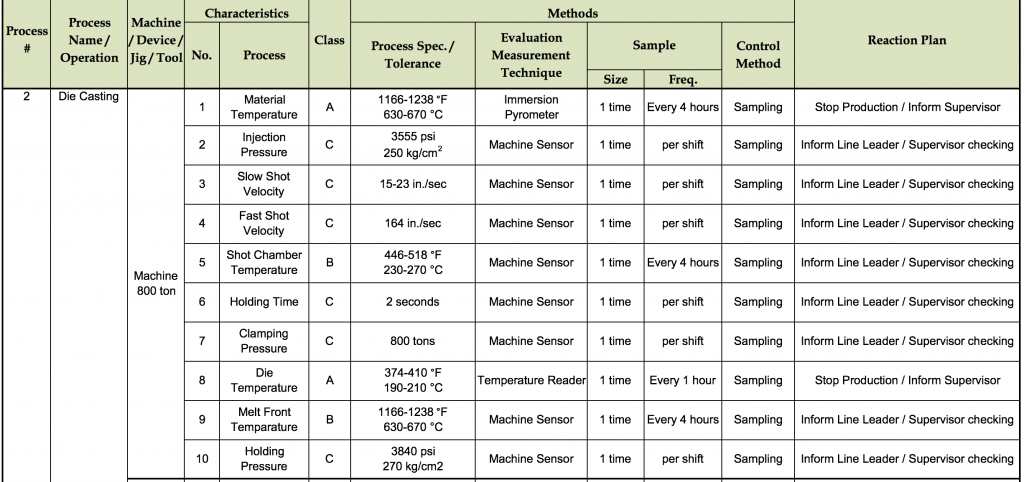
  • Process controls — in this example, what to check regularly on a die casting machine to ensure it works properly. (Note that the mold and the materials also need to be checked regularly — it’s not only about the machine.)Process Control Plan example 1


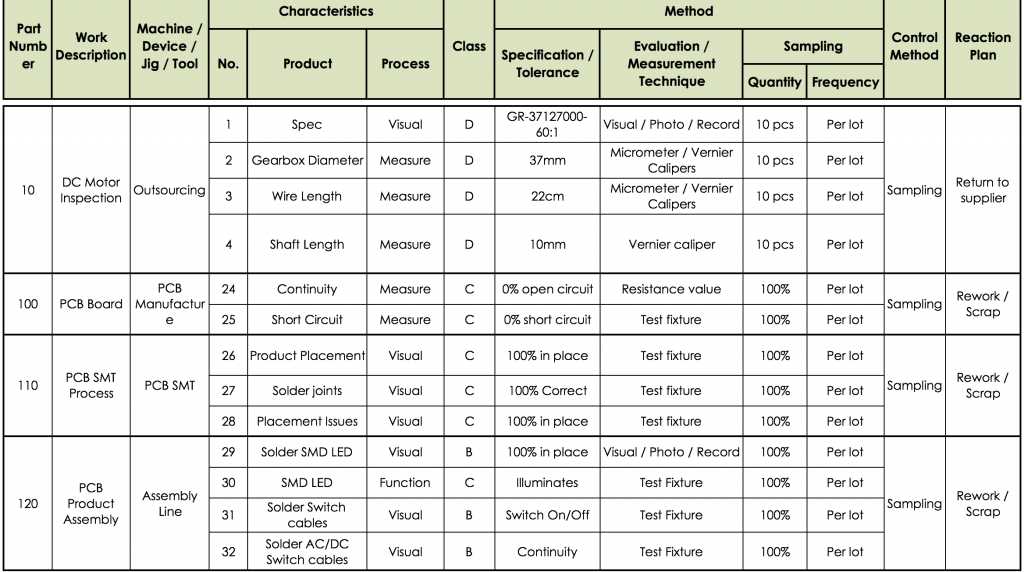
  • Product controls — in this case, an inspection of incoming components and inspection of some characteristics of semi-finished products. (It should also include inspection of completed products, obviously.)Product Control Plan example 2

Based on the control plan, proper work instructions can be given to the main interested parties:

  • Production operators (who need to achieve that plan and do some of the checks when appropriate)
  • Quality inspectors & engineers (who need to do some of the checks)
  • Maintenance technicians (who need to know what the settings should be on the equipment)
  • Purchasers (who need to buy the right components & materials)
  • Customers (who need to know what specifications the manufacturer commits to, and who may want to audit the process controls)

*****

I made this whole approach look very linear, but often those process improvement tools are developed at the same time. Each document feeds the other two.

Our consultants have developed these documents in a number of projects, with good results. They are quite powerful.

What do you think? Do you, or your suppliers, use these process improvement tools?

Editor’s note: This post has been republished here from QualityInspection.org with some adjustments for Sofeast readers


Ultimate Guide To Sourcing From China And Developing Your Suppliers [eBook]

This FREE eBook starts from the beginning, discussing whether you need to hire a sourcing agent, and follows the sourcing process right through to developing a trusted supplier’s quality and productivity.

There are 15 chapters over 80+ pages to explore, providing exhaustive guidance on the entire sourcing and supplier development process from start to finish, including:

  • Identifying suppliers,
  • Negotiations,
  • Quality inspections,
  • Developing Chinese suppliers,
  • Improving factory quality and productivity,
  • and much more…

Just hit the button below to request and download your free copy:

Ultimate Guide To Sourcing From China And Developing Your Suppliers [eBook]

Off-Site QC VS In-Factory QC

Off-Site QC VS In-Factory QCIs there ever a situation where you’d want your product inspection to be performed away from your Chinese supplier’s factory? Yes! We’ll explain your options in Off-Site QC VS In-Factory QC.

Continue reading “Off-Site QC VS In-Factory QC”

Why we say “solutions” not “services” here at Sofeast

Explaining why sofeast offers solutions not services

Clients come to us with needs. Some of them know exactly what they need (such and such service) and how to get the most of our work. But most of them don’t, and instead they communicate their challenges.

As we recognized that fact, we have strived to offer full solutions to our clients needs, rather than an a-la-carte assortment of services. They might still look like a collection of individual services on our website, but we try to focus on our clients’ needs as much as our internal capabilities.

We collected a few examples to drive this point home.


Product quality inspections as solutions

In our view, there are 2 ways to conduct a product inspection.

  1. Check the product quality, provide the report, and move on to the next job (99% of QC inspection providers do this).
  2. Do all of the above, but follow up when issues are found. This can be suggestions to improve quality based on the facts found in the inspection and/or an engineer’s analysis on where the root cause of any quality issues lies (1% of QC inspection providers do this).

As an importer, you’ve got a big problem if defects are found, certainly if they’re severe. So isn’t a QC inspection service provider leaving you high-and-dry if they simply provide a report showing what the problems are without helping you devise a roadmap to solve them?

Here’s what we do to add value in this case…

At Sofeast, we aim to be in the 1% and will typically add value by doing the following to help you solve the QC issues we find by offering the experience that we have on our staff:

  • Armed with the inspection report, we can put you in touch with a project manager to discuss your quality situation and provide you with an experienced eye’s feedback. They’ll be looking to alert you to the real issues and to put your mind at ease about smaller points that probably aren’t serious enough to worry about. Ultimately, they’re there to help you get the most out of the report and suggest what the most effective action might be based on their experience in similar cases they’ve dealt with in the past.
  • After the inspection, we send an experienced engineer to your supplier’s facility to examine the causes of the quality issues.
    We regularly conduct 8D sessions to pinpoint issues and clarify them for clients, and, in terms of value, approximately one or two man-days of an engineer’s time provides a large ROI if recurring quality issues are fixed by the supplier now and in the future.


Second-party factory audits as solutions

Factory auditors can often be accused of simply verifying that a standard is being complied with by providing a list of points that do not comply.

While understanding the status of the systems being audited is helpful for the client, wouldn’t it be great if the auditor could somehow help to improve them, too?

For second-party factory audits (for the client, using their own checklist), the auditor can add value without causing conflicts of interest. Here’s an example:

  • Instead of focussing on all problems (non-conformities or NCs) that they find, how about pinpointing just a few of the most common ones and then providing some feedback about how to stop the causes of each issue?

(Note: We don’t do this systematically at Sofeast, but we are more than happy to do it when a client specifically requests it.)

Some of the businesses being audited have no experience in improving the systems where they have problems, so a well-timed suggestion from an auditor can give them a tangible way to drive improvement.

This doesn’t mean that an auditor’s role changes to becoming some kind of consultant, however, they add a lot of extra value to your factory audit if they’re able to provide a suggestion to your supplier, such as: “I have seen other companies avoid or reduce this issue by doing XYZ,” which they can then explore and work on.

Learn a lot more about 2nd party factory quality audits in this episode of the podcast


Project management for new product development as a solution

A new product development project is fraught with dangers.

  • Are you experienced in planning the new product project from start to finish?
  • Is the design actually realistic technically and financially?
  • Is your supply chain manageable and sustainable?
  • Is your supplier truly capable of manufacturing the product to the correct specifications?
  • Do YOU have the knowledge you need to understand and manage every phase of the project, from R&D to tooling and pre-production, through to mass production and fulfillment?
  • Can you manage the project from your country when production is in, say, China?

Of course, most importers who are launching a new product have gaps in their knowledge and experience. For instance, you may not be an industrial design expert; and that’s fine.

In this position, bringing in a local project manager who can fill in some of the gaps in your knowledge and provide ‘boots on the ground,’ makes absolute sense and is worth paying for.

But it’s amazing how many service providers sell the service of a project manager without explaining how valuable this really is (if they’re good). If clients don’t understand the capabilities of their project manager, they won’t see the value in paying for them, potentially muddling along and getting into trouble down the line.

Here’s what we do to add value in this case…

Our in-house R&D team have decades of experience working on products of all kinds (predominantly mechanical and electronic, but not limited to them), so we will be keeping DFM (Design For Manufacturing) in mind throughout your product development process in order to assure that you end up with a very ‘manufacturable’ product which you can get to market quickly.

That’s why we show why a good local project manager can help you enormously and add a lot of value:

  • They will explain issues and suggest workarounds that your supplier can’t or won’t be able to.
  • They are backed by colleagues who specialize in material & process engineering, procurement, logistics, and more, meaning that you have a broad range of experience to help handle every phase of your new product development and launch project.
  • They work to a proven framework which makes planning the project a lot more efficient than making it up as you go along.
  • They have access to Sofeast’s mature network of service providers that we’ve built up over more than a decade, such as trusted testing labs, component suppliers, designers, and more.
  • Your PM is supported by foreign top management who help devise the best possible plan from the start and can step in to aid them where specific expertise is required.

If your PM isn’t providing the above, then maybe you’ll be paying a low fee, but are they really contributing the support that you need, or are they just sending some messages now and again?

*****

Does this make sense? Does your provider simply offer services, or do they go further and provide a solution which offers lasting value? Let us know about your experiences, please.


Ultimate Guide To Sourcing From China And Developing Your Suppliers [eBook]

This FREE eBook starts from the beginning, discussing whether you need to hire a sourcing agent, and follows the sourcing process right through to developing a trusted supplier’s quality and productivity.

There are 15 chapters over 80+ pages to explore, providing exhaustive guidance on the entire sourcing and supplier development process from start to finish, including:

  • Identifying suppliers,
  • Negotiations,
  • Quality inspections,
  • Developing Chinese suppliers,
  • Improving factory quality and productivity,
  • and much more…

Just hit the button below to request your free copy:

Ultimate Guide To Sourcing From China And Developing Your Suppliers [eBook]

Is Your Chinese Supplier At Risk Of Bankruptcy?

Is Your Chinese Supplier At Risk Of BankruptcySome Chinese factories have suffered serious blows recently.

Large American companies are moving manufacturing outside of China, often abruptly. Many manufacturers were hit in 2020 by very soft demand and cancelled orders. Their government is becoming more serious in getting taxes paid and regulations complied with. And so forth.

The logical conclusion? Many factory owners who have accumulated debt and don’t see the light at the end of the tunnel are tempted to go out of business.

If you rely on a few key suppliers, will you be impacted if one of them goes bankrupt? It is not just a matter of getting a deposit back. It might threaten the continuity of supply to your customers!

Are there ways for you to monitor the situation and assess whether there is high risk so that you start relying on a backup instead and building up more inventory?

The good news is, yes, there are often signs you can probably pick up.

Here are my tips for assessing your Chinese supplier’s financial health:


Making use of public records

Certain elements of risk may be available as public records. They can point to a degrading financial situation if they appeared recently. Here is a non-exhaustive list:

  • Dishonored checks
  • Civil litigation
  • Performance defaults
  • Bankruptcy
  • Charges & mortgages
  • Liens
  • Adverse local media coverage

Other information of public record can also give an idea of the situation. If the supplier has added a shareholder recently, that may be part of a refinancing effort?


Sending someone on site

You are probably unable to visit your key suppliers these days. Maybe you should still have someone (typically, an auditor, or a project manager) pay them a visit.

Counting the number of operators who are busy, and comparing that to the number last year at the same period, would bring good insights.

Are they shrinking? Maybe they have gathered all their operations on one floor when they used to occupy 4 floors? They certainly lost considerable business. If they weren’t paid on the last shipments to those lost customers, it might be a matter of weeks before they are officially bankrupt.

Is the owner in a good mood, and is happy to take you to a nice dinner? Or does it seem to be hiding and avoid public places (which might indicate he contracted ‘shark loans’ and has trouble repaying them)?

You might also pick up some good signs. Do they still spend time on tasks and projects that bring dividends in the mid- to long-term? For instance, preventive maintenance, office renovations, keeping up quality systems, sending staff to training, etc. It can be hard to assess these points from a distance.

Better yet, have they invested in new equipment, or are they planning to?


Any other signs that they might be in a rough financial situation?

Have they asked for advance payments from your side? That usually means they are in a very tight cash situation.

Have they started to be much more rigid? For example, refusing to rework some issues? That’s a sign of a company that is scraping by, day by day.

If you present them with a contract to sign, do they just refuse to even read it, or do they sign it without any comments? That’s also not the sign of a company projecting itself 10 years from now.

Are they putting an order on hold? Maybe that’s because they don’t have the cash to give a deposit to a key supplier?

Have they had repeated issues due to their own suppliers? It might be due to the fact that they owe a lot of money to those suppliers, who are not happy and not making efforts.

Is there any equipment they had to dispose of? (Maybe in order to get a fresh infusion of cash?)

Visiting them, counting the number of operators who are busy, and comparing that to the number last year at the same period, would bring good insights.


How do Sofeast help you to assess whether a supplier is at risk of going bankrupt?

There are several ways in which we can help assess suppliers on the ground here in China for you.

Perform a credit check on them

A credit check might detect some elements of risk.
In it we’ll be checking points like:

  • Official business details and registered capital
  • Adverse data (dishonoured checks, debt, defaults, civil litigation, etc)
  • Credit history
  • Public records (Bankruptcies, etc)

We send you an easy-to-read English report that includes a risk evaluation.

The credit check price is 199 USD for 1 company – contact us to request this.

Check their legal records

Maybe they lost in a court of justice because they didn’t pay certain things? Maybe they have added a shareholder recently, as part of a refinancing effort? We could check those things in a Legal Records Check (99 USD for 1 company).

Audit the factory

Especially this year (2020), clients are unable to visit China due to the closed borders thanks to the coronavirus pandemic. So, in order to observe the supplier and examine for some of the telltale signs as mentioned in the section before this above, you can consider sending in an auditor.

Aside from examining your supplier’s production capability and reliability (always good to keep tabs on this eve with existing suppliers), your auditor will also be able to check the state of the manufacturer, see if there are any red flags, and ask probing questions that can shed light on how the business is doing (we discussed these kinds of on-site supplier evaluations in this podcast episode).

Factory audits start from 279 USD per man-day in major areas of China. 


*****

If you have never had the experience of a factory closing its doors forever, I can assure you it’s not fun. Several of our clients have been in that case. I hope the little checklist I put together in this article will be useful. Do you have any experiences or points to add? Let me know in the comments, please.


P.S.

If uncovering and dealing with supply chain risk (such as losing a key supplier) is important for your business (it should be!), take a look at my series of blog posts on Supply Chain Risk Management over on QualityInspection.org.

Editor’s note: This blog post first appeared on QualtyInspection.org here and is edited and republished for Sofeast readers.


Interested in designing or developing a new product to be manufactured in China? You will also like Sofeast’s Importer’s Guide to New Product Manufacturing in China!

This guide has been written specifically for entrepreneurs, hardware startups, and SMEs and gives you advance warning about the 3 most common pitfalls that can catch you out, and the best practices that the ‘large companies’ follow that YOU can adopt for a successful project.

It includes:

  • The 3 deadly mistakes that will hurt your ability to manufacture a new product in China effectively
  • Assessing if you’re China-ready
  • How to define an informed strategy and a realistic plan
  • How to structure your supply chain on a solid foundation
  • How to set the right expectations from the start
  • How to get the design and engineering right

Just hit the image below to get your copy
An Importers Guide to New Product Manufacturing in China Guide

Why Amazon FBA Prep Should Be Done In China (Not The West)

Why Amazon FBA Prep Should Be Done in China (not the USA)Michael Michelini wrote about Amazon packaging, and he mentioned the FBA prep services. I discovered a whole industry popped up and is probably growing fast.

What do they do? In Mike’s words:

Basically, a third-party prep service does everything on your behalf, including:

  1. Inspect your items to ensure there is no damage, especially if you’re selling “new” products.

  2. Carefully remove any stickers from the products, if there are any.

  3. Prepare the inventory according to Amazon’s requirements.

  4. Pack and provide box content information.

  5. Get the package ready for dispatch.

  6. Inform you through email when the package was shipped.

  7. Track your packages as they are in transit to the designated Amazon fulfilment center. 

And, I was thinking, most (probably 80%+) of the goods that go through these prep centers are made in China! 

Some might not have been packed the right way (e.g. multipacks, bubble wrap, etc.) by the manufacturer and mistakes might have been detected too late. Yes, I am sure that happens. 

But I’d guess some FBA sellers plan to import the goods from China and then use one of these prep service centers in, say, the USA to prepare their products, packaging, and orders for shipping. Wow…what a waste!

All of this can be done in China, before shipment, for a lower cost.


Why using an FBA prep service in the West is a waste of money!

If you’re using a local FBA prep provider, quite simply, they’re doing something that can be done in China at a lower cost. Here are 2 China-based alternatives that will save money:

1. Your supplier can be requested to prepare the proper packing and labeling before they even ship the products to you

Your supplier likely has the ability to handle the packaging and labelling for your products in-house. The costs of them using their local Chinese staff to do so are also going to be far lower than for a similar Western staff member to do the same! In addition, they should be able to keep the proportion of defective products down to a level acceptable on Amazon (and consistent with the product category and positioning).

I wrote about this before in How Amazon FBA Sellers Should Control Quality in China and in Quality Control of Products Shipped Directly to Amazon.

Second, if this is not realistic, you need to take another route.

2. Use a small Western-owned contract manufacturer located in China to act as your FBA prep service

A number of contract manufacturers in China have the ability to provide packaging, labeling, fulfillment, assembly, rework and even quality inspections. Better still, despite being in China, a number of them are Western-owned and managed, therefore using one  comes with four very important benefits over local providers in your country:

  1. Cost of labor is lower.
  2. The cost of developing and making labeling and packing elements is lower.
  3. In case some defective products are found, they can be sent back to the factory for re-work. Or simply you can negotiate a rebate on the order (reworked products often come with lower quality, anyway, so why take them?).
  4. As the factory gets the rejects, they learn about what is acceptable and what is not.

Now, one issue with this setup is, the Chinese supplier probably won’t agree to deliver the goods to another location without having been paid in full. They might agree to extend a rebate for the defective goods they receive, but that only works when it is only 2% of the order quantity… If it is 50%, they are not likely to honor their word.

However, this happens when their customer is an overseas company. They are more prone to extend credit when their direct customer is another China-based manufacturer (who won’t disappear overnight). In many cases, we have been able to negotiate with suppliers and pay them 15 or even 30 days after the products are delivered in our facility.

In that situation, if it turns out that 30% of the goods have a serious issue, they can simply all be returned to the supplier, and payment can be done for the good pieces only. This a much better setup than finding out about quality issues in Los Angeles or New York City!


Can Sofeast help FBA vendors?

Yes, we have a lot of experience of working with FBA vendors with Chinese suppliers.

You may find these solutions helpful:

  • Amazon FBA Seller Support – one of our experienced production managers assists you by helping to manage your supply chain, quality, and logistics using proven systems and templates to assure that your FBA business runs like clockwork.
  • Repair and rework – Sofeast’s 3PL facility receives your defective products. Your supplier may send staff to us to do the repair, or our operators can do so. We oversee the operation to make sure repair and rework occur correctly. We check, pack, and ship good products to you.
  • Agilian Technology – our Western-owned contract manufacturing subsidiary provides warehousing, 100% inspection and repacking, kitting, and assembly. (Better for smaller orders being sent from China to you and/or dropshipping to multiple customers).

*****

Have I got it wrong? Does a Western FBA prep service do a stellar job for you that you find invaluable? Perhaps your Chinese supplier is supporting you already? Let me know about your experiences in the comments.

Editor’s note: This post is based on an earlier post from QualityInspeion.org, but has been modified for Sofeast readers.


How To Find A Manufacturer In China: 10 Verification Steps.”

In this free eBook, we share the 10 verification steps we developed to help you find the right manufacturer.

It covers:

  • Background checks
  • Manufacturing capabilities
  • Quality system auditing
  • Engineering resources
  • Pricing, negotiation, & contracts
  • …and much, much more

Just hit the button below to get your copy now:

How To Find A Manufacturer In China: 10 Verification Steps