Prototype ≠ Production: The Million-Dollar DFM Mistake [Podcast]

One of the most common and costly mistakes in hardware development is assuming that a successful prototype means a product is ready for mass production.

It is an understandable assumption. The prototype works. The parts fit. The product functions as intended. From the outside, everything looks “good enough” to move forward.

But in real manufacturing environments, this assumption is often where problems begin.

In this episode of China Manufacturing Decoded, Adrian and Paul Adams discuss a real-world case where a product worked perfectly at prototype stage, yet multiple Design for Manufacturing (DFM) red flags were ignored. The outcome was not surprising, but it was expensive: predictable production issues, tooling problems, inconsistent quality, delays, rework, and significant financial impact.

Read and listen as they break down why prototype success and production readiness are not the same thing, and how DFM exists specifically to protect companies from these risks.

Listen here

Listen to the episode or watch on YouTube

Episode Sections:

  • 00:00: Prototype success vs production reality
    Why a working prototype does not mean you are ready for mass production.
  • 01:58: Real case: DFM red flags ignored
    A real example where prototype success led teams to dismiss critical DFM feedback.
  • 03:19: What prototypes are actually meant to validate
    Prototypes validate design intent, not production tolerances, tooling behavior, or repeatability.
  • 05:00: Materials & process differences
    Why the same material behaves very differently in prototype vs mass production.
  • 06:08: Tooling realities & hidden risks
    Demolding, deformation, and surface damage issues that prototypes never reveal.
  • 07:32: Production inconsistency & cost impact
    How ignored DFM issues drive rework, scrap, labor costs, and quality failures.
  • 09:53: The cost multiplier of late changes
    Why fixing issues after tooling can cost 10–100× more than early design changes.
  • 10:34: Why rushing early slows you down
    How shortcuts lead to delays, missed launches, and brand damage.
  • 13:36: Best practices: using DFM properly
    Treating DFM as a risk-reduction tool and involving manufacturing early.
  • 18:06: Final takeaway
    DFM exists to catch problems while they are still cheap and fixable…ignore it at your peril.

Further reading

Plastic, Silicone, Steel, and Others: Updated China Raw Materials Costs (late Jan ’26)

Sofeast’s team continues to monitor the cost evolution of key raw materials in China, helping importers and manufacturers stay informed. This latest update from the market analysts we work with reflects changes (RMB costs and %) over the past year through Jan 26, 2026. (Click the charts to expand them)

china raw material cost evolution jan 26

china raw material cost change jan 25 to 26 in rmb

Monthly China Raw Material Cost Changes – January 2026

Epoxy Resin (E-51) +3.48% monthly change

This week, the epoxy resin market showed a clear upward trend, with prices strengthening gradually.

  • Drivers
    Cost support increased across the chain, while downstream buyers stepped in for replenishment. This combination lifted market confidence and pushed transaction prices higher.
  • Outlook (next week)
    Domestic epoxy resin prices are expected to edge up slightly, supported by costs and restocking demand, though gains are likely to remain moderate.

ABS (AG-15E1) +6.45% monthly change

This week, ABS prices showed noticeable differentiation across the market. Early trading was weak, but transaction activity improved toward the end of the period.

  • Drivers
    Upstream costs fluctuated but trended higher overall. At the same time, differences in available spot resources led to mild price dispersion across regions and suppliers.
  • Outlook (next week)
    With cost support remaining elevated, ABS prices are expected to stay firm, although price differences between suppliers may persist.

Silicone (110) +3.47% monthly change

This week, domestic 110 silicone rubber prices remained broadly stable.

  • Drivers
    Both buyers and sellers focused on fulfilling existing orders and managing inventories. Producers mainly delivered pre-sold volumes, keeping overall inventory levels under control. Cost support from upstream raw materials remains strong.
  • Outlook (next week)
    DMC prices are expected to stay stable and gradually strengthen, providing solid cost support. Silicone rubber prices are likely to remain firm with limited volatility.

Zinc Alloy (Zamak 5) +5.63% monthly change

This week, electrolytic zinc prices fell from earlier highs before rebounding, resulting in a higher average level overall.

  • Drivers
    Tariff developments in Europe and the United States increased macro uncertainty and triggered risk-averse sentiment, limiting aggressive buying despite supply-side support.
  • Outlook (next week)
    With macro conditions still evolving, market sentiment remains cautious. Zinc alloy prices are likely to fluctuate within a narrow range.

Aluminum Alloy (ADC 12, Jiangsu) +6.66% monthly change

This week, aluminum prices declined first, and then recovered slightly within a narrow band.

  • Drivers
    Market sentiment became more volatile as bulls and bears competed. After prices pulled back, limited buying support led to a modest rebound.
  • Outlook (next week)
    Both upward and downward forces remain present. Aluminum prices are expected to stay range-bound with ongoing short-term fluctuations.

Paper for Color Box (157g double-coated) -1.01% monthly change

This week, the coated paper market continued its downward trend.

  • Drivers
    Some production lines were shut temporarily, and cost expectations turned bearish. As publishing orders near completion and supply increases with resumed production, inventory pressure has grown. Distributors are also showing a stronger willingness to sell at lower prices to recover cash.
  • Outlook (next week)
    With ample supply and no clear demand recovery, the market center may continue to shift downward in the near term.

Stainless Steel (304/2B 0.4 mm, Taiyuan) +8.62% monthly change

This week, stainless steel prices rose sharply, driven primarily by futures market momentum.

  • Drivers
    A strong futures market created a bullish atmosphere, lifting spot prices and improving sentiment among traders and mills.
  • Outlook (next week)
    After reaching elevated levels, caution is expected to increase. Prices may consolidate at higher levels, with relatively strong but more measured trading.

Battery Material (Lithium Cobalt Oxides) +4.98% monthly change

This week, precursor prices increased, lithium salts moved higher, and ternary material prices largely followed the upward trend.

  • Drivers
    Downstream demand in January has not fully recovered, and some automotive manufacturers are entering holiday periods in February. Cobalt salt exports from Congo remain limited, while domestic cobalt recovery continues to improve.
  • Outlook (next month’s orders)
    Attention will shift toward export volumes and post-holiday demand recovery. The processing environment remains stable, suggesting a firm but selective pricing outlook for battery materials.

How to combat rising costs?

Explore cost-reducing tips in this post: Rising Raw Material Prices: What Strategy To Follow? (6 Approaches).

What to do if your Chinese supplier suddenly tells you that material costs have risen: How To Cooperate With Your Chinese Supplier, Part 16: Bad News from China, Raw Material Prices Just Increased!

If your supplier just isn’t working out, maybe sourcing a new supplier will help you find one who can offer you better prices and more. If so, there’s no need to fear switching from your current supplier to a new one if you’re prepared: How To Switch To A Newer, Better Chinese Manufacturer? [eBook].


We hope this is helpful. Our mission at Sofeast is to provide importers with transparency in their supply chain and to give them greater control. And this information is crucial for gaining visibility into your manufacturer’s costing.

By the way, you can always contact us if you have any questions about whether a manufacturer’s quote is reasonable or not.

CES 2026 Trends: Robots, AI Hardware & Where Manufacturing Strategy Is Headed [Podcast]

In this episode of China Manufacturing Decoded, Adrian is joined by Kate Oliynykova, Sofeast’s Supply Chain Management lead, who recently attended CES in Las Vegas, to unpack the major developments from CES 2026, one of the largest global tech shows of the year. From the explosive rise of humanoid robots and physical AI devices to the noticeable expansion of Chinese hardware suppliers and what it all means for product teams, founders, and importers planning manufacturing in 2026, this episode cuts through the hype with grounded insights.

Listen here

Listen to the episode or watch on YouTube

Episode Sections:

  • 01:00 – CES 2026 overview: scale, attendance & significance
    Kate gives headline numbers: attendance, international visitors, exhibitors, and why this was the biggest post-pandemic CES.
  • 02:19 – Why CES still matters: networking & deal-making
    CES is positioned as a major networking event for hardware companies, startups, and partners.
  • 02:57 – Surge of Chinese exhibitors at CES
    Kate explains the sharp increase in Chinese suppliers and how Eureka Park has changed.
  • 03:55 – Eureka Park explained & why it matters
    What Eureka Park is, why it’s important, and how it differs from the main convention halls.
  • 04:36 – Humanoid robots emerge as the biggest trend
    Robotics numbers, China’s dominance, and the rise of affordable humanoid robots.
  • 05:09 – Real-world humanoid robot capabilities
    Examples of shipping models, pricing, applications, and programmability.
  • 06:36 – From viral clips to serious industrial AI
    Discussion of public misconceptions vs what was actually demonstrated at CES.
  • 07:31 – Physical AI & China’s hardware advantag
    Why China excels at turning AI concepts into physical products quickly and cheaply.
  • 08:16 – Regulation risks & trade considerations
    Concerns about regulation, drones, and geopolitical limits when using Chinese AI hardware.
  • 09:01 – Western tech giants respond (chips, OS, industrial AI)
    NVIDIA, Siemens, Qualcomm, and others building humanoid and robotics ecosystems.
  • 10:06 – Edge AI & on-device intelligence
    Shift toward low-power, on-device AI for privacy, speed, and autonomy.
  • 11:08 – Other global players at CES
    France, Korea, Hong Kong, and their strengths across AI, mobility, health tech, and industry.
  • 13:04 – Fun tech, tracking & wearables everywhere
    Smart collars, VR Lego, transparent displays, health tracking, and elder-care tech.
  • 14:49 – AI in smart manufacturing & formulation
    AI-assisted production, cosmetics, materials mixing, and industrial applications.
  • 15:51 – Manufacturing strategy discussions at CES
    Conversations with exhibitors about shifting production out of China — and back again.
  • 16:28 – Why companies return to China for early runs
    Speed, ecosystem depth, prototyping, and complex AI electronics remain China’s edge.
  • 17:11 – Hybrid manufacturing strategies
    Starting in China, then diversifying later once scale and risk justify it.
  • 18:09 – Tariffs, uncertainty & predictability
    Why geopolitical volatility elsewhere makes China comparatively predictable for many US firms.
  • 19:38 – Final takeaways: manufacturing is mathematics
    No single recipe — strategy depends on product, scale, cost, and risk.
  • 20:03 – Wrap-up & Sofeast support
    Adrian summarizes, invites listeners to get in touch, and closes the episode.

Further reading

🎧 Listen, rate, & subscribe to the ‘China Manufacturing Decoded’ podcast on your favorite provider

More episodes are on the way, so remember to rate us and subscribe! You can find us on:

Circular Economy Options in Manufacturing: Best to Worst Strategies for Electronics, Consumer Goods, and Textiles

The circular economy in manufacturing is often treated as a single sustainability goal, but in practice, circular economy options vary widely by product category, materials, and early design and sourcing decisions. For example, what works for textiles may be technically unrealistic for electronics, and strategies that sound “green” can actually introduce cost, quality, and compliance risks.

For businesses manufacturing their products, the real challenge is not whether to pursue circularity, but which circular economy strategies are technically feasible, commercially viable, and aligned with product risk.

In this guide, we break down the circular economy hierarchy from best to worst, with practical examples for electronics, consumer goods, and textiles, and explain why early product design and DFM matter far more than end-of-life recycling claims.


The Circular Economy Hierarchy in Manufacturing (Explained)

Understanding the circular economy hierarchy is important for making realistic sustainability decisions. Higher-ranking strategies preserve more embedded energy, materials, and value, while lower-ranking options often recover little and can even increase risk.

Learn more about how the EU is demanding that products be designed with sustainability in mind: EU Ecodesign regulation
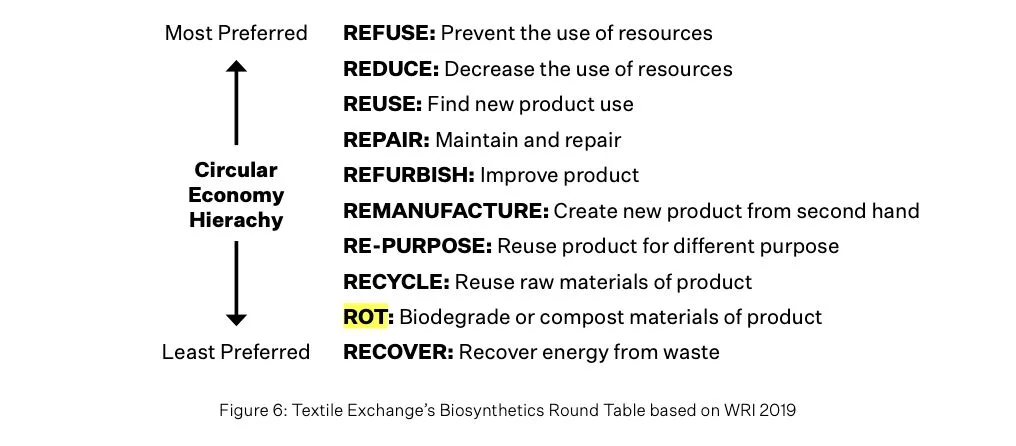
Circular Economy Options in Manufacturing Hierarchy

(Image source: Textile Exchange p38)

Summary of Circular Options and their Impacts

Circular Option Electronics Consumer Goods Textiles
Reduce High impact High impact High impact
Repair Medium–High Medium Medium
Recycle Low–Medium Medium Low
Biodegrade Not viable Limited Often misleading


1.Refuse and Reduce: The Most Effective Circular Economy Strategies

Reducing Resource Use Through Product Design

Refuse and reduce sit at the top of the circular economy hierarchy because they eliminate waste before manufacturing even begins.

Examples by category:

  • Electronics: minimizing component count, avoiding oversized batteries or using no batteries at all, and removing redundant features
  • Consumer goods: reducing material thickness, simplifying assemblies, eliminating decorative-only parts
  • Textiles: lowering fabric weight, avoiding unnecessary blends, minimizing trims and finishes

These strategies are locked in during early product design and DFM, interlinking sustainability and engineering decisions. Fewer materials usually mean lower cost, fewer opportunities for defects, and less manufacturing waste.


2. Reuse and Repair in Circular Manufacturing: Designing for Product Longevity

Extending Product Life Through Repairability and Durability

Reuse and repair focus on extending product lifespan by designing products in a way that enables maintenance, replacement, or refurbishment, and/or by making the product more durable in the first place.

Examples by category:

  • Electronics: modular design, replaceable batteries, mechanical fasteners instead of glue
  • Consumer goods: durable housings, replaceable wear parts, standardized components
  • Textiles: repairable seams (with low risk of damaging the fabric), reinforced stress points, spare buttons or panels

Designing for repair, disassembly, and/or durability increases upfront engineering effort but often reduces warranty claims and early field failures.


3. Refurbishment and Remanufacturing: Practical but Category-Dependent

Where Refurbishment Makes Commercial Sense

Refurbishment and remanufacturing are established circular manufacturing strategies, particularly for electronics and durable products.

Examples:

  • Electronics: refurbished devices such as smartphones, laptops, etc, and remanufactured industrial electronics
  • Consumer goods: tools, appliances, mechanical assemblies
  • Textiles: limited mostly to resale or reconditioning

Extending product life generally has a lower environmental impact than recycling, as it preserves embedded materials and energy. (Source: The Sustainability of Biosynthetics, 2022).

Also, refurbished is no longer niche: in a U.S. survey, about 1 in 4 respondents reported buying a refurbished smartphone, and in France, about 1 in 6 phones sold were refurbished, while surveys show intention to buy refurbished next is even higher. (Sources: IDC (US purchase rate) + GSMA (France share) + Vodafone (intention)).


4. Repurposing Products: Difficult to Scale in Manufacturing

Why Repurposing Is Rarely a Design-Led Strategy

Repurposing gives products a second life but is rarely scalable or controllable from a manufacturing perspective.

Examples:

  • Electronics: component reuse in secondary, low-reliability applications
  • Consumer goods: containers reused for storage or organization
  • Textiles: garments repurposed into wipes, insulation, or accessories

Because repurposing depends heavily on downstream users, it is difficult to design into a controlled manufacturing model.


5. Recycling in Manufacturing: Necessary, but Often Overestimated

The Limits of Recycling as a Circular Economy Solution

Recycling recovers materials but often requires high energy input and results in downcycling. Therefore, it sits lower in the circular economy hierarchy because of its limitations.

Examples:

  • Electronics: complex disassembly, low recovery rates for critical materials
  • Consumer goods: plastics downcycled into lower-grade applications (with aluminum as a notable exception)
  • Textiles: fiber blends that are difficult or impossible to separate; risk of using fabrics that include restricted chemicals (e.g. REACH). Textile Exchange stresses that recycling should be treated as a last-resort material recovery option, not a substitute for upstream circularity decisions (Textile Exchange, 2022)

Recycling should be treated as a fallback, not a primary circularity strategy.


6. Biodegradation and Energy Recovery: The Least Preferred Options

Why These Options End the Product Lifecycle

At the bottom of the hierarchy are biodegradation and energy recovery, which effectively end material value.

Examples:

  • Electronics: largely irrelevant due to hazardous materials
  • Consumer goods: limited to specific packaging use cases
  • Textiles: biodegradable fibers often fail to degrade under real-world conditions. Even Textile Exchange, quoted earlier, cautions that biodegradability frequently does not deliver the expected environmental benefit outside controlled conditions

These options offer minimal circular value and frequently fail to deliver the expected environmental benefits.


Key Takeaways for Product Teams and Importers

Circularity is not about choosing the “greenest” label, it’s about making better-informed engineering and sourcing trade-offs that balance sustainability, quality & durability, cost, and risk.

  • The most effective circularity options are decided at the earlier design and sourcing stages.
  • Reducing material use and designing for repair and reuse consistently deliver higher environmental and commercial value than downstream recycling or biodegradability claims.
  • Recycling should be treated as a fallback option, not a primary circular economy strategy, especially for electronics and complex assemblies.
  • Poorly chosen “green” design choices often increase product risk, leading to higher defect rates, compliance issues, warranty claims, and total landed cost.
  • Circularity must be evaluated alongside quality, durability, cost, and regulatory risk, not in isolation.
  • The most effective circular strategies align engineering reality with commercial constraints, rather than relying on end-of-life solutions that recover little value.


FAQs

  • What are the best circular economy options in manufacturing?
    The most effective circular economy options in manufacturing are refusing unnecessary materials, reducing resource use, and designing products for repair and reuse, as these preserve the highest material and energy value.
  • Why is recycling considered a lower-priority circular economy strategy?
    Recycling typically requires additional energy, recovers limited material value, and often results in lower-quality materials, making it less effective than upstream design-led circular strategies.
  • How does product design affect circularity?
    Most circularity outcomes are determined during early product design and sourcing decisions, such as material selection, component architecture, and ease of disassembly.
  • Is biodegradability a good sustainability solution?
    Biodegradability often fails to deliver real-world environmental benefits outside controlled conditions and is generally a last-resort option in the circular economy hierarchy.
  • Which industries benefit most from refurbishment and remanufacturing?
    Electronics and durable consumer goods benefit most from refurbishment and remanufacturing due to higher retained value and established secondary markets.

Why Your New Product Development (NPD) Partner Really Matters [Podcast]

Bringing a product from idea to mass production is never a straight line. In this episode, Adrian is joined by Paul Adams, who leads the New Product Development (NPD) team at Agilian Technology, to explain why the strength of your NPD partner can make or break your product.

They break down the full NPI journey, explain what a good NPD team actually does day-to-day, and highlight the risks importers face when working with “order-taker” factories instead of true development partners.

Listen here

Listen to the episode or watch on YouTube

Episode Sections:

  • 00:00 – Introduction & episode context
    Why NPD partnerships matter when going from idea to mass production
  • 01:55 – Overview of the NPI / NPD journey
    Why new product development is a process, not a single milestone
  • 02:36 – The six NPI phases explained
    Feasibility → Prototype → Tooling → Validation → Pre-production → Mass production
  • 05:00 – Why pre-production runs are critical
    Real example: catching a potential 30% failure rate before mass production
  • 07:30 – What an NPD team actually does
    Acting as both the customer’s voice and the company’s representative
  • 11:10 – Managing scope, budget, and expectations
    Why scope creep quietly kills timelines, cost, and quality
  • 14:10 – Transparency as a core NPD responsibility
    Why “telling customers what they want to hear” creates long-term risk
  • 16:35 – Embedding risk mitigation into every phase
    Living risk registers, phase gates, and cross-functional reviews
  • 21:00 – Risk goes beyond engineering
    Budget limits, internal constraints, and customer readiness
  • 24:00 – Benefits of a strong NPD partner
    Faster time-to-market, built-in quality, and reliability by design
  • 27:05 – Intellectual property protection and trust
    Why IP protection is foundational to long-term partnerships
  • 30:10 – Order-takers vs true manufacturing partners
    What importers should look for when choosing a contract manufacturer
  • 31:25 – Closing remarks & where to learn more

Further reading

🎧 Listen, rate, & subscribe to the ‘China Manufacturing Decoded’ podcast on your favorite provider

More episodes are on the way, so remember to rate us and subscribe! You can find us on:

Square Pegs, Round Holes: Why the “Wrong” Factory Can Kill Your Product [Podcast]

Choosing a manufacturer is not just about price, certifications, or whether they say “yes.” In this episode, Renaud and Adrian unpack one of the most common and costly sourcing mistakes they still see in 2026: working with factories that are fundamentally the wrong fit for your product.

From mechanical suppliers trying to assemble electronic products, to cost-driven factories being asked to deliver premium finishes, this episode explains why mismatched capabilities quietly derail projects, often only after tooling money is spent and timelines are blown.

If you’ve ever assumed that a long-time supplier can “figure it out,” this conversation is a reality check.

Listen here

Listen to the episode or watch on YouTube

Episode Sections:

  • 00:00 Intro + why factory experience still matters in 2026
  • 01:04 Basic due diligence vs real factory suitability
  • 02:01 The core mistake: buyers don’t understand what their project actually requires
  • 03:19 Real case: asking a mechanical supplier to assemble an electronic product
  • 05:22 What electronic products really require beyond “assembly”
  • 07:12 Electronics discipline: IPC standards, ESD handling & skilled labor
  • 09:27 Quality control blind spots when factories lack electronics experience
  • 10:00 Salvage projects: when customers come after choosing the wrong supplier
  • 10:20 Skipping DFM and going straight to tooling, a costly red flag
  • 11:36 Why Apple’s model works (and why most companies can’t replicate it)
  • 12:30 Factory focus: cost-driven vs quality-driven manufacturers
  • 14:40 Regulated products (medical, automotive, aerospace): experience is mandatory
  • 15:36 Why suppliers rarely admit they’re the wrong fit
  • 17:17 “Fake it till you make it” in manufacturing
  • 20:49 Lessons from Poorly Made in China: staged factories & appearances
  • 22:35 The buyer’s responsibility: suppliers won’t self-disqualify
  • 25:23 Audits + analysis: the cheapest insurance against the wrong factory
  • 26:40 Wrap-up: how to avoid picking the wrong horse in 2026

Further reading

🎧 Listen, rate, & subscribe to the ‘China Manufacturing Decoded’ podcast on your favorite provider

More episodes are on the way, so remember to rate us and subscribe! You can find us on:

The Iron Triangle of NPI: What to Sacrifice: Time, Cost, or Quality? [Podcast]

In the first episode of 2026, Adrian is joined by Paul Adams to unpack a concept that quietly shapes every product development project: the Iron Triangle of New Product Introduction (NPI). If you’ve ever launched late, gone over budget, or shipped a product that wasn’t quite ready, you’ve already met this triangle, even if you didn’t know its name. In this episode, we break down:

  • The three non-negotiable forces in NPI: cost, time, and quality
  • Why you can’t optimize all three at once
  • Real-world scenarios where one corner becomes the “anchor”
  • And the often-ignored fourth dimension that turns the triangle into a pyramid: risk

This is a practical, experience-driven discussion aimed at hardware startups, product teams, and importers navigating real manufacturing constraints.


Listen here

Listen to the episode or watch on YouTube

Episode Sections:

  • 00:00 Intro + what the “Iron Triangle” is
  • 02:37 Corner #1: Cost (dev, prototypes, tooling, fixtures, compliance)
  • 06:13 Corner #2: Time (deadlines, trade shows, competitor launches, investor milestones)
  • 09:43 Corner #3: Quality (specs, requirements, yield, “what quality means”)
  • 13:25 Scenario 1: Speed is king (90-day push → cost up or quality down/MVP)
  • 16:54 Scenario 2: Quality is king (bigger/longer field trial → time + cost increase)
  • 19:34 Scenario 3: Budget is fixed (scope creep, hidden costs, marketing budget)
  • 26:21 Beyond the triangle: Risk (the “pyramid” and what each tradeoff risks)
  • 33:10 Pro tip #1: Don’t change your anchor (make it visual)
  • 36:27 Pro tip #2: Change is a killer
  • 37:12 Pro tip #3: Phase-gate reviews (explicitly re-check the anchor)
  • 40:13 Wrap + CTA

Further reading

🎧 Listen, rate, & subscribe to the ‘China Manufacturing Decoded’ podcast on your favorite provider

More episodes are on the way, so remember to rate us and subscribe! You can find us on: