
Importing from China? Use this product specifications template.

[vc_row][vc_column][vc_single_image image=”10213″ img_size=”large” alignment=”center”][vc_column_text]

Many importers don’t organise their product specifications and dealings with suppliers at all well

Some importers send information about the product they expect through many different channels:

  • Email threads
  • Skype, WeChat, or QQ conversations
  • In the form of samples or validations of counter-samples
  • Drawings and explanations in face-to-face meetings

And they expect the supplier’s salesperson to gather all this information, translate it, and present it in a unified and coherent manner to the engineers and technicians who will manage production!!

As you can imagine, this can become chaotic and inefficient, and, should things go wrong, finding out the cause can be like looking for a needle in a haystack when so many different sources of information need to be searched through.

In fact, we discussed this messy way of working with suppliers in relation to what happens when problems occur between you in this episode of our podcast:

The better way? Collecting product specifications in a master document

In my view, it is the importer’s responsibility to gather all product specifications in one master document and to keep it updated.

The difficulty, of course, is to find a template that makes sense. Well, you are in luck. I’ve made a free template based on what we use here at Sofeast which you can download and modify where required:[/vc_column_text][vc_btn title=”Download the product specification template” color=”danger” align=”center” i_icon_fontawesome=”fa fa-file-text-o” add_icon=”true” link=”url:http%3A%2F%2Fbit.ly%2FSofeastProductSpecTemplate||target:%20_blank|”][vc_column_text]

Product Specifications Template Best Practices

If you want to get closer to the best practices when using this product specifications template, I have some more advice:

  • Think of the QC inspection and testing process when writing this document. It means you will include tolerances, descriptions of potential defects, and so on. (More info on this topic in How to prepare a QC inspection checklist).
  • Get this document reviewed by a quality assurance agency, if you want feedback to make it more precise and more useful.
  • Have someone translate it if you don’t fully trust the supplier’s salesperson to do so (a simple rule of thumb is that, if she doesn’t want to show you the translated document, it was never translated in the first place).
  • Get a factory manager to comment on it, and adapt it if necessary. Two-way communication is very important.
  • Ask the supplier to date, sign, and stamp it to indicate their acceptance of your specifications.

[/vc_column_text][vc_separator][vc_empty_space height=”20px”][vc_column_text]

Ultimate Guide To Sourcing From China And Developing Your Suppliers [eBook]

This FREE eBook starts from the beginning, discussing whether you need to hire a sourcing agent, and follows the sourcing process right through to developing a trusted supplier’s quality and productivity.

There are 15 chapters over 80+ pages to explore, providing exhaustive guidance on the entire sourcing and supplier development process from start to finish, including:

  • Identifying suppliers,
  • Negotiations,
  • Quality inspections,
  • Developing Chinese suppliers,
  • Improving factory quality and productivity,
  • and much more…

Just hit the button below to request and download your free copy:


Ultimate Guide To Sourcing From China And Developing Your Suppliers [eBook]
[/vc_column_text][/vc_column][/vc_row]

Quality Audits VS Process Audits [Comparison and Pros & Cons]

We’ve been speaking quite a lot about factory audits recently in our podcast mini-series about vetting Chinese suppliers. In particular, let’s compare quality audits vs process audits.Quality Audits VS Process Audits [Comparison and Pros & Cons]

Many buyers will send in a quality auditor. There are advantages to this approach, but experience has taught me that it is not always the best option…

Continue reading “Quality Audits VS Process Audits [Comparison and Pros & Cons]”

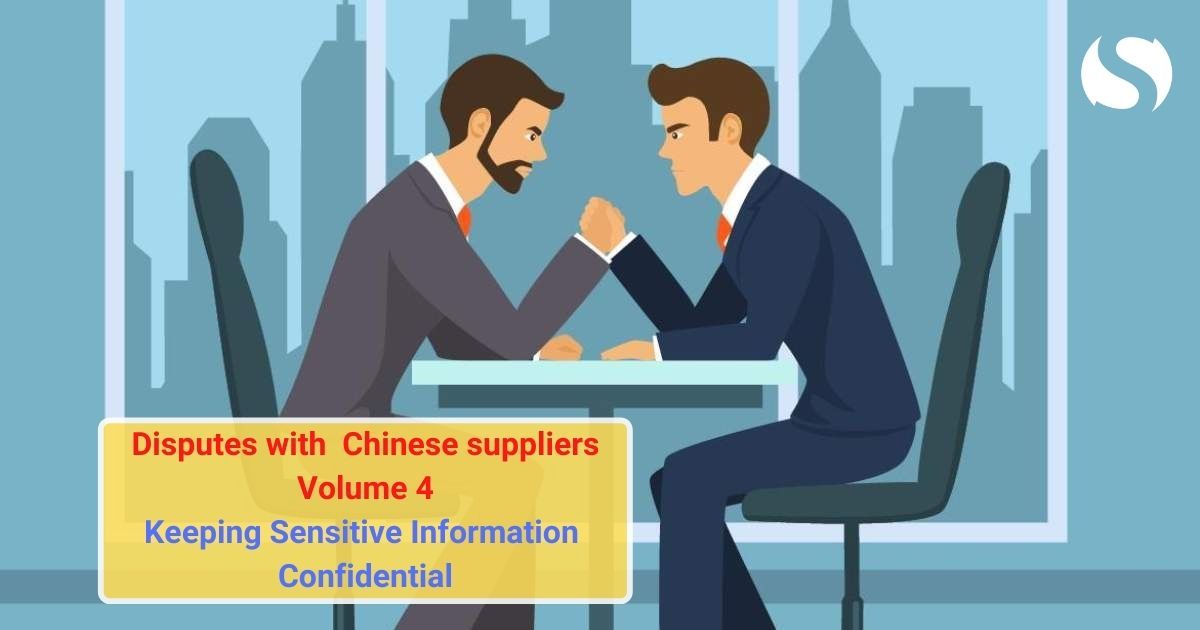
Keeping Sensitive Information Confidential – Disputes With Chinese Suppliers: Q&A (Volume 4)

Disputes with Chinese suppliers Volume 4

Q: I’m worried that my sensitive product information won’t be kept confidential when it is sent to component suppliers. How can it be kept secure?

Answer:

There are legal and non-legal approaches here.

Non-Legal: Reducing the amount of information being shared 

1. The most important action is to avoid giving too much information to one given supplier. If they see what the end product is, and if they think there is plenty of margin to grab, they might add 50% (or more!) to their price. Or they might give a low price, in the hope of being selected and with the purpose of competing with you later, and that’s probably even worse. 

2. The second most important action you can take is avoiding sending sensitive information to multiple suppliers or simplifying the tender to remove the most confidential parts.
Note: When working with Sofeast on sourcing, in some cases we know a supplier that is already qualified and is probably a good fit. In many other cases, we involve other suppliers but do some screening first. It is usually possible to ask them to provide information based on a similar component, or at least a part that requires similar processing when doing that screening.

If we do a good job of restricting both the information sent and the number of suppliers we need to send it to, the risk is already lower. As Steve Dickinson wrote last week in China Law Blog, there are many ways information can leak, and you want to minimize that.


Legal: Getting the supplier to sign an NDA or NNN agreement

The next step is figuring out whether each component supplier needs to sign a non-disclosure, non-use, and non-circumvention (NNN) agreement.

Read more about manufacturing contracts here 👉 How To Create A Valid Manufacturing Contract In China To Protect Your IP

We usually discuss this with our client, to make sure we are aligned. There are several cases:

  • We already have an NNN agreement with that supplier: we are all set.
  • We only communicate a very small part of the project information, and in itself that poses no IP dissemination risk: no need for an NNN agreement.
  • We communicate too much information to be in the situation above: it usually calls for a NNN agreement.

(Note: each project is unique in its own ways, so there are many special cases. For example, if we need to use a piece of technology developed by an OEM supplier, the approach is necessarily different, since they might have more confidential information to protect than our client.)

If you want to learn even more about legal options and China manufacturing contracts, listen to this episode of our podcast:

Other tips

  • In our experience, it’s always better to try to keep your product or brand information from suppliers unless they’re conducting the final packing. We discuss this in more detail here: IP Protection For Manufacturers. Keep Component Suppliers In The Dark
  • There is a relationship between a supplier’s interest in IP infringement and your order volumes. Low volumes (let’s say USD 10k per order or less) won’t be as attractive.


Are you designing, or developing a new product that will be manufactured in China?

Sofeast has created An Importer’s Guide to New Product Manufacturing in China for entrepreneurs, hardware startups, and SMEs which gives you advance warning about the 3 most common pitfalls that can catch you out, and the best practices that the ‘large companies’ follow that YOU can adopt for a successful project.

It includes:

  • The 3 deadly mistakes that will hurt your ability to manufacture a new product in China effectively
  • Assessing if you’re China-ready
  • How to define an informed strategy and a realistic plan
  • How to structure your supply chain on a solid foundation
  • How to set the right expectations from the start
  • How to get the design and engineering right

Just hit the button below to get your copy:

An Importers Guide to New Product Manufacturing in China Guide

Checklist for importers who are manufacturing products in China / low-cost Asia

Checklist for importers who are manufacturing products in China or low-cost AsiaMany people come to us and ask: “What are the steps we need to take now that we have decided to manufacture our products in China/Vietnam/SE Asia?”

While no two manufacturing projects are the same, I’ve tried to distill the process into a checklist that covers 95% of situations for importers of consumer goods and simple industrial products here. (If you are simply picking an off-the-shelf product, you will need to ignore some of the points.)

Continue reading “Checklist for importers who are manufacturing products in China / low-cost Asia”

How to set up a Receiving Inspection: Checklist, Procedure, Reporting form

I have written extensively about pre-shipment inspections (before, during, or after production), always from the perspective of the buyer checking what a supplier is doing; but I noticed that I haven’t covered what’s known as a receiving inspection (also called incoming quality inspections).

How to set up a Receiving Inspection

However, that’s a really important topic, so let’s get into how to set one up here…

Continue reading “How to set up a Receiving Inspection: Checklist, Procedure, Reporting form”