Plastic, Silicone, Steel, and Others: Updated China Raw Materials Costs (late Mar ’25)

It’s time for the monthly update tracking the costs of commonly used raw materials from China for the past year to help you understand the market’s current state. If you or your supplier purchase materials from China for your products, the cost changes you see here impact your bottom line!

Here’s the up-to-date material cost data from China for you as of late March 2025 and the price evolution over the past twelve months – Corrugated & Boxboard Paper had a reasonable 7% decrease, otherwise most materials were relatively stable on cost this month.

raw materials cost evolution mar 25

Here are the annual cost changes in CNY, including weekly changes for March 25:

raw materials costs in cny mar 24 to 25

Here is what the external market analysts we work with attribute these changes to during this past month and the overall monthly cost change in the last week of March:

Epoxy Resin (-2.45%)

The epoxy resin market continued to weaken this week.
Driving factors: Cost support performance is weak, and downstream buyers remain cautious.
Market outlook for next week: The domestic epoxy resin market is expected to remain weak.

ABS (-0.79%)

ABS market prices continued to fall this week.
Driving factors: Weak upstream raw material prices, abundant supply, and overall market weakness.
Market outlook for next week: With low costs and manufacturer inventory pressure, ABS prices are likely to remain weak.

Silicone Rubber 110 (+1.67%)

The price of 110 raw rubber increased this week.
Driving factors: Buyers reacted to rising prices by stocking up in the first half of the week, improving order volume. However, after the price increase, market sentiment turned cautious.
Market outlook for next week: The high trading atmosphere remains weak.

Zinc Alloy (+0.77%)

Electrolytic zinc prices fell early in the week but ended with an upward movement.
Driving factors: Increased supply pressure initially pushed prices down.
Market outlook for next week: Demand is expected to return, likely leading to price increases.

Aluminum Alloy (-0.32%)

Aluminum prices rebounded after an early rise, but inventory pressures persisted.
Driving factors: Demand elasticity is changing, and aluminum liquid absorption remains stable.
Market outlook for next week: Prices are expected to fluctuate within a range due to mixed market signals.

PVC (-0.62%)

The domestic PVC powder market weakened slightly this week.
Driving factors: Weak fundamental support and poor macroeconomic sentiment.
Market outlook for next week: Prices may continue fluctuating in a narrow range.

Paper for Color Boxes (No change)

The double-coated paper market remained stable this week.
Driving factors: Limited demand growth and ongoing supply-demand imbalances.
Market outlook for next week: Stability is expected to continue.

Corrugated & Boxboard Paper (-7.36%)

Market pressure led to further declines this week.
Driving factors: Continued supply-demand imbalances and lower paper mill quotations.
Market outlook for next week: Prices may continue to decline, but at a slower rate.

Stainless Steel (No change)

Stainless steel scrap prices fluctuated this week.
Driving factors: Market corrections due to futures hedging and shipment price adjustments.
Market outlook for next week: Expected steel shortages may lead to rational price reductions.

Lithium Batteries (+0.50%)

Battery-grade lithium carbonate prices saw a slight increase.
Driving factors: Stable supply, growing power market demand, and continued strength in the cobalt market.
Market outlook for next week: Demand is steadily increasing, supporting price stability.


How to combat rising costs?

Explore cost-reducing tips in this post: Rising Raw Material Prices: What Strategy To Follow? (6 Approaches).

What to do if your Chinese supplier suddenly tells you that material costs have risen: How To Cooperate With Your Chinese Supplier, Part 16: Bad News from China, Raw Material Prices Just Increased!

If your supplier just isn’t working out, maybe sourcing a new supplier will help you find one who can offer you better prices and more. If so, there’s no need to fear switching from your current supplier to a new one if you’re prepared: How To Switch To A Newer, Better Chinese Manufacturer? [eBook].


We hope this is helpful. Our mission at Sofeast is to help importers have transparency in their supply chain and to give them more control. And this information is critical to have some visibility into your manufacturer’s costing.

By the way, you can always contact us if you have any questions about whether a manufacturer’s quote is reasonable.

Manufacturing Process Controls = Better Product Quality [Podcast]

Manufacturing success isn’t just about having the right equipment—it’s about understanding and controlling every step of the process. In this episode, we explore the role of process controls in preventing defects, improving efficiency, and ensuring consistent quality. From real-world examples of manufacturing failures to practical strategies for process optimization, this discussion will help you take control of your production like never before.


Listen to the episode here

Listen: to the podcast episode

Watch: on YouTube


Episode sections

  • [00:00] – Introduction
  • [01:30] – What are Manufacturing Process Controls?
  • [02:51] – The Danger of Treating Manufacturing as a ‘Black Box’
  • [05:09] – Real-World Example: Troubleshooting Manufacturing Issues
  • [11:21] – The Four Key Elements of Process Controls
  • [14:50] – How to Take Control of Manufacturing Variables
  • [19:04] – Why Cheap Manufacturing Can Lead to Quality Risks
  • [23:53] – What is a Process Control Plan?
  • [31:00] – Conclusion: Why Process Controls Shouldn’t Be an Afterthought


Related content…


Listen, rate, & subscribe to the ‘China Manufacturing Decoded’ podcast on your favorite provider

More episodes are coming, so remember to rate us and subscribe! You can find us on:

Quality Inspections Guide: Minimize Risk, Maximize Quality [Podcast]

Welcome to the 263rd episode of China Manufacturing Decoded! This episode marks a special milestone—four full years of insightful discussions aimed at eliminating uncertainty in manufacturing, quality control, and other areas in China and Asia.

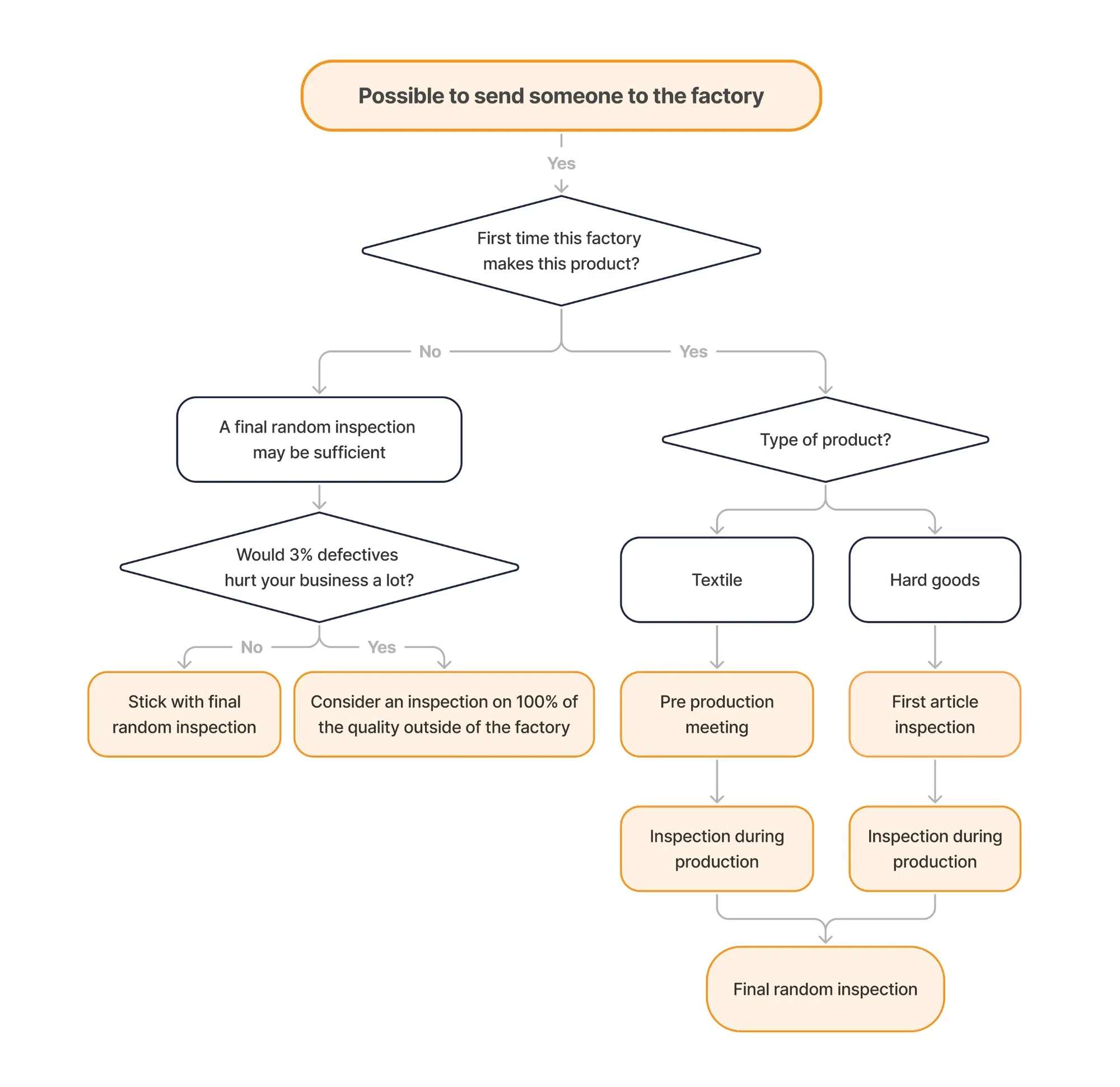
In this episode, we dive into the world of quality inspections. It doesn’t matter if you’re manufacturing products in China, India, or elsewhere in Asia; knowing when and how to inspect your products can save you from costly mistakes and quality issues down the line. We’ll break down the key types of inspections, when to use them, and how to make informed decisions that protect your business.

sofeast product quality inspection flowchart mar 25


Listen to the episode here

Listen: to the podcast episode

Watch: on YouTube


Episode sections

  • [00:00] – Introduction
  • [02:57] – Why Quality Inspections Matter
  • [05:59] – When and How to Conduct Quality Inspections if the factory has made the product before
  • [13:35] – What manufacturers of expensive products should focus on
  • [17:48] – When and How to Conduct Quality Inspections if the factory has NOT made the product before
  • [24:30] – How the risk analysis influences quality inspections
  • [28:00] – Wrapping Up


Related content…


Listen, rate, & subscribe to the ‘China Manufacturing Decoded’ podcast on your favorite provider

More episodes are coming, so remember to rate us and subscribe! You can find us on:

Prototype, Patent, then Market: A Misguided Concept

Prototype, Patent, then Market A Misguided ConceptAnyone manufacturing their product wants it to be on time, within budget, at the right level of quality and reliability, and in compliance with market regulations, but in terms of safety, they also don’t want it to be copied! There is a certain order to bring a new product to market safely, then, which reduces your risk of your product IP being copied by China copycats who can and will beat you to market if you have an attractive idea.

A customer recently asked us about which order to do things in, so let’s discuss why prototyping, patenting, and then going to market is a misguided concept that could land you in hot water.

Continue reading “Prototype, Patent, then Market: A Misguided Concept”

How Life Cycle Assessments Drive Product Sustainability Changes [Podcast]

In today’s episode, we’re exploring Life Cycle Assessments (LCAs) — a critical tool for manufacturers and product developers aiming to improve sustainability and meet growing regulatory demands. You’ll learn why understanding a product’s entire life cycle — from raw material extraction to disposal — is essential for reducing environmental impact, staying compliant with new regulations, and designing more sustainable products. The discussion will help you grasp how LCAs work, why they matter, and how they can give you a competitive edge.


Listen to the episode here

Listen: to the podcast episode

Watch: on YouTube


Episode sections

  • [00:00] Welcome and introducing the topic
  • [01:07] What Is a Life Cycle Assessment (LCA)?
  • [01:41] Example: Comparing EVs and Traditional ICE Cars
  • [05:38] Challenges in Battery Production and Disposal
  • [10:06] Why LCAs Matter for Sustainable Manufacturing
  • [14:50] The Complexity of Supply Chain Data Collection
  • [17:29] The Push to Disclose Sustainability Information to Consumers
  • [20:05] Future-Proofing Example and Product EPD
  • [26:05] Practical Tips for Implementing LCAs
  • [28:30] How LCAs Can Give You a Competitive Edge
  • [29:20] Wrapping Up


Related content…


Listen, rate, & subscribe to the ‘China Manufacturing Decoded’ podcast on your favorite provider

More episodes are coming, so remember to rate us and subscribe! You can find us on:

Pulling Your Tooling from Chinese Manufacturers: Key Risks and Best Practices

When it comes to switching from one Chinese manufacturer to another, one of the trickiest aspects is transferring tooling—whether it’s plastic molds, die casting tools, or others—from the old supplier to the new. While it may seem straightforward, the process of pulling out your tooling comes with acute risks that businesses often overlook. Let’s explore the key risks and best practices to follow when pulling tooling from Chinese manufacturers.

Continue reading “Pulling Your Tooling from Chinese Manufacturers: Key Risks and Best Practices”

Production-Ready? Critical Deliverables & Validations You Can’t Skip [Podcast]

Are YOU ready for production?

Rushing into production without proper checks can lead to costly mistakes. In this episode, we break down the critical buyer-side deliverables and validations that ensure your product is genuinely ready for mass production (especially for new electrical, electronic, and mechanical products). From quality control to reliability testing and supply chain stability, we’ll help you avoid common pitfalls and minimize risks. This is a recurring question from customers, and so it’s time to tackle it on the podcast.

Continue reading “Production-Ready? Critical Deliverables & Validations You Can’t Skip [Podcast]”

Trump Adds ANOTHER 10% Tariff To Chinese Products [BONUS Podcast]

In this bonus episode of China Manufacturing Decoded, Renaud discusses President Trump’s controversial new announcement that’s stirring up economic tensions with China as he has decided to double existing tariffs on Chinese goods to 20%, marking a significant escalation in the ongoing trade conflict between the world’s two largest economies.

Let’s look into why he has taken this action, how American importers may be affected, and also about how the trading relationship between the USA and China may evolve moving forward.

Continue reading “Trump Adds ANOTHER 10% Tariff To Chinese Products [BONUS Podcast]”