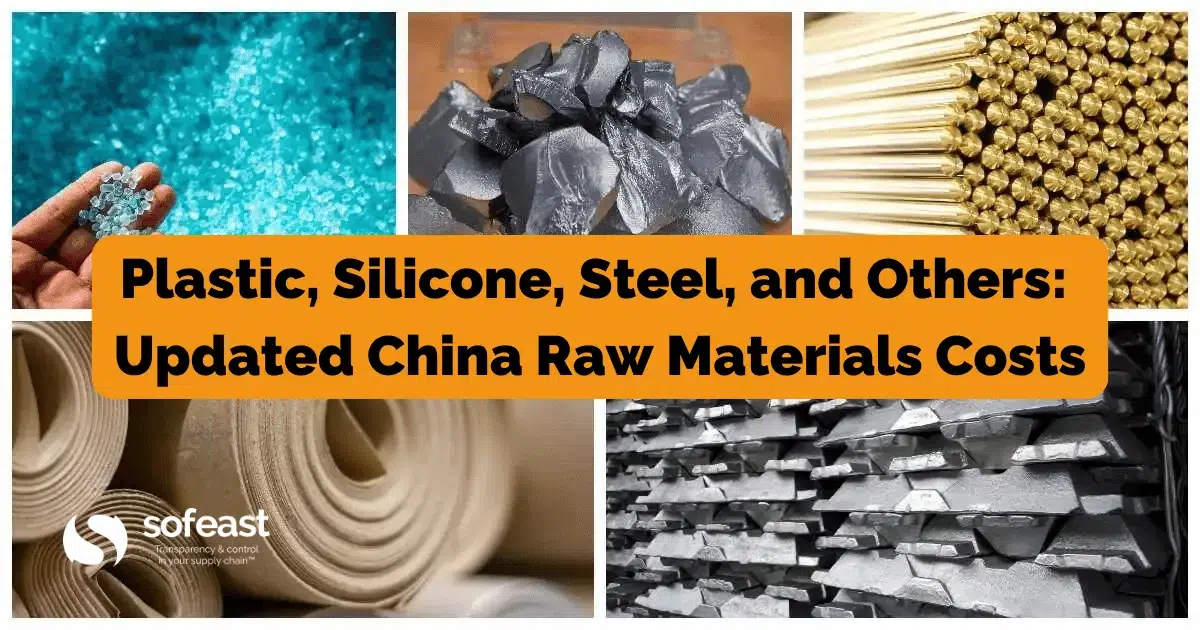
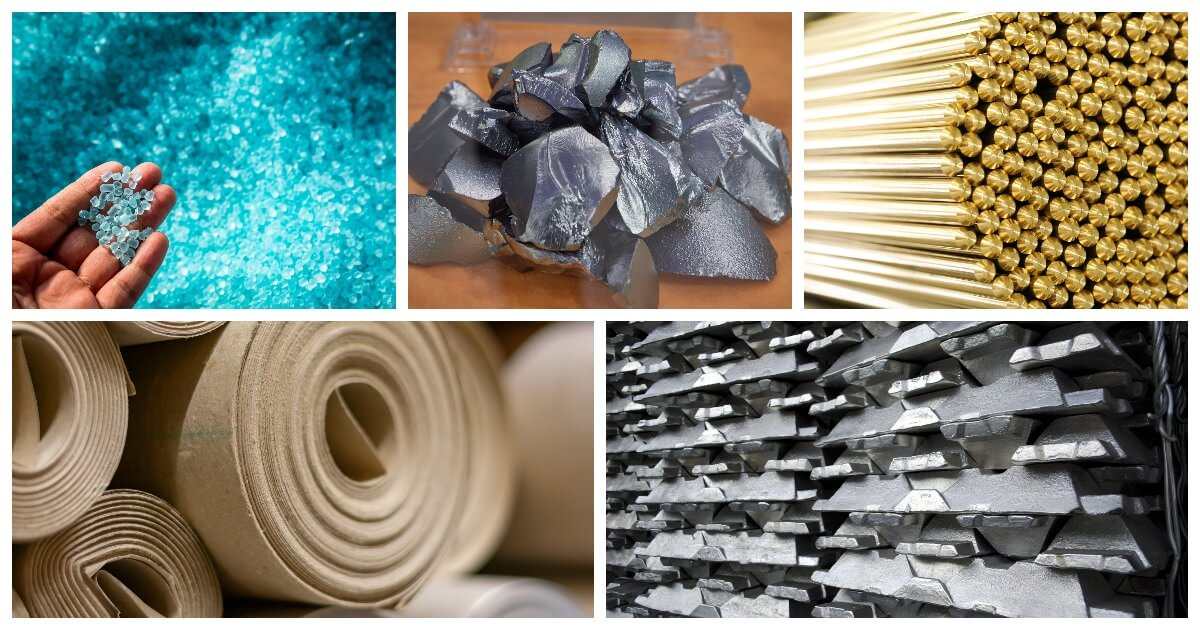
Plastic, Silicone, Steel, and Others: Updated China Raw Materials Costs (late December ’23)

sofeast china raw materials price indicesHere’s the monthly update from Sofeast’s sourcing team who has been tracking the costs of commonly used raw materials from China for the past year to help you understand where the market is right now. If you or your supplier are purchasing materials from China for your products the cost changes that you see here do have an impact on your bottom line!

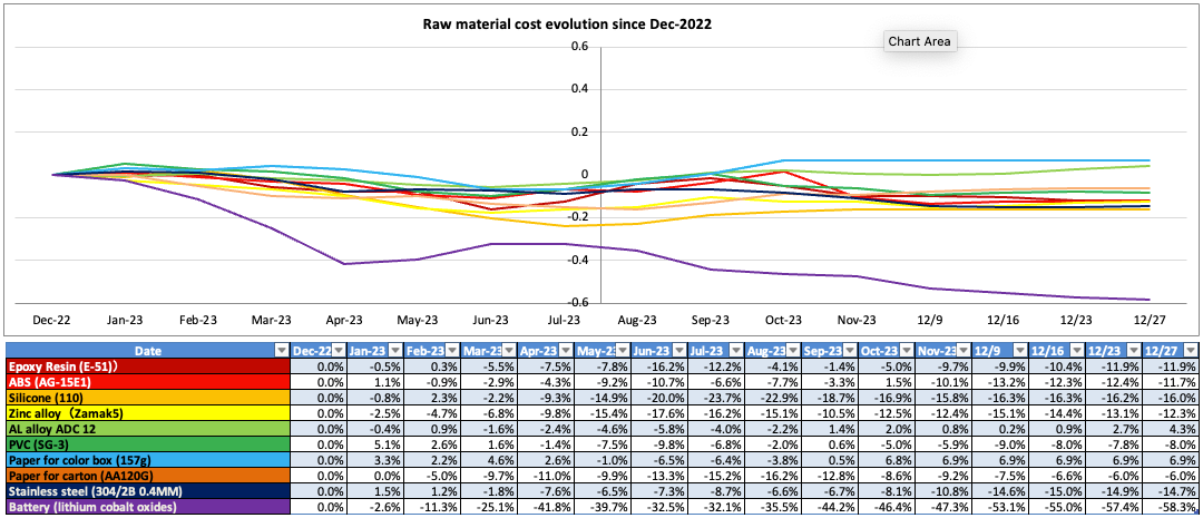
Here’s the up-to-date material cost data from China for you as of late December 2023 and the price evolution over the past twelve months:
raw material cost evolution since Dec 22

Here you can see the individual cost evolution per material over the past year, including the weekly and monthly change for December 2023:

raw material cost evolution since Dec 22

Here is what our market analysts attribute these changes to during this past month:

Epoxy Resin (E-51) – decreased 2.48%

On the supply side: Though some manufacturers hold higher inventories, their willingness to ship remains steady, ensuring sufficient market spot availability. However, potential disruptions in logistics due to holiday season congestion deserve attention.

Demand-wise: Most downstream industries are in their traditional off-season, leading to weakened overall demand. However, some pre-New Year’s Day inventory replenishment might occur. Closely monitor actual purchase volumes to gauge demand accurately.

Raw materials: According to Zhuo Chuang information, bisphenol A prices are expected to remain range-bound next week, facing upward and downward pressures. Epichlorohydrin prices are likely to continue their downward trend. Overall, raw material costs are anticipated to experience minimal fluctuations, offering limited support to spot performance.


ABS AG-15E1 – decreased 1.80%

The domestic ABS market saw a modest increase this week. Mainstream domestic material prices ranged from 9,400 to 10,350 yuan per ton, with lower-end prices rising by 100 yuan per ton and higher-end prices increasing by 50 yuan per ton compared to last Thursday. Buoyed by the uptrend in crude oil and styrene markets, the sentiment in the ABS market improved through a domino effect. However, spot transaction volume remained limited.


Silicone (110) – increased 0.68%

Domestic 110 Raw Rubber: This week, the market maintained stability, albeit with contrasting situations among different players. Leading enterprises offered lower prices, gaining an edge in order acquisition, but with extended delivery cycles. This pushed most customers towards them.

Many other manufacturers, struggling with significant profit losses, scaled back production. Local, low-production manufacturers capitalized on their spot supply advantage, focusing offers and transactions around 15,000 yuan per ton, typically in smaller orders.


Zinc alloy (Zamak5) – increased 0.20%

Despite a slight uptick in spot zinc prices, trader activity remained muted, reflecting a chilly market atmosphere. Downstream businesses adopted a cautious approach, opting for minimal purchases to fulfill immediate needs. This limited overall demand, further exacerbated by weakened construction activity in the north. Consequently, trading performance was lackluster.


AL alloy ADC 12 – increased 3.41%

Across the domestic spot market, shipments from cargo holders are dwindling. As traders hesitate to take on inventory, downstream manufacturers are only purchasing for immediate needs. This cautious approach, coupled with low social inventory, maintains a subdued trading atmosphere.


PVC (SG-3) – decreased 2.19%

Guangzhou’s PVC market saw prices dip slightly today, mirroring the weak performance of the futures market. Traders initiated the day with marginally lower offers than yesterday, but buyers remained hesitant, further dampening trading activity. The subsequent decline in futures prices prompted some additional downward adjustments in quotes. Consequently, point price supply has temporarily lost its price advantage.


Paper for color box (157g) – 0.00% change


Paper for carton (AA120G) – increased 3.55%

Three key factors shaped the corrugated paper market this week:

  1. Price Adjustments: Leading paper mills in Quanzhou and Taicang raised factory prices by 30-50 yuan/ton, while smaller mills maintained stable shipments. This resulted in limited market fluctuations.
  2. Rising Raw Material Costs: The price of waste yellow board paper, a crucial raw material, continued to climb. This upward trend, driven by the upstream and downstream product chain, provided some cost support.
  3. Subdued Demand: Terminal orders fell short of expectations, prompting downstream packaging factories to adopt a cautious approach, purchasing only as per order requirements. This widening gap between supply and demand further impacted the market.


Stainless steel (304/2B 0.4MM) – decreased 4.36%

Stainless steel roared this week, fueled by both futures and spot market momentum. Futures prices continued their ascent, providing a strong foundation for the sector. This bullish sentiment translated into a revitalized spot market atmosphere, with traders cautiously pushing prices higher. Adding to the heat, expanding snowfall in some regions disrupted deliveries, further driving up market optimism. Production enterprises, capitalizing on the positive sentiment, gradually increased their guiding prices, further fanning the flames of market enthusiasm. This synchronized upward movement in both futures and spot markets culminated in a significantly warmer trading atmosphere.


Battery (lithium cobalt oxides) – decreased 20.99%

The cathode material market shifted downwards this week, driven by a confluence of factors. Upstream raw materials, including lithium salt and cobalt salt, saw slight declines, offering weaker cost support. Additionally, downstream lithium battery production and marketing faced challenges, leading to reduced demand for positive electrode materials. As a result, overall transaction volume remained low, with only scattered single deals occurring in a subdued market atmosphere.


How to combat the rising costs?

Explore cost-reducing tips in this post: Rising Raw Material Prices: What Strategy To Follow? (6 Approaches).

What to do if your Chinese supplier suddenly tells you that material costs have risen: How To Cooperate With Your Chinese Supplier, Part 16: Bad News from China, Raw Material Prices Just Increased!

If your supplier just isn’t working out, maybe sourcing a new supplier will help you find one who can offer you better prices and more. If so, there’s no need to fear switching from your current supplier to a new one if you’re prepared: How To Switch To A Newer, Better Chinese Manufacturer? [eBook].


We hope this is helpful. Our mission at Sofeast is to help importers have transparency in their supply chain and to give them more control. And this information is critical to have some visibility into your manufacturer’s costing.

By the way, you can always contact us if you have any questions about whether a manufacturer’s quote is reasonable.
13 Strategies To Ensure Consistent Product Quality

Adrian and Renaud return for the last podcast of 2023, a bumper episode where they go through 13 quality strategies you can adopt to achieve consistent product quality.

They’re roughly split into pre-production and post-production strategies, so settle down and dive in here!


Listen to the episode here 👇

Listen: to the podcast episode

Watch: on Youtube


Episode sections

  • 00:00 – Greetings and introduction.

Pre-production

  • 02:18 – 1. Due diligence and factory audits to ensure the supplier has the capabilities to reach your quality standards.
  • 04:31 – 2. Define a quality standard.
  • 08:35 – 3. Product design with quality in mind (DfX principles).
  • 12:44 – 4. Feasibility study.
  • 17:04 – 5. Specify all aspects of the product to avoid grey areas.
  • 23:11 – 6. Implement a QA plan.
  • 26:04 – 7. Use a manufacturer with a quality management system.
  • 30:32 – 8. Quality (and compliance) testing.

During and Post-production

  • 33:32 – 9. Do IQC.
  • 37:08 – 10. Conduct product inspections.
  • 41:45 – 11. Process Controls.
  • 45:13 – 12. Mistake-Proofing.
  • 47:48 – 13. Traceability in the supply chain.
  • 51:01 – Wrapping up.


Related content…


Listen, rate, & subscribe to the ‘China Manufacturing Decoded’ podcast on your favorite provider

More episodes are coming, so remember to rate us and subscribe! You can find us on:

If you enjoyed this episode, don’t forget to give us a 5* rating and share it with your network if you enjoy listening!

Apple Ramp Up iPhone & Airpods Production In India. What Challenges Await?

According to the December 2023 WSJ article: Apple Aims to Make a Quarter of the World’s iPhones in India (Paywall), Apple will be expanding production of iPhones and other products like Airpods, which were only made in East and South East Asia before now, in India. But some challenges await them that any importers interested in manufacturing electronics in India should know about, here’s the rundown…

Continue reading “Apple Ramp Up iPhone & Airpods Production In India. What Challenges Await?”

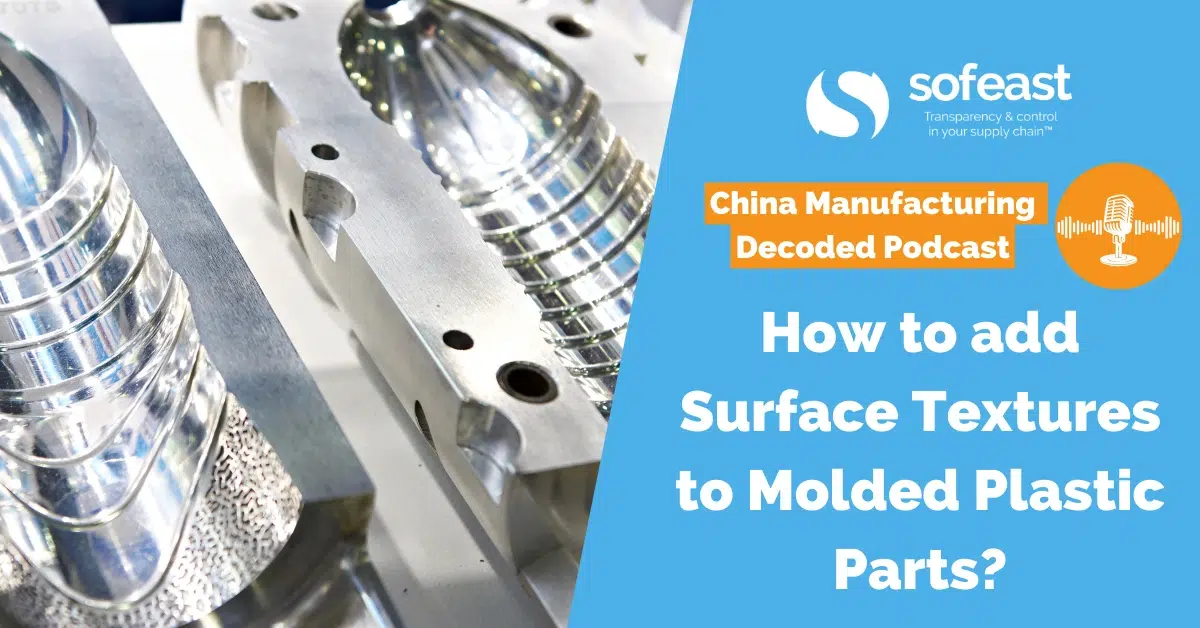
How to add Surface Textures to Molded Plastic Parts?

Adrian hosts and Paul Adams, one of Sofeast’s senior engineers joins him to talk about how to add surface textures to plastic injection mold tooling and get the finish that we want on our plastic molded parts.


Listen to the episode here 👇

Listen: to the podcast episode

Watch: on Youtube


Episode sections

  • 00:00 – Greetings and introduction to textures for plastic injection molded parts.
  • 02:55 – General points about getting started adding textures.
  • 07:59 – Draft Angle rules of thumb for mold design with textures in mind.
  • 14:58 – 5 Common methods used to add surface textures to the mold tooling itself.
  • 27:46 – Key benefits of Chemical Photoetching.
  • 30:30 – Roughness: Ra Value and Mold Tool Textures
  • 34:27 – Using mold texture books to help specify your texture/s
  • 37:29 – Some examples of typical textures from the Yik Sang texture book.
  • 43:20 – Summary and wrap-up.


Related content…

Get help from Sofeast with your tooling fabrication and management with these services:


Listen, rate, & subscribe to the ‘China Manufacturing Decoded’ podcast on your favorite provider

More episodes are coming, so remember to rate us and subscribe! You can find us on:

If you enjoyed this episode, don’t forget to give us a 5* rating and share it with your network if you enjoy listening!

Build Operate Transfer for factories: Can it be implemented in China?

The Build-Operate-Transfer model can be a beneficial approach for larger businesses that are looking to start manufacturing products in a new location while shielding themselves from some of the typical risks faced when setting up a new factory from scratch.

China is an obvious choice to start manufacturing in for certain businesses due to its deep & wide pool of component manufacturers and relatively inexpensive engineers, as well as mature transport and logistics infrastructure. That’s especially true when some of the output will be sold on the local market (made in China for China) and the impact of the China-USA trade/tech war is limited.

However, it can be hard for businesses to break into the market and set up a factory due to a lack of knowledge of local regulations, areas, customs, and business practices; not to mention the language barrier.

That’s not to say that foreign-owned businesses can’t set up a factory in China…we did it but fortunately, we started small and grew organically over the years. For a company new to China, could the Build Operate Transfer (BOT) model be a good alternative?

Continue reading “Build Operate Transfer for factories: Can it be implemented in China?”

Common Compliance & Recall Risks for Packing Materials Sold in the EU & UK (22/23)

Common Compliance & Recall Risks for EU & UK Packing MaterialsSofeast commissioned some research recently on which chemical compliance incidents occurred in EU countries in the past year 22/23, the substances found, where, and the actions taken by authorities.
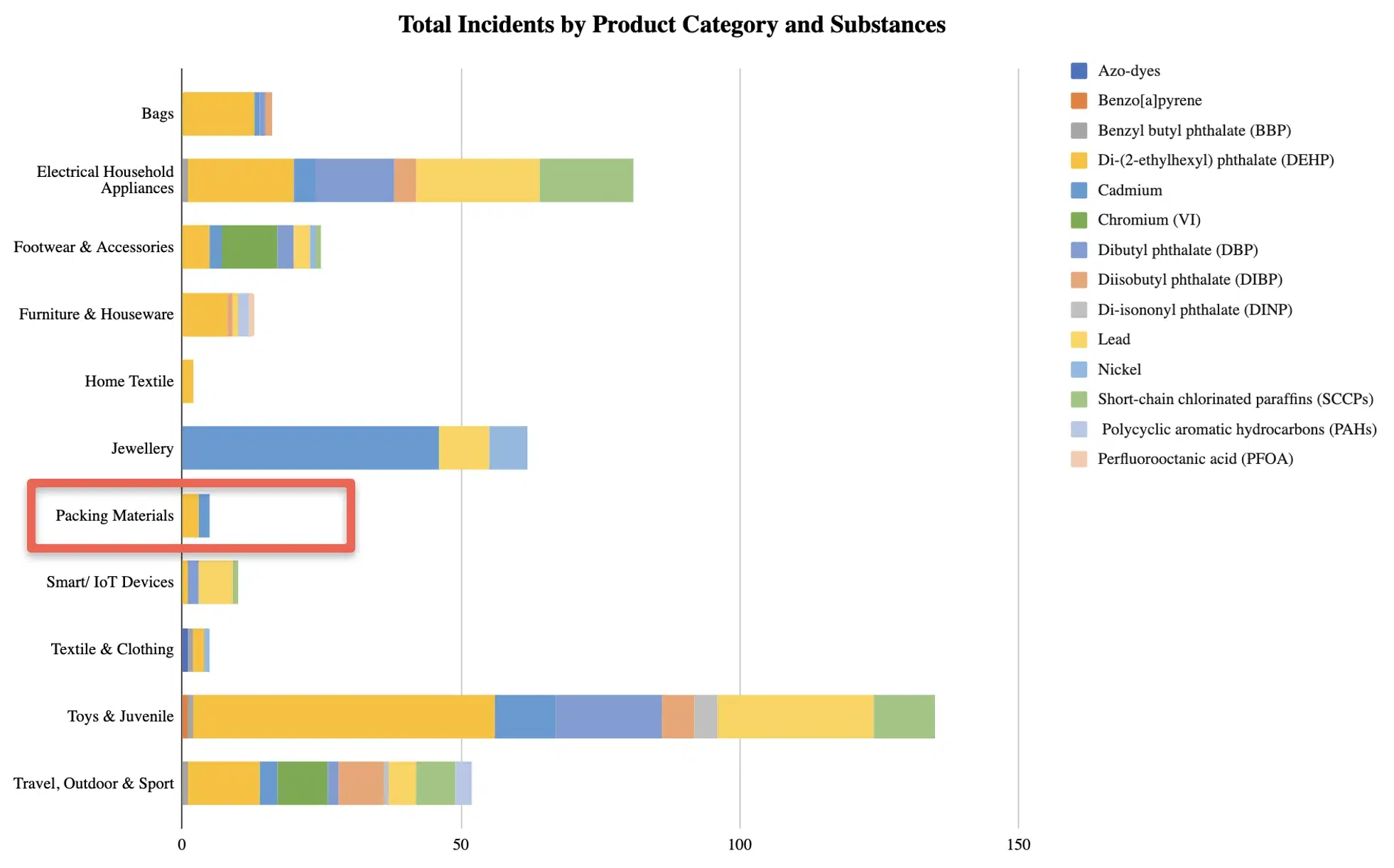
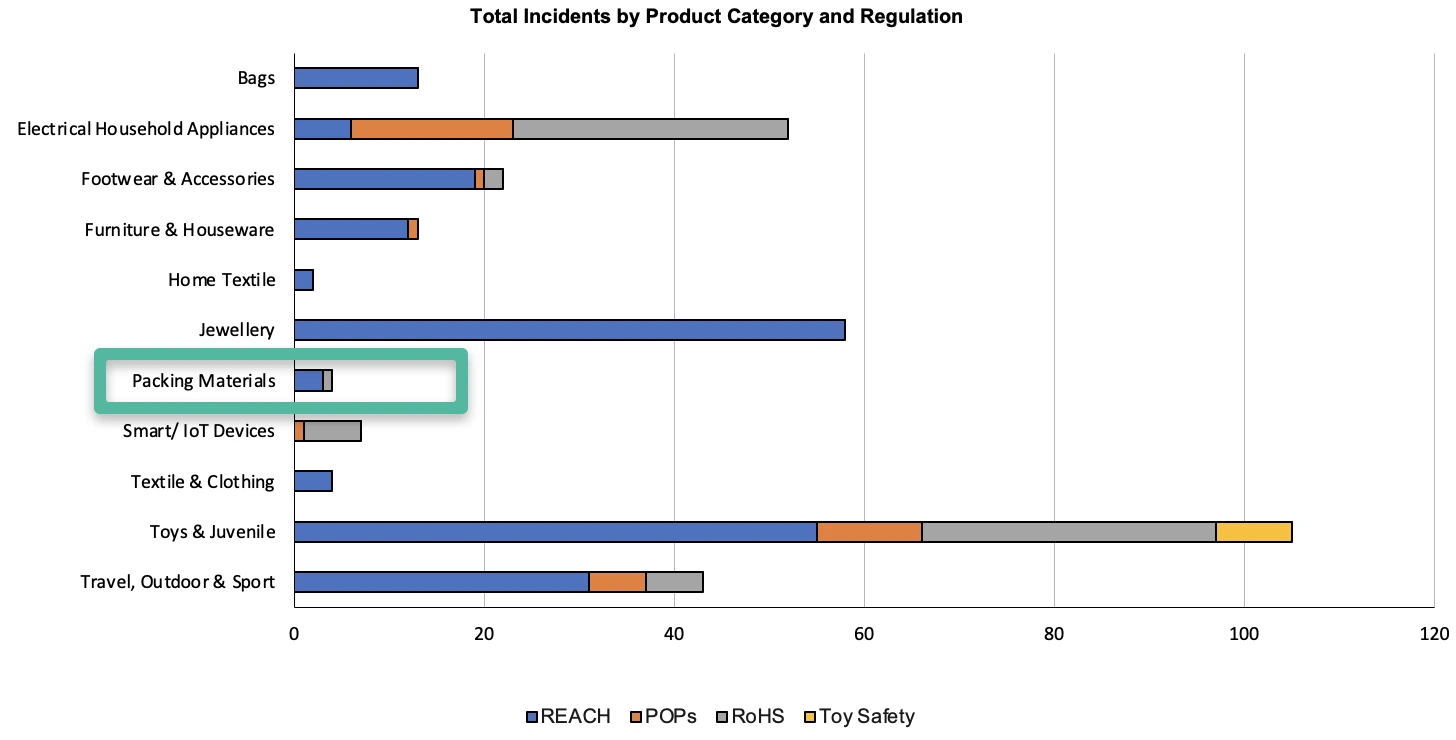
Let’s look at packing materials which were found to be non-compliant by market surveillance authorities. Packaging materials could be made of plastic, card, or metal, depending on how they’re used, therefore, there is scope for all kinds of problems.

Note: we only cover chemical compliance in this article.


[ez-toc]


What are the key applicable regulations & directives?

In general, we investigated these common regulations and standards that market surveillance authorities tend to check products against:


Market surveillance on chemical substances: recalls and withdrawals from market

Compared to consumer goods, packing materials had relatively few chemical compliance incidents during the year 22/23 with only 5 incidents logged that we found:

packing materials total incidents
These incidents were due to the detection of the following substances:

  • Di-(2-ethylhexyl) phthalate (DEHP) (most comm, and often in plastics) x3 
  • Cadmium (likely in metal parts) x2

Phthalates are plasticizers added to plastics to increase strength, durability, flexibility, and transparency. They’re banned or restricted because they’ve been scientifically shown to disrupt hormones and cause birth defects and are banned under RoHS.

Cadmium is a toxic metal often found in metal parts and is a common by-product of zinc production. However, it’s one of the RoHS-banned substances because it is a toxic carcinogen.


Which regulations were not complied with and by whom?

The packing materials were mainly in breach of REACH which regulates the use of harmful chemicals in most products, but one also failed to comply with RoHS which regulates the use of certain hazardous materials in the manufacturing of electrical and electronic products.

The offending packaging was all found to come from the PRC. While that’s probably not a surprise as most of the non-compliant products in general were from there, it still serves as a warning if that’s your manufacturing base.

total incidents packing materials
What steps did the authorities take?

Once again, Scandinavia takes the mantle of being strict on products at the border. In this case, only Sweden found issues with packing materials:

  • Sweden 4x (1 RoHS & 3 REACH)

All of these non-compliant packing materials were withdrawn from the market.


General advice to reduce such risks

Make sure you work with suppliers who are aware of the regulations in the countries where the devices are to be sold.

Ask your supplier for confirmation that every material is compliant, with testing reports if possible as evidence.

If you have a doubt, run a risk analysis (and the list of most common issues found, as laid out above, will be useful) and take action. It could mean that you select the suppliers of certain materials directly (and you ensure those are reputable manufacturers that show evidence of compliance) and/or you run some laboratory tests.

Finally, if you are still unhappy about the product’s risk profile, you may have to re-design it and choose less risky materials.


What can importers of packing materials learn from this data?

First of all, this information should be of concern to most importers, because your product is likely to be packaged somehow and this may be checked by market surveillance authorities for compliance with chemical safety requirements. How many products are sold with some kind of plastic packaging today, for example? And, as we know, there is always a danger that plastics will contain banned phthalates if not other substances.

So, even if packing materials aren’t your main import, it pays to ensure that they’re not manufactured with hazardous and restricted chemicals…and, if your suppliers are Chinese, be extra vigilant and do your due diligence on the packaging before the shipment leaves the factory.

Do you need a sourcing agent to buy from China?

Adrian and Renaud chat about whether hiring a sourcing agent is necessary for businesses who want to purchase products from China. They also discuss the different options, such as doing the sourcing work yourself, and their pros and cons.


Listen to the episode here 👇

Listen: to the podcast episode

Watch: on Youtube


Episode sections

  • 00:00 – Greetings and news: CNY ’24 prep and visa-free China entry for 6 countries.
  • 08:06 – Who typically uses a sourcing agent to buy from China and what types are there?
  • 13:10 – 4 sourcing approaches the buyer can take.
  • 14:02 – When does each approach make sense (and pros & cons)?
  • 41:25 – Sourcing options and compliance.
  • 43:43 – Wrapping up.


Related content…


Listen, rate, & subscribe to the ‘China Manufacturing Decoded’ podcast on your favorite provider

More episodes are coming, so remember to rate us and subscribe! You can find us on:

If you enjoyed this episode, don’t forget to give us a 5* rating and share it with your network if you enjoy listening!

Should YOU be wary of the cheapest Chinese suppliers?

Adrian hosts and Renaud joins to offer some cautionary advice about working with ‘the cheapest Chinese supplier’ with a focus on relatively ordinary consumer and electronic products. What might sound like a good deal could actually land you in hot water. Here’s why…


Listen to the episode here 👇

Listen: to the podcast episode

Watch: on Youtube


Episode sections

  • 00:00 – Greetings and introduction: Should we be wary of choosing the cheapest supplier?
  • 05:35 – Warning signs from cheap suppliers.
  • 09:54 – Do lowest prices = a stable relationship for the mid to long-term?
  • 15:18 – Does a manufacturing contract protect you from the supplier making changes due to not being able to afford to honor low prices?
  • 17:55 – What type of factory are you even dealing with?
  • 24:36 – An example quote for very low-cost plastic injection mold tooling and the problems you might face in future if you accept.
  • 27:23 – Avoiding the cheapest options and doing due diligence is a must for certain product types.
  • 29:21 – What can go wrong when you work with a cheap/bad supplier?
  • 33:47 – Is it really impossible to get a small factory to do a good job?
  • 39:18 – Wrapping up.


Related content…


Listen, rate, & subscribe to the ‘China Manufacturing Decoded’ podcast on your favorite provider

More episodes are coming, so remember to rate us and subscribe! You can find us on:

If you enjoyed this episode, don’t forget to give us a 5* rating and share it with your network if you enjoy listening!