How To Choose Which Factory Audit You Need?

A common piece of advice we give to customers is to undertake a factory audit when vetting new suppliers.

There are a number of different types of factory audits that you may consider, though, so which is right for you?

Continue reading “How To Choose Which Factory Audit You Need?”

Exploring The Benefits Of Rapid Prototyping And Rapid Tooling [Podcast]

Benefits Of Rapid Prototyping And Rapid Tooling

Listen to our latest podcast where we discuss the benefits of rapid prototyping and the different rapid tooling technologies you may take advantage of!

You’ll learn:

  • what rapid prototyping is
  • the difference between additive and subtractive manufacturing methods for prototypes
  • what ‘hard tooling’ which is used for mass production is and its features in comparison to rapid tooling
  • the different rapid tooling methods and their pros & cons
  • why a number of rounds of prototypes before going into production is invaluable
  • tips to follow if you’re going to create rapid prototypes to test and validate your new product designs
  • …and more!

👂 Listen here 👇

Hit this link to listen to the episode: The Benefits Of Rapid Prototyping (& Rapid Tooling Methods)

Or watch on YouTube if you prefer!


Show summary

✅ What is rapid prototyping? – some companies design their new product and get production tooling made, for plastic injection molding, at the cost of tens of thousands of dollars and later get feedback that there are some issues with the product design or the product includes features that are not popular with users. This leads to further delays and higher costs to adjust the design and change the tooling.

This is a case of trying to run before learning to walk, and rapid prototyping helps you test and validate the design before making the large (and hopefully final) investment into production tooling by creating prototype parts in a simple and fast way to allow you to test them and make sure the design is ready for production.

✅ Performing rounds of prototyping to get to a minimum viable prototype – You can remove the risks of problems (such as the product not working as expected, being too loud, etc) from your new product design by creating a minimum viable prototype that helps you test and validate the design quickly and at a low cost.

For new and complex products which have more risks, you will want to create a ‘proof of concept’ prototype which has the product’s features, doesn’t need to look good, and must function at least in a crude way. Then subsequent rounds of prototypes will be made which refine the design until you have a prototype that looks good and works well.

To do this you’re not going to open your production tooling at a high cost just to make some rounds of prototypes, that doesn’t make sense, because if the design needs to be changed based on your findings then the tooling will also need to be altered.

✅ The difference between additive and subtractive manufacturing approaches for prototypes – the most common rapid prototyping methods are 3D printing (additive manufacturing) and CNC machining (subtractive manufacturing). 3D printing can use a type of polymer (also other materials) and build a part layer by layer, whereas a CNC machine will take a block of material, let’s say metal, and remove material from it until the remaining material is shaped into your part. Both of these methods are fast and affordable, making them good for rapid prototyping (CNC machining can be used for production, too, however).

✅ PP samples and making the distinction between rapid prototyping and rapid tooling – you want to make sure that the ‘approved pp sample’ (golden sample) is as close to a production piece as possible in its use of materials and processes, so in the case of products needing tooling for injection molding, for example, your rapid prototypes will probably not be the final PP sample. This will come after your tooling is made and will be made using that tooling.

What’s the difference between rapid prototyping and tooling?

Rapid prototyping is the creation of custom parts using 3D printing, CNC machining, or some kinds of soft tooling (molds made with a softer material). Rapid tooling is where tooling (for instance, molds for plastic injection molding) is fabricated from silicone rubber or very soft steel (other soft materials like aluminum are used but aren’t common in China) which is faster than production tooling as very hard steel is used and takes longer to shape. Some PP samples can be made from rapid tooling if it’s the same as the final production ‘hard’ tooling.

Read Sofeast’s Guide To Rapid Tooling Prototyping for more details and a handy table that compares the different methods.

✅ Discussing hard tooling and its pros & cons – going straight into hard tooling, as many do, will take longer and be expensive. Around 6 weeks is a reasonable time to expect it to take to fabricate and test the tooling, therefore you are holding yourself up from being able to test your product design by waiting, and if the tooling needs to be adjusted it takes more time to remove some material and this can also affect the mold’s lifespan, too. If your product is ready for mass production, though, the hard tooling is great as it will last for a huge number of ‘shots,’ creates the texture you want (unlike 3D printing and CNC machining), has very tight tolerances which are particularly good for plastic parts, and you can conduct testing on real ‘production’ parts which will be very similar to those that get into consumers’ hands (ultimately if a part needs to be made with plastic injection molding, you will need to make prototypes using a mold, rather than rapid prototyping via 3D printing or CNC machining which are simply not going to provide a production finish).

✅ The benefits of doing iterations of prototypes during pre-production – based on this blog post: Prototesting: Reap All the Value of Proof of Concept Prototypes. ‘Quick and dirty’ prototypes have a place during NPD, but the closer you get to production the less you rely on them. Making fast iterations of physical prototypes with different tweaks and approaches helps a product designer test lots of approaches and refine the concept, so 3D printing and CNC machining to create rapid prototypes adds a lot of value. You will check that the product works, that a user will have a good experience, etc. Better to know these points early, rather than find out after hundreds of thousands of dollars and a lot of time have been spent.

✅ The pros & cons of the different technologies for typically making plastic parts –  Renaud talks through the different technologies that may be used for rapid prototyping:

  • 3D printing: Once the CAD drawing is ready you can get parts made almost immediately and use them straight away, but they don’t have the physical characteristics of a production part. The cost would be prohibitive for a larger number of pieces, and the tolerances and finish are not great (some rework would be needed to add textures etc). Sofeast has our own 3D printer on-site for prototyping.
  • CNC machining: A block of materials is held in place and an arm moves around it with a cutting tool to remove some of the material. It can provide a high level of accuracy and tight tolerances and is quite fast. Unlike 3D printing, you can use the same materials as will be used in mass production, and it can reproduce some textures (although is limited). Some metal products can be mass-produced using CNC machining. Sofeast also has our own CNC machine on-site for prototyping operated by our CNC engineer. Sometimes it’s important to CNC machine a part to prove to a supplier what can be done and push them to produce the parts more quickly.
  • Die casting: A competitor to CNC machining that also uses metal. Less waste than machining, but the final pieces can be quite porous and will need to be anodized before they can be coated etc which is more costly than CNC machining.
  • Silicone tooling: This is an injection mold that is good for perhaps 5-25 shots and can be made very quickly. The prototype parts will be made using a plastic polymer and after they have cooled in the mold they can be removed and tested. Tolerances and accuracy aren’t high, but it gives fast results in just days rather than the weeks or months it takes to create soft and hard tooling. Also, the same plastic can be used as in mass production and the pieces will be more similar to those that will come from the hard production tooling than, say, a 3D printed prototype.
  • Soft tooling: Uses soft steel to make the mold and so will last for fewer shots than hard tooling, but it could be suitable for smaller production runs. The accuracy and finish are very good. This is cheaper and will be a little quicker to make than hard tooling, perhaps a little over a month. Therefore, you should still be quite sure about the product design before you make this and will have gone through some rapid prototyping rounds using 3D printing, silicone tooling, etc, to make a look and use alike prototype first.
  • Altering standard parts: This is a bonus suggestion, as altering standard parts to suit your needs with a little rework such as adding a couple of holes is a workaround that helps you avoid needing to create custom parts from scratch. An example here is the original Tesla Roadster which used a lot of standard parts from a Lotus.

✅ Renaud’s key points to take away if you’re an importer who is looking into doing rapid prototyping  – here are the takeaways that will be helpful:

  • Look at similar products and avoid reinventing the wheel by creating something similar but with added features, this will derisk the product development process on the technical side.
  • Keep the product as simple as possible for a V1.0 in order to get to market as quickly and cheaply as possible, so just focus on the key problems the user needs a solution for by performing market research to validate that it solves them (additional functions etc can be added in a V20 or 3.0 later on).
  • Work with an industrial designer who has good communication and understands your vision (Andy Bartlett is a great example and we spoke with him about tooling for plastic injection molding on the podcast already).
  • Be aware of keeping control over your IP and designs when approaching manufacturers. Vet the suppliers first, get them to sign an NNN agreement and product development contract before you get them to start developing the product otherwise they may claim ownership of your product design and refuse to give you any design files.
  • Take your time in the product development stage to play with the design, refine it, speak to users, research alternatives and ways to simplify it, rather than rushing into fabricating hard tooling, getting certifications, and trying to go to market very quickly. In the latter approach, you risk missing something that would be seen in your prototypes that could turn into a big problem in mass production.


Related content…


Listen, rate, & subscribe to the ‘China Manufacturing Decoded’ podcast on your favorite provider 👍

There are more episodes to come, so remember to rate us and subscribe! You can find us on:

If you enjoyed this episode, don’t forget to give us a ⭐️⭐️⭐️⭐️⭐️ rating and share it with your network if you enjoy listening! 😊

My Supplier Didn’t Prepare My Export Packaging For Checking And More… | Disputes With Chinese Suppliers Q&A (Volume 7)

Disputes with Chinese suppliers Volume 7

What happens if your Chinese supplier hasn’t kept up their end of the bargain when inspections happen? In this case, what can you do if a supplier hasn’t prepared export packaging for checking or performed a package drop test, leaving you unsure if it will protect your products during transit?

Also, how do you use your quality inspection report to drive your supplier to improve and what to do if you do have a quality dispute?

Let’s explore these points in this volume of the ‘disputes with Chinese suppliers’ series where our CEO, Renaud Anjoran, answers your questions…

Continue reading “My Supplier Didn’t Prepare My Export Packaging For Checking And More… | Disputes With Chinese Suppliers Q&A (Volume 7)”

Types Of Printing Techniques Used In Manufacturing [Whitepaper]

sofeast types of printing techniques whitepaper example

There are a number of different types of printing techniques to choose from when manufacturing your new product.

The question is, which printing process fulfills your needs and fits your budget? In order to decide this, we created a free whitepaper outlining some of the most common types of product printing processes you’ll come across when manufacturing your products (in China, Asia, or elsewhere).

Continue reading “Types Of Printing Techniques Used In Manufacturing [Whitepaper]”

Why Is A Pre-Production Sample So Important? [Podcast]

Why Is A Pre-Production Sample So Important?

In This Episode…

Sofeast’s CEO Renaud and Adrian from the team are discussing why a pre-production sample is so important for obtaining your desired results once your products go into mass production.

What are PP samples? How do they evolve over time until they’re a final ‘golden’ pre-production sample? What problems do they help avoid? How to specify your exact requirements? Who pays for them? These questions and more are answered in this episode!


Just hit the play button to start listening..!

Listen to the episode right here 👇👇👇

🎧 Why Pre-Production Samples Are So Important 🎧


Show Notes

✅ Introducing the episode, discussion about the COVID situation and problematic raw material cost rises (Read this post for some guidance on how to mitigate cost rises: Rising Raw Material Prices: What Strategy To Follow? 6 Approaches)

✅ What are pre-production samples and where do they fit in the production process? – a pre-production sample can be any sample that is put together before mass production starts, but the context is important. Some may be made as an early prototype just to demonstrate a finish or color, for example, whereas others are a final PP sample (golden sample) which demonstrate what the mass-produced products should be like.

  • Garments – PP samples are often made using the exact fabrics, accessories, and colors, but are not made in the final cut & sew shop. They may also be made in the development phase before all the materials are purchased as a way to confirm the standard, rather than final finishes and colors. Samples for textiles are important as fit and texture are difficult to confirm in a checklist when they need to be tangible.
  • Electromechanical products – There are a number of samples or ‘prototypes’ that are created in several rounds and prepared by R&D engineers and put together using machined or 3D printed parts. If the buyer confirms that the prototype looks and functions how they like it becomes an approved prototype or sample, but this is not a ‘final’ PP sample. Then trials are made using the production tooling (as there may need to be tweaks to finishes, etc), a pilot run is performed, and the pieces coming off the line are validated and once everything is confirmed fine, we get to the final PP sample which can be expected to be the same as mass-produced products.

The point is that in different industries there are different PP samples made during the pre-production process and they serve different purposes, helping to validate different features of the product stage by stage. But there will be a final PP sample which is what you expect to receive from mass-production runs.

✅ Specify what YOU mean by a PP sample – buyers need to specify that they expect it to reach all of their standards, so that would be being made with the exact materials, color, finish, texture, tolerances, functions, production processes, etc, as the first batch of finished products will be if you are trying to define that you want the ‘golden’ sample. Otherwise, your supplier may send you a PP sample that doesn’t reach all of your standards (but is still an earlier PP sample, as many iterations might be made as mentioned earlier). You do not want that earlier sample to be used as a basis for production.

✅ About ‘Golden’ samples – these are the final PP samples that should be emulated in production. Manufacturers should keep a few of these, identify them clearly, and keep them safe and clean. Typically one should be kept for the quality staff, at least one for the production staff, and one for R&D staff, too. This helps the factory stay on track.

✅ How do you assure that your external inspection company gets hold of the PP sample? – A couple of ways to do this.

  1. If you trust your supplier the inspector can use their PP sample as your ‘approved sample’ as long as you are sure that your factory will not play any games. This cuts costs and simplifies the process, but it’s open to abuse if someone in the factory gives them a PP sample that has been tampered with (perhaps to suit their needs, such as being able to use a cheaper material, etc).
  2. Send the inspection company a sample – easiest is to send it to your supplier’s factory in a sealed package which is only to be opened by the inspector once they arrive (again, if trust is an issue this could carry risks), or you can send it to the inspection company’s office, but you need to be sure that the inspector can actually get the sample before they carry out your inspection and, in some cases, it may be that the inspector is rarely in the office and could live in a completely different region. If so, allowing time for it to be shipped to them internally is necessary.

✅ Some issues that we can expect to iron out during pre-production sample development – There are a number of ways obtaining PP samples can help avoid issues that would cause trouble if they were to make it into production pieces. For example:

  • The buyer may receive a PP sample from their supplier and notice that they really haven’t understood their needs well at all, such as using the wrong color. PP samples help to tangibly clarify understanding far better than a collection of photos, emails, and WeChat messages.
  • They should be tested according to the QC checklist and testing plan – if you have a final PP sample that is identical to what should come off the line during mass production, it’s a good opportunity to conduct testing and assure the product’s compliance with your standard and market’s safety requirements, etc, before production starts.

✅ Is it common for the PP sample process to be skipped? – buyers should know that they need a PP sample in their hand, although for large items like furniture or machinery this may not be possible.

✅ Why do suppliers deviate from your PP sample during production and what can be done to guard against this happening? – some buyers work with a supplier after seeing a sample that seems great and ‘shaking hands’ on what will then be produced. However, they have not clearly defined their specifications and quality standard in black and white, therefore, if finished products are made with some defects or non-compliances the manufacturer may effectively say something like: “But you didn’t specify this precisely…” There will possibly variations between colours, positioning of a logo, etc, so a standard needs to made stating explicitly what is and isn’t acceptable (for example, stating that ‘this shade of blue is perfect and I can also accept this slightly darker shade, but anything darker than that is not acceptable’).

To make your standard crystal clear, a well defined QC checklist needs to be made and provided to them so there can be no gray areas or assumptions.

✅ How to reduce variations? – assure that your supplier’s sub-suppliers provide high-quality parts and materials. They need to do preventive maintenance on their equipment, train and provide good work instructions to their staff. The storage of materials appropriately, such as reducing humidity for batteries, also has an impact on the final quality of the product. Success here is connected to vetting great suppliers.

✅ Should importers pay for PP samples? – In most cases, importers shouldn’t need to pay, but if suppliers don’t take you seriously they may ask you to pay. If you can’t give any evidence that you’re an established buyer who is going to purchase a decent order size, the supplier may be worried that you are just trying to get a product cheaply straight from the factory.

✅ Does the inability to visit China or other Asian countries hinder an importer’s ability to approve samples? – Digitizing the process can help in some cases. As Greg Fleming spoke about in this episode, for apparel if customers can see the garments animated using software it may be possible to skip some rounds of samples to save time and money. For other products, like electromechanical products, the pre-production process has certainly slowed down because in the past an importer could send staff to China/Vietnam/etc to work with their suppliers and produce a number of iterations quickly in order to get to a final pre-production sample. Now, without the ability to do this due to Covid restrictions, the process is reliant on sending samples back and forth and using video calls where possible.

*****

Do you have any questions about producing your pre-production sample? Let us know by commenting, please.


Related content…


Listen, rate, & subscribe to the ‘China Manufacturing Decoded’ podcast on your favorite provider 👍

There are more episodes to come, so remember to rate us and subscribe! You can find us on:

If you enjoyed this episode, don’t forget to give us a ⭐️⭐️⭐️⭐️⭐️ rating and share it with your network if you enjoy listening! 😊

How To Choose Which Product Quality inspection You Need?

How To Choose Which Product Quality inspection You Need
It’s a must to conduct a product quality inspection on products you’re getting made by a new overseas supplier, or perhaps from a regular supplier who’s manufacturing a new product for the first time. If you can’t be on-site, using an inspection agency (like Sofeast!) to go into the factory and inspect product quality on your behalf will be convenient.

Even if you use an inspection agency, you’ll need to advise them when to go into the factory and what the quality points are that you’ll expect them to check.


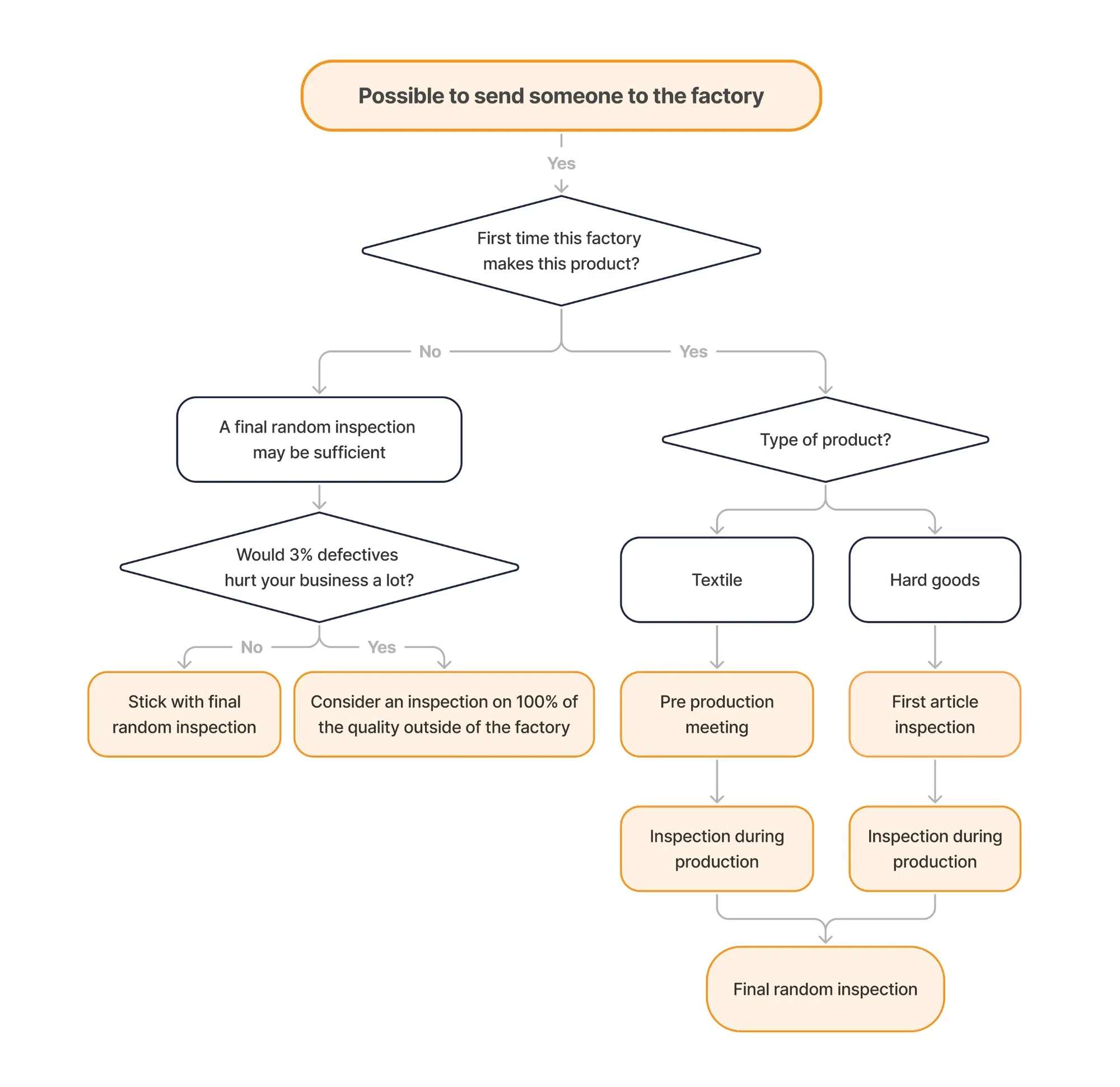
This flowchart and video summarize your product inspection choices

sofeast product quality inspection flowchart mar 25


Now get some suggestions for which product quality inspections are most suitable for you based on the situations outlined.


If you are unable to visit your supplier’s factory

Many factories in China and around Asia do not give access to third party staff, such as QC inspectors or customers like you due to covid restrictions. Furthermore, access to China is extremely limited in 2021 and so even visiting may be impossible anyway. However, it is still possible to check product quality:

  • Product samples can be sent to you or your inspection company for review.
  • QC inspectors can perform an ‘off-site inspection‘ where they have a live video call with your supplier’s factory staff and walk them through a few inspection steps while taking notes, finally reporting back and giving you assurances that your main requirements have been met.


If the supplier hasn’t made this product before

This is a risky scenario. You will usually benefit by performing a product quality inspection at an early stage in production. The goal here is to be proactive and put the factory in a position to reach your quality expectations from the start instead of reacting to finding bad quality pieces in a batch and then deciding whether to reject it or not.

For soft goods like apparel

A common approach is to have a “pre-production meeting” a day or so before sewing is set to start, in order to provide immediate feedback on the supplier’s readiness and cement in their minds what’s required from you. You can then follow it after a few days with an Inspection During Production (DPI) (which takes place when some of the finished pieces are off the line, let’s say around 10 to 30% of the run).

For hard goods, such as consumer electronics

Hard lines don’t have as much of a standard approach, but we suggest performing a First Article Inspection which, naturally, occurs on one of the first pieces off the line, and then follow it with an Inspection During Production (DPI) around 4 to 7 days later which will demonstrate that production is still going to plan.

The goals of the pre-production meeting and FAI are the same:

  • Confirming that your supplier is clear on what they’re doing and your expectations
  • Clarifying the forthcoming schedule
  • Detecting issues very early
  • Starting an investigation that will lead to fixes if any issues were found.

Lastly, conduct a FRI

Do you need to perform a final random inspection?

While it is advisable to perform these as standard if your budget allows, if very few issues have been found and the risks of packaging mistakes are low you could potentially skip it and save on costs. This will depend on how much you trust the supplier.


If the supplier has previously been making the same product

If your supplier has already been making the product at a quality standard that has reached your expectations, you probably don’t need to perform a rigorous product quality inspection program.

The exceptions to this rule will be if your order is worth a huge amount of money or the products you are having made pose risks to users if quality issues occur which you could be liable for, for example, children’s toys. In these cases, inspections at an earlier stage and throughout production will be safest.

If your product is pretty simple, such as a fairly common off-the-shelf consumer product, and your first order is a fairly small amount, then a final random inspection could be adequate.


If you can’t really tolerate defects in your products

If you can’t tolerate 2% or 3% of defective goods being shipped (which is a fairly standard defect rate), you need to plan for it early on when you’re sourcing a new supplier. Top-quality manufacturers will have a high MOQ and be fairly expensive. If you can sustain orders with them, then you can possibly demand such a low defect rate.

However, if your order quantities aren’t huge, realistic expectations are required as you may need to accept working with a smaller, less well-recognized supplier. Their MOQs may be lower, but they may also reject such a severe defect rate.

To give a couple of examples:

It is incredibly difficult to find a good T-shirt or promotional item manufacturer that will be interested in fulfilling an order of 500 pieces and will keep the proportion of defectives under 1%. Just accept it’s not realistic.

If you can’t work with a ‘top’ manufacturer but you still can’t accept a higher defect rate, what’s the solution?

In this case, you need to consider performing a 100% inspection outside of the supplier’s factory. Any defective pieces can be sorted out and only pieces that pass inspection will be shipped. Depending on your agreement with the supplier, defective pieces can be returned for a rebate, or reworked and then sent on to you.

*****

Got any questions about which inspection you need? Let us know, we’ll be happy to help advise!


More resources to help you decide which product QC inspections are right for you

Read these articles on our blog and QualityInspection.org:

QC Trends In 2021 (+ raw material costs and new product development)

QC Trends In 2021 (+ raw material costs and new product development)Sofeast’s CEO Renaud was recently a panellist on a fireside chat webinar from Global sources where he spoke about QC trends in 2021 and some other key topics that concern importers right now.

In case you missed this webinar, here are some of the key points he discussed:

Continue reading “QC Trends In 2021 (+ raw material costs and new product development)”

Vietnam VS China Manufacturers & Digitizing Processes In The Factory [Podcast]

Vietnam VS China Manufacturers & Digitizing Processes In The Factory [Podcast]

In This Episode…

Renaud interviews Greg Fleming, an experienced merchandising and manufacturing operations manager who went from New Zealand to Australia to China and finally is now based in Ho Chi Minh City in South Vietnam.

Greg’s background is mainly in the apparel trade, from fabric production to retail. Due to his experience in both Vietnam and China, he is well-placed to give us some really interesting insight into manufacturing in both countries.

Since Vietnam is a very popular China-alternative for many importers, let’s hear more about it from Greg here!


Just hit the play button to start listening..!

Listen to the episode right here 👇👇👇

🎧 Greg Fleming | Vietnam VS China Manufacturers & Digitizing Processes In The Factory 🎧


Show Notes

✅ Introducing the episode, Greg, and his experience

✅ What’s the COVID-19 situation in Vietnam? – Greg explains the stringent measures Vietnam is taking to control Covid, including thorough contact tracing, isolation, and the population’s ready acceptance of restrictions, such as mask-wearing.

✅ What are the main differences between working with Chinese or Vietnamese manufacturers? – Greg makes the point that manufacturing in Vietnam seems to have evolved to be more accomodating than China which can be more regimented, although this varies per region, so Vietnamese suppliers will do what they can to become a partner if you’re showing them similar flexibility. He suggests that honesty, openness, and clarity are the cultural differences between Vietnamese and (many) Chinese suppliers. For example, Chinese suppliers will often accept a contract even if they’re going to struggle to fulfill it, whereas those in Vietnam would usually apologize and walk away rather than disappoint you later.

✅ What have been the main obstacles that have prevented Vietnamese manufacturers from digitizing their processes? – 99% of multinationals in Vietnam have brought in some kind of IT systems (such as ERP, MES for managing the shop floor, PLM for new product development, etc), but on the factory floor, its use is probably at around only 5% because management and middle-management don’t understand it or see the value. This could be cultural as Vietnamese people are proud and don’t like new things forced on them, so when implementing it think about what the cultural and process change is that is going to relate to the uptake of IT.

✅ Is there a particular software Greg suggests for apparel based on his experience? – IT in apparel (soft goods) is very different from that used in hard goods because there are so many variations of SKUs that most ERPs don’t get. There are few apparel-specific ERPs, but the best at the moment is probably Coats Digital.  Greg endorses it because they have a really good apparel PLM (product lifecycle management), raw material libraries allowing you to create a BOM for multiple styles, the ability to create garment designs in 3D (remotely, which is helpful these days).

✅ How software can save on costs of getting a new apparel product from concept to production (example)  – an example of a study that found that it took 4.8 prototypes to go from concept to production-approved, so that’s around $20,000 to get everything sent between Asia and the USA, for example. This can be done using IT if the prototype designs are made and shared digitally in 3D, saving manufacturers a lot of money by doing everything in-country.

✅ How software can save on costs of getting a piece of new furniture from concept to production (example)  – centric PLM software is good for furniture as, in Greg’s opinion, it’s as complicated as garments. This is due to its size and shape, so the dimensions need to be precise when considering shipping them in containers. But as well as the need to get dimensions exact, there are also numerous safety considerations and laws for furniture to comply with, such as bookshelves having a mechanism that allows them to be attached to walls to not tip over and harm children. Key takeaway: select what’s right for you when starting on a digital transformation.

✅ When starting the digital transformation on a factory, where to begin? – The focus is on using IT to reduce wasted time and costs. A Vietnamese factory doesn’t want to receive emails from customers asking what is going on. Developing a digital tech pack providing detailed information and specifications about a product is a key task, as is deciding on what’s acceptable or not in new products, such as colors. On color and pre-production samples, Greg gives the example of brands in the West spending around $500 per time to send color swatches between Vietnam and the West for checking which is an avoidable cost. Datacolor color management software can be used to create the pre-production garment sample in the right color and is a far cheaper workaround to sending swatches between countries each time (as long as the final sample is within an acceptable delta of the agreed color). In his experience, machines have proven to be more reliable in recognizing the right colors than humans anyway. Eventually, a pre-production sample should be made, but only after the product is 95-98% agreed and ready in its digital form. Then this can be modeled in the factory and demonstrated to the customer via video conference rather than spending hundreds of dollars to ship it. This is a more efficient way to evolve how the garment trade operates.

✅ Summarising Greg’s approach of implementing IT  – the goal is to reduce the cost of doing business at the product development stage that allows a factory to implement mass-customization to facilitate what a merchandise financial planner needs today, that is to say, to be flexible on styles and order amounts. IT gives you the ability to order in smaller quantities, but many components require quite complex software which can’t be handled in excel, email, or by sending packages back and forth.

✅ Is there a risk that some importing countries will start to demand more proof that products are truly made in the country claimed, materials are not from certain contentious areas, they are sustainable, etc? What is the solution to this? – EU laws are coming in soon that will require exporters to prove the country of origin of their products. In the case of Vietnamese garments where 80+% of materials used come from outside of Vietnam (mainly China), this leaves them in a difficult situation. Customs may no longer accept invoices for materials etc as proof of origin due to fears over counterfeiting. Therefore, Greg suggests that blockchain-based IT software (which is already being invested in by the largest players) is the best way to mitigate the risks of counterfeiting in this situation and be able to comply.


Related content…

Remember, our company Sofeast provides most of our solutions in Vietnam, such as product inspections and factory audits. If you are importing from Vietnam and need assistance, we can help. Visit our website at Sofeast.com.


Listen, rate, & subscribe to the ‘China Manufacturing Decoded’ podcast on your favorite provider 👍

There are more episodes to come, so remember to rate us and subscribe! You can find us on:

If you enjoyed this episode, don’t forget to give us a ⭐️⭐️⭐️⭐️⭐️ rating and share it with your network if you enjoy listening! 😊

Chinese Copycats: A Real Problem For Entrepreneurs?

Chinese Copycats: A Real Problem For Entrepreneurs?

IP protection is always a concern for businesses and entrepreneurs, especially when manufacturing an innovative new product. Chinese copycats, or fast followers, are a threat to your new product and business as these vendors may mobilize quickly to copy and produce it, and bury your online presence with a deluge of ads, pages, videos, etc.

Let’s explore how these Chinese copycats operate with a real example so you can be aware of the risk. We’ll also look at some ways to protect your IP, too…

Continue reading “Chinese Copycats: A Real Problem For Entrepreneurs?”

Plastic, Silicone, Steel, and Others: Updated China Raw Materials Costs (May ’21)

As you may be aware, many China raw materials are increasing in costs quickly these days. Rising material costs are putting pressure on small manufacturers in China already, and prices are forecast to keep rising this year.

We’re tracking the raw material costs for some key materials and this month’s graph paints a concerning image:

china raw materials cost graph may 21

As you can see, most of the gains in prices of the previous months haven’t been lost. It has become the ‘new normal’, with relative stability throughout April.


Will this rising trend continue?

According to this article from the SCMP, metal prices are expected to increase 30 percent and agricultural prices to rise almost 14 percent this year, which is no joke if margins are already tight, and that’s just two categories.

What is causing this phenomenon? There seems to be no one answer. Here are some of the causes that might be at play:

  • A rise in demand. For example, much has been written about the higher-than-projected production of cars and consumer electronics, leading to shortages of chips. But these products also necessitate metals, plastics, rubber, and so on. In addition, many companies may have reconstituted their stock.
  • Constrained supply. To increase the amount of copper on the market, for example, not only the mines but the different transformation actors along the supply chain may have to invest in growing capacity.
  • Anticipation of global inflation. Some economists point to the side effects of the massive government spending plans in the USA and in the EU.


How to combat the rising costs?

There are some options you could follow, such as:

  • Source cheaper suppliers – in apparel this is more common, but in other industries where margins are tight, it may be counterproductive. Instead, attempting to reduce production costs may be more achievable.
  • Re-engineer cost drivers without removing value for customers – this would be altering the design of a product to use fewer components while assuring that the product still delivers the same benefits.
  • Develop new versions of your key products – increasing your prices may only be possible if you find ways to differentiate products by eliminating features or results of the current product that consumers have shown they don’t like from the newer version, for example.

These are just 3 examples in summary, but there are even more…

Read about these cost-reducing tips in this post: Rising Raw Material Prices: What Strategy To Follow? (6 Approaches)


We hope this is helpful. Our mission at Sofeast is to help importers have transparency in their supply chain and to give them more control. And this information is critical to have some visibility into your manufacturer’s costing.

By the way, you can always contact us if you have any questions about whether a manufacturer’s quote is reasonable.