Why Smart Devices Fail CE RED or FCC Testing & How to Prevent It

For many companies developing smart devices, passing CE RED or FCC Testing based on their requirements is one of the last steps before products can legally be sold in Europe or the USA. Unfortunately, too many projects hit a wall here.

The product may “work” perfectly, but if compliance wasn’t considered early enough in the design process, there is a high chance of getting a ‘fail’ test result. And the consequences are serious: extra costs, long delays (sometimes 2 months or more), frustrated investors, and early customers who cancel their orders.

At Sofeast, we’ve seen this pattern again and again, particularly among startups and SMEs rushing to market. The good news is that most failures are predictable and preventable.


Why Devices Fail Certification

Certification labs don’t test whether your smart device powers on or connects to Bluetooth. They test for electromagnetic compatibility (EMC), grounding, shielding, and many other things. These issues are often assumed to be ‘alright’ by design teams.

For example, some common culprits for failed EMC testing are:

  • Enclosures that leak or poorly direct emissions.
  • RF modules (e.g. BLE, Wi-Fi) that are placed too close to metal or grounded parts.
  • Firmware that produces current spikes or harmonics when stressed.

When enclosure design, RF layout, and firmware are not aligned, certification failure is almost inevitable.

When it comes to electrical safety, the lack of sufficient safeguards to prevent users is usually the cause of the issue. A few examples from recent projects we got involved in include:

  • A glass part that breaks too easily in an impact test
  • Poor selection of a power supply unit, with insufficient clearance on the PCB
  • An enclosure that is too flammable

(By the way, we have shot an entire series of videos on IEC 62368-1, and it will give you an idea for the breadth of risks considered by such a standard.)

The Real Cost of Failing CE RED or FCC Testing

We’ve supported companies that only discovered problems after tooling and pilot runs were completed. At that stage, options are painful:

  • Redesigning enclosures, picking new critical components, re-designing the electronics: sometimes upwards of $50K in rework.
  • Delayed pilot production: months lost getting to market.
  • Repeat testing costs: sometimes 10,000 USD or more.

It’s not just about money. Missing a crucial Christmas season is a serious blow. Competitors can catch up, investors may lose confidence, and your product roadmap gets derailed.

A Smarter Approach: Build Compliance into the Design

Compliance is not a box to tick at the end; it should guide your decisions from the concept stage. That’s why we recommend a proactive approach:

  • Early BOM reviews: identify critical-to-compliance components, be clear about the requirements, and look for pre-certified or pre-tested components whenever possible.
  • Early design (including ‘design for manufacturing’) reviews: ensure good practices are followed.
  • Run simple tests in-house if possible, for quick adjustments.
  • Pre-compliance scanning & testing: get a competent lab to review some samples for the most likely issues. It is better if that lab is the same as the one you will use for validation testing and (if applicable) certification.

Now, realistically, a design team cannot be an expert in every safety requirement for every product. When it comes to electrical home appliances, for example, the standard for a grill is different from that of a hair drier or a washing machine. But trying to follow the advice outlined above always improves the odds of your project!

Why You Can’t Rely on the Factory

It’s tempting to assume your manufacturer in Asia will make sure your product passes CE/FCC. But their responsibility is to build what you asked for. If compliance wasn’t designed in, they can’t do anything about it…

Ultimately, compliance is your responsibility as the importer. Leaving it to the factory is a recipe for failure.

Conclusion

Compliance test failures don’t happen by chance; they almost always come from predictable design & sourcing oversights.

Analyzing Different types of Testing Labs and their Activities [Podcast]

Adrian and Renaud dive deep into the world of product testing, sharing information about the best types of testing labs for different needs. They explore the three main types of testing labs—calibration, compliance, and reliability—and discuss when each is applicable, why they’re important, and how they support different stages of product development. From consumer goods to industrial equipment, this conversation provides listeners with practical tips to ensure product quality and safety.

The episode covers key factors to consider when evaluating testing labs, including certifications, accreditations, and standards like ISO 17025. Adrian and Renaud also discuss how testing requirements differ across industries and products, and they share valuable insights into creating effective test plans.

This episode equips you to understand the types of testing labs available, and what they concentrate on.


Listen to the episode here

Listen: to the podcast episode

Watch: on Youtube


Episode sections

  • 00:00: Introduction and Overview
  • 00:17: Types of Testing Labs: Calibration, Compliance, and Reliability
  • 04:30: Calibration Testing in Detail
  • 10:50: Compliance Testing and Certifications
  • 18:00 – Reliability Testing and Customization
  • 25:30: Understanding Lab Accreditations and Standards
  • 32:45: Wrapping Up

We invite listeners to a free upcoming webinar on November 14th, where Renaud will be speaking about maximizing manufacturing efficiency and backer management for crowdfunding projects. This event promises to provide further insights into product development and quality management for product launches.


Related content…


Listen, rate, & subscribe to the ‘China Manufacturing Decoded’ podcast on your favorite provider

More episodes are coming, so remember to rate us and subscribe! You can find us on:

Common Compliance & Recall Risks for Packing Materials Sold in the EU & UK (22/23)

Common Compliance & Recall Risks for EU & UK Packing MaterialsSofeast commissioned some research recently on which chemical compliance incidents occurred in EU countries in the past year 22/23, the substances found, where, and the actions taken by authorities.
Let’s look at packing materials which were found to be non-compliant by market surveillance authorities. Packaging materials could be made of plastic, card, or metal, depending on how they’re used, therefore, there is scope for all kinds of problems.

Note: we only cover chemical compliance in this article.


[ez-toc]


What are the key applicable regulations & directives?

In general, we investigated these common regulations and standards that market surveillance authorities tend to check products against:


Market surveillance on chemical substances: recalls and withdrawals from market

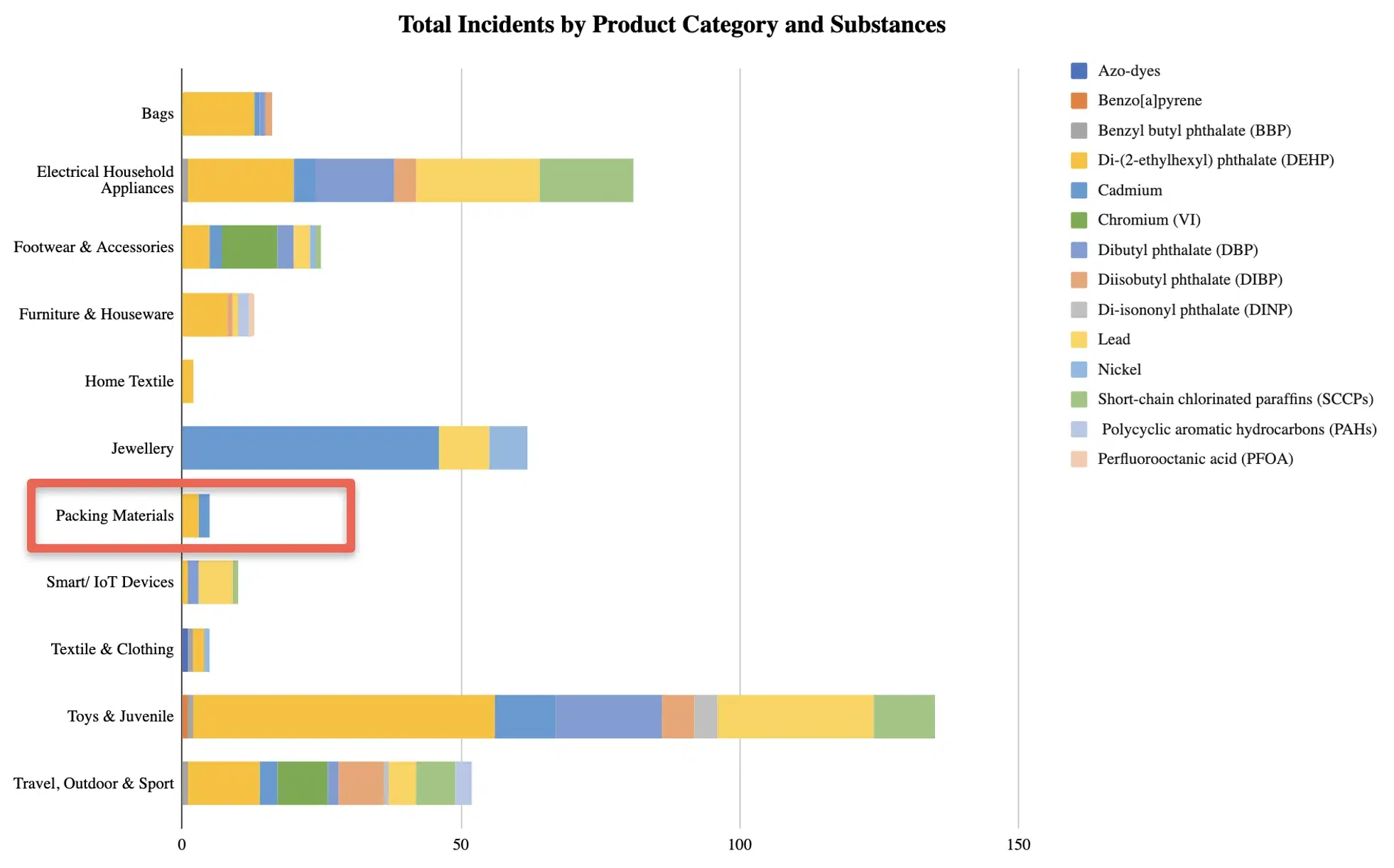
Compared to consumer goods, packing materials had relatively few chemical compliance incidents during the year 22/23 with only 5 incidents logged that we found:

packing materials total incidents
These incidents were due to the detection of the following substances:

  • Di-(2-ethylhexyl) phthalate (DEHP) (most comm, and often in plastics) x3 
  • Cadmium (likely in metal parts) x2

Phthalates are plasticizers added to plastics to increase strength, durability, flexibility, and transparency. They’re banned or restricted because they’ve been scientifically shown to disrupt hormones and cause birth defects and are banned under RoHS.

Cadmium is a toxic metal often found in metal parts and is a common by-product of zinc production. However, it’s one of the RoHS-banned substances because it is a toxic carcinogen.


Which regulations were not complied with and by whom?

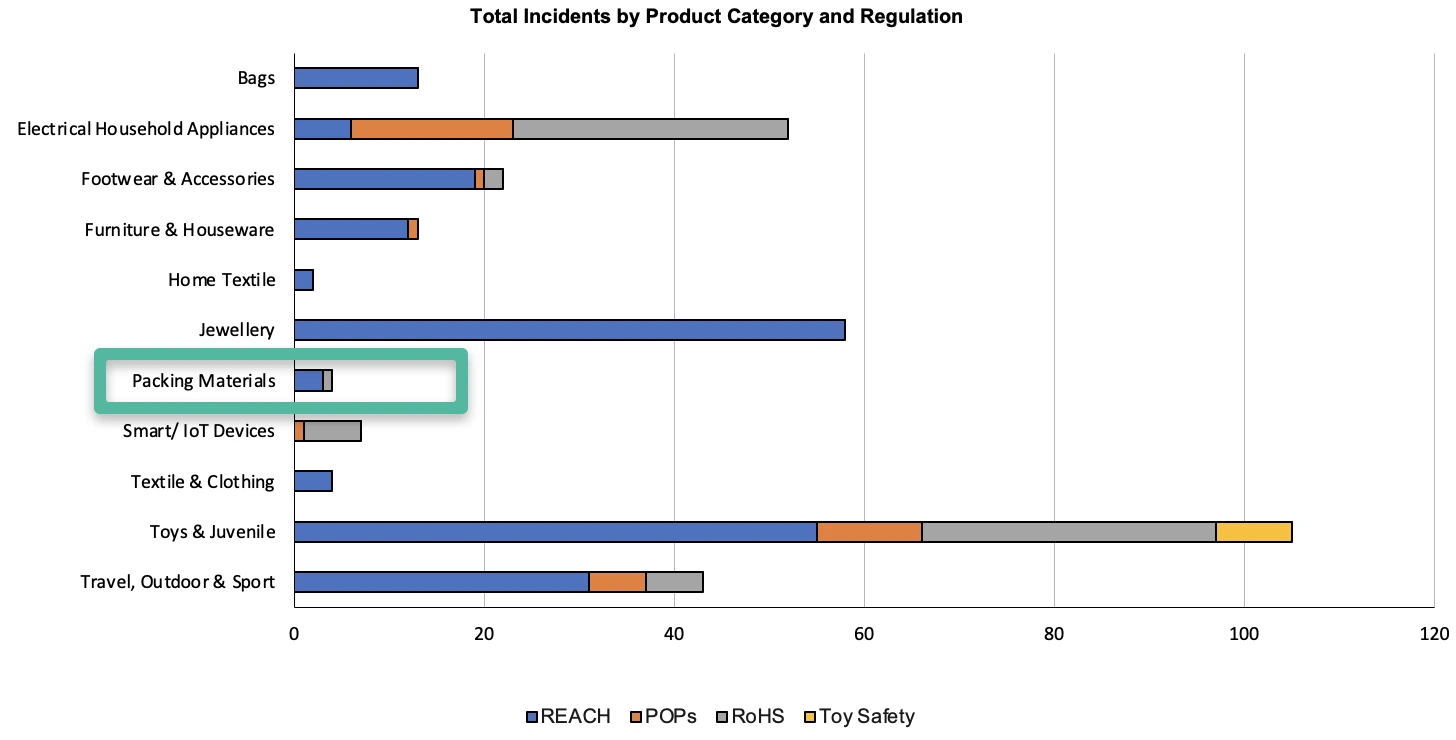
The packing materials were mainly in breach of REACH which regulates the use of harmful chemicals in most products, but one also failed to comply with RoHS which regulates the use of certain hazardous materials in the manufacturing of electrical and electronic products.

The offending packaging was all found to come from the PRC. While that’s probably not a surprise as most of the non-compliant products in general were from there, it still serves as a warning if that’s your manufacturing base.

total incidents packing materials
What steps did the authorities take?

Once again, Scandinavia takes the mantle of being strict on products at the border. In this case, only Sweden found issues with packing materials:

  • Sweden 4x (1 RoHS & 3 REACH)

All of these non-compliant packing materials were withdrawn from the market.


General advice to reduce such risks

Make sure you work with suppliers who are aware of the regulations in the countries where the devices are to be sold.

Ask your supplier for confirmation that every material is compliant, with testing reports if possible as evidence.

If you have a doubt, run a risk analysis (and the list of most common issues found, as laid out above, will be useful) and take action. It could mean that you select the suppliers of certain materials directly (and you ensure those are reputable manufacturers that show evidence of compliance) and/or you run some laboratory tests.

Finally, if you are still unhappy about the product’s risk profile, you may have to re-design it and choose less risky materials.


What can importers of packing materials learn from this data?

First of all, this information should be of concern to most importers, because your product is likely to be packaged somehow and this may be checked by market surveillance authorities for compliance with chemical safety requirements. How many products are sold with some kind of plastic packaging today, for example? And, as we know, there is always a danger that plastics will contain banned phthalates if not other substances.

So, even if packing materials aren’t your main import, it pays to ensure that they’re not manufactured with hazardous and restricted chemicals…and, if your suppliers are Chinese, be extra vigilant and do your due diligence on the packaging before the shipment leaves the factory.

Common Compliance & Recall Risks for IoT Devices Sold in the EU & UK

Common Compliance & Recall Risks for IoT Devices in the EU & UK.Sofeast commissioned some research recently on which chemical compliance incidents occurred in EU countries in the past year 22/23, the substances found, where, and the actions taken by authorities.
Let’s look at issues found in IoT Devices by market surveillance authorities. These products are usually consumer electronics and as such will use plastics, metals, electrical components, and other materials in which manufacturers sometimes use restricted and banned chemicals.

Note: we only cover chemical compliance in this article.


[ez-toc]


What are the key applicable regulations & directives?

In general, we investigated these common regulations and standards that market surveillance authorities tend to check products against:

IoT devices could have problems with all of the above because, aside from REACH, RoHS, and POPs, some children’s toys are also IoT devices these days.


Market surveillance on chemical substances: recalls and withdrawals from market

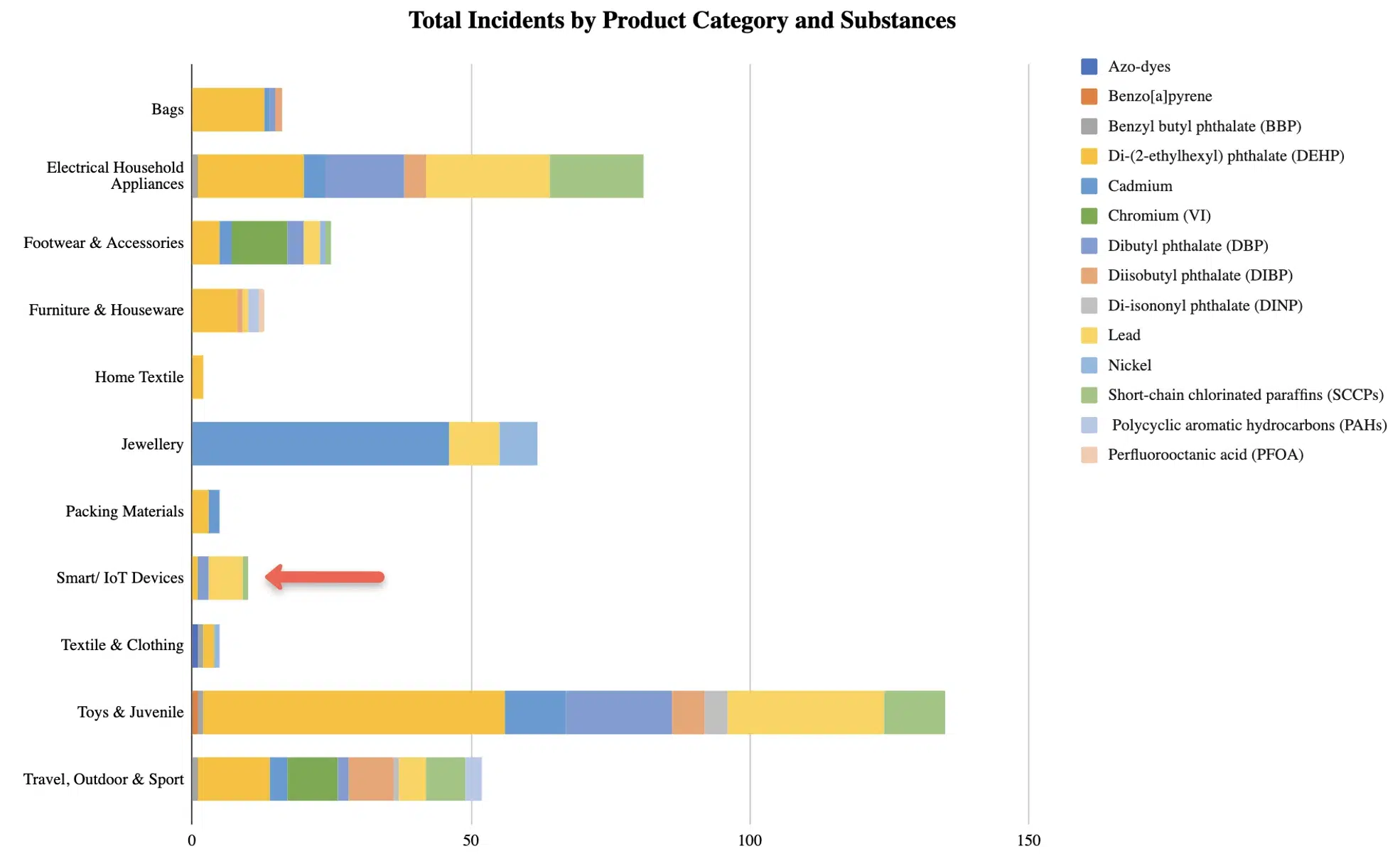
IoT devices only had a relatively modest number of incidents discovered in 22/23, however, this still provides some information importers can learn from:

iot devices incidents substances
These banned substances were found in the devices which were USB chargers, earbuds, and a camping shower:

  • Short-chain chlorinated paraffins (SCCPs)
  • Di-(2-ethylhexyl) phthalate (DEHP) (most comm, and often in plastics)
  • Cadmium (likely in metal parts)
  • Lead (likely in soldering)

Phthalates are plasticizers which are added to plastics to increase strength, durability, flexibility, and transparency. They’re banned or restricted because they’ve been scientifically shown to disrupt hormones and cause birth defects and are banned under RoHS.

Short-chain chlorinated paraffins have historically been used as plasticizers and fire retardants, but they are toxic carcinogens that accumulate in the body without being flushed out and cause damage to health and the environment.

Cadmium is a toxic metal which is often found in metal parts and is a common by-product of zinc production. However, it’s one of the RoHS-banned substances because it is a toxic carcinogen.

Lead is also a toxic metal and is banned in products due to its toxicity, especially the damage it does to the nervous system, cognitive development, and health in general, especially in children. It is sometimes used as a stabilizer, in solder, and is useful due to its malleability, corrosion resistance, and more.


Which regulations were not complied with and by whom?

iot regulations incidentsIn the several incidents involving IoT devices, most broke the RoHS regulation and some also consisted of banned POPs. The majority of the offending products were from China, with a couple of unknown origins.

What steps did the authorities take?

It should be noted that the incidents were picked up by market surveillance authorities from different Scandinavian EU countries who seem to be particularly hot on upholding these regulations:

  • Sweden 5x (RoHS & POPs)
  • Norway 1x (RoHS)

Authorities took several steps to reduce the risk posed by the devices that were in breach of regulations:

  • 2 were withdrawn from the market (in Norway and Sweden)
  • 4 had their online marketplace listings taken down (Sweden)


General advice to reduce such risks

Make sure you work with suppliers who are aware of the regulations in the countries where the devices are to be sold.

Ask your supplier for confirmation that every material is compliant, with testing reports if possible as evidence.

If you have a doubt, run a risk analysis (and the list of most common issues found, as laid out above, will be useful) and take action. It could mean that you select the suppliers of certain materials directly (and you ensure those are reputable manufacturers that show evidence of compliance) and/or you run some laboratory tests.

Finally, if you are still unhappy about the product’s risk profile, you may have to re-design it and choose less risky materials.


What can importers of IoT devices learn from this data?

As with many consumer electronics, IoT devices often contain metal, plastics, and electronic components, and all of these are prone to including banned substances like metals and phthalates because, despite their toxicity for humans and the environment, they can make manufacturing easier or improve certain functions due to their positive properties. Manufacturers in Asia who are cutting corners may still use them, as we’ve seen with some of these devices.

If your product includes plastics and metals like these IoT devices, you need to make sure you work with experienced and well-organized suppliers who give you some transparency into what they are buying. Otherwise, risks are too high and lab testing for compliance is a must.

Once again, Scandinavia can be seen to be checking incoming products for chemical compliance quite strictly.

Common Compliance & Recall Risks for Electric Household Appliances Sold in the EU & UK

Sofeast commissioned some research recently on which chemical compliance incidents occurred in EU countries in the past year 22/23, the substances found, where, and the actions taken by authorities.
Let’s look at issues found in electric household appliances by market surveillance authorities. There were a range of problems found in all sorts of appliances, and since today’s electrical devices use so many different types of materials and are imported in such huge volumes, buckle up, it’s going to be a ride!

Note: we only cover chemical compliance in this article, but it is one of the most important compliance aspects for electric household appliances in general.


[ez-toc]


What are the main applicable regulations & directives?

In general, we investigated these common regulations and standards that market surveillance authorities tend to check products against:

Electric household appliances could potentially fail to comply with all of the above, especially the first three.


Which regulations didn’t electrical appliances comply with?

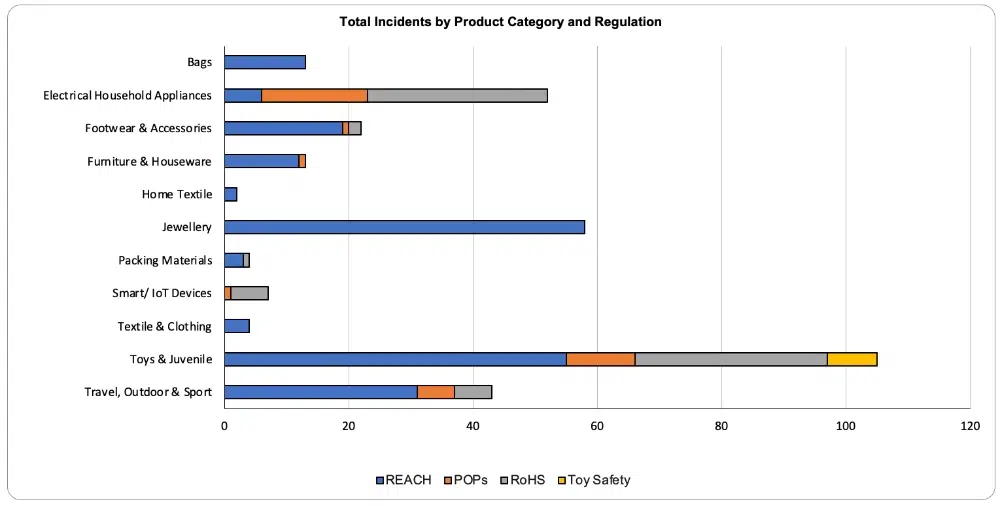
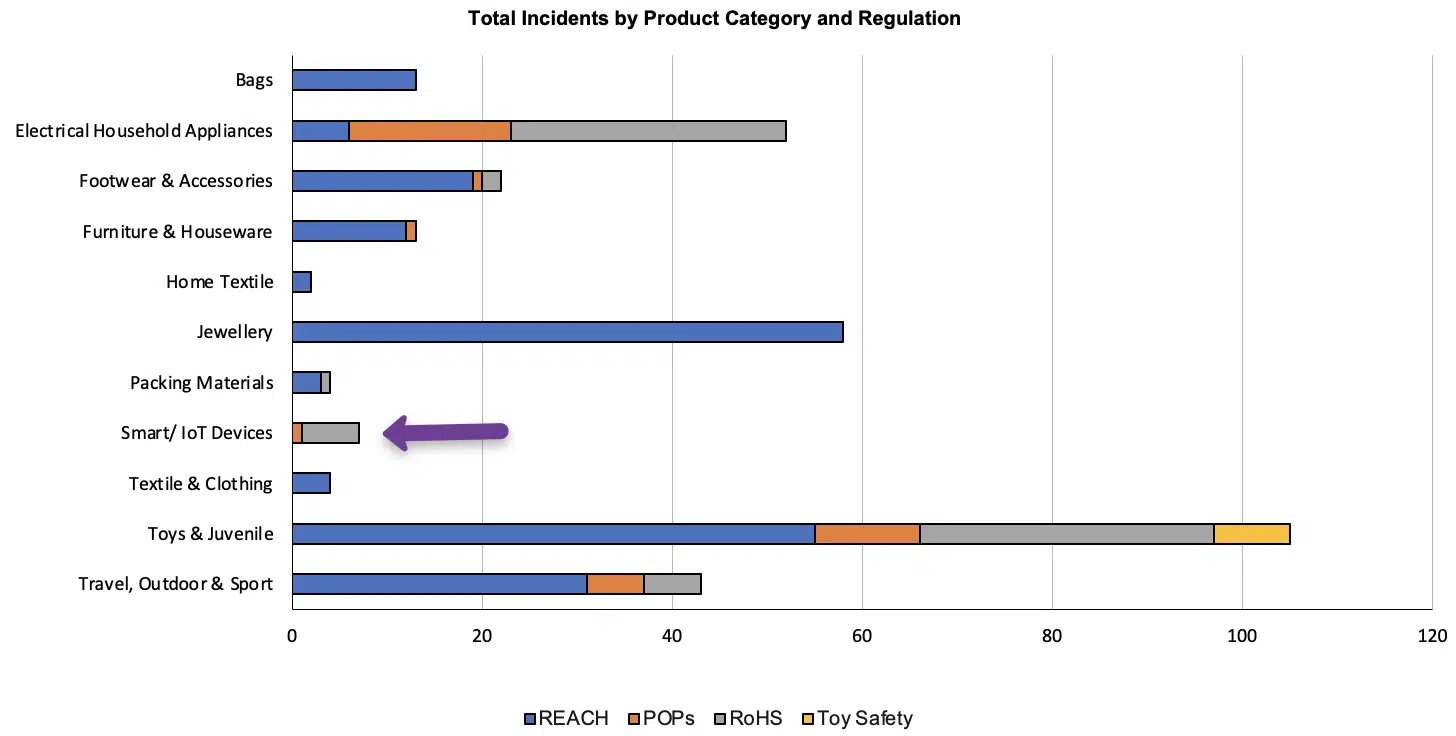
Electrical household appliances were one of the top offending product types where compliance issues were found, only toys and children’s products and jewellery were found to have more (and toys will usually always be scrutinized more by market surveillance authorities due to their nature):

total compliance incidents per product category 22 23

In total, products were found to have these problems:

  • REACH – 6
  • RoHS – 29
  • POPs – 17

In some cases, a single product may have failed to comply with more than one of these regulations.


Many restricted substances found in materials often used in electric household appliances

Today’s consumer electronics used in the home commonly use all kinds of plastics and metals. Unfortunately, these are materials that also proved to be risky when it comes to restricted substances being used by manufacturers:

common restricted substances found per material eu uk imports 22 23
Not every instance you see above occurred in electric household appliances, but it does demonstrate that plastics, metals, and metal alloys are particularly problematic materials that you need to be wary of when sourcing and testing for your product.

Household appliances specifically had these restricted substances in them

We can go deeper and show you exactly which restricted substances were found:

restricted substances found in home appliances 22 23

These substances were detected:

  • Benzyl butyl phthalate (BBP)
  • Di-(2-ethylhexyl) phthalate (DEHP)*
  • Cadmium
  • Dibutyl phthalate (DBP)*
  • Diisobutyl phthalate (DIBP)
  • Lead*
  • Short-chain chlorinated paraffins (SCCPs)*

*(Most commonly found. There are many more harmful substances that might be found in electrical devices like these, but at least you can be aware that the above are problems and tell your suppliers to avoid them.)

Why these substances are harmful?

Phthalates are plasticizers which are added to plastics to increase strength, durability, flexibility, and transparency. They’re banned or restricted because they’ve been scientifically shown to disrupt hormones and cause birth defects and are banned under RoHS.

Cadmium is a harmful metal which is often found in metal parts and jewellery as it is a by-product of zinc production, a metal commonly found in these types of products. However, it’s one of the RoHS-banned substances because it is a toxic carcinogen.

Lead is a toxic metal which is known to cause damage to the kidneys and nervous, cardiovascular and reproductive systems, among other illnesses. Lead can be used in solder and is also found in other electrical components and product coatings.

SCCPs are a type of POP that damages multiple organs including the liver, kidney, and thyroid. They are found in electrical devices because they’re often used in metalworking, and they’re also used as plasticizers and flame retardants.


Market surveillance actions taken: recalls and withdrawals from the market

The 30 actions taken can be broken down into the following responses by market surveillance authorities:

  • Withdrawn from market – 18
  • Product listing removed from the marketplace – 10
  • Distributors/retailers stopped selling the product – 2
  • Product banned from being marketed – 1

Interestingly the problems didn’t result in product recalls or products being rejected at the border.

It should be noted that the incidents were picked up by market surveillance authorities from different EU countries:

  • Germany 3x
  • Luxembourg 2x
  • Norway 9x
  • Poland 4x
  • Sweden 40x

Once again, we can see that the Swedish authorities seem to be particularly hot on detecting non-compliant products.

Where did the offending products come from?

The vast majority of the incidents were found in products made in the PRC, but a couple were made in Poland.


General advice to reduce such risks

Make sure you work with suppliers who are aware of the regulations in the countries where the bags are to be sold.

Ask your supplier for confirmation that every material is compliant, with testing reports if possible as evidence.

If you have a doubt, run a risk analysis (and the list of most common issues found, as laid out above, will be useful) and take action. It could mean that you select the suppliers of certain materials directly (and you ensure those are reputable manufacturers that show evidence of compliance) and/or you run some laboratory tests.

Finally, if you are still unhappy about the product’s risk profile, you may have to re-design it and choose less risky materials.


Read about the chemical compliance risks of other product types

Common Compliance & Recall Risks for Bags Sold in the EU & UK

Common Compliance & Recall Risks for Bags Sold in the EU & UK


Sofeast commissioned some research recently on which chemical compliance incidents occurred in EU countries in the past year 22/23, the substances found, where, and the actions taken by authorities.

Let’s look at issues found in bags by market surveillance authorities. This is understandable because they commonly use leather, plastic, and metal parts, three materials where banned or restricted substances can often be found if manufacturers haven’t followed compliant industry regulations.

Note: we only cover chemical compliance in this article, but it is probably the most important compliance aspect for bags in general.


[ez-toc]


What are the main applicable regulations & directives?

In general, we investigated these common regulations and standards that market surveillance authorities tend to check products against:

For bags, we would expect to find them fall foul of REACH, RoHS, and POPs.


Market surveillance on chemical substances: recalls and withdrawals from market

As you can see, bags were not the product type with the most incidents discovered, but we can learn about their niche from the data:

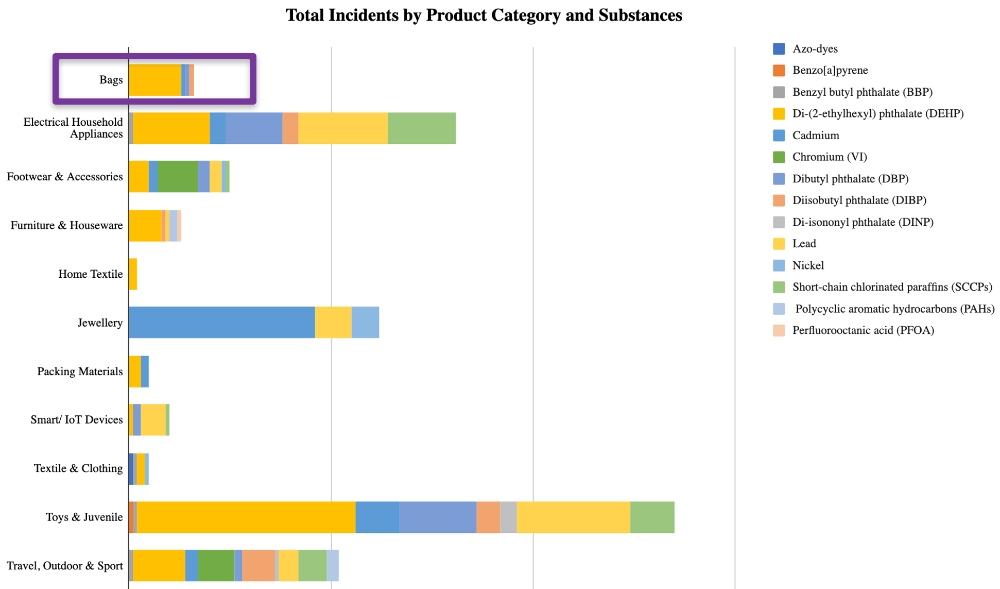
bags chemical compliance incidentsThese banned substances were found in bags:
  • Di-(2-ethylhexyl) phthalate (DEHP) – most commonly
  • Cadmium (likely in metal parts)
  • Dibutyl phthalate (DBP)
  • Diisobutyl phthalate (DIBP)

Phthalates are plasticizers which are added to plastics to increase strength, durability, flexibility, and transparency. They’re banned or restricted because they’ve been scientifically shown to disrupt hormones and cause birth defects and are banned under RoHS.

Cadmium is a harmful metal which is often found in metal parts and jewellery as it is a by-product of zinc production, a metal commonly found in these types of products. However, it’s one of the RoHS-banned substances because it is a toxic carcinogen.

Which regulations were not complied with and by whom?

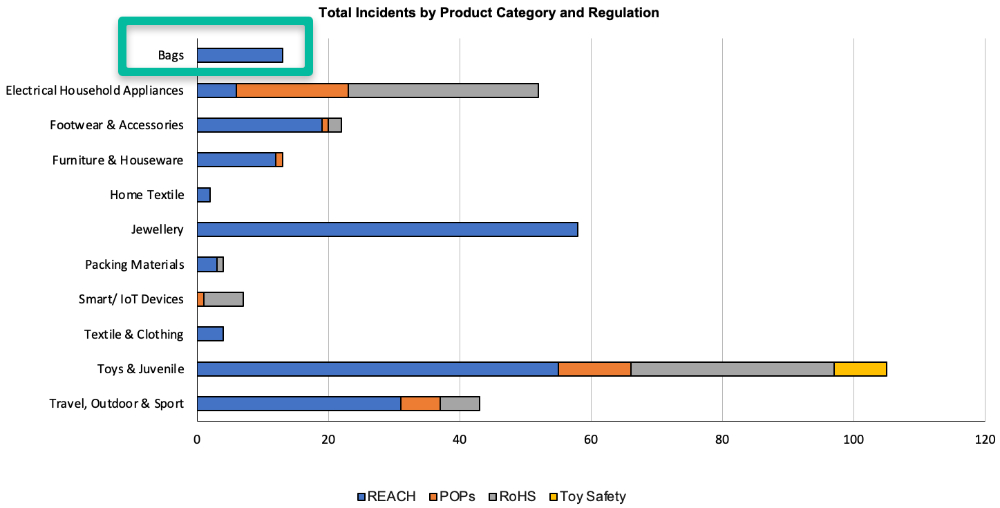
incidents and materials per product categoryIn the 13 incidents we found connected to bags, only the REACH regulation was found to have been breached due to the nature of the substances found.
12 of the incidents occurred in bags from the PRC, while one was of an unknown location.

What steps did the authorities take?

It should be noted that the incidents were picked up by market surveillance authorities from different EU countries:

  • Estonia 1x
  • Hungary 9x
  • Italy 1x
  • Poland 1x
  • Sweden 3x

Authorities took several steps to reduce the risk posed by the offending bags:

  • 6 were withdrawn from the market.
  • 2 were recalled from end users.
  • 3 had their online marketplace listings taken down.
  • 5 were banned from being marketed moving forward along with accompanying measures.
  • However, in this case, none were stopped and rejected at the border.


General advice to reduce such risks

Make sure you work with suppliers who are aware of the regulations in the countries where the bags are to be sold.

Ask your supplier for confirmation that every material is compliant, with testing reports if possible as evidence.

If you have a doubt, run a risk analysis (and the list of most common issues found, as laid out above, will be useful) and take action. It could mean that you select the suppliers of certain materials directly (and you ensure those are reputable manufacturers that show evidence of compliance) and/or you run some laboratory tests.

Finally, if you are still unhappy about the product’s risk profile, you may have to re-design it and choose less risky materials.

Component-Level Testing And Its Benefits

Join Andrew Amirnovin, Sofeast’s reliability expert and our head of New Product Development, on a deep dive into what component-level testing is, the process followed for selecting and testing components that won’t let you down, and the various benefits you’ll get by doing this during the product design and development process.


Listen to the episode here 👇

Listen: to the podcast episode

Watch: on Youtube


Episode sections

  • 00:00 – Greetings and introducing today’s topic.
  • 01:21 – What is the difference between component-level and product-level testing?
  • 08:14 – What’s the component qualification process?
  • 15:59 – The 10-point component testing and evaluation process. 
  • 36:13 – Why businesses and entrepreneurs bringing a new product to market shouldn’t be expected to have the testing expertise in-house and what we do to help.
  • 40:18 – Examples of problems that might occur if component testing is not done properly.
  • 43:37 – Do YOU need to decide on and do all types of component-level testing?
  • 47:10 – Wrapping up.


Related content…


Listen, rate, & subscribe to the ‘China Manufacturing Decoded’ podcast on your favorite provider

More episodes are coming, so remember to rate us and subscribe! You can find us on:

If you enjoyed this episode, don’t forget to give us a 5* rating and share it with your network if you enjoy listening!

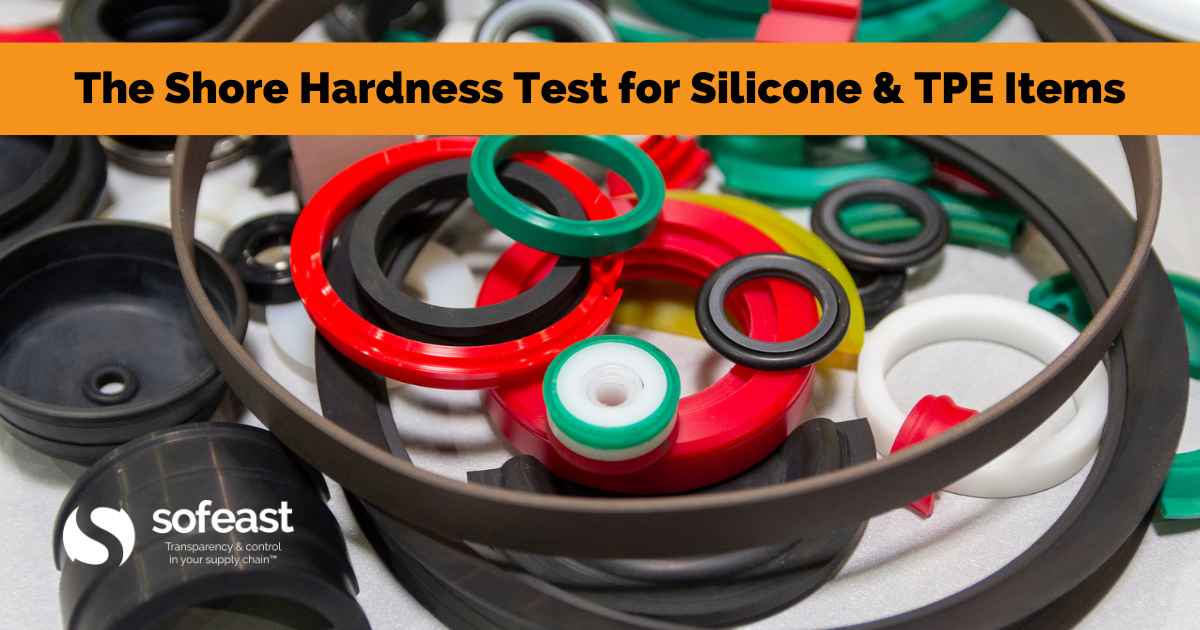
The Shore Hardness Test for Silicone and TPE Items

In this post, we’ll show you how to check the hardness of soft silicone and TPE parts and items with the Shore hardness test. Much of the time the hardness (or softness as it may well be seen) of these items is critical, as they need to have a certain level to reach their expected level of functionality or their applications, quality standard, performance in terms of durability, and ability to comply with industry regulatory standards.

There is a certain scale used, the Shore hardness scale, so let’s get acquainted with this and learn how to check the Shore hardness of silicone and TPE items here.

Continue reading “The Shore Hardness Test for Silicone and TPE Items”

List of Textile Testing Labs in South India (10 options)

[vc_row][vc_column][vc_single_image image=”15041″ img_size=”full”][vc_column_text]India is a well-known source of textile fabrics, apparel, and other softlines. It is competitive with other producers such as Bangladesh, Vietnam, China, etc. So in complement to the manufacturers, there are also plenty of textile testing labs in India that you can use to check and confirm the quality and compliance of products you are buying.

What normally happens during textile testing?

There are a lot of standards that are related to certain types of textile fabrics, accessories, and garments. Your lab should be aware of the kinds of standards your product and market will require for compliance and quality, but it’s also a good idea for buyers to research them in advance — ideally from the product design stage.

For example, here are just a few standards:

  • REACH – analytical analysis for presence of restricted substances
  • ASTM D2061 Standard Test Methods for Strength Tests for Zippers
  • BS EN ISO 11641:2012 Leather. Tests for colour fastness. Colour fastness to perspiration
  • ASTM-D6614 Standard Test Method for Stretch Properties of Textile Fabrics – CRE Method
  • ISO 283 Textile conveyor belts — Full thickness tensile strength, elongation at break and elongation at the reference load — Test method

Specific tests have been developed for nearly all aspects of your textile products. Accessories like zippers on apparel, but also other types of textiles like material products and leather.

Labs may carry out the testing using chemical analysis equipment, physical stress equipment, and visual checks.

Read more in these resources:

[/vc_column_text][/vc_column][/vc_row][vc_row][vc_column][vc_column_text]

List of South Indian textile testing labs

We’ve selected 10 textile testing labs in India for you centered around the south of the country where our office is based and many of the best labs can be found.

Please note, we have concentrated on providing laboratories that are certified by the NABL (India’s National Accreditation Board for Testing and Calibration Laboratories) as these are more credible choices.[/vc_column_text][vc_tta_accordion color=”white” c_align=”center” active_section=”1″][vc_tta_section title=”1. AZO Textile Testing Laboratory” tab_id=”1646668852575-7e58d1db-86bd”][vc_column_text el_class=”t-center li-aero”]

  • Location: Tirupur, Tamil Nadu
  • Website: http://www.azolab.com/index.php
  • Founded: 1997
  • Staff: 10
  • Testing Services: Color Fastness Testings Service, Chemical Analysis Testing Services, Water Analysis Testing Services, Chemical Analysis Services, Color Fastness Testing Services
  • ISO 9001 certification status: Yes 
  • NABL: Yes
  • Contact email/phone: info@azolab.com/ 9244302610
  • Export license (N)
  • Testing  lead time: 1 week 

[/vc_column_text][/vc_tta_section][vc_tta_section title=”2. The South India Textile Research Association” tab_id=”1646669553225-56aa4b5c-ed96″][vc_column_text el_class=”t-center li-aero”]

  • Location: Coimbatore, Tamil Nadu 
  • Website: https://sitra.org.in/
  • Founded: 1956
  • Staff: 100 to 200
  • Testing Services: Medical Textile Services, Chemical Testing, Accessories and Woven & Knitted Testing, Calibration, Textile Services and Training Programs Services, etc
  • ISO 9001 certification status: Yes 
  • NABL: Yes
  • Contact email/phone: info@sitra.org.in/ +91-422-2574367
  • Export license (N)
  • Testing  lead time: 1 week 

[/vc_column_text][/vc_tta_section][vc_tta_section title=”3. AGS India LABORATORIES PRIVATE LIMITED” tab_id=”1646668852597-f5e9d0a2-6393″][vc_column_text el_class=”t-center li-aero”]

  • Location: Tirupur, Tamil Nadu
  • Website: http://www.agstextiletesting.com/
  • Founded: 2010
  • Staff: 10
  • Testing Services:  Textiles / Garments Tests, Strength Parameters Test, Performance Parameters Test, Colour Fastness Parameter Test and Yarn Test Parameters Test.
  • ISO 9001 certification status: Yes 
  • NABL: Yes
  • Contact email/phone: service@agstextiletesting.com/ 9092992294
  • Export license (N)
  • Testing  lead time: 1 week 

[/vc_column_text][/vc_tta_section][vc_tta_section title=”4. Southern Textile Testing Lab” tab_id=”1646669440873-95508682-0aab”][vc_column_text el_class=”t-center li-aero”]

  • Location: Tirupur, Tamil Nadu
  • Website: https://southernlab.in/
  • Founded: 2003
  • Staff: 10
  • Testing Services: Washing tests, colour fastness tests, fibre composition tests, physical & eco tests.
  • ISO 9001 certification status: Yes 
  • NABL: Yes
  • Contact email/phone: info@southernlab.in/ 89034 19070
  • Export license (N)
  • Testing  lead time: 1 week 

[/vc_column_text][/vc_tta_section][vc_tta_section title=”5. Premier Testing Services India” tab_id=”1646669631055-54a82eea-7a1a”][vc_column_text el_class=”t-center li-aero”]

  • Location: Tirupur, Tamil Nadu 
  • Website: https://pts-india.com/
  • Founded: 2017
  • Staff: 50
  • Testing Services: Textiles and Consumer Products Testing on apparel, fabrics, and more, including CPSIA/REACH, care label, restricted substance tests, and many more.
  • ISO 9001 certification status: Yes 
  • NABL: Yes
  • Contact email/phone: info@pts-india.com/ 99948 60545
  • Export license (N)
  • Testing  lead time: 1 week 

[/vc_column_text][/vc_tta_section][vc_tta_section title=”6. RR LAB (TEXTILE TESTING & INSPECTION SERVICES)” tab_id=”1646669694758-3bd5c76c-0b30″][vc_column_text el_class=”t-center li-aero”]

  • Location: Tirupur, Tamil Nadu 
  • Website: http://tea-india.org/rrlab
  • Founded: 2004
  • Staff: 20
  • Testing Services: Textiles and Consumer Products TestingInspections (colorfastness, care labeling, dimensional stability, construction analysis, fiber composition, chemical content, etc)
  • ISO 9001 certification status: Yes 
  • NABL: Yes
  • Contact email/phone: info@rrlab.in/98422 77454
  • Export license (N)
  • Testing  lead time: 1 week 

[/vc_column_text][/vc_tta_section][vc_tta_section title=”7. Atlabs Textiles Private Limited” tab_id=”1646669780241-69333301-0345″][vc_column_text el_class=”t-center li-aero”]

  • Location: Tirupur, Tamil Nadu 
  • Website: https://www.atlabs.in/
  • Founded: 2019
  • Staff: 20
  • Testing Services: testing garments, fabrics, materials, and accessories, appearance, colorfastness, performance, physical tests, specialized tests, eco parameters
  • ISO 9001 certification status: Yes 
  • NABL: Yes
  • Contact email/phone: info@atlabs.in/ 95003 44455
  • Export license (N)
  • Testing  lead time: 1 week 

[/vc_column_text][/vc_tta_section][vc_tta_section title=”8. Inspectraa” tab_id=”1646669891142-6a854878-6408″][vc_column_text el_class=”t-center li-aero”]

  • Location: Tirupur, Tamil Nadu 
  • Website: http://inspectraa.com/index.html
  • Founded: 2002
  • Staff: 20
  • Testing Services: Textiles, Home textiles, Apparels, Leather products, Coir products, Footwear, Toys, Paper, Sporting Goods, Candles and Decorative accessories
  • ISO 9001 certification status: Yes 
  • NABL: Yes
  • Contact email/phone: info@inspectraa.com/99942 30001
  • Export license (N)
  • Testing  lead time: 1 week 

[/vc_column_text][/vc_tta_section][vc_tta_section title=”9. Testtex India Laboratories Pvt. Ltd” tab_id=”1646670110130-8d774f74-9bf8″][vc_column_text el_class=”t-center li-aero”]

  • Location: Tirupur, Tamil Nadu 
  • Website: https://www.testtex.com/
  • Founded: 1990
  • Staff: 50
  • Testing Services: Food and Agriculture, Water, Textile, Apparels, Leather, Footwear and Accessories, Consumer Goods Testing, Construction Material Testing, Toys & games, Packaging Material
  • ISO 9001 certification status: Yes 
  • NABL: Yes
  • Contact email/phone: labsindiatirupur@testtex.com/ 9821318289
  • Export license (N)
  • Testing  lead time: 1 week 

[/vc_column_text][/vc_tta_section][vc_tta_section title=”10. SGS INDIA PRIVATE LIMITED” tab_id=”1646670316586-6a4919f0-11a2″][vc_column_text el_class=”t-center li-aero”]

  • Location: Chennai, Tamil Nadu 
  • Website: https://www.sgsgroup.in/
  • Founded: 2001
  • Staff:100 to 500
  • Testing Services: Food and Agriculture, Water, Textile, Apparels, Leather, Footwear and Accessories, Consumer Goods Testing, Construction Material Testing, Toys & games, Packaging Material
  • ISO 9001 certification status: Yes 
  • NABL: Yes
  • Contact email/phone: anitha.jeyaraj@sgs.com/98408 30473 
  • Export license (Y)
  • Testing  lead time: 1 week 

[/vc_column_text][/vc_tta_section][/vc_tta_accordion][/vc_column][/vc_row][vc_section][vc_row][vc_column][vc_column_text]That’s your 10 textile testing labs in India. Hopefully, this will help you start your sourcing journey, but also feel free to contact us if you need further help.

This list has been prepared by our project managers who are based in the country.


Next steps to source suppliers from India…

If you’re ready to source suppliers in India we can help you. 👍
The next steps we suggest are:

  1. New supplier identification to find appropriate suppliers for your needs.
  2. Perform a background check on shortlisted suppliers.
  3. Conduct an on-site factory audit to confirm your chosen supplier’s Quality, Environmental, and/or Social Compliance Systems.
  4. Perform product inspections on-site at different stages of production.

If you have questions about finding the right supplier in India, contact us, we’ll try and help however we can!


[/vc_column_text][/vc_column][/vc_row][/vc_section]

How Many Product Samples Do We Really Need To Test For Reliability And Compliance?

How Many Product Samples Do We Really Need To Test For Reliability And Compliance

You need to be aware that during new product development, and also during mass production runs, a number of samples will need to be tested in different ways. The objective is generally to assure their quality, their reliability, and their safety, and to get certified for import and sale.

But how many might be needed? Here’s an example for you based on an electro-mechanical product to be tested…

Continue reading “How Many Product Samples Do We Really Need To Test For Reliability And Compliance?”