Designing for Sustainability Is the Easy Part. Making It Work Is Harder.

I recently read the Punctuate Design article on sustainable product design practices for a circular economy, and it got me thinking about designing for sustainability. Their article does a good job of reframing sustainability as part of good design, not simply a bolt-on. The focus on disassembly, modularity, repairability, and long-term value retention is sound, and in principle, few product teams would disagree with it.

However, I feel that where things get more interesting is when these ideas leave the design studio and meet component suppliers, tooling constraints, production schedules, and cost pressure.

That is usually where sustainability ambitions are tested…


What they said about Designing for Sustainability

At a high level, the article outlines a set of design-led strategies aimed at preserving product value for as long as possible, rather than treating sustainability as an end-of-life issue. (Click to expand the graphic)
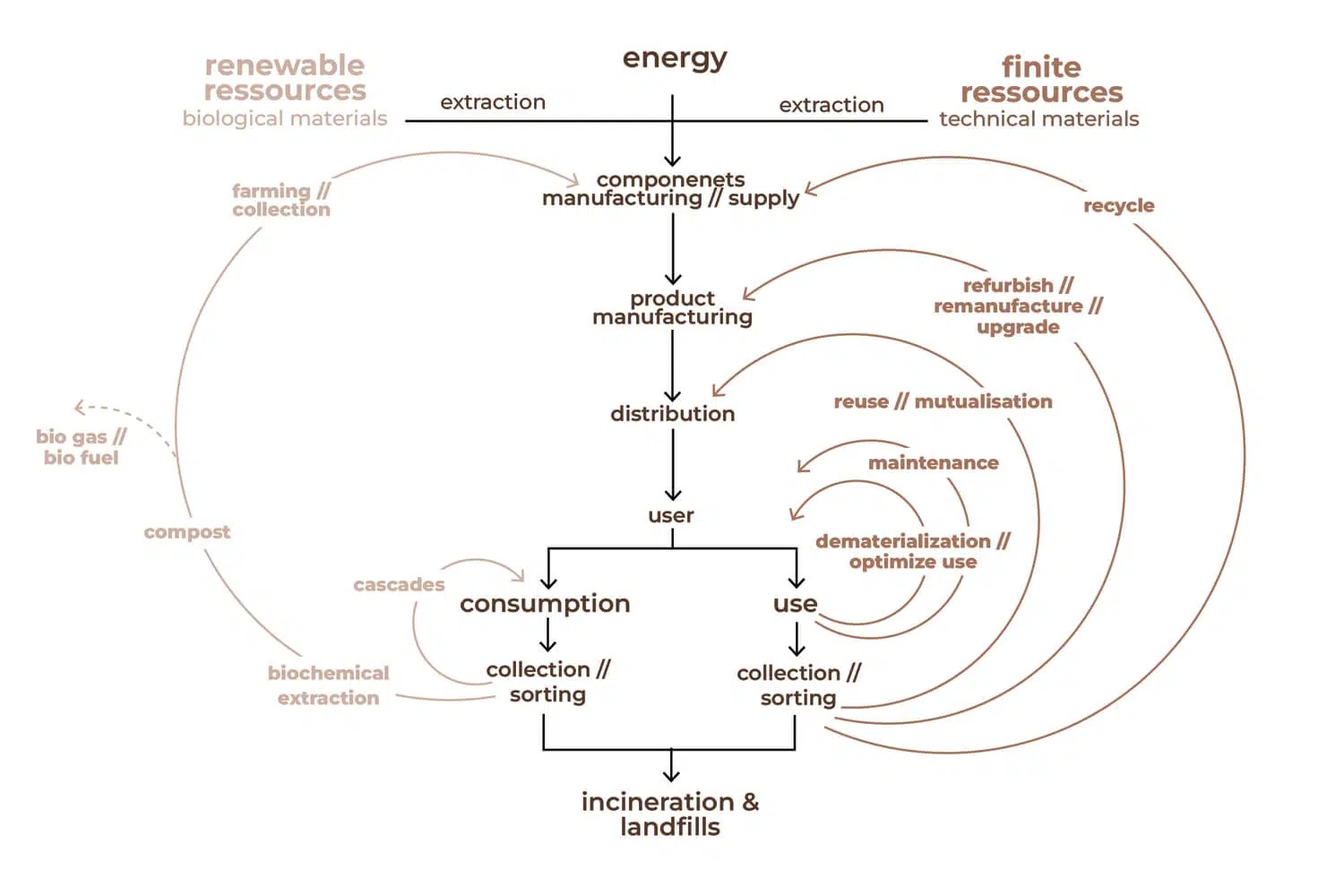
Designing for Sustainability practices graphicThe emphasis is on decisions made early in the design phase that allow products to stay in use, be adapted, or be recovered instead of being discarded and ending up being burned or in landfills (brown lines). It highlights:

  • Design for disassembly, so products can be taken apart efficiently for repair, adaptation, or material separation
  • Modular product architectures, allowing upgrades or partial replacement rather than full product scrapping
  • Repairability and user participation, with clear pathways for maintenance that extend product life
  • Multifunctional and multigenerational use, reducing the need for additional products over time
  • Cascading material use, where resources flow through successive applications rather than becoming immediate waste

Taken together, these ideas highlight sustainability as a question of value retention and adaptability, not just material choice or recycling rates. They make a compelling case for why sustainability must be designed in from the start (and these ideas closely align with cradle-to-cradle thinking, by the way).

Where the discussion becomes more difficult, and more interesting, is when these principles move beyond design intent and into real-world manufacturing. I’ll now share some thoughts on this…


Circular design starts with intent, but survives on execution

Concepts like design for disassembly or modularity are not new. Many product teams already discuss them early in development. The challenge is that intent alone rarely survives first contact with manufacturing.

A product designed to be disassembled only delivers sustainability benefits if:

  • Fasteners remain accessible after cosmetic parts are added
  • Components survive repeated disassembly and reassembly
  • Factories follow the intended assembly sequence rather than shortcuts
  • Cost-down exercises do not quietly replace screws with glue

In practice, we often see products that could be repairable in theory but are not repairable in reality because these downstream decisions were never controlled. That makes sense; it’s often cheaper and easier not to follow through.

This may be a design failure; it may also be a process failure.


Modularity and repairability can increase complexity and risk

Modular design and user-repairable products sound attractive, and they can be powerful. But they also introduce real engineering and quality challenges, which can be off-putting for manufacturers.

Every module interface is a potential failure point. Every repeated assembly cycle stresses plastics, threads, seals, and connectors. Products designed to be opened must be validated differently from sealed products, not just once, but repeatedly.

When repairability is introduced without updated validation strategies, tighter tolerances, and clearer assembly standards, the result is often higher field failure rates rather than improved sustainability.

This is a common disconnect we see: sustainability features are added, but the engineering and quality systems remain unchanged, resulting in a high return rate.


Sustainability is locked in early, but enforced later

One point the Punctuate Design article makes, and that we see very clearly in practice, is that sustainability outcomes are largely locked in during early design decisions.

Material selection, product architecture, part count, and fastening methods determine what is possible later. Once steel tooling is cut and suppliers are selected, your options quickly become limited.

However, early intent only becomes real outcomes if it is enforced later through:

  • Supplier capability assessment and alignment
  • Tooling and assembly process reviews
  • Test criteria that go beyond basic function
  • Documentation that explains why certain design choices must not be changed

Without this enforcement, designing for sustainability’s intentions can be quietly swept under the rug during production ramp-up.

If you’re interested in how these ideas play out on the buyer and supplier side, Sofeast has a useful overview of how procurement decisions shape real sustainability outcomes in their article on responsible and sustainable purchasing practices.


Factories tend to do just what they are measured on

Factories do not necessarily ignore sustainability, but they optimize for what they are measured on.

If lead time, yield, and unit cost are the only metrics that matter, sustainability features that might slow assembly, require additional care, or increase inspection time will likely be treated as problems to be removed at the DFM stage — unless specified as critical.

This is why sustainable product design cannot be separated from supplier alignment and quality & reliability management. Factories must understand not just how to build a product, but what must not be changed, and why.

When that understanding is missing, even well-designed products drift away from their original sustainability goals.


Sustainability is not the same as compliance

There is also an important distinction between sustainability and compliance.

Passing environmental regulations or material standards does not guarantee that a product is durable, repairable, or long-lived. A compliant product that fails prematurely still generates waste, often more waste than a non-certified product that lasts twice as long.

From a real-world perspective, product reliability is one of the strongest sustainability levers available, yet it is often discussed separately from sustainability initiatives.

For readers wanting more context on how regulators are now pushing sustainability into product requirements, Sofeast has a clear primer on the EU’s Ecodesign for Sustainable Products Regulation.


Final thought

The value of the Punctuate Design article is that it reminds us that sustainability is primarily in the realm of product design.

But in manufacturing, design intent is only the starting point.

Sustainable products emerge when design, engineering, suppliers, and quality systems are aligned, and when sustainability is treated as a performance requirement, not a slogan.

Good design makes sustainability possible.
Good execution is what makes it real.
Circular Economy Options in Manufacturing: Best to Worst Strategies for Electronics, Consumer Goods, and Textiles

The circular economy in manufacturing is often treated as a single sustainability goal, but in practice, circular economy options vary widely by product category, materials, and early design and sourcing decisions. For example, what works for textiles may be technically unrealistic for electronics, and strategies that sound “green” can actually introduce cost, quality, and compliance risks.

For businesses manufacturing their products, the real challenge is not whether to pursue circularity, but which circular economy strategies are technically feasible, commercially viable, and aligned with product risk.

In this guide, we break down the circular economy hierarchy from best to worst, with practical examples for electronics, consumer goods, and textiles, and explain why early product design and DFM matter far more than end-of-life recycling claims.


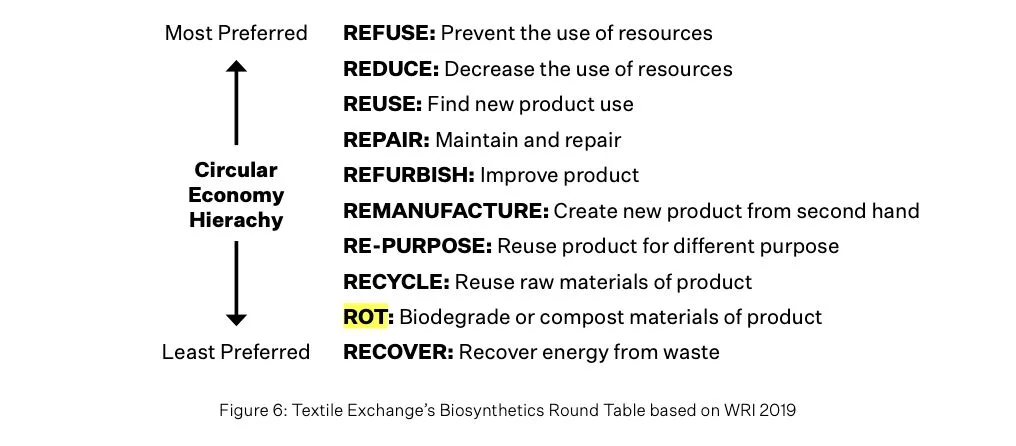
The Circular Economy Hierarchy in Manufacturing (Explained)

Understanding the circular economy hierarchy is important for making realistic sustainability decisions. Higher-ranking strategies preserve more embedded energy, materials, and value, while lower-ranking options often recover little and can even increase risk.

Learn more about how the EU is demanding that products be designed with sustainability in mind: EU Ecodesign regulation

Circular Economy Options in Manufacturing Hierarchy

(Image source: Textile Exchange p38)

Summary of Circular Options and their Impacts

Circular Option Electronics Consumer Goods Textiles
Reduce High impact High impact High impact
Repair Medium–High Medium Medium
Recycle Low–Medium Medium Low
Biodegrade Not viable Limited Often misleading


1.Refuse and Reduce: The Most Effective Circular Economy Strategies

Reducing Resource Use Through Product Design

Refuse and reduce sit at the top of the circular economy hierarchy because they eliminate waste before manufacturing even begins.

Examples by category:

  • Electronics: minimizing component count, avoiding oversized batteries or using no batteries at all, and removing redundant features
  • Consumer goods: reducing material thickness, simplifying assemblies, eliminating decorative-only parts
  • Textiles: lowering fabric weight, avoiding unnecessary blends, minimizing trims and finishes

These strategies are locked in during early product design and DFM, interlinking sustainability and engineering decisions. Fewer materials usually mean lower cost, fewer opportunities for defects, and less manufacturing waste.


2. Reuse and Repair in Circular Manufacturing: Designing for Product Longevity

Extending Product Life Through Repairability and Durability

Reuse and repair focus on extending product lifespan by designing products in a way that enables maintenance, replacement, or refurbishment, and/or by making the product more durable in the first place.

Examples by category:

  • Electronics: modular design, replaceable batteries, mechanical fasteners instead of glue
  • Consumer goods: durable housings, replaceable wear parts, standardized components
  • Textiles: repairable seams (with low risk of damaging the fabric), reinforced stress points, spare buttons or panels

Designing for repair, disassembly, and/or durability increases upfront engineering effort but often reduces warranty claims and early field failures.


3. Refurbishment and Remanufacturing: Practical but Category-Dependent

Where Refurbishment Makes Commercial Sense

Refurbishment and remanufacturing are established circular manufacturing strategies, particularly for electronics and durable products.

Examples:

  • Electronics: refurbished devices such as smartphones, laptops, etc, and remanufactured industrial electronics
  • Consumer goods: tools, appliances, mechanical assemblies
  • Textiles: limited mostly to resale or reconditioning

Extending product life generally has a lower environmental impact than recycling, as it preserves embedded materials and energy. (Source: The Sustainability of Biosynthetics, 2022).

Also, refurbished is no longer niche: in a U.S. survey, about 1 in 4 respondents reported buying a refurbished smartphone, and in France, about 1 in 6 phones sold were refurbished, while surveys show intention to buy refurbished next is even higher. (Sources: IDC (US purchase rate) + GSMA (France share) + Vodafone (intention)).


4. Repurposing Products: Difficult to Scale in Manufacturing

Why Repurposing Is Rarely a Design-Led Strategy

Repurposing gives products a second life but is rarely scalable or controllable from a manufacturing perspective.

Examples:

  • Electronics: component reuse in secondary, low-reliability applications
  • Consumer goods: containers reused for storage or organization
  • Textiles: garments repurposed into wipes, insulation, or accessories

Because repurposing depends heavily on downstream users, it is difficult to design into a controlled manufacturing model.


5. Recycling in Manufacturing: Necessary, but Often Overestimated

The Limits of Recycling as a Circular Economy Solution

Recycling recovers materials but often requires high energy input and results in downcycling. Therefore, it sits lower in the circular economy hierarchy because of its limitations.

Examples:

  • Electronics: complex disassembly, low recovery rates for critical materials
  • Consumer goods: plastics downcycled into lower-grade applications (with aluminum as a notable exception)
  • Textiles: fiber blends that are difficult or impossible to separate; risk of using fabrics that include restricted chemicals (e.g. REACH). Textile Exchange stresses that recycling should be treated as a last-resort material recovery option, not a substitute for upstream circularity decisions (Textile Exchange, 2022)

Recycling should be treated as a fallback, not a primary circularity strategy.


6. Biodegradation and Energy Recovery: The Least Preferred Options

Why These Options End the Product Lifecycle

At the bottom of the hierarchy are biodegradation and energy recovery, which effectively end material value.

Examples:

  • Electronics: largely irrelevant due to hazardous materials
  • Consumer goods: limited to specific packaging use cases
  • Textiles: biodegradable fibers often fail to degrade under real-world conditions. Even Textile Exchange, quoted earlier, cautions that biodegradability frequently does not deliver the expected environmental benefit outside controlled conditions

These options offer minimal circular value and frequently fail to deliver the expected environmental benefits.


Key Takeaways for Product Teams and Importers

Circularity is not about choosing the “greenest” label, it’s about making better-informed engineering and sourcing trade-offs that balance sustainability, quality & durability, cost, and risk.

  • The most effective circularity options are decided at the earlier design and sourcing stages.
  • Reducing material use and designing for repair and reuse consistently deliver higher environmental and commercial value than downstream recycling or biodegradability claims.
  • Recycling should be treated as a fallback option, not a primary circular economy strategy, especially for electronics and complex assemblies.
  • Poorly chosen “green” design choices often increase product risk, leading to higher defect rates, compliance issues, warranty claims, and total landed cost.
  • Circularity must be evaluated alongside quality, durability, cost, and regulatory risk, not in isolation.
  • The most effective circular strategies align engineering reality with commercial constraints, rather than relying on end-of-life solutions that recover little value.


FAQs

  • What are the best circular economy options in manufacturing?
    The most effective circular economy options in manufacturing are refusing unnecessary materials, reducing resource use, and designing products for repair and reuse, as these preserve the highest material and energy value.
  • Why is recycling considered a lower-priority circular economy strategy?
    Recycling typically requires additional energy, recovers limited material value, and often results in lower-quality materials, making it less effective than upstream design-led circular strategies.
  • How does product design affect circularity?
    Most circularity outcomes are determined during early product design and sourcing decisions, such as material selection, component architecture, and ease of disassembly.
  • Is biodegradability a good sustainability solution?
    Biodegradability often fails to deliver real-world environmental benefits outside controlled conditions and is generally a last-resort option in the circular economy hierarchy.
  • Which industries benefit most from refurbishment and remanufacturing?
    Electronics and durable consumer goods benefit most from refurbishment and remanufacturing due to higher retained value and established secondary markets.

How Life Cycle Assessments Drive Product Sustainability Changes [Podcast]

In today’s episode, we’re exploring Life Cycle Assessments (LCAs) — a critical tool for manufacturers and product developers aiming to improve sustainability and meet growing regulatory demands. You’ll learn why understanding a product’s entire life cycle — from raw material extraction to disposal — is essential for reducing environmental impact, staying compliant with new regulations, and designing more sustainable products. The discussion will help you grasp how LCAs work, why they matter, and how they can give you a competitive edge.


Listen to the episode here

Listen: to the podcast episode

Watch: on YouTube


Episode sections

  • [00:00] Welcome and introducing the topic
  • [01:07] What Is a Life Cycle Assessment (LCA)?
  • [01:41] Example: Comparing EVs and Traditional ICE Cars
  • [05:38] Challenges in Battery Production and Disposal
  • [10:06] Why LCAs Matter for Sustainable Manufacturing
  • [14:50] The Complexity of Supply Chain Data Collection
  • [17:29] The Push to Disclose Sustainability Information to Consumers
  • [20:05] Future-Proofing Example and Product EPD
  • [26:05] Practical Tips for Implementing LCAs
  • [28:30] How LCAs Can Give You a Competitive Edge
  • [29:20] Wrapping Up


Related content…


Listen, rate, & subscribe to the ‘China Manufacturing Decoded’ podcast on your favorite provider

More episodes are coming, so remember to rate us and subscribe! You can find us on:

ISO 20400 for Sustainable Procurement: A framework for better global citizens

ISO 20400 for Sustainable Procurement A framework for better global citizensThe ISO 20400 standard for sustainable procurement is beneficial to today’s manufacturers as it will help you improve your sustainability, environmental impact, ethical behavior, and social responsibility. We introduce the standard with a summary of its key points here…

Continue reading “ISO 20400 for Sustainable Procurement: A framework for better global citizens”

India’s Efforts To Mitigate Its Environmental Impact (Summer 2023)

India’s Efforts To Mitigate Its Environmental Impact (Summer 2023)China gains a lot of headlines for its leadership in renewable energy production, and rightly so, as they push to hit peak greenhouse gas emissions by 2030.

However, its neighboring giant, India, is also working on reducing its environmental impact, too, so let’s see what they’re doing…

Continue reading “India’s Efforts To Mitigate Its Environmental Impact (Summer 2023)”

Responsible & Sustainable Purchasing Practices in Focus

Renaud and Adrian discuss both responsible and sustainable purchasing practices. It can be easy to overlook buyers’ role in their supply chains’ ESG performances, but those that do not purchase responsibly or go further and so sustainably, are damaging their own supply chain’s sustainability. You’ll learn why in this episode…


Listen to the episode here 👇

Listen: to the podcast episode

Watch: on Youtube


Episode sections

  • 00:00 – Introduction.
  • 02:44 – What is responsible purchasing? (+ 3 examples)
  • 14:34 – Responsible product design practices are a linked topic.
  • 16:29 – What is sustainable purchasing?
  • 18:55 – How sustainable procurement affects the supply chain.
  • 25:50 – ‘Big buyers’ are in a position to make positive changes. Small buyers, less so, but you still have options.
  • 30:30 – Forthcoming EU regulations will demand buyers to purchase more responsibly and sustainably.
  • 35:06 – The good news: You will save money!
  • 36:51 – Wrapping up.


Related content…


Listen, rate, & subscribe to the ‘China Manufacturing Decoded’ podcast on your favorite provider

More episodes are coming, so remember to rate us and subscribe! You can find us on:

If you enjoyed this episode, don’t forget to give us a 5* rating and share it with your network if you enjoy listening!

Do you have enough visibility over your supply chain to satisfy new EU sustainability regulations?

The EU is bringing in sustainability regulations in 2025 that will demand that you have full visibility over your supply chain and can provide evidence of who is in it, where they are, and what materials and components go into your product so the product’s sustainability can be seen, i.e. you don’t use unsustainable or harmful materials or have suppliers in highlighted areas, such as where there might be forced labor.
But are importers ready?
This episode shows you what kind of effort lies ahead to become compliant for EU importers.


Listen to the episode here 👇

Listen: to the podcast episode

Watch: on Youtube


Episode sections

  • 00:00 – Greetings and introduction.
  • 01:40 – The EU ‘Green Deal’s’ new sustainability requirements and what they mean.
  • 07:35 – What sustainability information must be collected?
  • 17:12 – How easy will it be to get visibility into your supply chain?
  • 29:18 – Approaches used to oversee supply chains.
  • 43:46 – Why the old business model of buying off-the-shelf products from an ODM will probably need to change?
  • 46:14 – Conclusion: What you can do to prepare and how this will affect many areas in future.


Related content…


Listen, rate, & subscribe to the ‘China Manufacturing Decoded’ podcast on your favorite provider

More episodes are coming, so remember to rate us and subscribe! You can find us on:

If you enjoyed this episode, don’t forget to give us a 5* rating and share it with your network if you enjoy listening!

39 Strategies For Designing Products With A Lower Environmental Impact

Renaud and Adrian from the team tackle how to design products with less negative environmental impacts and share and comment on the 39  environmental improvement strategies from the IEC 62430:2019 standard for environmentally conscious design.

You’ll find that you won’t need to implement all of these ideas, but let’s say you do a lifecycle assessment and find a few key areas to improve, even a few relevant strategies from this podcast could reduce your environmental footprint by a lot which could be beneficial in terms of reducing costs, pleasing customers, and being a greener business!


Listen to the episode here 👇

Listen: to the podcast episode

Watch: on Youtube


Episode sections

  • 00:00 – Greetings and introduction: why are we talking about products’ environmental footprints and sustainability?
  • 09:54 – Good product design practices for bringing to market products with a lower environmental impact from IEC 62430:2019.
  • 14:09 – 1. Design for material sourcing
  • 24:44 – 2. Design for manufacture
  • 30:45 – 3. Design for transport and distribution
  • 36:58 – 4. Design for use (including installation and maintenance)
  • 51:23 – 5. Design for end of life
  • 55:11 – Why importers need to start thinking about and planning for more sustainable products


Related content…


Listen, rate, & subscribe to the ‘China Manufacturing Decoded’ podcast on your favorite provider

More episodes are coming, so remember to rate us and subscribe! You can find us on:

If you enjoyed this episode, don’t forget to give us a 5* rating and share it with your network if you enjoy listening!

EU ESPR is Coming in 2023: Act Now to become more Sustainable. [Podcast]

EU ESPR is Coming in 2023 Act Now to become more Sustainable.

Renaud and compliance expert Clive Greenwood are back with a warning for importers who sell products in the EU about the impending EU Ecodesign for Sustainable Products Regulation (ESPR) which is due to come into effect in May 2023.

This regulation requires your products to be made more sustainably, such as with a minimum amount of recyclable material, and that your supply chain’s players and environmental impact are made fully transparent to market surveillance authorities. If products don’t comply they won’t be allowed to be sold in the EU (a similarly draconian approach was taken with medical devices being sold into the EU when the EU MDR came into law, so we have no reason to believe that the EU will make things easier). This may require you to redesign products and get information about energy use, emissions, pollution, materials and components used, etc, from suppliers that you’ve never had before. That means you’re behind the curve if you haven’t started work on this yet…

So, you need to start by assessing the environmental impact of your products being made overseas in China or elsewhere right now, and Renaud and Clive will explain how, as well as give some insight into how seriously this is being taken by Chinese manufacturers.

If you sell into the EU now, don’t skip this! And if you sell into other developed markets, such as Canada, the USA, the UK, etc, it still applies to you as similar legislation is coming.


Listen here!

Listen: Why YOU need to assess the Environmental Impact of Made-in-China Productions NOW

Watch: On YouTube


Episode sections

  • 00:00 – Greetings and introducing the topic and our guest, Clive.
  • 03:20 – The sustainability trend is embodied by the Ecodesign for Sustainable Products Regulation for putting products on the EU market. What is it?
  • 07:37 – Does product design for sustainability play a role?
  • 09:00 – Are any product categories in the crosshairs of the EU first?
  • 18:00 – What are Chinese manufacturers doing about this sustainability requirement? Do they even know or care about it?
  • 19:35 – Lithium-ion batteries: A growing environmental issue.
  • 28:02 – Are other governments taking notice of this?
  • 30:19 – How do companies usually assess the environmental impact of their products, including extraction and manufacturing?
  • 33:12 – What a mobile phone lifecycle may include, and how ecodesign might affect how it’s designed and developed.
  • 39:45 – How will ‘Fast Fashion’ be affected?
  • 42:30 – What can businesses do to become compliant?
  • 50:51 – Your new commercial decision will not only be about a supplier’s costs but also if they’re able to assist you to comply with the new Ecodesign regulation.
  • 53:04 – What the product passport should include?
  • 55:18 – Advice for you if you’re selling into the EU now.
  • 59:03 – Wrapping up.


A disclaimer…

We are not lawyers. What we discussed above is based only on our understanding of the regulatory requirements. We do not present this information as a basis for you to make decisions, and we do not accept any liability if you do so. Please consult a lawyer before taking action.


Related content…


Listen, rate, & subscribe to the ‘China Manufacturing Decoded’ podcast on your favorite provider

More episodes are coming, so remember to rate us and subscribe! You can find us on:

If you enjoyed this episode, don’t forget to give us a 5* rating and share it with your network if you enjoy listening!

How To Comply With The EU Ecodesign Regulation? [Podcast part 2]

How To Comply With The EU Ecodesign Regulation (Part 2)

This is a crucial listen to anyone currently importing products into the EU! The new EU Ecodesign for Sustainable Products Regulation is coming soon, meaning that you will be legally obliged to comply with its demands for more sustainable products, a transparent supply chain, and clear control over how environmentally friendly the production of your materials, components, and products are!

If that sounds like a lot of information to obtain and, potentially, changes to your product design and suppliers, that’s probably because it is in many cases!

In part 1 on this topic, we discussed what the regulation is: The EU Ecodesign Regulation Is Coming, But Are You Prepared? [Podcast part1]

Now, let’s take a deep dive into what you will need to do to comply with the regulation as our CEO Renaud and compliance expert Clive Greenwood talk you through it.


Listen here!

Listen: How To Comply With The EU Ecodesign Regulation? (Part 2. Feat. Clive Greenwood)

Watch: on Youtube


Episode sections

  • 00:00 – Greetings & Introduction to today’s topic: EU Ecodesign Regulation.
  • 02:26 – Why is product design important?
  • 08:07 – The role of ‘Repairability’ and ‘Maintainability.’
  • 10:12 – The need to document your approach.
  • 12:03 – How product designs will need to change according to the EU ESPR proposal [quotes].
  • 18:38 – Addressing ‘Greenwashing.’
  • 20:47 – Postmarket surveillance.
  • 25:01 – Calculating energy consumption throughout the product lifecycle.
  • 30:11 – Supply chain information will be transparent – suppliers who are more sustainable will be preferred.
  • 34:37 – The example of garments and their supply chain.
  • 37:58 – Detailed traceability & visibility over the supply chain – requirements.
  • 43:18 – ESPR will evolve over time and cause headaches for importers…
  • 46:23 – The key data you need to start collecting NOW.
  • 48:13 – Will ESPR negatively impact SMEs more than large businesses?
  • 52:36 – You have been warned!


A disclaimer…

We are not lawyers. What we discussed above is based only on our understanding of the regulatory requirements. We do not present this information as a basis for you to make decisions, and we do not accept any liability if you do so. Please consult a lawyer before taking action.


Related content…

We’ve created some great resources on this topic – read them and get help here:


Listen, rate, & subscribe to the ‘China Manufacturing Decoded’ podcast on your favorite provider

There are more episodes to come, so remember to rate us and subscribe! You can find us on:

If you enjoyed this episode, don’t forget to give us a 5* rating and share it with your network if you enjoy listening!