


The EU Batteries and Waste Batteries Regulation (2023) is going to impact a lot of the electronic products we work on for our customers if they are to be sold in the EU from about 2025; especially portable electronics. Battery sustainability, traceability, and recycling are becoming very important for products sold in EU countries. Let’s look into the regulation in more detail here so you can be prepared…
Tag: batteries
The Dangers of Cheap Li-ion Batteries and the Future of Compliance
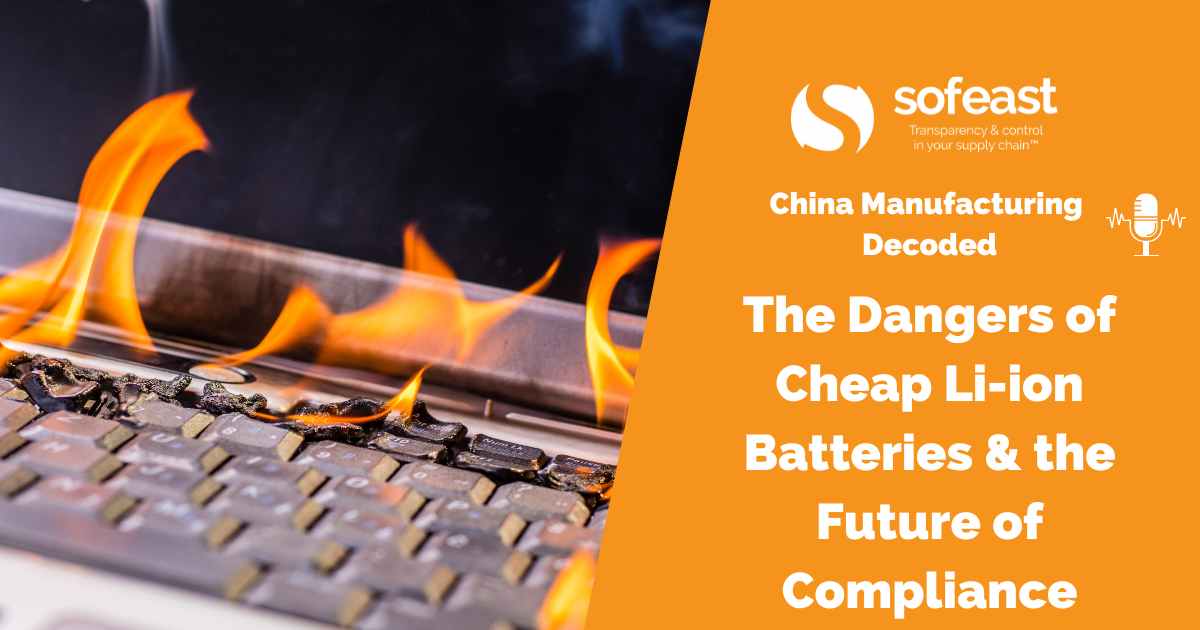
China-based British compliance expert, Clive Greenwood, joins Renaud this time to discuss the risks that cheap Li-ion batteries from China flooding the globe pose to consumers.
They go on to discuss in detail the health and safety and compliance laws governing batteries (and most products), and forthcoming sustainability laws that will be in place from next year that will affect all importers. It doesn’t matter if you’re in the EU, USA, or elsewhere; you’re running out of time to comply with the laws discussed, and no, those cheap batteries aren’t going to be compliant…
Listen to the episode here 👇
Listen: to the podcast episode
Watch: on Youtube
Episode sections
- 00:00 – Greetings and introducing Clive.
- 02:41 – Today’s topic: The Risks Posed by Cheap Batteries from China.
- 06:09 – The battery lifecycle.
- 11:31 – Some examples of the differences in cost and risk of batteries and EV components from China.
- 20:19 – Existing and forthcoming standards and regulations affecting batteries.
- 26:52 – How personal EVs will probably be governed by IATF 16949 in future.
- 29:10 – New legislation coming in 2024 and 2025 that targets consumer lithium batteries specifically and what this means to importers.
- 37:19 – From 2025 the liability for fires and other dangers caused by poor-quality batteries is going to be on YOU, the importer, and there’s no escape.
- 41:13 – Selling products with a Li-ion battery? Take these actions…
- 43:47 – Most issues with batteries are ‘near-misses’ that importers may never hear about leading to a lack of awareness about the risks with batteries.
- 45:35 – Chargers and the prevention of battery fires.
- 47:51 – The ESPR represents a serious challenge for importers with a supply chain in China (and other Asian countries to an extent).
- 50:19 – Liability for problems won’t wait for the importer to put things right, they need to be right the first time around.
- 52:14 – What changes are happening in other parts of the world regarding health and safety?
- 57:08 – Wrapping up.
Related content…
- Chinese battery danger (Telegraph article – paywall)
- Get help from Sofeast to prepare to comply with the EU ESPR
- What is the EU Ecodesign for Sustainable Products Regulation?
- The EU Ecodesign Regulation Is Coming, But Are You Prepared? [Podcast part 1]
- How To Comply With The EU Ecodesign Regulation? [Podcast part 2]
- E-Waste Impact on the Environment (Analysis)
- Understanding The Environmental Impact of EV Batteries
Listen, rate, & subscribe to the ‘China Manufacturing Decoded’ podcast on your favorite provider
More episodes are coming, so remember to rate us and subscribe! You can find us on:
- Apple Podcasts
- Spotify
- Google Podcasts
- TuneIn
- Amazon Podcasts
- Deezer
- iHeartRADIO
- PlayerFM
- Listen Notes
- Podcast Addict
- Podchaser
- The podcast’s website at China Manufacturing Decoded
If you enjoyed this episode, don’t forget to give us a 5* rating and share it with your network if you enjoy listening!
Disclaimer…
We are not lawyers. What we wrote above is based only on our understanding of the regulatory requirements. Sofeast does not present this information as a basis for you to make decisions, and we do not accept any liability if you do so. Please consult a lawyer before taking action.
What Manufacturing Process Controls Are Important In Battery Factories?
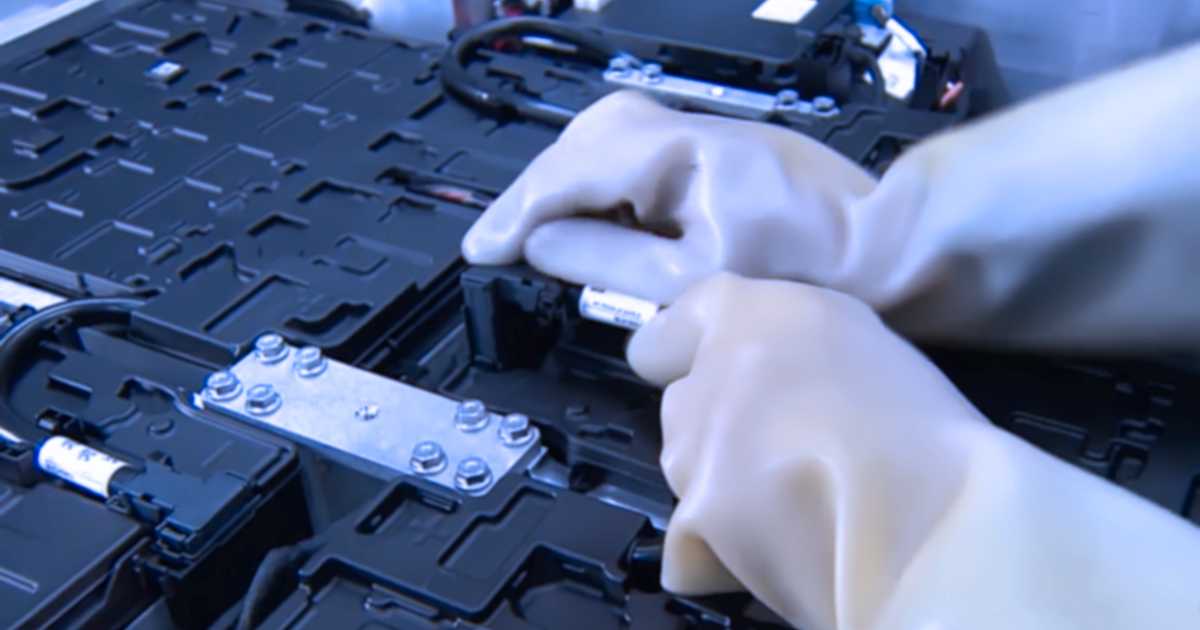
Nearly all the electronic products we have worked on include a battery. It is always a critical component since a failure of the battery means a failure of the whole product.
You may think batteries are very standard and mature products. And yet, even if you buy standard size battery packs, there is still a relatively high risk of experiencing quality issues.
In this article, we suggest a few important ways battery manufacturers need to control their processes in order to consistently make good products. (There are, of course, differences between types of battery technology, but the advice here holds true for most modern batteries.)
1. Preliminary concepts
You may want to watch an introduction about the reasons why battery manufacturing process control is so important:
2. Labeling
It is shocking how often some key inputs to the processes are not properly labeled… or, worse, mislabeled!
When the usual operators are not there, the likelihood of using the wrong material is pretty high, with disastrous consequences.
3. Controlled environment
Cell manufacturing is very sensitive to humidity. And extreme temperatures can impact quality all throughout production, as well as during storage of materials and finished goods.
If the factory has no way to control humidity and temperature where it should be kept within certain limits, we highly doubt their ability to make consistently good batteries!
4. Preventive maintenance of key equipment
Let’s take an example. When a pump delivers electrolyte into the cells, it is extremely important to ensure the pump works as expected.
If the pump is used until it obviously malfunctions, how many doses were improperly injected before that issue is noticed? That might impact hundreds of cells or more.
Preventive maintenance cannot be skipped on critical equipment.
5. Statistical monitoring of key dimensions
When electrodes are coated, is the coating thickness always within an optimal narrow band?
When the materials that will form that coating are mixed, are the amounts of certain solids monitored?
After the mixing and before the coating is applied, are certain properties (e.g. viscosity) checked?
These are a few of the variables that world-class factories follow up very closely, usually with statistical process control tools such as process behavior charts (a.k.a. control charts), capability indices (e.g. Ppk), and others.
6. Traceability
If some batteries are found unsafe, the whole batch should be contained (i.e. it has to be put aside and not be shipped to any customer) and the issue should be investigated carefully. That’s when traceability comes into play.
A good traceability system will provide information about what resources (materials, equipment, and people) were used for this batch. It also provides information on the in-process and intermediary records. That is critical information for such an investigation.
A very good traceability system will provide data for the whole batch but also at the individual battery level. It is sometimes available for the pack assembly operations.
7. Battery pack assembly
We have seen many instances of improper soldering. Whether it is done manually (with high variation from operator to operator) or automatically (with the risks of poor setting, deviation over time, etc.), it is a common source of issues.
In addition, the design of the packs should make it impossible for certain parts to come in contact (that’s how short-circuits and fires/explosions often happen).
8. Finished product testing
This article is about process controls, however, testing the finished products is a very important part of the quality system and it should give feedback to improve process controls. This step is not to be skipped.
We see many factories do a short ageing (a.k.a. burn-in) test. And checking only a few properties (e.g. voltage, capacity…). That might not be sufficient!
Here also statistical tools can be useful. There is usually no need to do in-depth testing on 100% of the pieces, however, a few pieces of each batch should be subjected to a serious reliability & safety testing program.
******
These are just some of the ways things can go wrong, but you’ll find that these are the most frequently found sources of quality problems in batteries.
Are you importing battery-powered electronic products?
We’ve created a buyer’s guide with a thorough introduction to battery types (both disposable and rechargeable), their pros and cons, costs, uses, and more.
The FAQs section is extremely detailed, including information about cell chemistries, information buyers need from their battery suppliers, how to calculate power supply, battery testing tips, and much, much more!
All you need to do get a good grounding in the different types of batteries which are available for buyers manufacturing electronic products is hit the button below to read the guide (no download required) 👇:
Battery Safety Testing 101 For Buyers + Videos

Batteries are an integral component for many of today’s electronics, so battery safety testing should be a key concern for importers.
Don’t forget that, as the importer of either batteries or electronic devices that include batteries, you’re liable for consumer injury should the batteries turn out to be dangerous. You should also assure that your batteries comply with your market’s regulatory demands, which could mean, for instance, not importing batteries made with certain materials.
So, how to assess whether your batteries will be compliant and safe? Battery safety testing.
Continue reading “Battery Safety Testing 101 For Buyers + Videos”
Types Of Batteries For Buyers Of Consumer Electronics [Introductory Guide]
![Types Of Batteries For Buyers Of Consumer Electronics [Introductory Guide]](https://artbyraksha.sofeast.com/wp-content/uploads/2020/12/Different-Types-Of-Batteries-For-Electronic-Products-Importers-Guide-1-768x301-1.jpg)
Sourcing batteries for your new electronic product can be confusing. There are so many different types that selecting the most appropriate in terms of cost, features, and performance can be challenging for buyers…
![Types Of Batteries For Buyers Of Consumer Electronics [Introductory Guide]](https://artbyraksha.sofeast.com/wp-content/uploads/2020/12/Types-Of-Batteries-For-Manufacturers-Of-Consumer-Electronics-Introductory-Guide.jpg "Types Of Batteries For Buyers Of Consumer Electronics [Introductory Guide]")
An important part of the electronic product development process is choosing the correct type of battery for your product. Consumers, perhaps, often take the battery in their device for granted, but as a buyer it’s different…
You should be concerned with:
- Cost
- Compliance
- Safety
- Performance
- Longevity
Amongst other things!
Get it wrong, and consumers will no doubt complain that the device doesn’t perform well, is too expensive, etc, perhaps resulting in returns or sluggish sales.
🔎 Related: Lithium Ion Battery Safety Guidelines For US Imports
So, a thorough introduction to the various types of batteries would be helpful?
Yes, a buyer’s first step when sourcing batteries should be understanding the options.
For instance, would your product be best off using primary or secondary cells? What power capacity is your device likely to require, and does that influence battery choice? How does battery capacity work and is measured?
So, for this reason, we’ve created a guide: Different Types Of Batteries For Electronic Products (Importer’s Guide)
In it, you’ll see useful information, such as a description of battery types and their pros & cons. The FAQs section is really great, as it delves into many of the questions battery buyers are asking, such as the difference between a cell and a battery, what information battery buyers really need from their supplier, how to test battery voltage with a multimeter, some of the key battery compliance standards to be aware of, what a battery management system for Lithium-ion and other secondary batteries is, issues related to battery disposal, and much more.
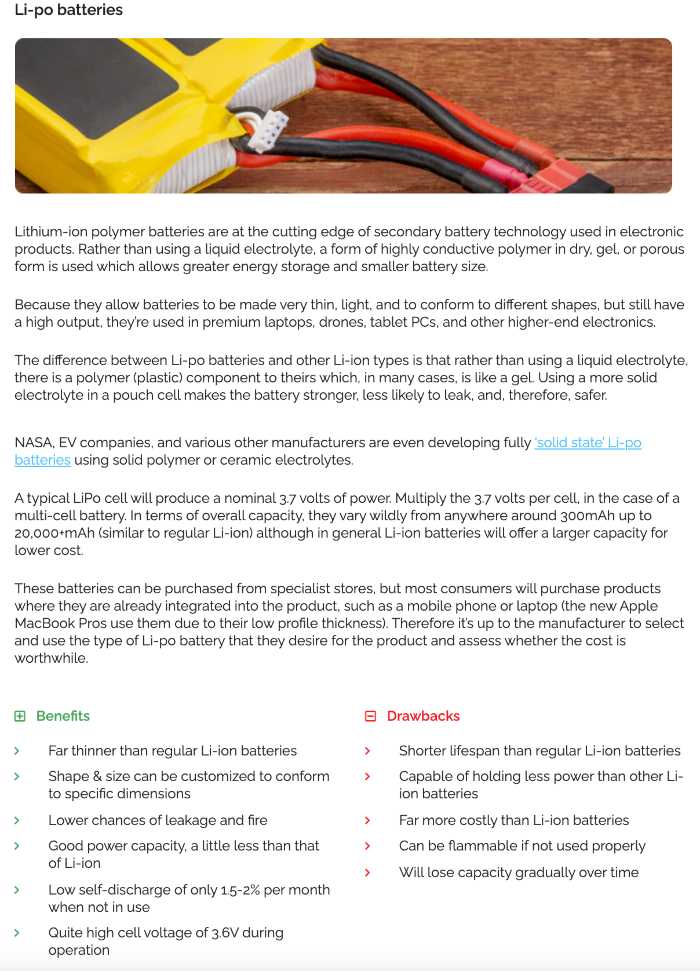
Take a look 👀 Here’s the section about Li-Po batteries which are commonly used in high-end smartphones and laptops:
Where to read the guide?
The good news is that this guide requires no form fills to read and is totally free.
All you need to do get a good grounding in the different types of batteries which are available for buyers manufacturing electronic products is hit the button below 👇:
11 Common Electronic Product Certification And Compliance Requirements

Regulatory electronic product certification requirements can present challenges for organizations looking to design, develop and market electrical and electronic products in different countries around the world. As these requirements are primarily focused on particular products, use cases and generally the environment for which they are intended to operate, regulations and information on the subject are often difficult to understand and navigate.
Let’s take a look into the real world of 11 common compliance requirements for electrical/electronic products and gain further insights into their meanings, methodologies and test requirements.
The following electronic product certification and compliance requirements will be discussed (keep reading or hit the links below to jump to the section you prefer):
1. FCC: Federal Communications Commission (FCC)
Recognized FCC Mark:

General overview:
The Federal Communications Commission (FCC) label or the FCC mark is a certification mark employed on electronic products manufactured or sold in the United States. It certifies that the electromagnetic compatibility and interference from the device is under limits approved by the Federal Communications Commission.
FCC objectives are to set applicable standards and testing measures to ensure that Radio Frequency (RF) emissions of electronic devices meet the following requirements:
Operation of an electronic device is subject to the following two conditions: (1) This device may not cause harmful interference, and (2) this device must accept any interference received, including interference that may cause undesired operation.
Generally speaking, all electronics devices that are capable of emitting and transmitting Radio Frequency energy for the purpose of communication must adhere to The Federal Code of Regulation known as FCC Part 15, FCC.
FCC Part 15 is a federal regulation that sets limitations on the amount of electromagnetic interference a device can permissibly generate. Electronic devices that operate at a clock rate of 9kHz and above fall within the standard.
Radiated emissions: FCC Part 15 classifies RF electronic devices as the following:
Intentional radiators: These are devices that intentionally transmit and receive radio energy. Examples include products containing Wi-Fi, Zigbee, Bluetooth, RFID and Alarm systems to mention a few.
Unintentional radiators: Devices that generate radio frequencies within itself, which is then unintentionally radiated by means of conduction from the device which may cause interference or upset with other electronic devices.
Incidental radiators: Devices that generate radio frequency energy although the device is not intentionally designed to. Examples include DC motors, Mechanical light switches to mention a few.
Conducted emissions: FCC Part 15 classifies RF electronic devices as the following:
Conducted emissions, all electronic devices create electromagnetic energy and a certain portion of this energy will be conducted onto wired power and telecommunication ports connected to the device. Examples include A.C or D.C power supplies, wired Network communications, USB peripherals, Multimedia devices and Personal computers to mention a few.
Classification categories: FCC Part 15 classifies electronic devices into two categories.
FCC Class A – Reserved for devices that are intended for use in Industrial environments and nonresidential areas.
FCC Class B – Reserved for devices that are intended for use in Residential environments.
Generally speaking, electronic consumer goods fall under FCC Class B. This classification is the most stringent because they tend to operate in environments where devices are in close proximity to one another.
👉 Read about FCC compliance for consumer electronics in more detail here.
2. IC: Industry Canada (IC)
Recognized IC Mark:

General overview:
Industry Canada (IC) is essentially Canada’s equivalent to the Federal Communications Commission (FCC). They are responsible for the certification requirements of Electronic devices and Radio equipment either manufactured or entering into the Canadian marketplace.
Generally speaking, Industry Canada applies the same test criteria as mentioned above for FCC. In fact, IC accepts FCC testing data and certification fulfillment provided that the date of completion by FCC is less than a year old. It is recommended that both applications for IC and FCC be applied for at the same time with your regulatory certifications lab, this will minimize the duplicate testing efforts, timelines and ultimately costs.
3. Radio Equipment Directive (RED): Conformité Européenne “CE RED”
Recognized CE RED Mark:

General overview:
Formally known as The Radio and Telecommunications Terminal Equipment (R&TTE). The CE RED directive is responsible for the certification requirements of Electronic devices and Radio equipment either manufactured, imported or sold into the European (EU) market.
It’s important to note that RED as compared to FCC or IC characterizes other factors which otherwise were not. Most notably the addition of Health, Safety, The Low Voltage Directive (LVD) and Electromagnetic Compatibility (EMC). We will briefly describe these below.
What is considered the Health of Radio equipment? Generally speaking, this is defined as adhering to designated frequency bands with specified powers, bandwidths and duty cycles. It also encompasses efficient use of the radio spectrum. Globally, the number of devices operating within the radio spectrum has skyrocketed and regulators are tasked with ensuring proper check and balances are in place. Effectively setting boundaries, policies and regulations to derive a set of harmonized standards within the EU, Member states and neighboring countries.
Why did RED adopt the LVD? LVD identifies Health and Safety risks associated with Electrical/Electronic devices which primarily address the potential hazards of electrical shock and fire.
Why has RED adopted EMC Electrical Safety within their directives? RED requires radio equipment to have an adequate level of Electromagnetic compatibility (Disturbance and immunity). Radiated emissions, Conducted emissions and Immunity are the primary scope behind the EMC directive.
Radiated emission and immunity testing involves measuring the RF electromagnet field strength of the emissions that are generated by the device. While immunity tests the susceptibility of the device to external RF sources of electromagnetic field disturbance and its ability to operate as intended without upset.
Conducted emissions and immunity testing is performed on devices containing wired connections. Typical wired connections are network and AC or DC power ports entering or exiting the device. Wired connectivity can present emissions challenges if unwanted RF energy generated within the device is permitted to propagation either intentionally or non-intentionally through wired connections to other devices. While immunity tests the susceptibility of the device on wired ports to external sources of unwanted RF energy in addition to harmonic current emissions, voltage fluctuations and flicker.
In addition to RF Immunity, Electrostatic Discharge (ESD), Common mode Electrical Fast Transients (EFT) and Surges are some of the applicable tests of EMC on devices with wired ports. Further information is presented below under Electromagnetic Compatibility (EMC) section.
4. Conformité Européenne (CE)
Recognized CE Mark:
General overview:
The Conformité Européenne (CE) Mark is defined as the European Union’s (EU) mandatory conformity marking for regulating products either manufactured, imported or sold into the (EU) market.
The presence of the CE mark, generally by means of self-declaration indicates that the product has been assessed by the manufacturer fulfilling the requirements set by the EU for Safety, Health and environmental protection. Also known as a Declaration of Conformity (DoC).
This declaration is by no means a guarantee of conformance, if requested the manufacturer, importer or person responsible for placing the product on the EU market must show appropriate technical documentation issued by an international or European Notified test body for validity.
Relevant regulations as they pertain to Electrical and Electronics devices state that product complies with the Low Voltage Directive (LVD) and Electromagnetic Compatibility (EMC). LVD has been discussed above, under the CE RED topic, while EMC is described below.
5. Electromagnetic Compatibility (EMC)
EMC Mark:
General overview:
The certification mark is based on the EMC Directive 2014/30/EU. Compliance with IEC 61000-6-3 for emissions and IEC 61000-6-1 for immunity requirements applies to Electrical and Electronic devices intended for use in residential, commercial and light industrial environments. Equipment either manufactured, imported or sold into the European (EU) market are designated.
The presence of the EMC mark, generally by means of self-declaration or self-certify indicates that the product has been presumably assessed by an EU Notified test Body who will apply a CE mark to the device upon fulfilling the requirements set by the EU for Safety, Health and environmental protection. Also known as a Declaration of Conformity (DoC).
Generally, the EMC directive is a performance directive which ensures that the device does not disturb or create undesired interference or noise on other radio and telecommunications equipment.
Another very important aspect of EMC directive is to protect electrical and electronic devices from potential hazards such as Electrical fast transients, lightning strikes and electrostatic discharges while operating in their intended environment.
For a list of additional IEC standards on EMC referenced by the IEC 61000 family, please review this content online.
Common cases of failure to comply with FCC, IC, CE RED and EMC
Generally, a lack of understanding or knowledge of the applicable electronic product certification and compliance standards. Secondly, unfamiliarly of the intended environment that the device will be used.
The most common cause of radiated emissions failures is attributed to the permissible allowable limits of radio frequency (RF) and unwanted spurious emissions also known as harmonics or side-band frequencies that are outside of a transmitter’s assigned or designated channel.
The most common cause of conducted emissions failures is electromagnetic interference (EMI) disturbances generated within the device that propagates through cabling attached to the device. The most common causes of disturbances occur during the cycling ON/OFF of resistive or inductive loads. In addition, disturbances are also generated by Switch-mode power supplies and Micro-controllers.
Similarly, the same principles apply to EMC with a focus on Immunity. Electrical and Electronic devices connected through wired ports must also operate as intended within their environment. These environments in some cases can he harsh and susceptible to lightning strikes, transient voltages, surges and electrostatic discharge. Common failures include the lack of protection for these wired ports.
Design and mitigation techniques for FCC, IC, CE RED and EMC
During the initial development and design stage of any electronic device, appropriate considerations should be given to purchasing applicable standards in an effort to understand the various test criteria, methodologies, limits and permissible deviations that a device will be subjected to.
The objective is to understand the requirements and have provisions within the electronic design and Printed circuit board (PCB) to mitigate issues that may arise during certifications.
The following design and PCB recommendations should be carefully considered:
- Optimum selection of electronic components.
- Placement of sensitive RF circuits and antenna networks within the PCB.
- PCB Grounding schemes (Analog and Digital).
- PCB trace routing techniques.
- PCB board stack-up
Mitigation techniques include:
- EMI filtering devices on all Input/output signal, control and communications lines (Ferrite Beads).
- Transient, Surge and ESD protection devices on all Input/output signal and communications lines. (TVS diodes)
- Common mode filtering on D.C power and USB communications ports.
- Provisions for EMI shielding coatings
For Intentional radiators, Wi-Fi, Zigbee and Bluetooth it is suggested that you consider ready-designed System On Modules (SOM) microcontrollers with integrated radios that offer Radio certifications based on modular approval. This will greatly improve your success during the certification process and reduce your time to market.
Document preparation
All regulatory certification bodies will request under strict non-disclosure guidelines copies of the clients’ technical product specifications. These tend to include the following:
- Users guide and Installation manuals.
- Block diagrams.
- Product’s Bills of Materials (BOM).
- Electrical/Electronic component datasheets.
- Electrical/Electronic Schematics.
- Printed Circuit Board (PCB) Layout.
- Information pertaining to Software or Firmware for embedded products.
- Traceability information.
- Internal and external photographs of the device.
- Label design inclusive of Regulatory certification marks (FCC, CE and so forth).
- Manufacture information, which is the place where the client will manufacture the products.
- Legal company representatives.
6. UL1642, 7. UL2054, and 8. UN/DOT 38.3 For Batteries
Recognized Mark:

General overview:
UL 1642 is the standard for the battery safety assessment of Lithium polymer (Li-ion) Batteries (Cells) covering both rechargeable and non-rechargeable types with chemistries containing metallic lithium, lithium alloy and lithium-ion. These consist of single, multiple and Li-ion pouch cells either connected in series or parallel.
Testing criteria for UL 1642 is more in-depth as compared to UL 2054 covering a wider scope of tests which include (External short circuit, abnormal charge and overcharge, forced discharge, crush, impact, shock, vibration, heating, temperature cycling, projectile, insulation resistance and internal short circuit or internal fire test).
UL 2054 is the standard for the battery safety assessment of household and commercial batteries covering both rechargeable and non-rechargeable types. Under this standard, battery chemistries include Li-Ion, Nickel (Ni-Cad and Ni-MH), Alkaline, Carbon Zinc and Lead-acid.
Testing criteria mainly focuses on (External short circuit, abnormal charge and overcharge, forced discharge, drop, and molded casing heating tests).
The purpose is to ensure safety and how these batteries are used within in product with the intent to reduce risk of injury to persons due to fire and explosion. Coverage includes user-replacement cells and proper disposal measures.
Safety issues have been well known and documented for Li-ion battery technologies. As Li-ion cells are limited by the number of charge/discharge cycles the lithium electrolyte gets depleted. When sourcing these type of cells it’s important to ensure that your purchasing from a reputable manufacturer, one that has the proper expertise in lithium chemistry and understands your application requirements.
UN/DOT 38.3 (United Nations), (U.S Department of Transportation) UN/DOT 38.3 issues recommendations and regulates the safe worldwide transportation of lithium and Li-ion batteries. It is a self-certify standard whereby independent third party test labs is not required. However, due to liability concerns, most companies choose to perform this.
Environmental conditions such as (Low pressure, temperature cycle, vibration and shock) all constitute stresses that batteries will be exposed to during transport. If you want to ship these batteries Worldwide by Air, Vessel, Rail or Truck, all Lithium and Li-ion batteries must conform to this standard.
Lithium batteries are classified as dangerous goods and can pose a safety risk if they are not tested and packaged in accordance with transport regulations.
9. Restriction of Hazardous Substances (RoHs)
General overview:
RoHs is a directive that is governed and mandated for the European Union (EU). Compliance with the EU’s RoHs directive is required for Electrical, Electronic devices either manufactured, imported or sold into the European (EU) market.
This directive sets protective measures for both people and the environment from banned (to prohibit or forbid) hazardous chemicals and substances found in both electrical and electronic devices. Hazardous chemical restrictions are (Cadmium, lead, mercury, hexavalent chromium and others to name a few).
There are various different technologies that are used to test for RoHs chemical composition. The most common include X-Ray Fluorescence Spectroscopy (XRF) while others include chemical-based testing.
👉 Read more about the RoHS test and regulation.
10. Registration, Evaluation, Authorization and Restriction of Chemicals (REACH)
General overview:
REACH is the authorization and restriction of hazardous chemicals, a regulation of the European Union (EU). Compliance with the EU’s REACH is required for chemicals including those used to make products. Examples of these chemicals may be referenced online.
Understanding the difference between RoHs and REACH can be confusing. Generally, RoHs is the ban (to prohibit or forbid) of approximately 6 hazardous chemicals mostly product specific. Whereby, REACH generally refers to a large number of chemicals produced and used within the assembly and production of products.
👉 Read more about REACH testing.
11. Bluetooth
Recognized Mark:

General overview:
The Bluetooth Special Interests Group (SIG) is the regulatory body that oversees the development of the Bluetooth standards and licensing agreements of Bluetooth technologies and trademarks. In order to release a Bluetooth end product to market, the solution needs to be qualified.
It is important to note that all products using Bluetooth technologies must comply with regulatory compliance standards applicable to the regions/countries they operate in, such as FCC, IC and CE RED.
An organization having the intent to incorporate Bluetooth wireless technologies into their products must first become a member of the Bluetooth SIG program.
There are several steps required during the application process:
The Qualification process whereby the company has a design that is a specific configuration of hardware and/or software which must be designated under a Bluetooth product type. Product types include (End products, controller subsystems, host subsystem, profile subsystems and components). For more information, it is suggested to reference the Bluetooth Product Listing Database online.
Companies have the option of qualification without additional testing which encompasses technologies already certified by Bluetooth SIG and used within your product without changing or adding additional Bluetooth features.
And secondly, qualification with additional testing which is the creation or modification of Bluetooth technologies or combinations of both already certified and otherwise not certified.
The Declaration process whereby the Bluetooth (SIG) designates a Declaration ID upon receipt of the application, the option of qualification and detailed information from the company including the Design name, model number, design description, hardware version, software Version and so forth.
Conclusion
First and foremost, it is essential that your organization clearly defines and understands the electronic product certification requirements for each country you wish to sell your product. In some cases certain countries may be harmonized, however careful research must be taken into consideration.
Ultimately, having a plan is your best line of defense. As electronic product designers, the compliance process can appear overwhelming and intricate to say the least. Certification labs are a valuable resource that should be considered even during the prototype phase of your design. They typically offer services like Pre-scans which will enable you to gain insights into the electromagnetic characteristics and behaviors that the device exhibits. This initial information is vital in planning your next design revision if it is deemed necessary.
This guide was written in October 2020 by Ryan Clark Watt, a Canadian Electrical, Electronic and Mechanical Engineer with 25 years of experience.
Ultimate Guide To Sourcing From China And Developing Your Suppliers [eBook]
This FREE eBook starts from the beginning, discussing whether you need to hire a sourcing agent, and follows the sourcing process right through to developing a trusted supplier’s quality and productivity.
There are 15 chapters over 80+ pages to explore, providing exhaustive guidance on the entire sourcing and supplier development process from start to finish, including:
- Identifying suppliers,
- Negotiations,
- Quality inspections,
- Developing Chinese suppliers,
- Improving factory quality and productivity,
- and much more…
Just hit the button below to request and download your free copy:
![Ultimate Guide To Sourcing From China And Developing Your Suppliers [eBook]](https://artbyraksha.sofeast.com/wp-content/uploads/2026/07/UltimateGuideToSourcingFromChinaAndDevelopingYourSupplierseBook1200x628px-300x157-1.jpg "Ultimate Guide To Sourcing From China And Developing Your Suppliers [eBook]")
How To Keep A Chinese Battery Supplier Honest?
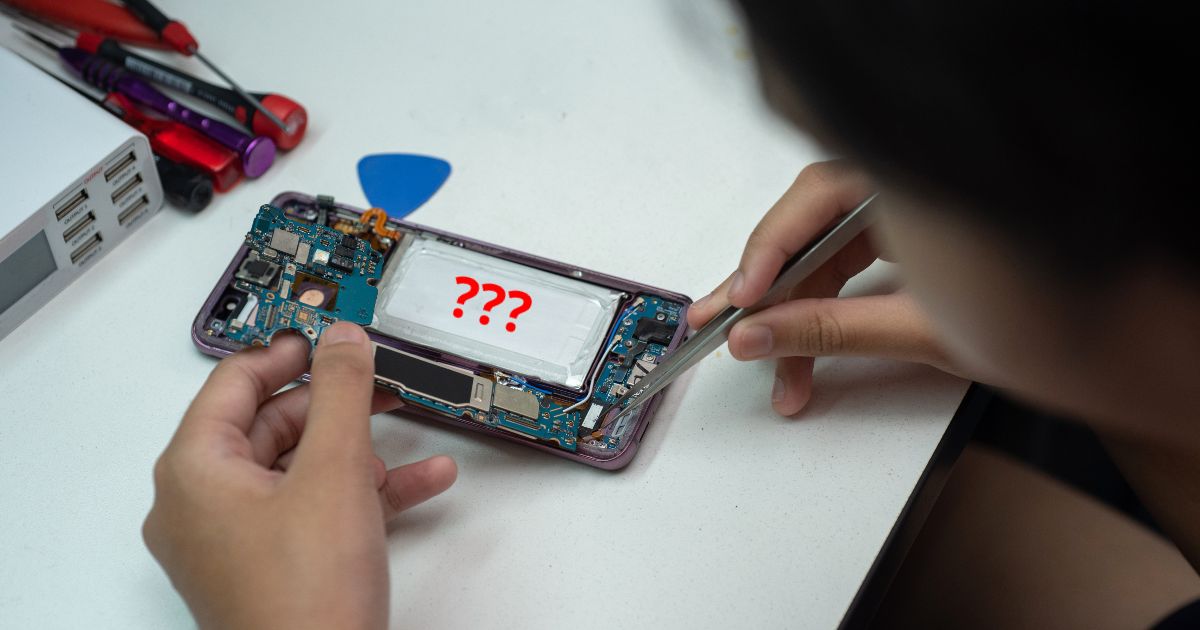
Let’s say you buy an electrical product from your Chinese supplier and they promise to purchase original batteries from a well-known company. Are you sure you will get the types of batteries that you’ve paid for? Here’s how to keep your Chinese battery supplier honest.
Continue reading “How To Keep A Chinese Battery Supplier Honest?”