[vc_row][vc_column][vc_single_image image=”14563″ img_size=”full” alignment=”center”][vc_column_text]
In continuation of our discussions on regulatory compliance requirements, in this post, we would like to focus our attention on three very prominent organizations for North American product safety and compliance certifications, UL, ETL, and CSA.
[/vc_column_text][vc_message el_class=”t-center li-aero”]
Table of contents
Click on each heading to jump to that section of the guide, or just keep reading:
[/vc_message][vc_raw_html]JTNDYSUyMGlkJTNEJTIydWxfZXRsX2NzYSUyMiUzRSUzQyUyRmElM0U=[/vc_raw_html][vc_column_text el_class=”t-center li-aero”]
Who are UL, ETL, and CSA?
The three North American product safety bodies for electronics are as follows:
- Underwriters Laboratories (UL), founded in 1894
- Edison Testing Laboratories (ETL) a division of Intertek, founded in 1896
- CSA Group (CSA) formally known as the Canadian Standards Association, founded in 1944
All three organizations are registered within North America under the Occupational Safety and Health Administration (OSHA) and OSHA’s Nationally Recognized Testing Laboratory (NRTL) scheme. OSHA is responsible for providing safety standards that safeguard work environments inclusive of employees from potentially dangerous hazards.
Additionally, the American National Standards Institute (ANSI) in cooperation with Underwriters Laboratories (UL) are responsible for creating the guidelines, testing criteria, and defining applicable standards and administration.
While NRTL is an independent Third-party entity recognized by OSHA that oversees, qualifies and registers private sector testing laboratories to perform independent safety certifications on the design and manufacturing of products sold within North America, Canada and the United States of America.
What do these certifications focus on?
Generally, the focus or aim is the evaluation of Electrical/Electronic Safety, Functional and critical elements inclusive of the environment in which they are intended to operate.
However, these particular three organizations UL, ETL and CSA do in fact have a tremendous amount of overlap in the services they offer based on their testing schemes and applicable certification criteria. There are some distinguishable differences as it pertains to different countries.
Are they mandatory?
It’s important to understand that UL, ETL and CSA are not mandatory or compulsory North American product safety certifications. Those who intend to market and sell their products should really consider the benefits of these organizations and the respective certification Marks they represent.
Please consider that most distributors, retailers and customers will not consider advertising or selling products that have not achieved or bear one of these compliance Marks. Essentially, these Marks are a form of insurance policy for the manufacturer, distributor and retailer in an effort to avoid liability issues. Ultimately, safety is paramount and these certification organizations adhere strictly to testing and compliance methodologies while ensuring proper checks and balances are in place in an effort to safeguard the industry and consumers alike.
At this point, you may find it useful to examine an example product teardown. Skip to it here: What are regulators & testing labs looking for? (product teardown & examples)[/vc_column_text][vc_empty_space height=”20px”][vc_raw_html]JTNDYSUyMGlkJTNEJTIyd2hpY2hfbWFyayUyMiUzRSUzQyUyRmElM0U=[/vc_raw_html][vc_column_text]
Which compliance mark is most suitable for you?
A question that is often asked by those seeking information and clarity on which compliance Mark UL, ETL or CSA is considered the most appropriate or whose Mark carries the most recognition. Let us consider the facts in an effort to demystify this question about North American product safety and compliance.
As mentioned above, it is the sole responsibility of the governing bodies OSHA, NRTL, ANSI and UL that set and enforce the standards inclusive of the test criteria that needs to be achieved. All three organizations with the addition of Third-party testing laboratories must be registered and strictly adhere to the guidelines, rules and regulations set forth by these governing bodies.
It is also important that considerations be awarded to distributors, retailers and consumers alike when making this important decision as they have an underlying knowledge of their own respective ecosystems within the countries and markets they intend to sell your products.
In fact, it is not uncommon for companies to seek compliance Marks for all three or likewise transition between one Mark or the other. Competition is healthy, what’s important is other factors that may influence choices or decisions which could very well boil down to lab scheduling conflicts and most importantly costs. The bottom line is each of these Marks demonstrates a cohesive and competent set of regulations for the safety of products entering the North American marketplace.
We must also be aware that once a product has been awarded a compliance Mark in agreement with either of the certified bodies as a manufacturer, a routine Follow-up inspection service is mandatory. This investigation service ensures that strict checks and balances are in place on behalf of the manufacturer and that there are zero deviations from the intended predefined and certified selection of materials, components and assembly procedures.
[/vc_column_text][vc_empty_space height=”20px”][vc_raw_html]JTNDYSUyMGlkJTNEJTIycGxhbm5pbmclMjIlM0UlM0MlMkZhJTNF[/vc_raw_html][vc_column_text]
Planning and preparations for compliance submission
During the planning stages and development of a product, companies are encouraged to seek guidance from compliance regulators and testing labs. Having a firm understanding of the products they intended to create inclusive of the environment in which they’re intended to operate, it is recommended that an initial meeting take place with customer service representatives or project engineers. These individuals are there to provide additional insights and clarification on technical requirements.
Purchasing an applicable copy of the Standard will also serve as an informative means, offering insights into testing procedures, methodologies and in-depth acceptance and failure criteria as defined by the governing bodies.
Other value-added services that these organizations offer is something known as a Preliminary evaluation of products for companies that may be uncertain or are looking for additional guidance. All of the above measures are intended to de-risk the project and avoid potential pitfalls.
[/vc_column_text][vc_empty_space height=”20px”][vc_raw_html]JTNDYSUyMGlkJTNEJTIyc3VwcG9ydGluZ19kb2NzJTIyJTNFJTNDJTJGYSUzRQ==[/vc_raw_html][vc_column_text el_class=”t-center li-aero”]
Typical supporting documents required for compliance testing and certification
In preparations for North American product safety and compliance testing, inclusive of Follow-up services, each company intending to place a product on the market will be responsible for preparing a wide range of support documents for submissions. These documents will essentially form the foundation of your mutual agreement and commitment in upholding the regulations of the safety compliance Mark.
Additionally, this information must be safeguarded and kept on-site at the manufacturer of your products. During the Follow-up inspection services by an authorized representative, he/she will use this information to cross-reference what is currently being used or deployed during the manufacturing and assembly process against what was previously submitted and certified.
1) Bills of Material (BOM) Electrical, Electronic and Electromechanical components:
- Manufacturer’s Name and Part numbers along with Reference designators identifying each component.
- Alternate substitution components.
- Detailed description of the component and its respective electrical characteristics and ratings.
- The number or quantities of each component used.
2) Support documents for components:
- Electrical/Electronic Datasheet specifications.
- Declarations of conformity (RoHS, Flammability and material compositions).
- UL Recognized, CE or otherwise Recognized by an authority.
3) Schematics (Electrical and electronic):
- PDF versions of Schematics.
4) Printed Circuit Board (PCB):
- PDF and 274X Gerbers consisting of all layers of the PCB inclusive of copper weight distributions.
- Trace widths and Spacing information pertaining to hazardous voltages, high current and heat dissipation.
- PCB manufacturing information consisting of material compositions and dialectics used during construction.
- Flammability ratings, hazardous markings and areas within the PCB that could present electrical shock.
- Fuse ratings.
- Part numbers, Serial numbers and PCB board revisions markings inclusive of the company name and logo.
5) Printed Circuit Board Assembly (PCBA):
- Photographs for both sides Top and Bottom of finished PCBA assemblies.
6) Wiring and connectors:
- Manufacturer’s Name and Part numbers.
- Material composition inclusive of wire gauge (AWG) and sheathing.
- Flammability ratings.
- Voltage and current handling specifications.
- Markings on wires indicating UL, ETL, CSA and CE or otherwise Recognized by an authority.
- Colors of wires.
- Labels.
- Interconnectivity.
- Mechanical strength or force of wire crimp terminals and connectors (Pull-test).
7) Mechanical and electromechanical assembly:
- All mechanical elements of a product consisting of enclosures.
- Material compositions and flammability ratings.
- Manufacturing assembly diagrams inclusive of each stage of the assembly.
- Materials used during the assembly (Adhesives, glues, and other chemical compounds).
8) Manufacturing testing procedures, Hi-Pot Electrical and other dielectric strength tests.
9) Safely and potentially hazardous ratings for electric shock and flammability typically related to markings.
10) Compliance Marks, Labels and so forth.
11) User guides and Instruction manuals for the product.
Once all of these materials have been submitted to the regulatory bodies and certification testing and compliance Marks have been granted, it is extremely important that both the company and manufacturer collectively seek approvals in advance of any alternative component or materials changes inclusive of manufacturing practices and procedures. Otherwise, during the factory Follow-up procedure if evidence is found that either party has changed or made substitutions to the product that is not representative of the sample provided during submission for compliance, violations could be imposed which could result in heavy fines, product recalls and even legal liability for damages resulting in personal or property damages.
Note: It’s recommended for you to use pre-certified components or devices within your product if possible as this will ensure added safety measures have been taken into account and will improve your success rate for obtaining compliance.
For organizations seeking North American product safety and compliance, it is critically important that preparations are well in place with an emphasis on the importance of selecting a manufacturing facility that is familiar with compliance regulations and Follow-up services. In fact, it would be advisable that the manufacturer has previous experience in these areas.
[/vc_column_text][vc_empty_space height=”20px”][vc_raw_html]JTNDYSUyMGlkJTNEJTIycHJvZHVjdF90ZWFyZG93biUyMiUzRSUzQyUyRmElM0U=[/vc_raw_html][vc_column_text el_class=”t-center li-aero”]
What are compliance regulators and testing laboratories really looking for? (Product teardown & examples)
Good question…Considering the sheer magnitude of components and materials that need to be evaluated we could spend hours, days and weeks on this topic alone. Let’s consider some of the fundamental aspects of what is considered to be North American product safety compliance and how it relates to specific items that may form the foundation of your product.
Compliance regulators and testing labs will go through an in-depth evaluation of the whole system consisting of every component, cable, mechanical enclosure, materials and so on and so forth.
Product teardown of an AC/DC switching power adaptor
For all intents and purposes, our goal is to share with our audience a few measures that the company producing this readily-available AC/DC Switching Power adaptor has taken in an effort to meet UL safety requirements for North America and bears the cULus compliant Mark. You’ll see them in the following product teardown:
External product markings:

As you can observe, this product bears several international compliance Marks which cULus is clearly visible. In addition, there is other important information that is required and mandated by compliance regulators pertaining to the following:
- Model number.
- Input/Output voltage ratings.
- Current handling capability.
- Warnings and Cautions pertaining to the risk of electric shock.
- Manufacturing date, Factory information and location.
- Where it was made, which country.
- Serial number.
Internal Heat-sink and EMI suppression:

The internal components of this product are heavily encased in aluminum shielding which serves several purposes.
Firstly, this product has a tendency to emit radiated emissions since it is a Switching power supply and the aluminum acts as a shield thus preventing these emissions from interfering and causing upset with other devices within its respective environment.
Secondly, the aluminum surround provides a means for thermal heat dissipation for components like Field Effect Transistors (FET), Voltage regulators and Transformers. The heat has to go somewhere and since this product is fully enclosed by a plastic body heat dissipation is achieved in this manner. The presence of Kapton tape as visible in Yellow is additional protection providing insulation for Transformers, Coils and Capacitors.
PCB Markings, Labels and Warnings:
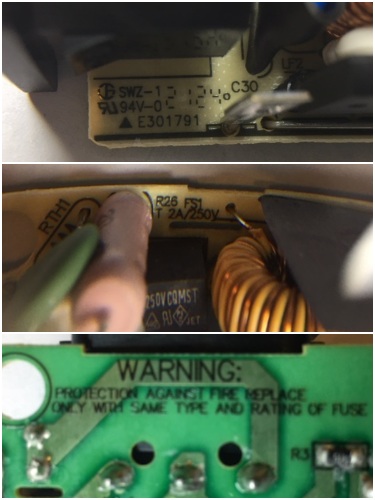
PCB markings also play a vital role and are mandated for compliance. Above you can witness specific markings for Flammability ratings using the designation of 94V-0 which are assurances that the PCB itself has been manufactured in accordance with specific materials that are flame retardant.
Additionally, the type of Fuse rating 2A/250V inclusive of Warnings related to proper Fuse replacement is clearly visible.
For further information on this topic and an example of an Underwriters Laboratory (UL LLC) Report, we give credit to Siemens AG, Process Industries and Drives, D-76181 Karlsruhe, Germany for providing this source.[/vc_column_text][vc_empty_space height=”20px”][vc_raw_html]JTNDYSUyMGlkJTNEJTIyY29tcGxpYW5jZV9tYXJrcyUyMiUzRSUzQyUyRmElM0U=[/vc_raw_html][vc_column_text el_class=”t-center li-aero”]
Recognized North American Product Safety Regulatory Compliance Marks
Here are the UL, ETL-Intertek, and CSA certification marks along with an overview of each to clarify your choices. We’ll divide them into those of each organization:
UL: Underwriters’ Laboratories
UL Mark:
General overview of UL:
Underwriters’ Laboratories (UL) is a globally recognized non-profit organization whose aim is to define safety guidelines and industry standards inclusive of independently performing tests services on new products and technologies entering the North American marketplace. Furthermore, UL is one of the most commonly sought-after certification organizations as it applies to testing and qualification on a wide assortment of electrical components and products as mentioned within the list below.
The UL Mark is a compliance designation that provides assurances to consumers that the safety and performance claims of products and components have been thoroughly and rigorously evaluated.
Examples of technologies that UL typically investigates for compliance:
- Electrical and Electronic equipment. (Appliances, Power supplies..etc).
- Electrical and Electronic components. (Circuit breakers, Fuses, Relays..etc).
- Alarm signaling devices. (Smoke detectors, Fire suppression and Alarm monitoring).
- Information Technology. (Computers, Security and Access control).
- Wire and Cable (Appliance and Extension cords).
- Any equipment that is intended for use in hazardous environments. (Oil, Gas and Intrinsically safe).
- Life safety and protective gear. (Life jackets, Personal Protective Equipment (PPE) and Flame retardant clothing).
Why is it important to purchase UL Approved products?
In an effort to safeguard the consumer and the environment for which it is intended to be used, UL approval is one way to guarantee that based on their evaluation, consumers and businesses have assurances that there will not be any detrimental hazardous safety or performance issues.
There is no generalized UL Mark, in-fact it’s divided into a four-tier system or categories as follows (Listed, Recognized, Classified and Certified). It is also important to note that each country whether it is the USA (US), Canada (C) or combined (CUS) for North America, each has adopted specific Marking requirements branding their own respective country designations. Each unique country has its own distinguishable differences while adhering to its own respective laws and regulations.
You might also like: What ‘UL Listed’ Means on Electronics, and Why You Should Look for It
UL LISTED Mark:
UL LISTED Country of origin Mark:

What does UL LISTED mean?
UL listed is one of the most common and highly sought after UL Marks for standalone products or equipment that are self-contained and serve a specific function. The UL Listed designation assures the consumer that UL has rigorously tested and approved representative samples and found that they comply with all of its safety standards. Inclusive of potential electrical shock hazards, flammability resistance, mechanical function and life-saving equipment. LISTED is often referred to as the most stringent set of test requirements under the classification categories.
Examples of self-contained products typically fall within the followings categories:
- Computer and Information Technology equipment
- Residential, Commercial and Industrial appliances
- AC/DC Power adapters and Power bars
- Batteries and Charging adaptors
UL RECOGNIZED Component Mark:

UL RECOGNIZED Country of origin Mark:

What does UL RECOGNIZED mean?
Typically used and intended for individual electrical/electronic component parts or subassemblies that are deployed within larger products or systems which are intended to be installed only by the manufacturer. UL stipulates conditions and acceptable testing criteria of how these components may be used or deployed within products. In some cases, UL may not test components and rely upon the manufacturer to perform this service under strict adherence to safety guidelines defined by UL.
Examples of components typically fall within the followings categories:
- Printed Circuit Boards (PCB).
- Electromechanical switches, relays and solenoids.
- Power supplies.
- Residential, Commercial and Industrial Automation controls.
UL CLASSIFIED Mark:

UL CLASSIFIED Country of origin Mark:

What does UL CLASSIFIED mean?
UL Classified means that samples of the product have only been evaluated and tested to meet certain industry standards regarding usage and compliance for a limited range of hazards. Thus, potentially limiting their respective usage and deployment. Generally, if a product is Classified its respective testing meets only particular requirements based on a single test with a published result.
Examples of products typically fall within the followings categories:
- Building materials.
- Industrial equipment.
- Fire protection gear.
- Marine and diving gear.
UL CERTIFIED Mark:

UL CERTIFIED Country of origin Mark:
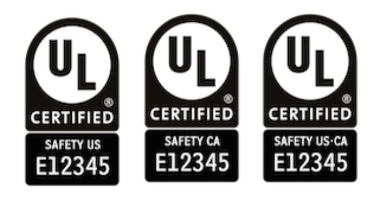
What does UL CERTIFIED mean?
The Enhanced version of the UL Certified Mark is relatively new, which is intended to eventually replace both UL Listed and UL Classified labels in use today. The aim or intent is the creation of a “smart” label consisting of both a 2D bar code and a representative UL Mark in an effort for businesses and consumers alike to gain access to safety standards online. Consumers will have the ability to scan the bar code which will in turn offer insights into which standards were applied and test metrics used for certification based on a particular product.
Edison Testing Laboratories a division of Intertek Testing Laboratories (ETL)
ETL LISTED Mark:
General overview of ETL:
The Edison Testing Laboratories (ETL) is also a globally recognized certification organization similarly to UL offering testing and compliance services for Listed products, typically standalone products or equipment that are self-contained and serve a specific function.
ETL vs. UL, which listing or compliance Mark should my company choose?
In fact, there are no differences between them. ETL does not create its own standards for certifications. ETL basically tests products to previously published standards for Safety. As previously mentioned both certification organizations offer competitive services and are recognized by NRTL and OSHA.
ETL LISTED Country of origin Mark:

What does ETL LISTED mean?
Similarly to UL the LISTED Mark indicates that the product has been rigorously tested by Intertek and has been found to comply with national safety standards inclusive of potential electrical shock hazards, flammability resistance, mechanical function and life savings. LISTED is often referred to as the most stringent set of test requirements under the classification categories.
Product categories for ETL Listed compliance generally follow the same broad range as mentioned in the UL section.
There are two ETL approval Marks ETL LISTED and ETL VERIFIED. It is also important to note that each country whether it is the USA (US) or Canada (C) or combined (CUS) for North America each have adopted specific marking requirements branding their own respective country designation for products sold within each country. As mentioned above, each unique country has its own distinguishable differences and test cases while adhering to its own respective laws and regulations.
ETL VERIFIED Mark:
What does ETL VERIFIED mean?
ETL Verified Mark demonstrates that a product has been tested and found to comply with certain design and performance standards while symbolizing the integrity of a product. The aim is to differentiate products bearing this Mark within the marketplace with assurances to distributors, retailers and consumers that a product has been tested based on acceptable limits for performance and safety.
The CSA Group (formerly the Canadian Standards Association/CSA)
CSA Mark:
General overview:
The CSA Group (CSA) is also a globally recognized certification organization similarly to both UL and ETL offering testing and compliance services. All organizations provide competing certifications thus offering customers alternate options when seeking safety compliance in North America. It’s not uncommon for customers to use either UL, ETL or CSA and in some cases transition between them. The CSA Mark demonstrates that the product has been tested against applicable standards written and administered by (ANSI) and (UL) as mentioned above while achieving safety compliance regulations for North America, both the USA and Canada.
The CSA Group does not follow the same nomenclature as UL and ETL when Marking products for different classifications or categories such as Listed, Recognized or otherwise Certified.
UL vs. ETL vs. CSA, which listing or compliance Mark should my company use?
Once again, all three organizations adhere strictly and conform to standards that were published by (ANSI) and (UL). It’s entirely at the discretion of the company seeking safety certifications. As previously mentioned, it is helpful for companies to discuss certification requirements with distributors, retailers and consumers in the geographical location they intend to sell their products.
CSA Country of origin Mark:
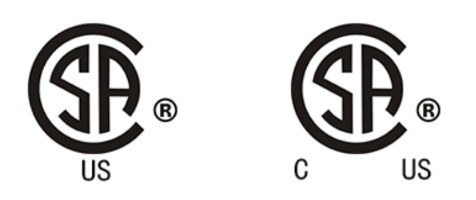
Country of origin, whether it is USA (US) or Canada (C) or combined (CUS) for North America each have adopted specific marking requirements branding their own respective country designation for products sold within each country. As mentioned above, each unique country has its own distinguishable differences and test cases while adhering to its own respective laws and regulations.
Product categories for CSA compliance generally are intended for end products and equipment following the same broad range as mentioned in both the UL and ETL sections.[/vc_column_text][vc_empty_space height=”20px”][vc_raw_html]JTNDYSUyMGlkJTNEJTIyY29uY2x1c2lvbiUyMiUzRSUzQyUyRmElM0U=[/vc_raw_html][vc_column_text el_class=”t-center li-aero”]
Conclusion
In an effort for companies to gain further insights into North American product safety and compliance regulations, we strongly encourage those to seek the professional services offered by these three organizations (UL, ETL and CSA).
These services should be considered during the early design phases of your product. As mentioned, purchasing applicable standards will be an invaluable asset to your design teams as they can cross-reference, and gain applicable testing criteria, inclusive of permissible acceptance metrics and overall methodologies behind each standard.
Lastly, none of these North American product safety and compliance regulations is mandatory. It is at the sole discretion of companies looking to market and sell products here. In addition, companies have options when selecting an appropriate compliance organization. Take the time to understand your ecosystem and be rest assured that either of them serves a single purpose which is to safeguard our work environments and protect consumers.
This guide was written in February 2022 by Ryan Clark Watt, a Canadian Electrical, Electronic and Mechanical Engineer with 25 years of experience.[/vc_column_text][vc_empty_space height=”20px”][vc_raw_html]JTNDYSUyMGlkJTNEJTIycmVzb3VyY2VzJTIyJTNFJTNDJTJGYSUzRQ==[/vc_raw_html][vc_column_text el_class=”t-center li-aero”]
Related resources
If you’re interested in North American product safety and compliance regulations, you will also enjoy reading and listening to the following resources about certifications:
“Can Sofeast help with certifications for our new product?”
Yes. And this should be planned from the design stage. Many projects have gone very far into prototyping and even production, only to be dropped because they had to get back to square 1… a new iteration of the design that takes certification constraints into account.
We have experience with the most common types of certification for the US and Europe.
Learn more about how Sofeast can help you with certifications and compliance here:
[/vc_column_text][vc_btn title=”Explore ‘Compliance Testing Consulting’ from Sofeast” color=”primary” align=”center” i_icon_fontawesome=”fa fa-check” add_icon=”true” link=”url:https%3A%2F%2Fwww.sofeast.com%2Fquality-assurance%2Fcompliance-testing-consulting%2F|||”][vc_empty_space][vc_message message_box_color=”warning” icon_fontawesome=”fas fa-exclamation-triangle”]
Disclaimer…
We are not lawyers. What we wrote above is based only on our understanding of the regulatory requirements. We do not present this information as a basis for you to make decisions, and we do not accept any liability if you do so. Please consult a lawyer before taking action.[/vc_message][/vc_column][/vc_row]





![Richard Barnett | Electronics Supply Chain Risk Management in 2021 [Podcast]](https://artbyraksha.sofeast.com/wp-content/uploads/2021/02/Richard-Barnett-Electronics-Supply-Chain-Risk-Management-in-2021-Podcast-1024x535-1.jpg)
![Types Of Batteries For Buyers Of Consumer Electronics [Introductory Guide]](https://artbyraksha.sofeast.com/wp-content/uploads/2020/12/Different-Types-Of-Batteries-For-Electronic-Products-Importers-Guide-1-768x301-1.jpg)
![Types Of Batteries For Buyers Of Consumer Electronics [Introductory Guide]](https://artbyraksha.sofeast.com/wp-content/uploads/2020/12/Types-Of-Batteries-For-Manufacturers-Of-Consumer-Electronics-Introductory-Guide.jpg "Types Of Batteries For Buyers Of Consumer Electronics [Introductory Guide]")