Fitness Wearable Development Challenges: What You Need to Know Before Manufacturing in China

Smart wearables that collect vital data, such as fitness trackers, smartwatches, and medical-grade health monitors, are becoming more and more popular in the marketplace. They are, for the vast majority, made in China. As they start to be produced in very large numbers, they are following the model of other mass-market electronic products, and buyers need to be aware of the implications of that model before starting their fitness wearable development project.


The General Model of R&D vs. Assembly in China

Not many people know how wearable technology manufacturing (and other electronics such as smartphones and laptops) is organized in China.

Some companies do the R&D, designing the PCB, writing the firmware, and selecting components, and then sell the whole solution as “kits” to other companies. Let’s call them the R&D companies.

Those other companies buy the kits, then assemble and test the final products. We’ll call them the assemblers.

Assemblers do not:

  • Have access to the source code.
  • Decide what key components to use.
  • Control the sensor integration.

All of these decisions are made by the R&D company.

So, when you get in touch with a manufacturer of a smartwatch, chances are, all they can do is offer relatively light customization. The software may have a slightly different feel. Maybe the casing will have a different shape. But it usually doesn’t go much deeper than that.

What Does That Mean When It Comes to Customization Options?

When made in China outside of big brands like Apple or Huawei, these products tend to be low-cost with intense competition between assemblers, and very little differentiation.

Any of the models will often look like many others that are made from the same kit. A kit typically includes:

  • The electronic design and components.
  • The firmware is loaded on the motherboard.
  • Key peripherals like display, memory, and ports.

All these elements have been tested to work together. Customizations are possible, but they require additional payment, which goes mostly to the R&D company. Typically, you pay the assembler, who then pays the R&D company.

A real-world customization example

A German company orders a smartwatch with slight customization. They pay an assembler in Shenzhen who is using a kit from a Shenzhen R&D company. The assembler doesn’t have the source code or own the IP, and simply passes on requests (and payments) to the R&D company. In the end, the German company cannot get the source code, bill of materials, or key technical data, even if they forced the assembler to share everything they had.

The Extra Implications for Fitness/Medical Wearables That Collect Vitals Data

If you are developing a medical device or fitness wearable and want to build your own intellectual property, you need raw biometric data from the device’s sensors.

Look at the Apple Watch health functions:

  • Blood oxygen
  • ECG
  • High/low heart rate notifications
  • Irregular rhythm notifications
  • Low cardio fitness notifications
  • Sleep apnea notifications

All these rely on raw sensor data, which is then processed through a proprietary algorithm. To compete, you must create your own formulas, tuned for your niche application.

Without raw data, you can’t…

  • You can’t develop your own analytics.
  • You can’t run population-level data analysis.
  • You won’t have a strong IP to attract investors.
  • You may not be able to meet medical device certification requirements.

As noted earlier, assemblers do not have the raw data because they don’t have access to the source code.

Is It Impossible to Have Access to the Raw Data?

In our experience, only a small minority of companies will provide raw data.

Why?

  • IP protection – Raw data access could lead to reverse engineering of their algorithms.
  • Performance concerns – If raw data is compared to certified medical devices or even an Apple Watch, discrepancies might be exposed.
  • Business model – R&D companies want to keep customers dependent on their integrated solutions.

By only providing processed or calculated values, they avoid scrutiny.

What This Means for Your Medical or Fitness Wearable Development Strategy

If you want to own your product and work based on an existing device, here’s what I recommend:

  • Find and work directly with the R&D company.
  • Negotiate raw data access upfront.
  • Verify they can actually provide it (ask for sample data or API documentation).
  • Lock IP rights into your contract.

The problem is that it’s quite difficult and it often is impossible.

If you have time & funding, and if you want a device unique to your company, there is an alternative. Start the product design from scratch with your own team or a “work for hire” design firm. That’s how you have full flexibility, provided your design architecture and your development contracts allow for it.

For a medical device in the EU or the USA, these steps are essential for achieving regulatory compliance.

You may also like…

  • OEM, ODM, Contract Manufacturers: Which Chinese Supplier to Choose?
  • EU MDR Compliance When Developing a New Medical Device in China: High-Level Steps

How to Manufacture a New Product with the Customer Journey in Mind

Sofeast’s CEO Renaud and head of New Product Development, Andrew discuss how to build a product while keeping the whole customer journey in mind. Making a good product is just one step of the journey, and in fact, there are 8 steps in the customer’s journey that we need to consider when designing and developing our new product (according to Tony Fadell’s book, Build)! Let’s go through them here…


Listen to the episode here 👇

Listen: to the podcast episode

Watch: on Youtube


Episode sections

  • 00:00 – Greetings and introducing today’s topic.
  • 04:49 – 1. Awareness.
  • 13:06 – 2. Education
  • 17:51 – 3. Acquisition.
  • 24:31 – 4. Product.
  • 27:39 – 5. Onboarding.
  • 32:15 – 6. Usage.
  • 38:08 – 7. Support.
  • 41:51 – 8. Loyalty.
  • 48:22 – In conclusion.


Related content…


Listen, rate, & subscribe to the ‘China Manufacturing Decoded’ podcast on your favorite provider

More episodes are coming, so remember to rate us and subscribe! You can find us on:

If you enjoyed this episode, don’t forget to give us a 5* rating and share it with your network if you enjoy listening!

Sourcing Chinese Manufacturers: Western Or Chinese Model? [Podcast]

Sourcing Chinese Manufacturers_ Western Or Chinese Model_ [Podcast]Our CEO Renaud wrote this guest post on Harris Bricken’s ‘China Law Blog’ explaining the two typical Chinese manufacturing models for importers looking for a partner to help them develop and mass produce their new product.

In this episode, he discusses the two models in more detail with Adrian from the Sofeast team and you’ll learn why Chinese manufacturers usually don’t behave in the same way as those in the West or those following a Western model in China. When developing a product you need to be careful that both sides’ expectations are clear from the start, your IP is protected, and you understand the pros & cons of each model. Renaud explores all of this here.

Usually, transparency, control, and IP protection are key requirements for SMEs and entrepreneurs bringing an innovative product to market, and you’ll also see why these needs really influence the type of manufacturer that you probably want to be working with in China.

Ready to go? Let’s do it!


Listen here!

Listen: Chinese Or Western Model Manufacturer. Which To Use In China?

Watch on Youtube


Episode sections

  • 00:00 – Greetings & introduction
  • 01:59 – Who does the product engineering design work?
  • 08:16 – The ‘Western Model’ and its pros & cons
  • 18:13 – The ‘Chinese Model’ and its pros & cons
  • 33:03 – How do you select which model is better for your needs?
  • 38:50 – Wrapping up.


Related content…


Disclaimer

Here at Sofeast, we are not lawyers. What we discussed above is based only on our understanding of the legal requirements. We do not present this information as a basis for you to make decisions, and we do not accept any liability if you do so. Consider consulting a lawyer before making legal decisions.


Listen, rate, & subscribe to the ‘China Manufacturing Decoded’ podcast on your favorite provider

There are more episodes to come, so remember to rate us and subscribe! You can find us on:

If you enjoyed this episode, don’t forget to give us a 5* rating and share it with your network if you enjoy listening!

A Product Designer’s Tips For New Product Launches

A Product Designer’s Tips For New Product Launches

In this post, we interview an experienced product designer to get his tips for new product launches.

Why?

A lot of people who come up with an innovative product idea think that the new product launch process goes something like this:

  • I come up with a design
  • Someone makes the prototype for me and I sign off on it
  • It goes into mass production
  • I find customers and makes sales
  • I reorder more of the product
  • I keep selling and progressively making more money
  • …and so on

This graph would represent their assumption on how the new product launch process goes:
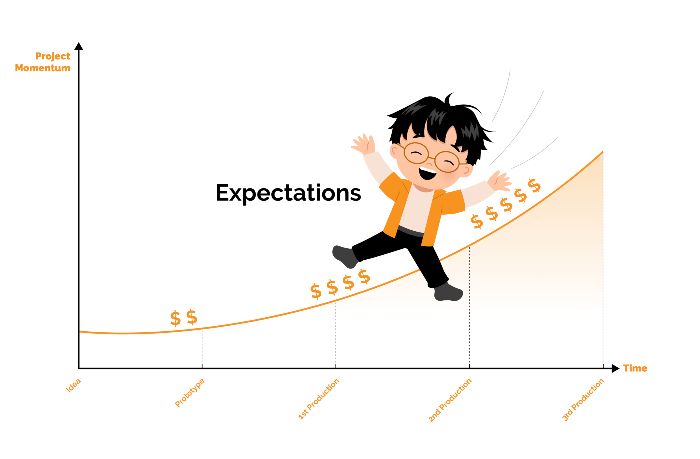
unrealistic new product introduction process
However, is this realistic?

British product designer Andy Bartlett knows a thing or two about launching new products, and he has some thoughts on the process and will dispel some assumptions. Here are a series of questions about new product launches and his tips to help you:


Is the new product launch process usually fairly straightforward if you’ve got a unique, cool product that will sell?

Some entrepreneurs and companies who come up with an admittedly innovative and cool product idea get sucked into this assumption that a new product launch will go smoothly and doesn’t have numerous stages to follow. This is because we’re all consumers at heart, so we all love and buy stuff in our everyday lives and much of the time we never really stop to consider the energy, effort and human endeavor that sits behind a beautiful, simple, elegant product that we love. 

I particularly think the process requires a great deal of investment when you’re doing something new. If you’re doing something for the first time it generally takes much more effort than the second, third, and fourth. The payoff is that as you get better and better at doing it you use some of that previous investment of knowledge and wisdom and skill and bring it to the next development. 


How important is the pre-production work?

Another area that gets overlooked is the product’s concept and early design stages. Just getting to the point where you have a great product concept that works well is a huge step.

Related 👉 We’ve written about the importance of going to a manufacturer with mature designs before.

I worked for Panasonic and for the first three years not one of my concepts ever went to market! So you can imagine how many concepts are developed by Apple, Microsoft, or HP that never go anywhere, and how many years of work go into them. To get to a green-lit concept where the user is happy, we can make our market projections, the cost and brand guys are happy, it takes an enormous amount of work and sometimes the market’s moved on and the product’s no longer relevant.

The early design work determines so much of everything else in the project, so that’s why it’s so important to get that right and work with good people. Someone did a study (mentioned in the graph here) and found that the cost of the design itself when you compare it to the cost of tooling, purchasing the components, manufacturing, distributing, and everything is somewhere around three to five per cent of the total, however, it determines something like 70 per cent of the total cost. 

This is because during the early design stages you define the materials, the technology, how it works, how simple or complicated the product’s going to be, and more. If you look at the number of decisions you make in a new product development, many of the core decisions are made really early on and the whole project stacks and builds on those decisions about things like material and processes and because they’re made so early in the development process you know the consequences of going back and changing them if you get them wrong or if they prove to be flawed later on are huge.

That being said, the early design work before pre-tooling can really be the tip of the iceberg with most of the effort still to be done in terms of signing the tooling off, the tooling validation process, developing packaging, developing assets for your online presence, distribution, and so on and so forth. Maybe as a consumer you never consider all of those, too. 


Any tips to control the project?

Avoid selecting an immature technology where the manufacturing readiness level is pretty low as this will give your manufacturer a lot of headaches. It’s very easy to be seduced by certain processes or finishes or technologies that will just draw in so much time and effort, requiring lots of other people to do R&D, but consider if features are truly fundamental to your product offering.

Related 👉 We wrote about avoiding feature-creep before.

It’s really important that you’re not wasting energy on niche processes as they may not be worth it. The skill in the process of taking a product to market is to say no to dead ends early on and not go too far down a route that’s likely to cause pain. 

Let’s look at the ‘sunk cost fallacy’ which is also known as the ‘Concorde fallacy.’ The Concorde was a supersonic passenger plane and the concept was to fly people very quickly across the Atlantic and basically, the project ran 10 times over cost and it’s a really interesting analogy here because they carried on ploughing the money in because they’d already invested so much energy, time, and money that they couldn’t possibly walk away from it.

This is a trap we can all fall into when we develop a new product; it’s wise to know when to say no to new technologies, custom parts, complex features, and so on, rather than stubbornly carrying on. There were some studies that showed that the bigger the project and the more complex the elements going into it, the more likely it is to run over cost. So you should really focus on what creates value for the users and try to make the product relatively simple, then not only would it be faster and less risky to develop, but there’s a lower risk of you going over your budget, too. Back during my days in the toy industry, we used to have to be able to describe a new toy concept in one sentence. If we failed it was deemed to be too complex and an idea that would need to be refined before it could be further developed.

I should also stress the importance of procurement and sourcing the right suppliers for critical components, because that also can derail the entire project if, for example, a supplier suddenly raises the price massively or simply says that it’s no longer available. 


How does design relate to reliability?

Reliability is largely determined by design. People often think of quality and they think of the guys doing the assembly on the line, but then if they want the product to keep working for two or three years the design itself has to be reliable and that comes from making sure that you consider the stress points and the redundancy if needed and things like that, and also choosing the right component suppliers that already come with proven reliability levels.


When do design changes become impractical?

Exploring ideas and making some changes during the concept and early design stages is cost-effective. Doing so once you’ve made a tool and it becomes slow, painful, and costs escalate quickly (e.g. making changes to tooling is slow and expensive) over simply tweaking a CAD drawing. It’s even worse if production has already begun. Therefore being thorough and making sure that designs are mature is critical.


What is ‘agile prototyping?’ 

Let’s say product development is to get all the way to a prototype that is approved and looks and works as you need it to. This can be a ton of work. Sometimes it takes more than 10 prototypes for complex electronic products and the process kind of starts again after tooling is made if you have very high expectations for the finish. The point is, it’s unrealistic to just create one good prototype and then go into production. To coin Mark Zuckerberg’s phrase, ‘move fast and break things’ when prototyping by accepting ‘good enough’ to move quickly because searching for perfection will slow you down and prevent you from learning things quickly which may be really important, particularly when doing something for the first time.

Having that sort of quick agile mindset helps, so favor sketching over CAD in order to move quickly and utilize 3D printing to get prototypes really quickly that are good enough to put in front of customers you may be selling to so you can show them physical properties, because if it’s a new product you need to get feedback from typical users during development. Would you rather spend six months to get a perfect prototype only to find out that maybe you went in the wrong direction, or would you rather do some quick iterations to show the product to some people once a month and get valuable feedback that keeps you on track? 


When to go into mass production?

Let’s say you’ve done the engineering of your new product that you designed from the ground up, selected relatively high-quality components and tested the prototypes like crazy for a month. The manufacturer might say that the next step is to wire them a thirty per cent deposit and go straight into mass production. Some entrepreneurs do this and that’s a mistake.
There are still plenty of steps to undertake and decisions to make:

What’s the quality standard? Where’s the testing plan? Has the product been certified for your market (you shouldn’t wait for the product to be mass-produced before checking that it’s compliant for obvious reasons)? Are you performing any pilot runs? If not, how have you validated that everything can be made properly? 

The typical Chinese manufacturer wants to go into production and get paid. They don’t want the hassle of the testing and validation I mentioned as this slows them down from arriving at their goal. So a manufacturer that pushes you to pay and not worry, claiming that they’re experienced in producing your type of product even though it’s new and has been designed from the ground up is exhibiting major red flags.

Fundamentally, using them is a bad sourcing decision right there, but on the other hand, the entrepreneur didn’t plan for a lot of important pre-production steps either and didn’t communicate what their process is to the supplier, so some of the blame has to be shared. 

It’s very tempting to expedite a development process and bypass certain stage gateways, particularly if you’re under time and budgetary pressure. Not every product needs a very long and full development path. It is possible to have a quick development path depending on the nature, complexity, and challenges of the product you’re making, but there are certain stages that shouldn’t be skipped, such as pilot runs for EVT, DVT, and PVT.
You don’t just jump from a prototype to mass production, you tentatively go through three or four different development gateways at each time pausing, reflecting, reviewing, testing, and checking. Otherwise, your risks of problems occurring during the production and ending up with defective or sub-standard products that require expensive rework and even being shipped back to the manufacturer from abroad are greatly increased. 

If problems are found during inspections on finished products, the pre-production work to iron out and avoid them probably hasn’t been thorough enough, therefore the development process is an investment that will save you a lot of heartache, money, and time, even if it does feel somewhat laborious or slow whilst you’re doing it.

Having an auditable trail in the development process is very valuable and reassuring because if you are importing and developing a new product and putting it into the market in significant numbers, you will sleep better at night knowing that you followed the correct development process and haven’t skipped anything critical. Let’s take an extreme example: there’s a recall on your product as it has caused injuries or death. You’re in court and a judge is asking you questions about how well-tested the product was before it went into mass production. If you cannot answer the questions they will say you were negligent and then if you say “I didn’t know that people usually do that,” this is no defence, but if you say “this is our risk analysis and you see that we covered the foreseeable safety failures and we identified ways to address them, we did some reliability testing, to address some issues found we made some engineering changes, and we purchased this component here and the battery from fully certified manufacturers, etc,” they will see that you were unlucky but not negligent.


Do you have a key takeaway for entrepreneurs planning to go to market with a new product idea?

It’s really hard getting your first product to market, but it gets easier and easier especially with the next versions of the same product. Getting bogged down with trying to be perfect or include too many features is a mistake.

There’s nothing wrong with having a road map where you initially go to market with your minimal viable proposition knowing that version two is on the road map. 

A really valid way of putting your product out there and sustaining and growing your brand is to get to market quickly with existing technology that only allows you to achieve say 80 per cent of what you want, but allows you to build momentum and later go back and explore the new technologies that are available in version 2.0 with the time, energy, and resources to do so. 


Conclusion

So, you can see from Andy’s tips for new product launches, the process is complex and can lead you into trouble if certain stages or activities are skipped. Take moving from prototype to mass production as one of the examples of this. The average Chinese manufacturer may suggest doing this, but there’s a huge amount of testing and validation to be done in order to assure that issues are avoided or minimized during production so you end up with quality and compliant products ready for the market.

With this being said, a more realistic representation of the new product launch process will look more like this:
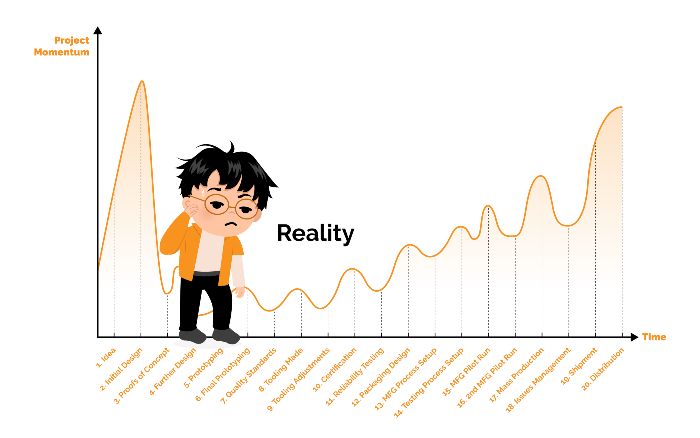
realistic new product introduction process
Do Andy’s points about the complexity of launching products resonate with you? Were you surprised by the process? Perhaps you suffered from issues because of going into production too soon? Please let us know your thoughts or your own tips for new product launches by commenting below!


Are you designing, or developing a new product that will be manufactured in China?

Sofeast has created An Importer’s Guide to New Product Manufacturing in China for entrepreneurs, hardware startups, and SMEs which gives you advance warning about the 3 most common pitfalls that can catch you out, and the best practices that the ‘large companies’ follow that YOU can adopt for a successful project.

It includes:

  • The 3 deadly mistakes that will hurt your ability to manufacture a new product in China effectively
  • Assessing if you’re China-ready
  • How to define an informed strategy and a realistic plan
  • How to structure your supply chain on a solid foundation
  • How to set the right expectations from the start
  • How to get the design and engineering right

Just hit the button below to get your copy:
An Importers Guide to New Product Manufacturing in China Guide

Exploring The Key New Product Development Deliverables [Podcast]

exploring the key new product development deliverables

Join our CEO Renaud Anjoran as he talks you through the new product development process and its various deliverables that form milestones for the buyer and help assure that you get quality and safe products going into mass production.

You’ll learn about key deliverables you should expect from the product R&D stage through to mass production, including design files, the BOM, how to reduce risks, the control plan, inspections, pre-production validation testing, and more.


Listen here!

Listen: What Are The New Product Development Deliverables?

Watch: Watch on YouTube


Episode sections

  • 00:00 Introduction. 
  • 01:03 – Going through the NPD process from the buyer’s side and its deliverables in detail.
  • 04:06 – The latest version of design files. 
  • 05:42 – The BOM.
  • 07:28 – Risk mitigation.
  • 09:28 – Elements and learnings from the automotive industry (PPAP). 
  • 10:49 – Risk analysis – FMEA on design & processes.
  • 14:28 – The process flow chart/diagram.
  • 15:55 – The control plan.
  • 19:37 – Calibration or verification certificates of fixtures and instruments for checking quality.
  • 21:44 – Product QC inspections.
  • 23:31 – Pilot run stage – EVT, DVT, PVT.
  • 28:03 – Engineering changes.
  • 29:23 – Prototypes/tooling/PP samples.
  • 31:44 – Does every type of part or product require such stringent deliverables?
  • 33:45 – Wrapping up


Related content…


Listen, rate, & subscribe to the ‘China Manufacturing Decoded’ podcast on your favorite provider

There are more episodes to come, so remember to rate us and subscribe! You can find us on:

If you enjoyed this episode, don’t forget to give us a 5* rating and share it with your network if you enjoy listening!

Getting To Grips With Non-Recurring Engineering Costs (NRE) [Podcast]

Getting To Grips With Non-Recurring Engineering Costs (NRE) [Podcast]In this episode of the podcast, we discuss Non-Recurring Engineering costs for manufacturers. As the name suggests, these costs are usually one-off and are what it takes to get your product into production. These costs are perhaps better known as R&D costs, and it’s important to get to grips with them as they have a great impact on your product’s sale price, as well as the feasibility of manufacturing it in the first place.

It’s fair to say that the NRE costs often turn out to be more than initially estimated, so being able to accurately calculate them starts with understanding the many things that can be accounted for which can be everything from product design, to prototyping costs, certifications, wages for development staff, tooling costs, and much more.

Caution is required, too, as when working with a Chinese supplier they may swallow some of the NRE costs themselves, which sounds good, but they may expect something more in return than you’re willing to give up!

So, let’s get to grips with NRE costs in this episode.


Just hit the play button to start listening..!

Listen to the episode right here 👇👇👇

🎧 Getting To Grips With Non-Recurring Engineering Costs 🎧

Watch on YouTube ▶️  youtu.be/jQkDIcJ_y_I

Here’s a summary of key sections of this episode:

✅ What are NRE costs? (A brief summary) – essentially NRE costs are all of the one-time expenses (investment) that you need to pay in order to get your product into production. A lot of it is engineering work, but not all. When planning your expenses, you will calculate the one-time NRE costs against the unit cost and cost of sales and distribution and decide how much to add to the unit sales cost in order to cover the NRE costs plus interest. This tends to be true for electrical/mechanical products. For apparel and shoes, it is usually simpler. There are NRE costs such as design and samples and checking the start of production, but then it is mainly recurring production work.

✅ Some examples of common NRE costs for the different production processes:

  • Plastic injection molding – industrial designed parts in CAD, DFM review, rapid prototyping, tooling design and fabrication, trials to approve tooling, etc
  • Metal parts – as above, but also cast molds, clipping tools
  • Electronics – unique PCBA needs to be designed, stencils, artwork, outline guides, programming setup, drill profile, visual inspection, etc

✅ Going through some of the other processes and materials, and their costs – extrusion (plastic or aluminum), compression molding, silicone tends to be cheaper. Creating plastic parts can be done via 3D printing, CNC machining, or injection molding – each increasing in cost and also suitability for high volumes. Processes used are dependant on volumes required, so that should be taken into account.

✅ Why your NRE costs are probably higher than you’re initially anticipating – Renaud shares an example of real Sofeast customers who believed that their NRE costs were fairly modest and tried to keep them low by approaching upworkers, trading companies, etc, to handle the design and sourcing, but finally, have to accept that the NRE costs are far higher than they anticipated if they want to get the product made at the standard they require.

✅ Do some suppliers pay the NRE costs for you? – it may be that when purchasing very standard products, or white labeling products which have already been developed, that you won’t need to pay NRE costs as they have already been paid by the manufacturer who supplies them.

  • The difference between standard ‘off-the-shelf’ products (little NRE cost), custom ‘off-the-shelf’ products (little NRE costs, but beware of ODM manufacturers selling these without actually owning the IP), and fully custom components, like a unique enclosure (higher NRE costs that you will need to pay for).
  • Who will own the IP of the product if a manufacturer offers to share or take care of the NRE costs? This can happen as manufacturers try to lock you in by refusing to give you designs, BOM, etc, because ‘they developed it.’ You need to be wary of this. At the least, a manufacturer will probably try to claw back the NRE costs by charging you a higher per-unit price if they do work on the R&D side but grant you ownership of the IP.

✅ Using a development or development & manufacturing agreement to protect yourself – this sort of agreement will spell out who will own the IP, what information should be accessible to the buyer, and who is responsible for paying NRE costs. Some manufacturers in Asia will do this work with the expectation of retaining ownership of IP, etc, as standard practice, therefore an agreement protects against this happening.

✅ Most manufacturers are more interested in mass production rather than product development, so how does this impact you during the R&D stage? – in this case, the manufacturer doesn’t want to get involved with activities that accrue NRE costs such as product design, sourcing, etc. In this case, you may need to hire an engineering team or work with a company like us (Sofeast) who can help with the product engineering, supply chain side of things, compliance and testing, etc.

✅ How to gauge what the manufacturer is comfortable with doing for you – in general, the closer you are to production the more appealing a prospect you are to manufacturers, but you should look into their capabilities while sourcing suppliers and performing due diligence, as well as simply asking what they can do on the R&D side.

✅ If you have a prototype that is fully functional, you’re ready to give it to a factory and go into mass production, right? – No. This would indicate that you aren’t even halfway yet! Sourcing work, qualification of suppliers, DFM review, certifications, tooling design and fabrication, testing, and more, are still to be done. So, you can see how the NRE costs add up quickly.

✅ NRE costs you need to consider when projecting your costs – these activities typically full under the umbrella of NRE costs: design work, sourcing, supplier qualification, reliability and compliance testing, producing prototypes, getting customer feedback on the prototypes and making changes to them, creating the quality plan, fabricating tooling, putting in place testing stations and special checking fixtures, sourcing your assembly supplier, and negotiating a good manufacturing contract with them with a lawyer. Also for products with software, the firmware and app production tends to be created at an early stage as an NRE cost (although it will be updated later which also adds to it over time).

✅ Typical recurring costs – for comparison, here are some of the typical recurring costs you will also need to consider when developing and manufacturing a new product: the parts used to manufacture products, amortized tooling cost for custom parts in the per-unit cost (in some cases), material and processing costs for the parts, assembly costs (labor/factory overheads), scrap and rework, packaging, shipping, import duties and tariffs, dropshipping costs, returns and replacements, and warranty costs.

*****

What are your experiences with Non-Recurring Engineering Costs? Did yours turn out to be higher than you’d initially estimated for? What, in particular, came as a surprise? Please share your experiences or advice by leaving a comment.


Additional content related to today’s episode…


Listen, rate, & subscribe to the ‘China Manufacturing Decoded’ podcast on your favorite provider 👍

There are more episodes to come, so remember to rate us and subscribe! You can find us on:

Don’t forget to give us a ⭐️⭐️⭐️⭐️⭐️ rating and share it with your network if you enjoy listening! 😊

Why Are Pilot Runs So Important When Launching New Products? [Podcast]

Why Are Pilot Runs So Important When Launching New Products? [Podcast]

Pilot runs aren’t just a ‘good idea,’ they’re a must when manufacturing new products as you are about to find out…

Renaud and Adrian from the team explore an important part of the new product launch process: pilot runs.

In this episode, they’ll be exploring the following questions: What is a pilot run, why is it so important when bringing new products to market, and what are the benefits we can expect when performing them before going into full production?

After listening you will see why pilot runs are such an important tool in order to minimize the risks you face when launching a new product, in particular.


Just hit the play button to start listening..!

Listen to the episode right here 👇👇👇

🎧 Why Pilot Runs Are A ‘Must-Do’ When Launching New Products 🎧

Here’s a summary of key sections of this episode:

✅ Why PRs are such an important activity
✅ PRs as a tool to validate the workshop’s capability to mass-produce the products
✅ How many PRs to perform before starting mass-production
✅ How PRs are conducted in different industries
✅ Do smaller production runs still need a pilot?
✅ Why Chinese manufacturers often don’t like PRs
✅ A list of benefits the PR will give to you


Additional content related to today’s episode…

Do you perform pilot runs before mass-production? What benefits have you gained from them? Let us know by leaving a comment, please.


Listen, rate, & subscribe to the ‘China Manufacturing Decoded’ podcast on your favorite provider 👍

There are more episodes to come, so remember to rate us and subscribe! You can find us on:

Don’t forget to give us a ⭐️⭐️⭐️⭐️⭐️ rating and share it with your network if you enjoy listening! 😊

How To Protect Product IP When Working With Contractors & Factories In Different Locations? [6 tips]

How To Protect Product IP When Working With Contractors & Factories In Different Locations? [6 tips]
Entrepreneurs, hardware startups, and various SMEs commonly outsource parts of their new product manufacturing project to various individuals and companies around the world, such as product designers and factories. But one worry they have is how to protect product IP when it’s in the hands of these different contractors who often aren’t in their own country.

Continue reading “How To Protect Product IP When Working With Contractors & Factories In Different Locations? [6 tips]”

Incubator Or Accelerator? What Should A Hardware Startup Choose?

[vc_row][vc_column][vc_single_image image=”10432″ img_size=”full”][vc_column_text]Hardware startups often ask us: ‘Incubator or accelerator? What’s our best choice?’ 

The answer depends largely on where you’re at with your product idea, how mature your business/company is, and what kind of investment you are looking for.

Continue reading “Incubator Or Accelerator? What Should A Hardware Startup Choose?”

Importing from China? Use this product specifications template.

[vc_row][vc_column][vc_single_image image=”10213″ img_size=”large” alignment=”center”][vc_column_text]

Many importers don’t organise their product specifications and dealings with suppliers at all well

Some importers send information about the product they expect through many different channels:

  • Email threads
  • Skype, WeChat, or QQ conversations
  • In the form of samples or validations of counter-samples
  • Drawings and explanations in face-to-face meetings

And they expect the supplier’s salesperson to gather all this information, translate it, and present it in a unified and coherent manner to the engineers and technicians who will manage production!!

As you can imagine, this can become chaotic and inefficient, and, should things go wrong, finding out the cause can be like looking for a needle in a haystack when so many different sources of information need to be searched through.

In fact, we discussed this messy way of working with suppliers in relation to what happens when problems occur between you in this episode of our podcast:

The better way? Collecting product specifications in a master document

In my view, it is the importer’s responsibility to gather all product specifications in one master document and to keep it updated.

The difficulty, of course, is to find a template that makes sense. Well, you are in luck. I’ve made a free template based on what we use here at Sofeast which you can download and modify where required:[/vc_column_text][vc_btn title=”Download the product specification template” color=”danger” align=”center” i_icon_fontawesome=”fa fa-file-text-o” add_icon=”true” link=”url:http%3A%2F%2Fbit.ly%2FSofeastProductSpecTemplate||target:%20_blank|”][vc_column_text]

Product Specifications Template Best Practices

If you want to get closer to the best practices when using this product specifications template, I have some more advice:

  • Think of the QC inspection and testing process when writing this document. It means you will include tolerances, descriptions of potential defects, and so on. (More info on this topic in How to prepare a QC inspection checklist).
  • Get this document reviewed by a quality assurance agency, if you want feedback to make it more precise and more useful.
  • Have someone translate it if you don’t fully trust the supplier’s salesperson to do so (a simple rule of thumb is that, if she doesn’t want to show you the translated document, it was never translated in the first place).
  • Get a factory manager to comment on it, and adapt it if necessary. Two-way communication is very important.
  • Ask the supplier to date, sign, and stamp it to indicate their acceptance of your specifications.

[/vc_column_text][vc_separator][vc_empty_space height=”20px”][vc_column_text]

Ultimate Guide To Sourcing From China And Developing Your Suppliers [eBook]

This FREE eBook starts from the beginning, discussing whether you need to hire a sourcing agent, and follows the sourcing process right through to developing a trusted supplier’s quality and productivity.

There are 15 chapters over 80+ pages to explore, providing exhaustive guidance on the entire sourcing and supplier development process from start to finish, including:

  • Identifying suppliers,
  • Negotiations,
  • Quality inspections,
  • Developing Chinese suppliers,
  • Improving factory quality and productivity,
  • and much more…

Just hit the button below to request and download your free copy:


Ultimate Guide To Sourcing From China And Developing Your Suppliers [eBook]
[/vc_column_text][/vc_column][/vc_row]