Why User Experience Is Harder Than Engineering [Podcast]

A product can meet every specification, pass every technical test, and still disappoint customers.

That is because users do not experience specifications, engineering reports, or phase-gate approvals. They experience how quickly the product responds, whether its controls make sense, whether it feels comfortable and safe, and whether they can set it up without becoming frustrated.

In this episode of China Manufacturing Decoded, Adrian speaks with Paul Adams, Sofeast’s Head of New Product Development, about why user experience is often more difficult to validate than engineering performance.

Paul shares several real product-development examples and explains how early prototypes, independent user feedback, and prolonged real-world use can uncover experience problems before tooling and mass production make them expensive to correct.

You’ll learn:

* Why technical compliance does not guarantee a good user experience
* How packaging and button behavior can make a working product appear faulty
* Why safety limits and customer comfort are not always the same
* Which timing, feedback, accessibility, and setup problems to test
* Why engineers and product owners should not be the only testers
* How to incorporate usability feedback earlier in the NPI process

Listen here

Listen to the episode or watch on YouTube

Podcast sections

  • 00:00 Introduction
  • 00:45 Why passing technical tests is not enough
  • 03:27 Packaging and power-button problems
  • 06:38 Safety compliance versus user comfort
  • 09:13 Why usability is harder than engineering
  • 11:57 Why UX is underinvested during NPI
  • 15:50 Why designers should not test their own products
  • 18:26 How to identify user-experience faults
  • 20:25 Missing or ambiguous product feedback
  • 22:06 Reachability, readability, and controls
  • 24:01 Product setup and instructions
  • 25:33 Why you need to live with the product
  • 28:20 Final takeaway

Further content

🎧 Listen, rate, & subscribe to the ‘China Manufacturing Decoded’ podcast on your favorite provider

More episodes are on the way, so remember to rate us and subscribe! You can find us on:

Design to Cost: Hit Your Price Target Before Production [Podcast]

A common question in product development is:
“How can we reduce the cost of this product?”

The problem is, it’s often asked too late.

By the time a product is fully designed, most of its cost is already locked in. At that stage, reducing cost usually means compromises, redesigns, or pressure on suppliers (which often leads to quality issues).

A better question to ask is:
“What should this product cost, and how do we design for that from the start?”

That’s where design-to-cost comes in.

Let’s talk through it here…


Listen here

Listen to the episode or watch on YouTube

Episode Sections:

  • 00:00:03 – Introduction & industry context
  • 00:01:15 – Why reducing cost late rarely works
  • 00:02:09 – How costs get locked in early
  • 00:04:58 – What “design to cost” really means
  • 00:06:59 – Designing within cost constraints
  • 00:10:29 – The biggest cost reduction levers
  • 00:11:29 – Cutting features without losing value
  • 00:14:35 – Main drivers of product cost
  • 00:19:04 – Common mistakes that increase costs
  • 00:26:19 – Why simplicity improves cost and reliability
  • 00:27:19 – Practical design-to-cost strategies
  • 00:30:29 – Case study: the Coolest Cooler failure
  • 00:31:49 – Final takeaway: design for cost from day one

Further content

🎧 Listen, rate, & subscribe to the ‘China Manufacturing Decoded’ podcast on your favorite provider

More episodes are on the way, so remember to rate us and subscribe! You can find us on:

Designing for Sustainability Is the Easy Part. Making It Work Is Harder.

I recently read the Punctuate Design article on sustainable product design practices for a circular economy, and it got me thinking about designing for sustainability. Their article does a good job of reframing sustainability as part of good design, not simply a bolt-on. The focus on disassembly, modularity, repairability, and long-term value retention is sound, and in principle, few product teams would disagree with it.

However, I feel that where things get more interesting is when these ideas leave the design studio and meet component suppliers, tooling constraints, production schedules, and cost pressure.

That is usually where sustainability ambitions are tested…


What they said about Designing for Sustainability

At a high level, the article outlines a set of design-led strategies aimed at preserving product value for as long as possible, rather than treating sustainability as an end-of-life issue. (Click to expand the graphic)
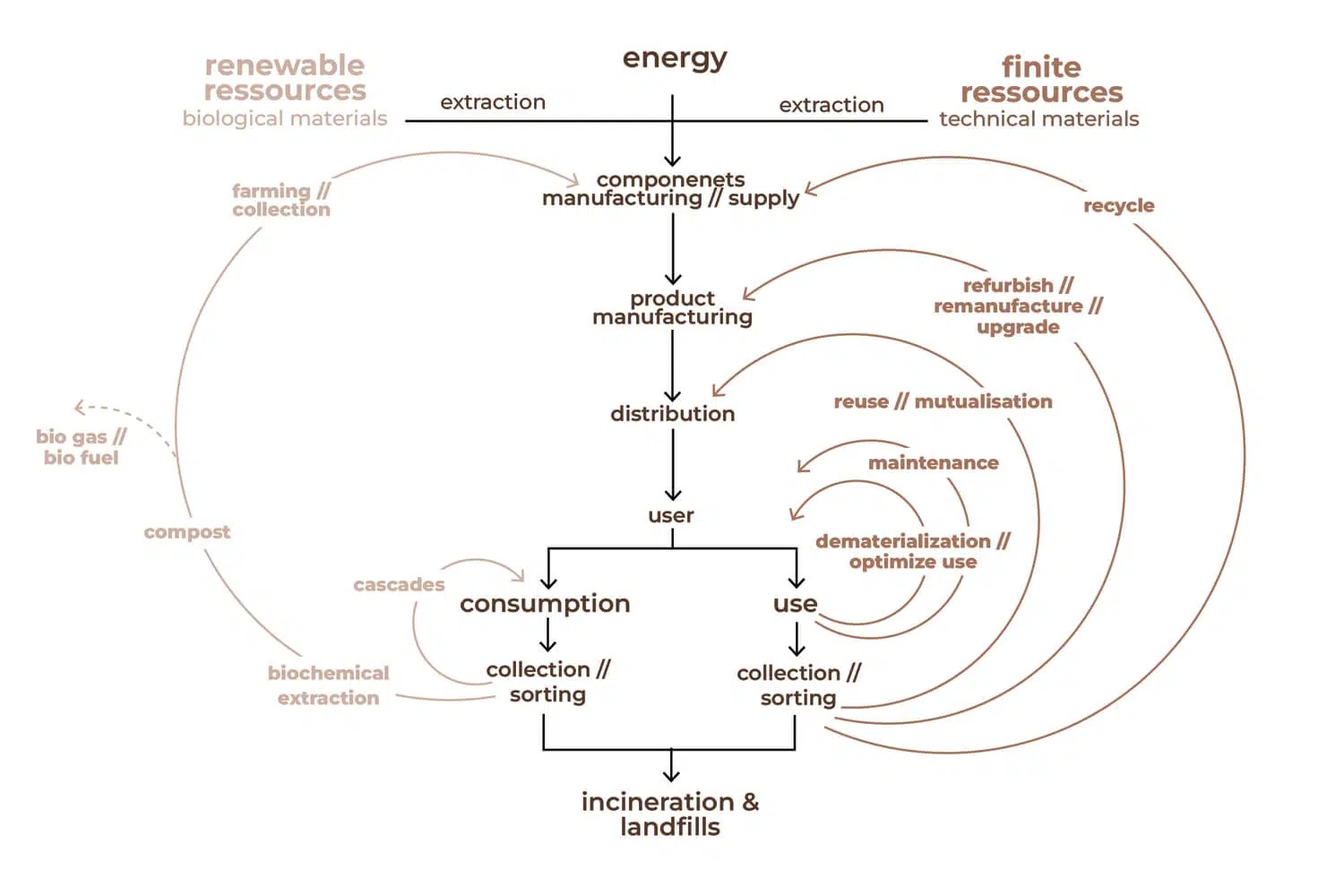
Designing for Sustainability practices graphicThe emphasis is on decisions made early in the design phase that allow products to stay in use, be adapted, or be recovered instead of being discarded and ending up being burned or in landfills (brown lines). It highlights:

  • Design for disassembly, so products can be taken apart efficiently for repair, adaptation, or material separation
  • Modular product architectures, allowing upgrades or partial replacement rather than full product scrapping
  • Repairability and user participation, with clear pathways for maintenance that extend product life
  • Multifunctional and multigenerational use, reducing the need for additional products over time
  • Cascading material use, where resources flow through successive applications rather than becoming immediate waste

Taken together, these ideas highlight sustainability as a question of value retention and adaptability, not just material choice or recycling rates. They make a compelling case for why sustainability must be designed in from the start (and these ideas closely align with cradle-to-cradle thinking, by the way).

Where the discussion becomes more difficult, and more interesting, is when these principles move beyond design intent and into real-world manufacturing. I’ll now share some thoughts on this…


Circular design starts with intent, but survives on execution

Concepts like design for disassembly or modularity are not new. Many product teams already discuss them early in development. The challenge is that intent alone rarely survives first contact with manufacturing.

A product designed to be disassembled only delivers sustainability benefits if:

  • Fasteners remain accessible after cosmetic parts are added
  • Components survive repeated disassembly and reassembly
  • Factories follow the intended assembly sequence rather than shortcuts
  • Cost-down exercises do not quietly replace screws with glue

In practice, we often see products that could be repairable in theory but are not repairable in reality because these downstream decisions were never controlled. That makes sense; it’s often cheaper and easier not to follow through.

This may be a design failure; it may also be a process failure.


Modularity and repairability can increase complexity and risk

Modular design and user-repairable products sound attractive, and they can be powerful. But they also introduce real engineering and quality challenges, which can be off-putting for manufacturers.

Every module interface is a potential failure point. Every repeated assembly cycle stresses plastics, threads, seals, and connectors. Products designed to be opened must be validated differently from sealed products, not just once, but repeatedly.

When repairability is introduced without updated validation strategies, tighter tolerances, and clearer assembly standards, the result is often higher field failure rates rather than improved sustainability.

This is a common disconnect we see: sustainability features are added, but the engineering and quality systems remain unchanged, resulting in a high return rate.


Sustainability is locked in early, but enforced later

One point the Punctuate Design article makes, and that we see very clearly in practice, is that sustainability outcomes are largely locked in during early design decisions.

Material selection, product architecture, part count, and fastening methods determine what is possible later. Once steel tooling is cut and suppliers are selected, your options quickly become limited.

However, early intent only becomes real outcomes if it is enforced later through:

  • Supplier capability assessment and alignment
  • Tooling and assembly process reviews
  • Test criteria that go beyond basic function
  • Documentation that explains why certain design choices must not be changed

Without this enforcement, designing for sustainability’s intentions can be quietly swept under the rug during production ramp-up.

If you’re interested in how these ideas play out on the buyer and supplier side, Sofeast has a useful overview of how procurement decisions shape real sustainability outcomes in their article on responsible and sustainable purchasing practices.


Factories tend to do just what they are measured on

Factories do not necessarily ignore sustainability, but they optimize for what they are measured on.

If lead time, yield, and unit cost are the only metrics that matter, sustainability features that might slow assembly, require additional care, or increase inspection time will likely be treated as problems to be removed at the DFM stage — unless specified as critical.

This is why sustainable product design cannot be separated from supplier alignment and quality & reliability management. Factories must understand not just how to build a product, but what must not be changed, and why.

When that understanding is missing, even well-designed products drift away from their original sustainability goals.


Sustainability is not the same as compliance

There is also an important distinction between sustainability and compliance.

Passing environmental regulations or material standards does not guarantee that a product is durable, repairable, or long-lived. A compliant product that fails prematurely still generates waste, often more waste than a non-certified product that lasts twice as long.

From a real-world perspective, product reliability is one of the strongest sustainability levers available, yet it is often discussed separately from sustainability initiatives.

For readers wanting more context on how regulators are now pushing sustainability into product requirements, Sofeast has a clear primer on the EU’s Ecodesign for Sustainable Products Regulation.


Final thought

The value of the Punctuate Design article is that it reminds us that sustainability is primarily in the realm of product design.

But in manufacturing, design intent is only the starting point.

Sustainable products emerge when design, engineering, suppliers, and quality systems are aligned, and when sustainability is treated as a performance requirement, not a slogan.

Good design makes sustainability possible.
Good execution is what makes it real.

Designing for Toughness: How to Specify & Achieve the Right IK Rating (Podcast)

In this episode, Adrian and Paul unpack IK ratings, what they measure (impact energy in joules), how they differ from IP ratings, and how to translate a fuzzy requirement like “make it rugged” into materials, geometry, and a test plan that reliably hits IK06–IK10 targets in real-world use.

This helps hardware teams moving from prototype to mass production who need housings/enclosures that survive drops, knocks, and tool strikes without functional failure.


Listen here

Listen to the episode or watch on YouTube

What you’ll learn in this episode

  • IK vs IP: why dust/water ingress protection is different from impact toughness
  • How the IK00–IK10 scale maps to impact energy (J) and typical product environments
  • Material shortlists by target IK (PP/HIPS/ABS → PC/ABS/modified PA)
  • System-level design levers that actually move IK results (thickness, ribs, radii, gate/weld lines)
  • How to build a practical verification plan, including environmental factors (temperature, UV, chemicals) and sample counts

Episode Sections:

  • 00:12 – Introduction: designing for toughness via IK rating
  • 01:58 – IK vs IP: ingress ≠ impact toughness
  • 05:16 – What is IK? Impact energy (J); Izod/Charpy context
  • 08:33 – IK scale overview: IK00 → IK10 (~20 J)
  • 09:18 – Start with real-world use before materials
  • 10:15 – Low-impact examples (e.g., light switches)
  • 11:56 – Mid-impact examples (bench drops, tools falling)
  • 12:50 – High-impact / IK10: sledgehammer territory
  • 14:02 – Specify toughness explicitly: choose an IK level
  • 17:02 – Mapping joules to IK (≈0.35 J to 20 J)
  • 19:34 – Materials at IK06 (~1 J): PP, HIPS, ABS, PA
  • 21:47 – Materials at IK09 (~10 J): high-impact ABS, PC/ABS, modified PA
  • 25:51 – Designing for IK: thickness, ribs, radii
  • 27:18 – Molding realities: gate location, weld lines
  • 29:26 – Environment trade-offs: temperature, UV, chemicals, cost
  • 33:14 – Same IK, different designs: oil vs building site
  • 35:16 – Key takeaway: IK is a system rating
  • 35:40 – Wrapping up

Key takeaways

  • Don’t say “rugged,” specify an IK level tied to real-world abuse.
  • IK is a system rating, not a material number: geometry + molding + assembly all matter.
  • Validate under environmental extremes (temp/UV/chemicals) and define pass/fail clearly.
  • Budget time and units for design–test iterations to confidently hit IK targets.

Extra resources to dive deeper

🎧 Listen, rate, & subscribe to the ‘China Manufacturing Decoded’ podcast on your favorite provider
More episodes are on the way, so remember to rate us and subscribe! You can find us on:

Fail‑Safe by Design: Avoiding Catastrophic Product Failures [Podcast]

In this episode of China Manufacturing Decoded, Adrian and Renaud explore the concept of fail-safe design, the idea that when something goes wrong, your product should fail in a way that protects the user rather than endangering them.

They discuss real examples, from Tesla’s hidden door handles to airplane systems, and show how principles like simplification, redundancy, error-proofing, and structured risk analysis apply not only to complex machines but also to everyday consumer products.

If you’re developing a new product, this conversation is a reminder to always ask: “What happens if it fails?”


Listen here

Listen to the episode or watch on YouTube

Show sections

  • 00:00:03 – Introduction
  • 00:01:00 – Tesla door handle fail-safe issue
  • 00:02:32 – Building lock systems vs. car safety
  • 00:05:55 – Structured thinking in fail-safe design
  • 00:07:21 – Designing with users in mind
  • 00:09:02 – Risk analysis methods: FMEA & fault tree analysis
  • 00:11:10 – Catastrophic failures & extreme examples
  • 00:12:18 – Everyday product applications
  • 00:14:21 – Principle: Simplification in design
  • 00:16:13 – Redundancy in critical systems
  • 00:20:30 – Battery management & safety logic
  • 00:20:34 – Human error and mistake-proofing
  • 00:23:09 – Error-proofing examples: tables & plugs
  • 00:23:41 – Trade-offs and cost considerations
  • 00:26:03 – Testing, regulations & standards (UL, ETL, etc.)
  • 00:27:11 – Summary & wrap-up
  • 00:28:07 – Final thoughts & listener takeaway
  • 00:28:19 – Outro

Extra resources to dive deeper

🎧 Listen, rate, & subscribe to the ‘China Manufacturing Decoded’ podcast on your favorite provider

More episodes are on the way, so remember to rate us and subscribe! You can find us on:

Getting It Right from the Start: Essential Guide to Working with Manufacturers [Podcast]

Are you gearing up to manufacture a new electronic / hard good product? In this episode, Renaud and Adrian break down exactly what you need to prepare before starting with a manufacturer. These insights could save you time, money, and major headaches.


Listen to the episode here

Listen: to the podcast episode

Watch: on YouTube


Episode sections

  • 00:00: Welcome and Introduction
  • 01:13: Sourcing Existing Products: Know What You’re Buying
  • 03:26: Transferring Production: Matching Capabilities
  • 06:12: Developing a New Product: What to Avoid
  • 10:04: Design First, Then Involve the Factory
  • 13:06: Involving the Manufacturer in Development (Correctly)
  • 16:07: Avoiding Design Integration Pitfalls
  • 20:32: NPI: New Product Introduction Essentials
  • 24:05: Small Factories & Unstructured NPI: A Hidden Risk
  • 27:01: Wrapping Up: Do the Work Now to Save Later


Related content…


Listen, rate, & subscribe to the ‘China Manufacturing Decoded’ podcast on your favorite provider

More episodes are coming, so remember to rate us and subscribe! You can find us on:

How Life Cycle Assessments Drive Product Sustainability Changes [Podcast]

In today’s episode, we’re exploring Life Cycle Assessments (LCAs) — a critical tool for manufacturers and product developers aiming to improve sustainability and meet growing regulatory demands. You’ll learn why understanding a product’s entire life cycle — from raw material extraction to disposal — is essential for reducing environmental impact, staying compliant with new regulations, and designing more sustainable products. The discussion will help you grasp how LCAs work, why they matter, and how they can give you a competitive edge.


Listen to the episode here

Listen: to the podcast episode

Watch: on YouTube


Episode sections

  • [00:00] Welcome and introducing the topic
  • [01:07] What Is a Life Cycle Assessment (LCA)?
  • [01:41] Example: Comparing EVs and Traditional ICE Cars
  • [05:38] Challenges in Battery Production and Disposal
  • [10:06] Why LCAs Matter for Sustainable Manufacturing
  • [14:50] The Complexity of Supply Chain Data Collection
  • [17:29] The Push to Disclose Sustainability Information to Consumers
  • [20:05] Future-Proofing Example and Product EPD
  • [26:05] Practical Tips for Implementing LCAs
  • [28:30] How LCAs Can Give You a Competitive Edge
  • [29:20] Wrapping Up


Related content…


Listen, rate, & subscribe to the ‘China Manufacturing Decoded’ podcast on your favorite provider

More episodes are coming, so remember to rate us and subscribe! You can find us on:

3 “Must-Follow” Product Design Optimizations & Best Practices [Podcast]

Paul Adams, senior engineer and head of new product development at Sofeast, spills the beans on 3 key product design optimizations and best practices that it pays to follow to have a successful product launch, namely:

  1. How to optimize the design for cost, size, and weight?
  2. What are the best practices for PCB design and layout?
  3. How to ensure the product’s functionality and reliability?


Listen to the episode here 👇

Listen: to the podcast episode

Watch: on Youtube


Episode sections

  • 00:00 – Greetings and introduction.
  • 02:34 – 1. How to optimize the design for cost, size, and weight?
  • 02:51 – Optimizing for cost.
  • 10:51 – Optimizing for size.
  • 13:40 – Optimizing for weight.
  • 17:29 – 2. What are the best practices for PCB design and layout?
  • 26:31 – DFM for PCBs.
  • 31:47 – 3. How to ensure the product’s functionality and reliability?
  • 43:51 – Wrapping up.


Related content…


Listen, rate, & subscribe to the ‘China Manufacturing Decoded’ podcast on your favorite provider

More episodes are coming, so remember to rate us and subscribe! You can find us on:

If you enjoyed this episode, don’t forget to give us a 5* rating and share it with your network if you enjoy listening!

When to do Design Reviews on Innovative Hardware Products? [Podcast]

Adrian hosts and Renaud goes deep into design reviews which can really save your skin by identifying and fixing problems that can lead to defects and failures. What kinds of product design reviews can be done to reduce problems, and when during the product design and development process should they be done?


Listen to the episode here 👇

Listen: to the podcast episode

Watch: on Youtube


Episode sections

  • 00:00 – Greetings and introduction.
  • 02:25 – Why design reviews are important.
  • 12:02 – The different types of reviews and when they’re done: Phase 1. Early stages
  • 17:18 – Phase 2. Proof-of-concept and feasibility study.
  • 22:22 – Phase 3. Design FMEA when the design starts to take shape.
  • 28:47 – When to do Design for Reliability / Manufacturing reviews?
  • 34:08 – Process FMEA just before the design is locked and tooling is made.
  • 37:22 – Wrapping up.


Related content…


Listen, rate, & subscribe to the ‘China Manufacturing Decoded’ podcast on your favorite provider

More episodes are coming, so remember to rate us and subscribe! You can find us on:

If you enjoyed this episode, don’t forget to give us a 5* rating and share it with your network if you enjoy listening!

AI Product Design: How to use AI early during Industrial Design (Examples)

AI product design appeals to today’s industrial designers who are looking for improvements in efficiency and creativity.

We’re going to explore how combining two innovative AI tools, ChatGPT and Midjourney, could change the way designers approach the early concept discovery phase of Industrial Design, providing compelling ideas that they otherwise may not have come up with.

Continue reading “AI Product Design: How to use AI early during Industrial Design (Examples)”