Gold: 3 QC Plans You Need Before Production (Ep. 30 Revisited) [Podcast]

Quality problems are often discovered during an inspection, but they usually begin much earlier.

They begin when the buyer and supplier have not agreed on what quality means, how it will be checked, who is responsible for testing, or what must be confirmed before production starts.

In this rewind episode of China Manufacturing Decoded, we revisit a classic discussion with Renaud Anjoran about three different types of quality control plans:

  • The product quality control plan, which defines inspection, testing, and quality responsibilities
  • The process control plan, which helps control quality throughout manufacturing
  • The QC plan for a new product, which addresses the additional risks involved before mass production begins

Renaud explains what each plan covers, when it is appropriate, and why buyers should not rely on the supplier to define quality requirements for them.

The episode also covers approved samples, testing equipment, critical components, pilot runs, process controls, and what private-label buyers should document before placing an order.

The core lesson remains highly relevant today: quality control planning should take place before production, not after defective products have already been made.

Listen here

Listen to the episode or watch on YouTube

Podcast sections

  • 00:00 Introduction to this rewind episode
  • 01:56 What quality control plans are and why they are needed before production
  • 04:06 Why there is more than one type of QC plan
  • 04:43 Type 1: The product QC plan and contract-related quality terms
  • 05:28 Defining testing, inspections, AQL limits, compliance, and responsibilities
  • 06:41 What happens if serious issues are found after shipment?
  • 07:11 Why even smaller buyers should document quality expectations
  • 08:06 Type 2: The process control plan
  • 09:04 Mapping production processes and critical steps
  • 10:20 Turning the control plan into work instructions and checks
  • 11:02 When process control plans become important
  • 11:54 Why final inspection alone is often too late
  • 12:27 Controlling quality through incoming components and sub-suppliers
  • 13:50 How to check whether suppliers can follow process control plans
  • 15:03 Type 3: The QC plan for a new product
  • 16:27 Quality, reliability, and compliance requirements
  • 17:35 Golden samples and approved prototypes
  • 18:00 Testing stations, jigs, fixtures, and functional checks
  • 19:07 Intended use, reliability expectations, and compliance needs
  • 19:52 Component manufacturing, assembly, tooling, and work instructions
  • 21:35 Pilot runs and pre-production approvals
  • 22:35 Why new products force buyers and suppliers to think harder
  • 22:59 Supplier optimism and the “we’ll fix it later” risk
  • 24:16 Why quality standards need to be clear and useful
  • 25:08 Why buyers often skip proper QC planning
  • 26:42 Why defining requirements is the buyer’s job
  • 27:40 Which QC plans apply to which buyers and products?
  • 28:22 QC planning for all buyers vs larger or higher-risk buyers
  • 29:26 Why process control is worth considering for new products
  • 30:12 Why every buyer still needs at least a basic quality standard
  • 31:12 What off-the-shelf and private-label buyers should focus on
  • 33:02 2026 outro and key lesson recap

Further content

🎧 Listen, rate, & subscribe to the ‘China Manufacturing Decoded’ podcast on your favorite provider

More episodes are on the way, so remember to rate us and subscribe! You can find us on:

Manufacturing Process Controls = Better Product Quality [Podcast]

Manufacturing success isn’t just about having the right equipment—it’s about understanding and controlling every step of the process. In this episode, we explore the role of process controls in preventing defects, improving efficiency, and ensuring consistent quality. From real-world examples of manufacturing failures to practical strategies for process optimization, this discussion will help you take control of your production like never before.


Listen to the episode here

Listen: to the podcast episode

Watch: on YouTube


Episode sections

  • [00:00] – Introduction
  • [01:30] – What are Manufacturing Process Controls?
  • [02:51] – The Danger of Treating Manufacturing as a ‘Black Box’
  • [05:09] – Real-World Example: Troubleshooting Manufacturing Issues
  • [11:21] – The Four Key Elements of Process Controls
  • [14:50] – How to Take Control of Manufacturing Variables
  • [19:04] – Why Cheap Manufacturing Can Lead to Quality Risks
  • [23:53] – What is a Process Control Plan?
  • [31:00] – Conclusion: Why Process Controls Shouldn’t Be an Afterthought


Related content…


Listen, rate, & subscribe to the ‘China Manufacturing Decoded’ podcast on your favorite provider

More episodes are coming, so remember to rate us and subscribe! You can find us on:

How To Set Up A Process Control Plan [11 Steps]

How To Set Up A Process Control Plan [11 Steps]When manufacturing it’s important to put controls in place to drive success, reduce costs and errors that could disrupt production, and avoid poor quality products being manufactured. There are several process improvement tools that can be used for this purpose, one being the process control plan.

Continue reading “How To Set Up A Process Control Plan [11 Steps]”

3 Key Process Improvement Tools You Need To Start Using: Flow Chart, FMEA, Control Plan

3 Process Improvement Tools Flow Chart, FMEA, Control PlanDo you wonder why you still suffer from quality issues, even though the process is quite mature and seems to be well understood?

Or are you preparing to launch the production of a new product… or production of an existing product in a new factory? And you want to plan ahead to avoid missteps that might be quite costly?

There are 3 key process improvement tools that you can use:

  1. The Process flow chart
  2. The Process FMEA (Failure Mode & Effects Analysis)
  3. The control plan (both for product and for the process)

And there is a logical order that you can follow. Let’s go through these documents one by one…


1. The Process Flow Chart

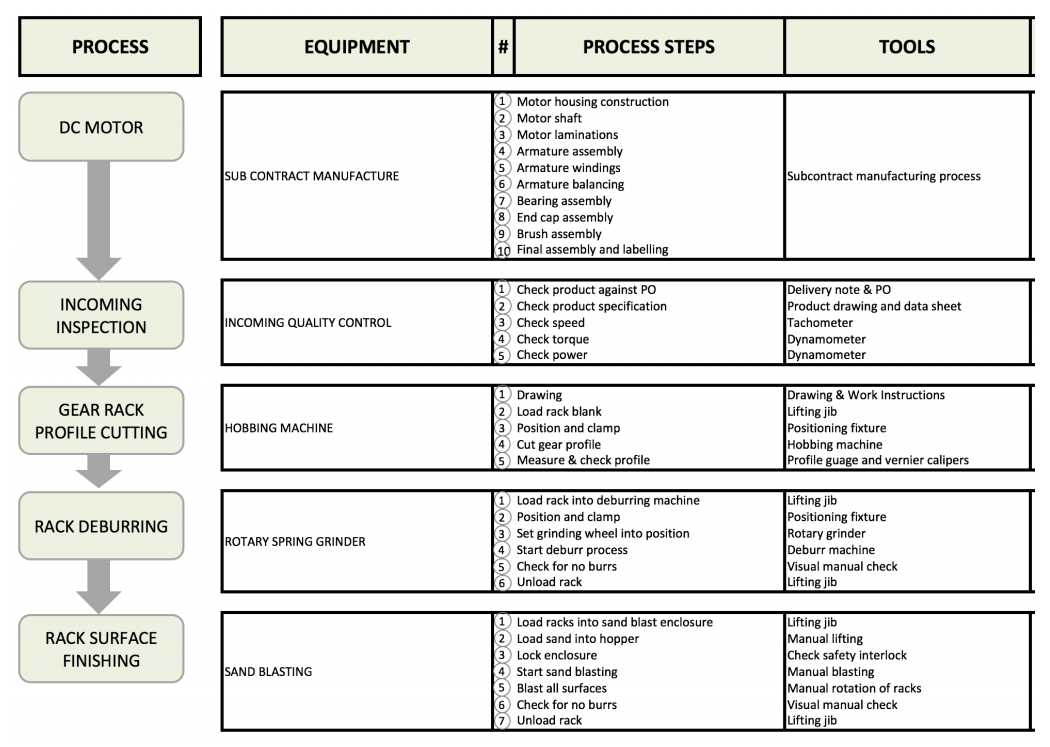
This is simply the mapping of the process steps. There are many templates you can follow, and here is an example of a process flowchart:

process flowchart example

Take a step back and look at this process. What steps can be combined (less picking & stacking, fewer mistakes, higher productivity)? Are there ways to eliminate one step (e.g. by clipping rather than positioning and then screwing)?


2. The Process FMEA

With the process map in hand, walk on the factory floor and observe each step. for each process, make a list of things that might go wrong (the “failure modes”). Bring in people from different teams and backgrounds if possible.

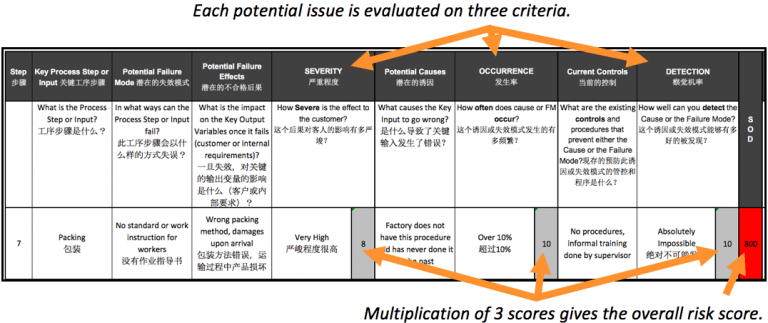
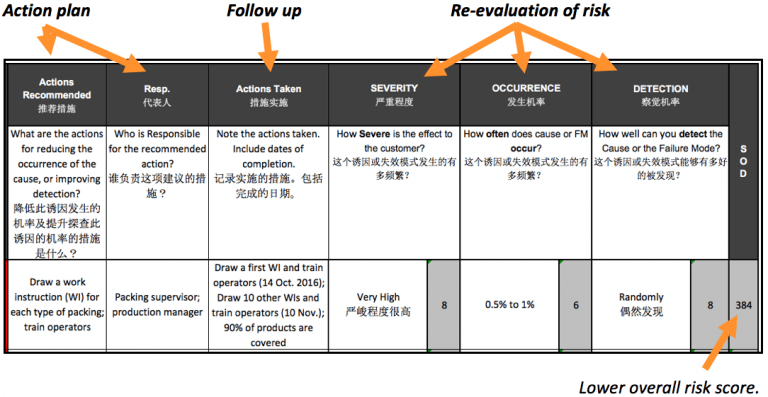
The FMEA is a great way to assess the risks and to rank them. The 3 components of risk in this form are:

  • The severity of the impact (on the customer, on the downstream process…) if it happens
  • Occurrence — how often it is expected to happen
  • Detection — how likely is it to be caught before it has an impact?


FMEA Risk Assessment

And then, for each failure mode, it drives an action plan. It is a living document and should be updated often.

FMEA Countermeasures Followup

👉 Read more about the Process FMEA, when to use it, and get a FREE template

A word of caution. It is not an easy exercise. Don’t expect a production supervisor or a quality auditor to do it nicely without prior training and experience.

In theory, it is a tool to think of issues that might come up in the future. But an easier way to start is to include the issues that came up in the past… if that process has been in place for some time.


3. The control plan

Based on the above documents, you have:

  1. A map of the process steps
  2. A ranking of the highest risks to watch out for

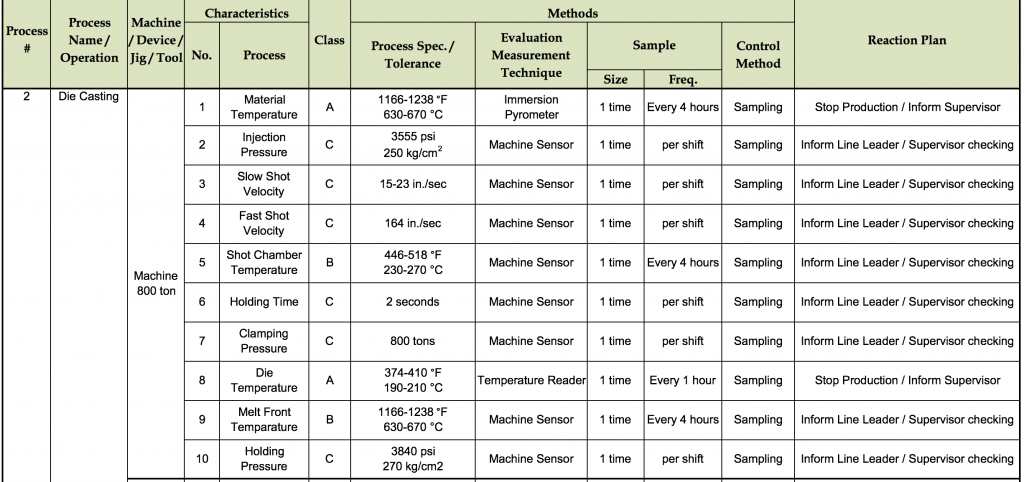
This the basis for a good process control plan — the central document that the factory should use to drive the process’ capability up (in other words, improve process controls so as to get better product quality).

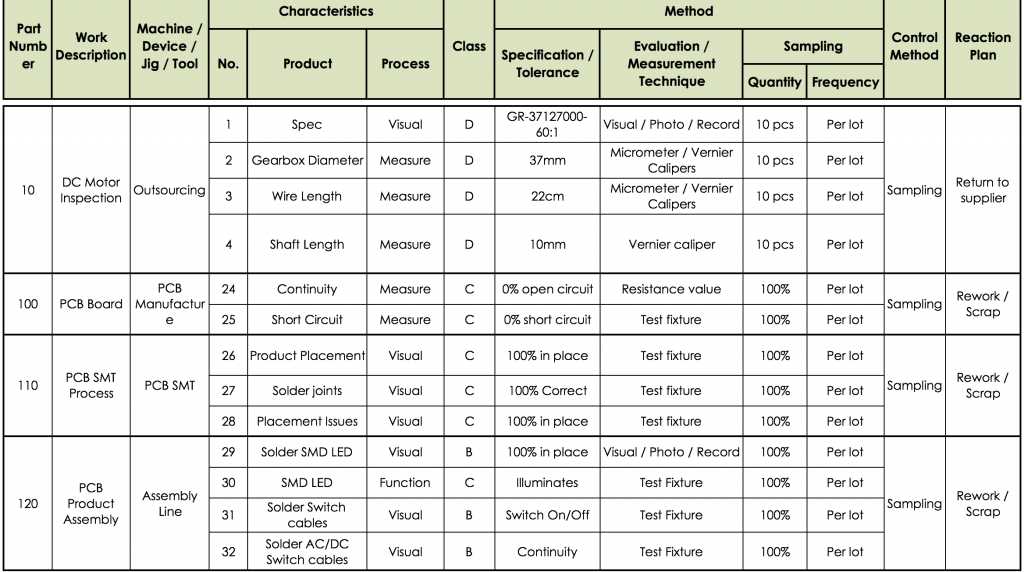
A good control plan includes:

  • Process controls — in this example, what to check regularly on a die casting machine to ensure it works properly. (Note that the mold and the materials also need to be checked regularly — it’s not only about the machine.)Process Control Plan example 1


  • Product controls — in this case, an inspection of incoming components and inspection of some characteristics of semi-finished products. (It should also include inspection of completed products, obviously.)Product Control Plan example 2

Based on the control plan, proper work instructions can be given to the main interested parties:

  • Production operators (who need to achieve that plan and do some of the checks when appropriate)
  • Quality inspectors & engineers (who need to do some of the checks)
  • Maintenance technicians (who need to know what the settings should be on the equipment)
  • Purchasers (who need to buy the right components & materials)
  • Customers (who need to know what specifications the manufacturer commits to, and who may want to audit the process controls)

*****

I made this whole approach look very linear, but often those process improvement tools are developed at the same time. Each document feeds the other two.

Our consultants have developed these documents in a number of projects, with good results. They are quite powerful.

What do you think? Do you, or your suppliers, use these process improvement tools?

Editor’s note: This post has been republished here from QualityInspection.org with some adjustments for Sofeast readers


Ultimate Guide To Sourcing From China And Developing Your Suppliers [eBook]

This FREE eBook starts from the beginning, discussing whether you need to hire a sourcing agent, and follows the sourcing process right through to developing a trusted supplier’s quality and productivity.

There are 15 chapters over 80+ pages to explore, providing exhaustive guidance on the entire sourcing and supplier development process from start to finish, including:

  • Identifying suppliers,
  • Negotiations,
  • Quality inspections,
  • Developing Chinese suppliers,
  • Improving factory quality and productivity,
  • and much more…

Just hit the button below to request and download your free copy:

Ultimate Guide To Sourcing From China And Developing Your Suppliers [eBook]