Gold: 3 QC Plans You Need Before Production (Ep. 30 Revisited) [Podcast]

Quality problems are often discovered during an inspection, but they usually begin much earlier.

They begin when the buyer and supplier have not agreed on what quality means, how it will be checked, who is responsible for testing, or what must be confirmed before production starts.

In this rewind episode of China Manufacturing Decoded, we revisit a classic discussion with Renaud Anjoran about three different types of quality control plans:

  • The product quality control plan, which defines inspection, testing, and quality responsibilities
  • The process control plan, which helps control quality throughout manufacturing
  • The QC plan for a new product, which addresses the additional risks involved before mass production begins

Renaud explains what each plan covers, when it is appropriate, and why buyers should not rely on the supplier to define quality requirements for them.

The episode also covers approved samples, testing equipment, critical components, pilot runs, process controls, and what private-label buyers should document before placing an order.

The core lesson remains highly relevant today: quality control planning should take place before production, not after defective products have already been made.

Listen here

Listen to the episode or watch on YouTube

Podcast sections

  • 00:00 Introduction to this rewind episode
  • 01:56 What quality control plans are and why they are needed before production
  • 04:06 Why there is more than one type of QC plan
  • 04:43 Type 1: The product QC plan and contract-related quality terms
  • 05:28 Defining testing, inspections, AQL limits, compliance, and responsibilities
  • 06:41 What happens if serious issues are found after shipment?
  • 07:11 Why even smaller buyers should document quality expectations
  • 08:06 Type 2: The process control plan
  • 09:04 Mapping production processes and critical steps
  • 10:20 Turning the control plan into work instructions and checks
  • 11:02 When process control plans become important
  • 11:54 Why final inspection alone is often too late
  • 12:27 Controlling quality through incoming components and sub-suppliers
  • 13:50 How to check whether suppliers can follow process control plans
  • 15:03 Type 3: The QC plan for a new product
  • 16:27 Quality, reliability, and compliance requirements
  • 17:35 Golden samples and approved prototypes
  • 18:00 Testing stations, jigs, fixtures, and functional checks
  • 19:07 Intended use, reliability expectations, and compliance needs
  • 19:52 Component manufacturing, assembly, tooling, and work instructions
  • 21:35 Pilot runs and pre-production approvals
  • 22:35 Why new products force buyers and suppliers to think harder
  • 22:59 Supplier optimism and the “we’ll fix it later” risk
  • 24:16 Why quality standards need to be clear and useful
  • 25:08 Why buyers often skip proper QC planning
  • 26:42 Why defining requirements is the buyer’s job
  • 27:40 Which QC plans apply to which buyers and products?
  • 28:22 QC planning for all buyers vs larger or higher-risk buyers
  • 29:26 Why process control is worth considering for new products
  • 30:12 Why every buyer still needs at least a basic quality standard
  • 31:12 What off-the-shelf and private-label buyers should focus on
  • 33:02 2026 outro and key lesson recap

Further content

🎧 Listen, rate, & subscribe to the ‘China Manufacturing Decoded’ podcast on your favorite provider

More episodes are on the way, so remember to rate us and subscribe! You can find us on:

How To Choose Which Product Quality inspection You Need?

How To Choose Which Product Quality inspection You Need
It’s a must to conduct a product quality inspection on products you’re getting made by a new overseas supplier, or perhaps from a regular supplier who’s manufacturing a new product for the first time. If you can’t be on-site, using an inspection agency (like Sofeast!) to go into the factory and inspect product quality on your behalf will be convenient.

Even if you use an inspection agency, you’ll need to advise them when to go into the factory and what the quality points are that you’ll expect them to check.


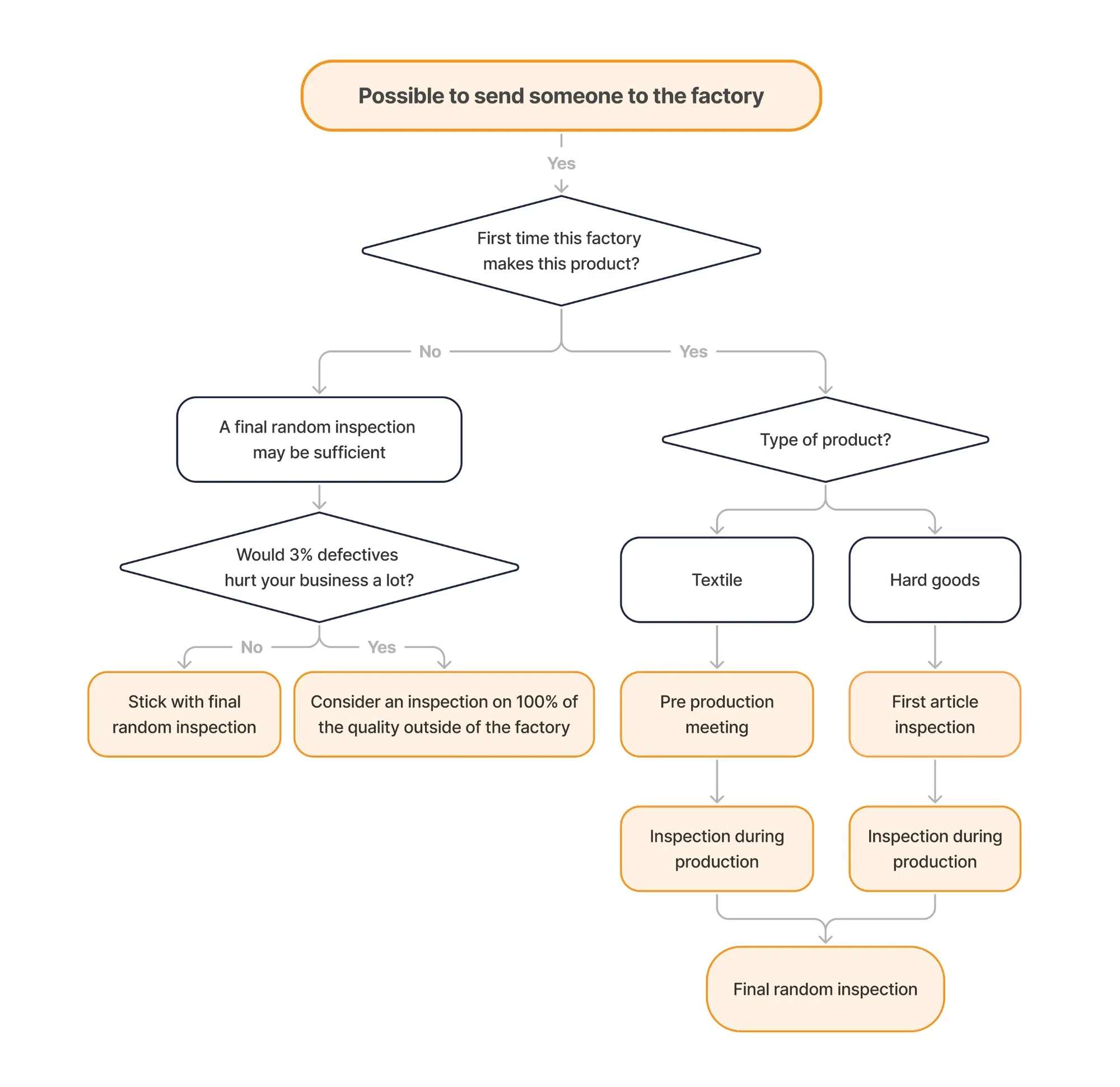
This flowchart and video summarize your product inspection choices

sofeast product quality inspection flowchart mar 25


Now get some suggestions for which product quality inspections are most suitable for you based on the situations outlined.


If you are unable to visit your supplier’s factory

Many factories in China and around Asia do not give access to third party staff, such as QC inspectors or customers like you due to covid restrictions. Furthermore, access to China is extremely limited in 2021 and so even visiting may be impossible anyway. However, it is still possible to check product quality:

  • Product samples can be sent to you or your inspection company for review.
  • QC inspectors can perform an ‘off-site inspection‘ where they have a live video call with your supplier’s factory staff and walk them through a few inspection steps while taking notes, finally reporting back and giving you assurances that your main requirements have been met.


If the supplier hasn’t made this product before

This is a risky scenario. You will usually benefit by performing a product quality inspection at an early stage in production. The goal here is to be proactive and put the factory in a position to reach your quality expectations from the start instead of reacting to finding bad quality pieces in a batch and then deciding whether to reject it or not.

For soft goods like apparel

A common approach is to have a “pre-production meeting” a day or so before sewing is set to start, in order to provide immediate feedback on the supplier’s readiness and cement in their minds what’s required from you. You can then follow it after a few days with an Inspection During Production (DPI) (which takes place when some of the finished pieces are off the line, let’s say around 10 to 30% of the run).

For hard goods, such as consumer electronics

Hard lines don’t have as much of a standard approach, but we suggest performing a First Article Inspection which, naturally, occurs on one of the first pieces off the line, and then follow it with an Inspection During Production (DPI) around 4 to 7 days later which will demonstrate that production is still going to plan.

The goals of the pre-production meeting and FAI are the same:

  • Confirming that your supplier is clear on what they’re doing and your expectations
  • Clarifying the forthcoming schedule
  • Detecting issues very early
  • Starting an investigation that will lead to fixes if any issues were found.

Lastly, conduct a FRI

Do you need to perform a final random inspection?

While it is advisable to perform these as standard if your budget allows, if very few issues have been found and the risks of packaging mistakes are low you could potentially skip it and save on costs. This will depend on how much you trust the supplier.


If the supplier has previously been making the same product

If your supplier has already been making the product at a quality standard that has reached your expectations, you probably don’t need to perform a rigorous product quality inspection program.

The exceptions to this rule will be if your order is worth a huge amount of money or the products you are having made pose risks to users if quality issues occur which you could be liable for, for example, children’s toys. In these cases, inspections at an earlier stage and throughout production will be safest.

If your product is pretty simple, such as a fairly common off-the-shelf consumer product, and your first order is a fairly small amount, then a final random inspection could be adequate.


If you can’t really tolerate defects in your products

If you can’t tolerate 2% or 3% of defective goods being shipped (which is a fairly standard defect rate), you need to plan for it early on when you’re sourcing a new supplier. Top-quality manufacturers will have a high MOQ and be fairly expensive. If you can sustain orders with them, then you can possibly demand such a low defect rate.

However, if your order quantities aren’t huge, realistic expectations are required as you may need to accept working with a smaller, less well-recognized supplier. Their MOQs may be lower, but they may also reject such a severe defect rate.

To give a couple of examples:

It is incredibly difficult to find a good T-shirt or promotional item manufacturer that will be interested in fulfilling an order of 500 pieces and will keep the proportion of defectives under 1%. Just accept it’s not realistic.

If you can’t work with a ‘top’ manufacturer but you still can’t accept a higher defect rate, what’s the solution?

In this case, you need to consider performing a 100% inspection outside of the supplier’s factory. Any defective pieces can be sorted out and only pieces that pass inspection will be shipped. Depending on your agreement with the supplier, defective pieces can be returned for a rebate, or reworked and then sent on to you.

*****

Got any questions about which inspection you need? Let us know, we’ll be happy to help advise!


More resources to help you decide which product QC inspections are right for you

Read these articles on our blog and QualityInspection.org:

QC Trends In 2021 (+ raw material costs and new product development)

QC Trends In 2021 (+ raw material costs and new product development)Sofeast’s CEO Renaud was recently a panellist on a fireside chat webinar from Global sources where he spoke about QC trends in 2021 and some other key topics that concern importers right now.

In case you missed this webinar, here are some of the key points he discussed:

Continue reading “QC Trends In 2021 (+ raw material costs and new product development)”

6 Advantages Of Conducting An Off-Site Product Inspection

6 Advantages Of Conducting An Off-Site Product Inspection

Most product inspections take place at your supplier’s factory which makes sense as that’s where the products are being made, allowing a QC inspector to go in there and check during production, for example. But there are times when you may conduct an off-site product inspection. Let’s explore what this inspection is, its advantages, and some drawbacks, too.

Continue reading “6 Advantages Of Conducting An Off-Site Product Inspection”

How to set up a Receiving Inspection: Checklist, Procedure, Reporting form

I have written extensively about pre-shipment inspections (before, during, or after production), always from the perspective of the buyer checking what a supplier is doing; but I noticed that I haven’t covered what’s known as a receiving inspection (also called incoming quality inspections).

How to set up a Receiving Inspection

However, that’s a really important topic, so let’s get into how to set one up here…

Continue reading “How to set up a Receiving Inspection: Checklist, Procedure, Reporting form”

Off-Site QC VS In-Factory QC

Off-Site QC VS In-Factory QCIs there ever a situation where you’d want your product inspection to be performed away from your Chinese supplier’s factory? Yes! We’ll explain your options in Off-Site QC VS In-Factory QC.

Continue reading “Off-Site QC VS In-Factory QC”

How to Arrange Supplier Self Inspections for QC

How to Arrange Supplier Self Inspections for QCSupplier self inspections, rather than sending in external quality inspectors, are becoming increasingly important for today’s buyers.

In certain cases, it makes a lot of sense to stop sending employees to check if a supplier has done a good job.

However, it is not just a case of saying “oh, by the way, starting next month we’ll only check 20% of your shipments”, or “good job — we’ll trust you entirely from now on”.

Don’t play Santa Claus. Your suppliers VERY MUCH want you to stop sending inspectors to their facility, and in exchange, you can extract a few concessions…which will reduce your risks further.

But first, let’s look at the type of things you want to avoid…

Continue reading “How to Arrange Supplier Self Inspections for QC”

Beware! QC inspections based on AQL & random sampling have limits

Limits of QC inspections based on AQL & random samplingI wrote many times that QC inspections before shipment are a good way of keeping quality problems where they belong: In the factory.

Quality control inspections are a good tool. But pointing out their limits is important. Misinterpreting their reliability is very easy.

Continue reading “Beware! QC inspections based on AQL & random sampling have limits”