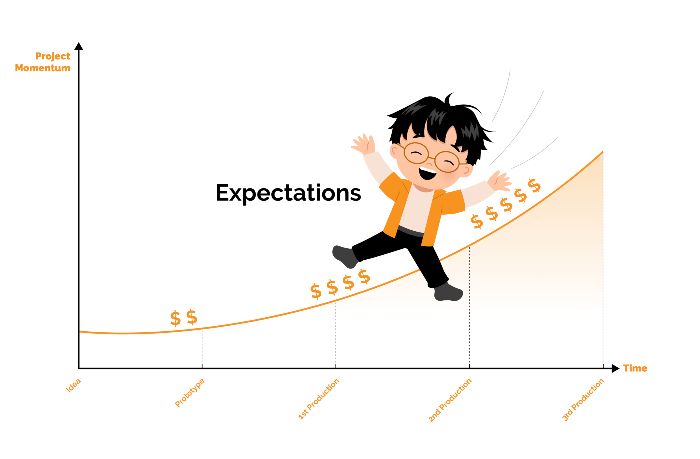
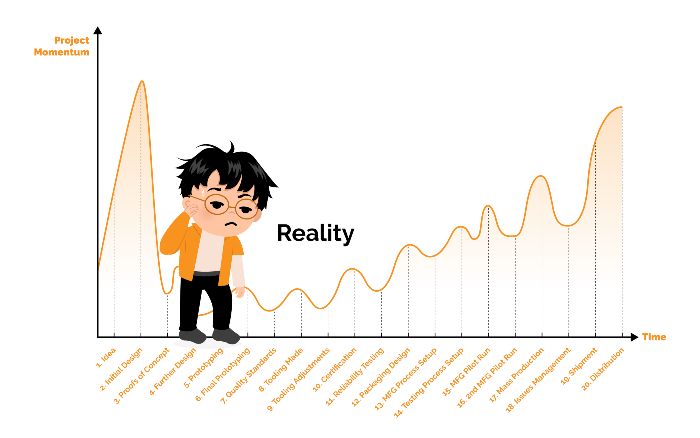
As part of our design support service, we have been speaking with many inventors planning to manufacture their new products in China about the importance of starting with mature product designs.
What many don’t understand is that several steps just can’t be skipped, especially in product design and development phases…
China manufacturing steps that shouldn’t be skipped
Inventors shouldn’t ignore this important process when starting a manufacturing project in China:*
- Product concept, including an idea about target customers, distribution, pricing…
- Product design (they usually have the first design, but not always very mature product designs)
- Prototypes to test the hypotheses behind the design (e.g. good user experience, the possibility of certifications, etc…)
- Pre-production process engineering
- Mass production
*(Remember, this is not for an off-the-shelf product. This is for a new-to-the-world product. The more unique and the more complex it is, the higher the number of uncertainties.)
Can my Chinese manufacturer help with all of the production steps?
If you are planning to get all of the above done with a Chinese manufacturer, you might be in for a disastrous ride. They are manufacturers and their business model is to produce, not to spend 6-12 months working on developments.
The more advanced your product design is, the more attractive your project will be to any factory, and the higher your chances of getting to market fast and without serious quality issues.
A few examples of what we call an ‘immature product design’
Do you find that your project fits into any of these categories?
1. The ‘concept only’ situation

An individual contacts design companies, explains a rough concept (‘same as products from brand XYZ, with a classy design and nice materials’), but he can show nothing. Or he drew something on a napkin.
This can work in a few product categories (e.g. apparel), with the right manufacturer or trading company. For mechanical and electronic goods, it goes nowhere.
Those individuals usually think all they need is a prototype (only 1 round of prototype, of course, since they don’t see difficulties), so they can show it and gather some market interest. Again, the absence of market validation at that stage is a big issue, and no good Chinese supplier will spend time on this type of project.
Related 👉 I’m developing a new product. Is it too early for me to work with Sofeast?
2. No understanding of the current competitive space
This is part of the product design. If you think you can mass-produce and distribute a better product than current players and achieve that at a lower price point, but you don’t bring in fresh ideas to cut costs, it is a sure sign that you are not thinking straight.
A company needs sufficient capital and sufficient margins to buy the first batch, to set the basics in place, and to grow from that base. It needs to pay for advertising, distribution, sales… If you are under-capitalized, your venture probably won’t go very far.
That’s actually a blocking factor from the very beginning. Chinese manufacturers, as well as design firms and prototyping companies, can match patterns. They have seen projects make certain mistakes and crash into the ground, and they won’t be motivated to help if they put you in the “will probably crash” category.
3. No clear target market in mind
If you have a design but you are unable to explain who will buy it, that’s an issue.
Some inventors tell us they will “just put it on Kickstarter” to see if it catches on. Oh, and they have no idea about the fees they’d have to pay an agency for preparing a nice Kickstarter campaign.
Again, you can’t motivate design or prototyping firms to put their best people on your project. They categorize you as having a “high chance of going nowhere”.
4. Industrial design (ID) has been done, but nothing else
ID is one of the first things to get right, so that’s a good thing. Hopefully, there are tolerances and a 3D printed prototype, too.
Let’s take the example of an electronic product. The basic information any manufacturer will need is:
- A detailed description of features
- List of components, with specifications
- Product architecture (how components are connected)
- PCB schematic
- A look-alike and work-alike prototype
- Testing stations
- A timeline and volume projections
If you haven’t worked on these, and you expect a manufacturer to work through all this on their own, you are taking a very serious risk.
You might spend 1 year working with a supplier that winds up quitting. You might see them go into production (with your money) and turn out a batch of non-conforming goods that can’t be sold. Everything will take longer than you imagine.
Is there a shortcut?
Not really.
Some people decide to develop their custom product with an ODM factory (which already makes very similar products). Sometimes it works. And sometimes it is a very dangerous trap.
We have seen situations that unfolded this way:
- The ODM factory learns all they can and they do the development with the purpose of selling it themselves in their existing distribution channels.
- The buyer made a tremendous mistake — not having the supplier sign an enforceable agreement that stipulates non-disclosure, non-use, and non-circumvention.
- The buyer provides design inspiration and market-related knowledge. They train the manufacturer, who gets many insights into this product.
- In the end, the buyer realizes that they have been trapped, their idea is being executed on, and there is nothing they can do about it.
Related 👉 on our podcast, we also discussed:
What’s next?
If you’re an inventor, a hardware startup, or a business that has a design idea, but you fit into one of the above categories, then you may have some questions about how to improve and prepare your designs to take them to mature product designs, which will help make your manufacturing progress smoothly, quickly, and on budget. Let us know by contacting us. We’ve helped lots of people in your position.
Editor’s note: This blog post originally appeared here on QualityInspection.org in 2019 and has been republished here for Sofeast readers.
The New Product Introduction (NPI Process) Guide for Hardware Startups
In this FREE guide, we explore everything that inventors, SMEs, and hardware startups need to know about making a new product in China and bringing it to market.
We include:
- Why preparation between product design and launch is necessary
- Exploring the NPI process, from a mere idea to mature product designs to production
- Finding the right manufacturing partner
- Design reviews & adjustments: DFM, DTC, DFQ
- Optimizations for improving cost and quality
- Small production runs before mass production
- Your role in the NPI process
If you’d find this helpful, take a look now by hitting the button below:



![Why The New Product Design & Introduction Process Is More Complex Than You May Think [Podcast]](https://artbyraksha.sofeast.com/wp-content/uploads/2021/09/Why-The-New-Product-Design-Introduction-Process-Is-More-Complex-Than-You-May-Think-Podcast.jpeg "Why The New Product Design & Introduction Process Is More Complex Than You May Think [Podcast]") Sofeast’s CEO Renaud Anjoran is joined by an experienced British product designer and friend of the podcast Andy Bartlett to discuss the NPI process and product design best practices for new and unique products, with a focus on the early design stages where the concept is being defined. For many entrepreneurs, there is a disconnect between expectations and reality when developing new products.
Sofeast’s CEO Renaud Anjoran is joined by an experienced British product designer and friend of the podcast Andy Bartlett to discuss the NPI process and product design best practices for new and unique products, with a focus on the early design stages where the concept is being defined. For many entrepreneurs, there is a disconnect between expectations and reality when developing new products.