Tariffs, Tactics, and Trade Shocks: Breaking Down Trump’s ‘Liberation Day’ Policy Blitz [Podcast]

In this emergency bonus episode, Renaud reacts to the significant trade policy shift announced by President Donald Trump on April 2, 2025, dubbed “Liberation Day.” This move introduced sweeping tariffs affecting numerous countries and has profound implications for global trade dynamics, as we shall see.

One thing is clear: the global sourcing game just changed dramatically. Importers and manufacturers alike must prepare for more unpredictability, faster pivots, and potentially, more tariffs. Stay vigilant—and start thinking a few moves ahead.


Listen to the episode here

Listen: to the podcast episode

Watch: on YouTube


Episode sections

  • [00:00] Introduction & Overview
  • [01:00] The April 2nd Announcement Breakdown
  • [04:10] China’s Tariff Reset and Its Uncertain Future
  • [06:00] Emerging Asian Hubs Under Pressure
  • [08:00] Legal and WTO Considerations
  • [10:00] Importers’ Reactions and Strategic Planning
  • [13:00] Impact on Chinese Manufacturers
  • [17:00] Nearshoring and the Mexico Loophole
  • [21:00] India’s Position in Global Sourcing
  • [25:00] Strategic Takeaways and Future Outlook

Related content…


Listen, rate, & subscribe to the ‘China Manufacturing Decoded’ podcast on your favorite provider

More episodes are coming, so remember to rate us and subscribe! You can find us on:

Trump Adds ANOTHER 10% Tariff To Chinese Products [BONUS Podcast]

In this bonus episode of China Manufacturing Decoded, Renaud discusses President Trump’s controversial new announcement that’s stirring up economic tensions with China as he has decided to double existing tariffs on Chinese goods to 20%, marking a significant escalation in the ongoing trade conflict between the world’s two largest economies.

Let’s look into why he has taken this action, how American importers may be affected, and also about how the trading relationship between the USA and China may evolve moving forward.

Continue reading “Trump Adds ANOTHER 10% Tariff To Chinese Products [BONUS Podcast]”

How Trump Tariffs will Impact YOUR Business

President Trump loves tariffs and is using them as an economic and political tool to try to improve the USA’s prospects. If you’ve ever wondered how such tariffs affect the prices of the products you buy, you’re not alone, there was a huge spike in Google searches for tariffs in the USA when the administration announced new tariffs on China, Canada, and Mexico at the start of February 2025.

Many American businesses that source goods from overseas—especially from China—have to deal with tariffs, which can increase their costs by a serious amount. In this post, we’ll watch Pete Keller, CEO of Fringe Sport’s video discussing tariffs, and then break down how tariffs work, how they affect the final price of products you purchase, and why even American-made products may not be immune to price hikes.

Continue reading “How Trump Tariffs will Impact YOUR Business”

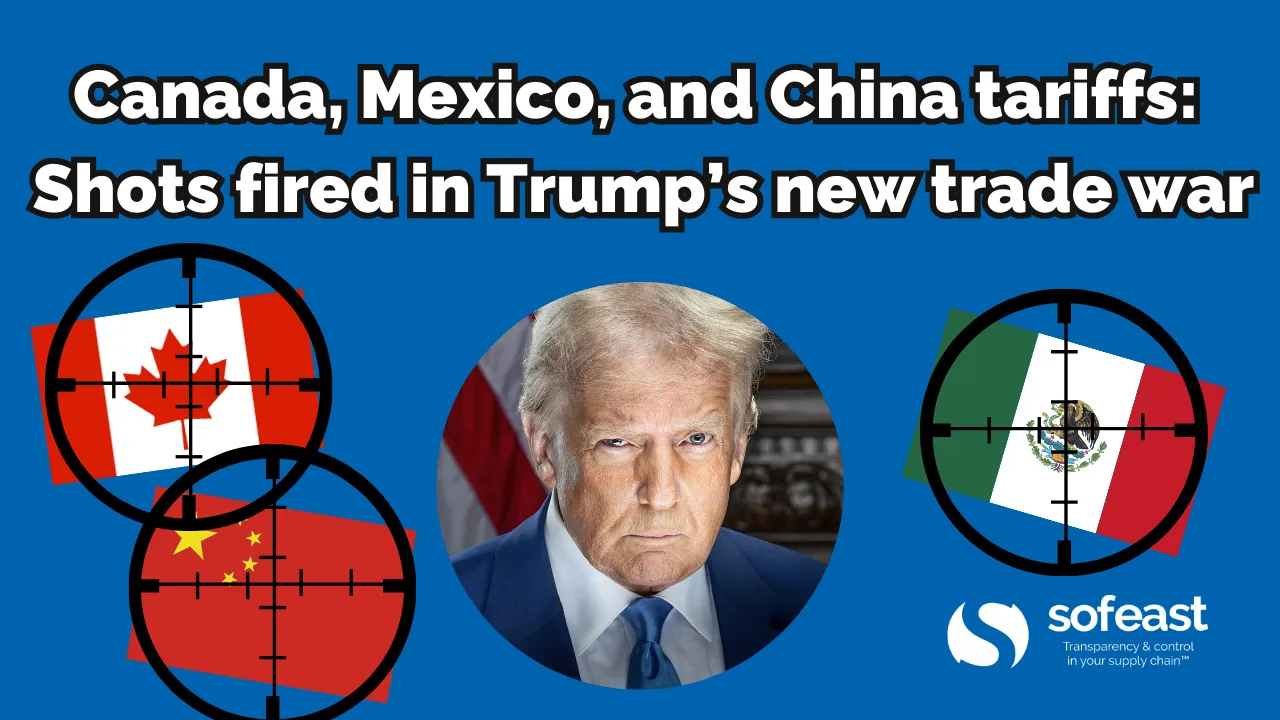
Canada, Mexico, and China tariffs: Shots fired in Trump’s new trade war

As of Jan 31 2025, President Trump declared a national emergency and invoked the International Emergency Economic Powers Act (IEEPA)* to impose additional tariffs on imports from China, Canada, and Mexico (although Mexico and Canada’s tariffs have now been paused as mentioned later). He has placed a 10% tariff on Chinese goods (in addition to existing tariffs where relevant), and a 25% tariff on Canadian and Mexican goods, with Canadian energy products subjected to a lower 10% rate. The tariffs are claimed to be necessary to reduce the risks posed to the USA by illegal immigration and fentanyl, with all three countries blamed for these issues.

Shots have well and truly been fired now, so now what?

*This Trump administration communique represents their points of view, so feel free to read additional resources on the topic.

Continue reading “Canada, Mexico, and China tariffs: Shots fired in Trump’s new trade war”

Importing to the USA, HTS Codes, and Tariff Tips (Feat. Owen Haacke of Supply Chain Shark) [Podcast]

New year, new podcast episode!

We kick 2025 off with Owen Haacke, co-founder of Supply Chain Shark, joining us to discuss the complexities of import tariffs, HTS codes, and strategies for minimizing costs in international trade. Owen shares valuable insights on compliance, cost reduction, and the importance of accurate classifications.


Listen to the episode here

Listen: to the podcast episode


Episode sections

  • 00:00: Introduction and greetings.
  • 03:10: HTS Codes: The Foundation of Import Tariffs.
  • 06:34: The Importance of Country of Origin.
  • 10:20: Examples of Adjusting HTS Codes to Reduce Costs.
  • 18:45: Tariff Engineering: Redesigning Products to Save Costs.
  • 23:10: The De Minimis Program: Opportunities and Risks.
  • 32:50: Wrapping Up.


Related content…


Listen, rate, & subscribe to the ‘China Manufacturing Decoded’ podcast on your favorite provider

More episodes are coming, so remember to rate us and subscribe! You can find us on:

Trump’s Second Term: Tariff Talks Ignite Global Tensions [Podcast]

In this episode of our podcast, Episode 246, hosts Adrian and Renaud delve into the complex topic of international trade policies as they discuss President Trump’s anticipated trade moves in his upcoming second term. Recorded on December 4th, the conversation centers around the potential tariffs Trump plans to impose, which will affect not only American businesses but also international listeners.

The hosts critically analyze Trump’s legacy in trade, specifically his use of tariffs during his first term, which left a significant mark with increased tariffs on Chinese products, a move that the Biden administration surprisingly maintained. They discuss how tariffs, often perceived as a protective measure for domestic jobs, actually impact importers and consumers directly, leading to increased costs. The episode highlights insights from a Harvard Business Review article that outlines who bore the brunt of these tariffs in practice.

Listeners are provided with a thorough analysis of Trump’s “bully strategy” in trade negotiations and the theory of tariffs as a fiscal tool to reduce income tax rates without facing political backlash for direct tax hikes. The episode wraps up with a discussion of the possible future scenarios as Trump’s second term begins, considering both economic and geopolitical factors.


Listen to the episode here

Listen: to the podcast episode

Watch: on Youtube


Episode sections

  • 00:00–02:00: Introduction and Context and Significance of Tariffs
  • 02:01–10:00: The Legacy of Trump’s First-Term Tariffs
  • 10:01–15:00: The Geopolitical Drivers Behind Tariffs
  • 15:01–22:00: Business Responses and Supply Chain Shifts
  • 22:01–28:00: Biden’s Continuation of Tariff Policies
  • 28:01–34:00: Trump’s Second-Term Proposals and Industry Impacts
  • 34:01–38:00: Political and Economic Ramifications
  • 38:01–42:00: Predictions and Closing Thoughts


Related content…


Listen, rate, & subscribe to the ‘China Manufacturing Decoded’ podcast on your favorite provider

More episodes are coming, so remember to rate us and subscribe! You can find us on:

Featured image credit: “Trump at a rally in Arizona, 2024”, by Gage Skidmore, licensed under CC BY-SA 2.0

Global Supply Chain Shifts: Freight Costs, Dropshipping Hurdles, & Upcoming U.S. Strikes [Podcast]

This week, your host Adrian is joined by Kate, head of the Sofeast supply chain management team, to bring you the latest updates in logistics and shipping.

Discover the recent decline in ocean freight costs, the impact of US port strikes, and the effect of Mexican customs enforcement on Chinese goods. Kate also discusses new US regulations affecting dropshipping and the consequences of the recent port explosion in Ningbo.

Plus, get a sneak peek into the upcoming Global Sources Consumer Electronics Fair in Hong Kong, where the Sofeast team will be at their subsidiary Agilian Technology’s booth.


Listen to the episode here

Listen: to the podcast episode

Watch: on Youtube


Episode sections

  • 00:00 – Introduction and greetings.
  • 00:46 – Decline in Ocean Freight Costs and Transit Time.
  • 03:07 – Potential Impact of U.S. East Coast Strikes.
  • 05:04 – Piracy in the Red Sea and Seizure of Chinese Goods in Mexico.
  • 07:06 – U.S. Sanctions on Chinese and Russian Entities.
  • 09:09 – Impact of Strikes and Congestion in the U.S. and Canada.
  • 10:09 – Dropshipping Regulatory Changes in the U.S.
  • 14:04 – Port Explosions and Dangerous Goods Documentation.
  • 17:04 – Upcoming Event: Global Sources Consumer Electronics Fair in Hong Kong.
  • 21:00 – Closing Thoughts.


Related content…


Listen, rate, & subscribe to the ‘China Manufacturing Decoded’ podcast on your favorite provider

More episodes are coming, so remember to rate us and subscribe! You can find us on:

If you enjoyed this episode, don’t forget to give us a 5* rating and share it with your network if you enjoy listening!

Manufacturing in China Update July 2024: FDI Down & Made In China 2025 [Video]

Our CEO, Renaud, recently appeared on The Legal Lunch Byte from American law firm and Asian manufacturing law experts Harris Sliwoski LLP (the creators of the China Law Blog).

Here’s the video:


Let’s quickly summarize the content…

Made In China 2025

What are the effects of the previous Trump administration’s policies on the Chinese economy, particularly the ‘Made In China 2025‘ plans?

Large Chinese corporations like Huawei, ZTE, BYD (which now holds the mantle of the world’s largest EV maker), and so on, are still thriving despite pressures from the USA and the ‘Trump tariffs’ (which were also expanded by Biden in May 2024). EVs, batteries, robotics, etc, are all growing well, despite the Chinese economy not being at its most dynamic. Basically, the industries targeted back in 2015 by MIC ’25 have remained strong thanks to the promised government support.


Foreign Direct Investment

Are more foreign companies investing in China these days, acquiring assets, doing more contract-related work, etc, or is there more talk of moving out of China?

FDI has gone down quite dramatically, manifested in lower investment in manufacturing capacity, with money being spent on sourcing safely (with enforceable contracts etc) instead.

Some American companies are looking for China alternatives, but this is not simple for anything more complex than the most simple products. For example, relatively complex electronic devices almost certainly can’t be made without using some Chinese components, even if they’re assembled elsewhere. SMEs will struggle to find local components and materials in, say, Vietnam…the largest companies may be able to set up local supply chains more easily, though. In Apple’s case, this has started to happen in countries like India, so perhaps in 5-10 years, there will be a mature pool of component suppliers that can rival the supply chain on offer in China.

What do the USA’s May ’24 China tariffs mean for importers? [Podcast]

Adrian and Renaud are back to examine the recent May 14th news of new China tariffs being implemented by the Biden administration with the overall aim of reducing trade with China which many in America see as flooding the market with cheap exports that damage American businesses who can’t compete. EVs, solar panels, medical devices, steel and aluminum, and more are in the firing line. So, how does this affect US importers and the relationship between the two giants? Let’s find out…


Listen to the episode here 👇

Listen: to the podcast episode

Watch: on Youtube


Episode sections

  • 00:00 – Greetings and introduction
  • 03:26 – When did China tariffs start being used?
  • 09:46 – Why add more tariffs now?
  • 16:20 – What does China have to say in response to this?
  • 20:45 – Which products and materials have been given these tariffs?
  • 29:51 – The USA’s target areas for improvement.
  • 33:06 – Will Chinese companies find other customers instead?
  • 36:36 – If you’re an American buyer likely to be affected by these tariffs, what can you do?
  • 39:51 – Wrapping up.


Related content…


Listen, rate, & subscribe to the ‘China Manufacturing Decoded’ podcast on your favorite provider

More episodes are coming, so remember to rate us and subscribe! You can find us on:

If you enjoyed this episode, don’t forget to give us a 5* rating and share it with your network if you enjoy listening!

HS vs HTS Codes: How to Find the Right Code for your Product? (incl. Links to Official Sources)

[vc_row][vc_column][vc_single_image image=”17594″ img_size=”full” alignment=”center”][vc_column_text]Importers who outsource manufacturing in Asia need to ship their goods around the world to where they’re being sold. Understanding the difference between HS vs HTS codes could be the difference between paying higher or lower import duties, fees, and tariffs because adding the wrong one to your products’ shipment could cost you!

Here is a guide covering (almost) everything you’ll need to know about HS vs HTS codes, including which might be right for you and where to find them…

Continue reading “HS vs HTS Codes: How to Find the Right Code for your Product? (incl. Links to Official Sources)”