Sofeast’s Top 5 Podcast Episodes of 2025

As we close out 2025, join us as we review which China Manufacturing Decoded episodes delivered the most value to our audience, measured simply by listener numbers.
The episodes below stood out and tackled some of the real decisions importers and product teams face: quality risk, sourcing strategy, tariffs, IP protection, and how to work effectively with manufacturers.

Here are the Top 5 podcasts of the year, ranked by downloads. Just click each image to listen!


1) Quality Inspections Guide: Minimize Risk, Maximize Quality

Quality Inspections Guide Minimize Risk, Maximize QualityA clear, practical guide to the main types of quality inspections, when to use each, and how inspection strategy should change depending on risk. Especially useful for teams trying to avoid last-minute shipment surprises.


2) The India Shift: Exploring PCBA Sourcing and Trade Dynamics in a Changing World
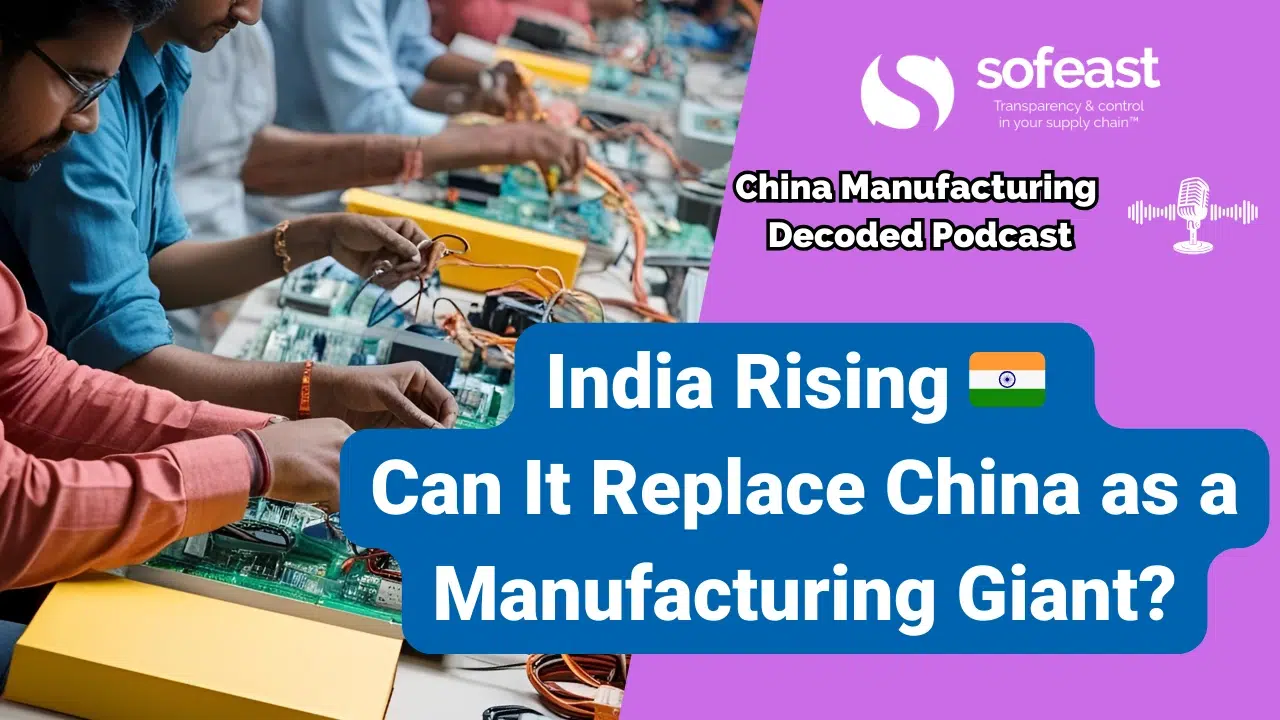
India Rising Can It Replace China as a Manufacturing GiantAn honest look at PCBA sourcing in India—what’s improving, what still needs work, and how geopolitical and tariff pressures are reshaping sourcing decisions for US-bound products.


3) Getting It Right from the Start: Essential Guide to Working with Manufacturers

Getting It Right from the Start Essential Guide to Working with Manufacturers [Podcast]This episode focuses on what to prepare before engaging a manufacturer: defining requirements, aligning expectations, and avoiding early-stage mistakes that often snowball into delays and cost overruns later.


4) Importing to the USA, HTS Codes, and Tariff Tips

Importing to the USA, HTS Codes, and Tariff Tips (Feat. Owen Haacke of Supply Chain Shark) [Podcast]A tactical deep dive into HTS codes, tariff exposure, and classification strategy, with real examples showing how small decisions can have a big impact on landed cost.


5) Protect Your IP: Strategies for Safely Sourcing Components

Protect Your IP Strategies for Safely Sourcing ComponentsA practical discussion on IP risk during component sourcing, including how information leaks happen in the real world and concrete ways to reduce exposure without stopping sourcing progress.


Want even more podcast episodes?

We’ve got you! Listen to them all here weekly.


A common thread across all 5 episodes

Despite covering different topics, these episodes share a theme: risk compounds when decisions are made too late or without structure, whether that’s inspections, sourcing locations, tariffs, or IP protection.

At Sofeast, our Quality Assurance (QA), Supply Chain Management (SCM), and New Product Introduction (NPI) support are designed to address these risks early, before they turn into costly problems.

If these episodes resonated with you, you’ll likely find value in working with a team that helps you plan, validate, and execute manufacturing decisions with fewer surprises and more control. Get in touch and let us know about your project!
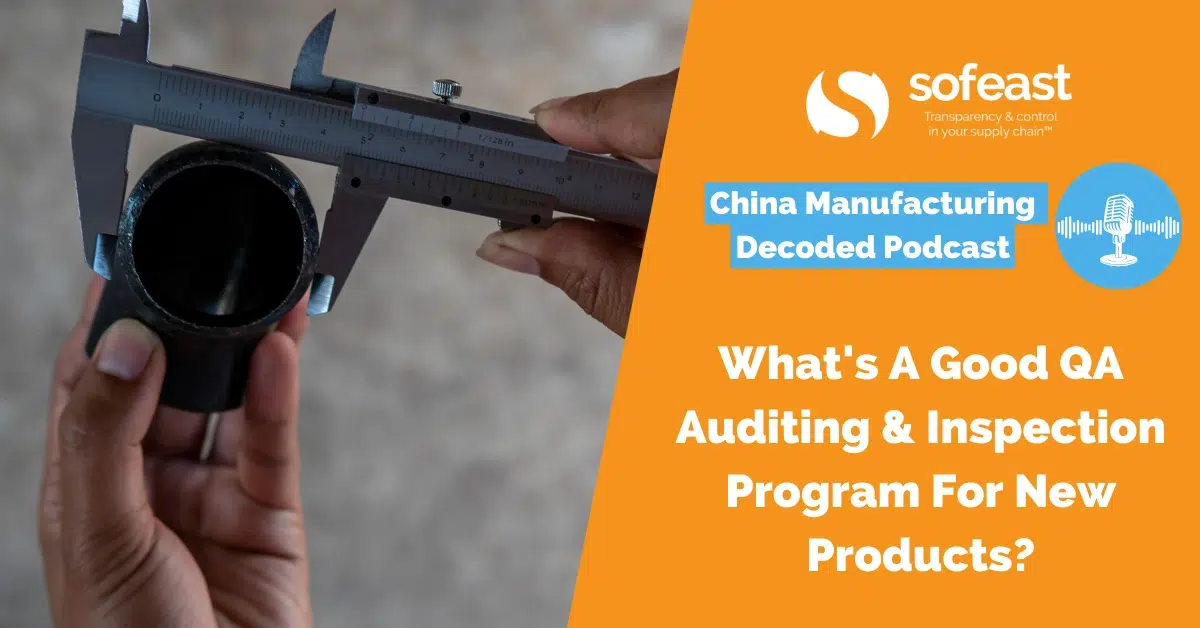
What’s A Good QA Auditing & Inspection Program For New Products?

Adrian and Renaud go through what makes a good QA auditing and inspection program for innovative new electro-mechanical products that will reduce risks of poor quality, reliability, and compliance issues, and detect them in time for them to be worked on before anything is shipped. Unless you are producing simple products or working with a supplier who is very experienced in manufacturing the exact product type you’re developing, you will very likely require some form of QA program like this.

It’s split into 5 points: 1-3 cover the preparation of the product and process design, then 4-5 are after the product starts mass production. Listen and explore what needs to happen to power up your product quality!


Listen to the episode here 👇

Listen: to the podcast episode

Watch: on Youtube


Episode sections

  • 00:00 – Greetings and introduction
  • 01:37 – Why do you need a QA auditing and inspection program?
  • 06:53 – #1. A DFM review of some components (especially custom-designed).
  • 10:50 – #2. A quality system audit of suppliers’ factories.
  • 18:00 – Are market surveillance authorities scrutinising product compliance more than before?
  • 21:13 – #3. Production line preparation audit at the assembly factory.
  • 28:46 – #4. A product inspection during the pilot run(s).
  • 33:12 – #5. Final product inspections during and after production.
  • 41:09 – Wrapping up.


Related content…


Listen, rate, & subscribe to the ‘China Manufacturing Decoded’ podcast on your favorite provider

More episodes are coming, so remember to rate us and subscribe! You can find us on:

If you enjoyed this episode, don’t forget to give us a 5* rating and share it with your network if you enjoy listening!

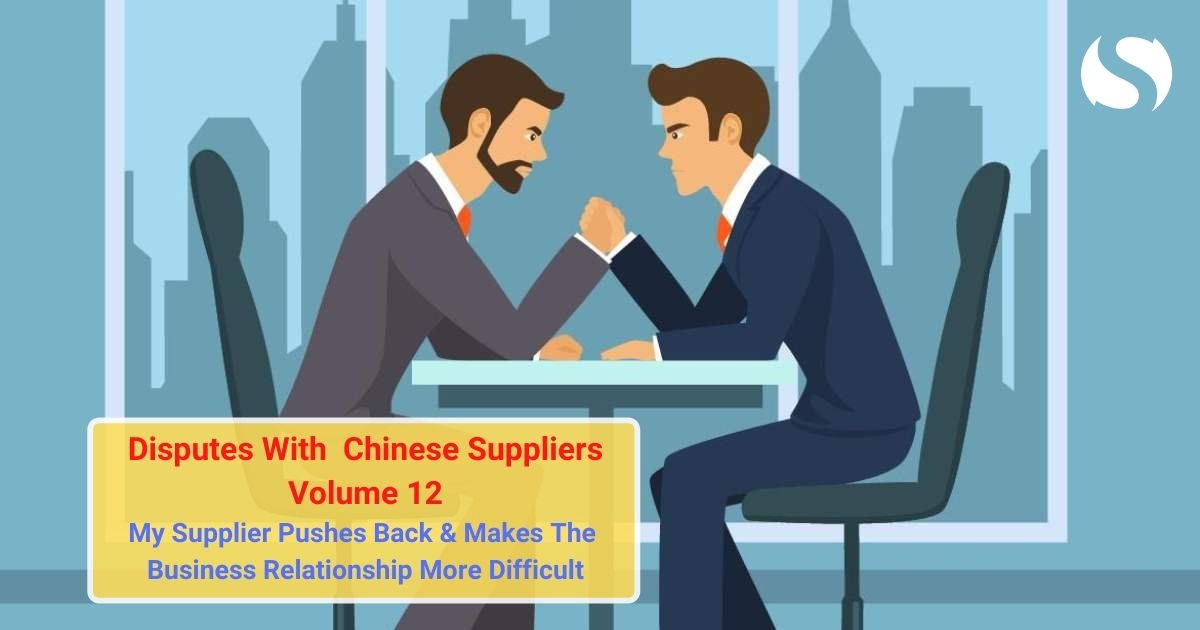
My Supplier Pushes Back & Makes The Business Relationship More Difficult | Disputes With Chinese Suppliers Q&A (Volume 12)

Disputes with Chinese suppliers Volume 12

Relationships with your Chinese suppliers aren’t always plain sailing. Oftentimes they push back against your requests and make the relationship more difficult. Let’s look at an real example we were sent of this (no identifying details given for confidentiality) and some suggestions on how to navigate the situation.

Continue reading “My Supplier Pushes Back & Makes The Business Relationship More Difficult | Disputes With Chinese Suppliers Q&A (Volume 12)”

DIY Sourcing From China Part 4: Final Inspections [Podcast]

DIY Sourcing From China Part 4: Final Inspections [Podcast]

Our CEO Renaud Anjoran continues this mini-series of episodes for importers who want to handle their own sourcing from China from start to finish with this episode about final inspections that is the fourth in the series.

Back in part 3 of the series, we discussed how to manage your project with your outsourced manufacturer and the role of inspections during the production process.

Moving on to the next stage, your supplier has now manufactured your products and you’re almost ready to ship! But before you do there’s a last important step to remember, to perform a final random inspection where you’ll verify product quantity, quality, and packaging and labelling accuracy.


Listen here!

Listen: Sourcing from China (Part 4): Use final inspections to verify order quality BEFORE shipment

Watch on Youtube


Episode sections

  • 00:00 – Greetings & introduction into where we are in the series and today’s topic: final inspections.
  • 02:30 – What are the risks of letting products ship without performing a final inspection? 
  • 11:04 – What is a final inspection? 
  • 16:18 – When are final inspections usually performed, and why?
  • 19:02 – Where should the final inspection take place and who does it? 
  • 24:11 – Why it’s a very busy time period for inspections just before Chinese New Year.
  • 25:51 – What are the unique benefits of a final inspection in comparison to earlier product inspections?
  • 31:51 – Wrapping up. 


Related content…


Listen, rate, & subscribe to the ‘China Manufacturing Decoded’ podcast on your favorite provider

There are more episodes to come, so remember to rate us and subscribe! You can find us on:

If you enjoyed this episode, don’t forget to give us a 5* rating and share it with your network if you enjoy listening!

DIY Sourcing From China Part 3: Project Management & Checking Quality Early [Podcast]

DIY Sourcing From China Part 3 Project Management & Checking Quality Early [Podcast]

This mini-series of podcast episodes was spawned following episode 65 where we discussed the different supplier options open to buyers who’re sourcing from China. One of which is to do it yourself!

If you’re interested in doing your own souring from China, these episodes go into detail about the must-do activities and risks you face. Our CEO Renaud Anjoran also provides you with plenty of great tips to make your life easier based on his decades of experience, too!

In earlier episodes (Part 1: Good Fit, Sourcing, Vetting, & Backups and Part 2: Negotiations, Terms, Leverage, & Quality Standards) we covered the earlier sourcing and vetting stages, as well as pre-production.

Now we’re ready to start production, but before you give the factory the green light let’s explore how to manage the project (your order with them) efficiently and why doing early checks of quality and more are so important just before and early on in production.


Listen here!

Listen: Sourcing from China (Part 3): Project management & checking quality early in production.

Watch: Watch it on YouTube


Episode sections

  • 00:00 – Introduction. 
  • 02:51 – When we’re working with a Chinese supplier, will they provide a dedicated member of staff to manage your order/project? 
  • 10:07 – What can very large companies like Apple expect from their suppliers in China? 
  • 12:40 – Why it’s YOUR job to drive the project and get your contact to follow up. 
  • 14:05 – What penalties can be enforced to keep suppliers in line? 
  • 22:10 – What are the production tracking best practices that professional buyers follow?
  • 30:44 – Are WeChat/Skype/Email effective for managing projects? 
  • 32:04 – What issues can be found and fixed if you perform quality inspections early on in production? 
  • 34:54 – When can we send an inspector during production and what difference does the timing make? 
  • 40:04 – What happens if a problem/s is found? 
  • 43:48 – How is the 1:10:100 ratio related to taking action on problems early? 
  • 49:20 – Wrapping up. 


Related content…

Don’t forget to listen to Part 1: Good Fit, Sourcing, Vetting, & Backups and Part 2: Negotiations, Terms, Leverage, & Quality Standards of this series.


Listen, rate, & subscribe to the ‘China Manufacturing Decoded’ podcast on your favorite provider

There are more episodes to come, so remember to rate us and subscribe! You can find us on:

If you enjoyed this episode, don’t forget to give us a 5* rating and share it with your network if you enjoy listening!

My Manufacturer Is Forcing Me To Accept Poor Quality! | Disputes With Chinese Suppliers Q&A (Volume 11)

My Manufacturer Is Forcing Me To Accept Poor Quality! | Disputes With Chinese Suppliers Q&A (Volume 11)Sometimes your Chinese supplier will use various dirty tricks to push you into accepting products that don’t reach your quality standard. Why could this happen and what can you do about it? Find out here with a helpful example and some tips…

Continue reading “My Manufacturer Is Forcing Me To Accept Poor Quality! | Disputes With Chinese Suppliers Q&A (Volume 11)”

How Can Small Buyers Of Garments Get High Quality From China? – Disputes With Chinese Suppliers Q&A (Volume 6)

How Can Small Buyers Of Garments Get High Quality From China?
This blog post is about issues with quality from an apparel supplier and is based on a real Sofeast customer’s experiences (with no identifying information given). We’re going to explain how to assure you’ll get high-quality garments from your Chinese supplier even if you are only a ‘small buyer.’


Q: My supplier is providing me with quite a lot of defective garments, even though they claim that the errors found are ‘under the AQL limits’ and ‘only about 3% of the total’. That’s equivalent to around 60 pieces out of every 2,000 I order. This seems a lot and hurts my brand. Is this normal?

In the apparel trade, yes, a 3% AQL is to be expected (not ‘normal’, but expected if you work with a relatively average or unsophisticated supplier). So, the factory salesperson is actually being honest about the 3%. In garments, I don’t think any buyer is happy about that proportion of defectives, but you will need to look for a better factory if you want a lower percentage.


Q: I paid for a final inspection which was not cheap, it failed due to puckering on 100% of the garments, but my factory doesn’t seem willing to take action to fix the issues and I’m struggling to negotiate with them from overseas. How do other companies handle this?

So, this factory sees a failed report with a very serious issue (very visible puckering along some seams) and they won’t do anything? That’s the sign of a bad factory. That’s quite unreasonable on their side, but not atypical, unfortunately. That’s why we usually suggest doing an earlier inspection, such as a pre-production meeting and/or inspection during production, to catch such issues before all is made and packed (at least the factory usually tries to minimize the damage on what they still have to sew).


Q: Are these errors and this behavior typical from a garment factory?

I think their errors are typical, yes. But their behavior is poor. One might say their behavior is typical, too, if they see you as a small customer and they believe you are not going to leave them over this type of issue. If they cannot or will not change their ways, it may be time to consider switching to a new supplier altogether or work on improving your supplier’s quality processes.


Q: How do large apparel companies like Nike manage to prevent any defective garments from reaching consumers?

Huge companies like Nike work with large (often > 5,000 people), very organized factories. They hold a lot of sway over their suppliers as they buy massive quantities. They have pushed those factories to work a LOT on process improvement, even introducing a lean manufacturing approach. That’s another world that is atypical in the garment trade…

If like Nike, you can work with a factory over which you have a lot of purchasing power (ideally, some of their lines work for your company continuously), certain things become possible:

  • Forcing them to do small pilot runs before launching mass production.
  • Not cutting all the fabric & accessories in advance (so cutting or fabric issues don’t impact large batches in their entirety).
  • Paying a lot of attention to the first bundles sewn, with a special process.

But, I am afraid this is not realistic for buyers who are purchasing smaller volumes, unfortunately.


Q: Would a 100% inspection be a possible solution for me to stop these quality problems and what would it cost?

Very few garment buyers arrange for a 100% inspection (apart from some Japanese companies). It adds quite a bit of cost.

However, we are able to perform a Full Production Check (FPC) on batches from your supplier keeping in mind specific problems that have been repeatedly occurring to give you peace of mind that defective garments won’t be shipped.

In terms of cost, the FPC is US$299 per man-day and it could be several man days to check, say, a couple of thousand garments. However, this type of quotation has to be done on a case-by-case basis, based on the ease of checking the garment and the types of defects that we have to catch.


What is the minimum we suggest ‘small buyers’ do to assure good quality products?

  1. Be very clear about the types of defects can and cannot tolerate, and in what maximum proportion
  2. Make sure any potential supplier is made aware of this
  3. Document your inspection checklist and the lists of issues you will count as defects
  4. Have the supplier sign a manufacturing agreement that stipulates what happens if too many defects are found
  5. Send an inspector at different times during the production of the first batch with a new supplier. And keep doing at least a final random inspection after that.


How about you?

Are you also having difficulties with a Chinese apparel supplier? Let us know what’s happening and we will try to offer some advice.


Get expert help to improve YOUR product quality from suppliers in China or Vietnam. Read: Quality Assurance In China Or Vietnam For Beginners

Grab your free copy and learn the common traps new importers from China or Vietnam fall into, and how to avoid or overcome them in order to get the best possible production results. It also outlines a proven quality assurance strategy that you can follow in order to have better control over your product quality, covering:

  • Finding Suitable Suppliers
  • Defining your Requirements before Production Starts
  • Don’t Skip the New Product Introduction Process
  • Regular Quality Inspections (Trust but Verify)
  • Tying Payments to Quality Approvals

Sounds good? Hit the button below to get your copy now:

quality assurance in china or vietnam ebook

“What Quality Inspections & Factory Audits Do Sofeast Offer?”

What Quality Inspections & Factory Audits Do Sofeast Offer?

For anyone who needs to organise inspections soon and is interested in learning more about our range of product quality inspections, I wrote this description along with some key points:

Continue reading ““What Quality Inspections & Factory Audits Do Sofeast Offer?””

How To Prepare Your QC Inspection Report

You may already have seen our infographic explaining how a random inspection works, if so, you’ll see that it is a good introduction to these inspections. Now, the next step is learning how to report the results in a QC inspection report.

how to prepare your qc inspection reportThere are many ways to prepare such a report. But here are a few guidelines to help you prepare a document that suits your needs.



What sections does a QC inspection report include?

A QC inspection report is usually composed of the following parts:

1. Conformity to specifications

You probably want the inspector to look at the following aspects of the products:

  • Components
  • Assembly
  • General outlook, colors
  • Labeling
  • Packaging & packing

It can look like this (this example counts only 1 checkpoint, but you are encouraged to list up to 10 or 15 points in each sub-part, to be inspected during the job):

What to report?

In my mind, the inspector should only show the non-conformities if he was trained properly and if you trust him. But that’s up to you. Some inspection firms commonly use freelancers that they don’t really know, and they require reporting (and photos) for everything. Up to you!


2. On-site tests & measurements

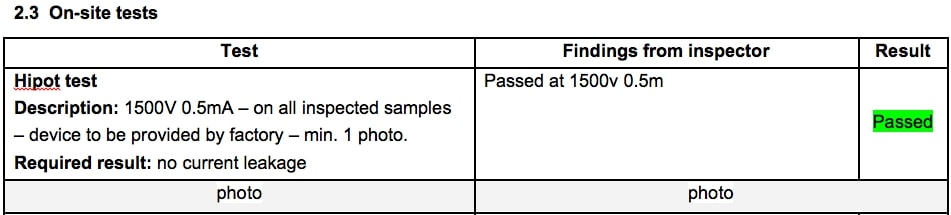
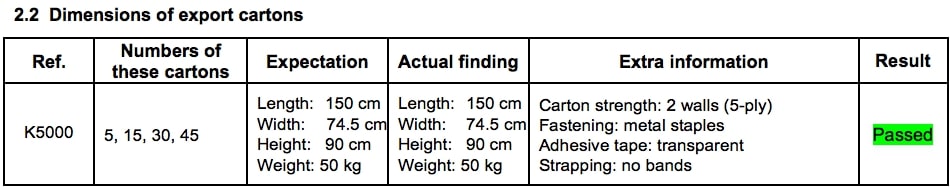
This is the place for the checks that take some time, and that are generally performed only on a few samples:

  • The tests (to be clearly described, including the equipment to use and the required result)
  • The measurements of the cartons and of the products (size and weight)

Here is an example of a test:

And for the measurements:


3. Production status

This is where the presented quantity is noted.

Here is a common way of displaying this information:

It is extremely important to know whether the inspector could count the number of products (sometimes they are piled up in bulk) and whether all products were available for sampling (sometimes they are under packing or repairing).

If the inspection takes place during production, you can add some extra questions to ask the factory: how many lines are working on my products, when will you get to 50% finished, etc.


4. Visual defects on the product and the packing

The inspector will look for defects, will place them in the right categories (critical/major/minor), will add the numbers up, and will compare them to the AQL limits.

This is the most basic part of every QC report, and every inspector knows how to present this. Make sure you get photos, and a clear description of each defect (if it’s not obvious on the photos, indicate the size of each defect and its position on the product).


5. Appendix: photos

This is the place where you list the photos that you want to see, whether there are problems or not.

A good tip: describe how each photo should be taken (what angle). This way, you can compare the photos across several inspection reports. Some buyers have noticed an evolution in the manufacturing process based on this technique.


Benefits of reporting like this

In this global environment where we’re learning to deal with the pandemic, travelling to China may be difficult, so for buyers who are abroad, the inspection report represents an important window into how well your suppliers (or factory) are currently doing after product inspections have been conducted.

You can use the inspector’s findings to report back to suppliers and make them accountable for poor (or good) results. If you’re able to indicate exactly where quality issues have occurred, it’s easier to make a plan to put them right in future, perhaps by implementing certain process improvement tools.


“Where can I learn more about creating quality inspection reports?”

You should take a look at this infographic that we also produced about these reports:

👉 Product Quality Checklist: How To Prepare It 


“Can I see some example reports?”

Yes, no problem!

You can see a selection of Sofeast’s past inspection reports on various product types ranging from soft lines through to industrial components that we’ve created for our clients in the past by hitting the link below (no identifying information is provided in them):

👉 Explore sample inspection reports


P.S. You may also be interested in…

These two podcast episodes where we discuss the 10 elements of a sound Quality Assurance strategy in China which certainly includes product inspections!

Editor’s note: This post has been recreated and adjusted from the earlier post on QualityInspection.org for Sofeast readers.

How To Bring In Quality Inspectors Without Upsetting Suppliers

How To Bring In Quality Inspectors Without Upsetting Suppliers

Many buyers are fed up with quality issues that went unnoticed and ended up being shipped out, and they know something needs to change. One obvious way to contain issues is to bring in quality inspectors to check product quality before shipment.

At the same time, they are afraid of shocking the manufacturer with a mark of distrust. They are afraid everything goes downhill from there.

Are you in this situation? Then this article is for you.

Continue reading “How To Bring In Quality Inspectors Without Upsetting Suppliers”