Design to Cost: Hit Your Price Target Before Production [Podcast]

A common question in product development is:
“How can we reduce the cost of this product?”

The problem is, it’s often asked too late.

By the time a product is fully designed, most of its cost is already locked in. At that stage, reducing cost usually means compromises, redesigns, or pressure on suppliers (which often leads to quality issues).

A better question to ask is:
“What should this product cost, and how do we design for that from the start?”

That’s where design-to-cost comes in.

Let’s talk through it here…


Listen here

Listen to the episode or watch on YouTube

Episode Sections:

  • 00:00:03 – Introduction & industry context
  • 00:01:15 – Why reducing cost late rarely works
  • 00:02:09 – How costs get locked in early
  • 00:04:58 – What “design to cost” really means
  • 00:06:59 – Designing within cost constraints
  • 00:10:29 – The biggest cost reduction levers
  • 00:11:29 – Cutting features without losing value
  • 00:14:35 – Main drivers of product cost
  • 00:19:04 – Common mistakes that increase costs
  • 00:26:19 – Why simplicity improves cost and reliability
  • 00:27:19 – Practical design-to-cost strategies
  • 00:30:29 – Case study: the Coolest Cooler failure
  • 00:31:49 – Final takeaway: design for cost from day one

Further content

🎧 Listen, rate, & subscribe to the ‘China Manufacturing Decoded’ podcast on your favorite provider

More episodes are on the way, so remember to rate us and subscribe! You can find us on:

Plastic, Silicone, Steel, and Others: Updated China Raw Materials Costs (late Dec ’24)

Yes, it’s the end of 2024, but we keep our fingers on the pulse regarding raw material costs in China! Here’s the monthly update tracking the costs of commonly used raw materials from China for the past year to help you understand the market’s current state. If you or your supplier purchase materials from China for your products, the cost changes you see here impact your bottom line!

Here’s the up-to-date material cost data from China for you as of late December 2024 and the price evolution over the past twelve months – Epoxy resin, cardboard, and colored paper’s costs have jumped up, and lithium batteries and PVC are down a little.
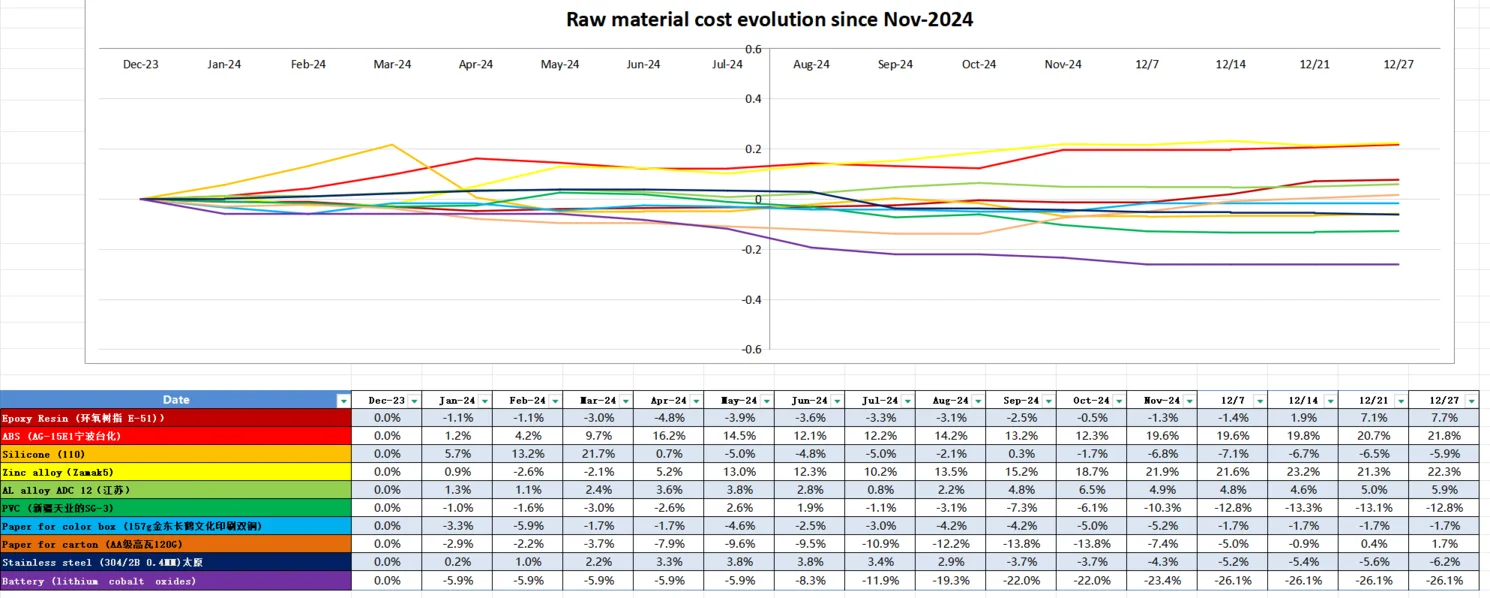
annual china raw material cost evolution dec 23 to dec 24Here are the annual cost changes in CNY:

china raw material monthly costs 2024Here is what the external market analysts we work with attribute these changes to during this past month and the overall monthly cost change of December:


Epoxy Resin (+9.13%)

The epoxy resin market continues its upward trend, driven by rising production costs. Manufacturers have released new pricing that reflects these higher costs, and low-cost options are increasingly scarce.

ABS (+1.79%)

The ABS market held steady with slight firmness in some regions. Positive macroeconomic outlooks and elevated upstream raw material costs have lent support to prices.

Silicone Rubber 110 (+1.02%)

Prices for domestic raw silicone rubber initially dropped early in the week but rebounded later. Major suppliers reduced prices to boost sales, encouraging lower-cost transactions. Pre-sale orders helped stabilize prices, although the overall market weakened slightly due to discounted offers.

Zinc Alloy (+0.37%)

Electrolytic zinc prices fell, with the average market price moving downward. Weak demand and subdued market sentiment contributed to the decline.

Aluminum Alloy (+0.99%)

Spot aluminum prices in the domestic market continued to decline due to weak macroeconomic signals during the policy adjustment period. Alumina prices also dropped slightly, easing cost pressures.

PVC (-2.69%)

The PVC powder market remained sluggish, though there was a slight uptick in price averages. High inventory levels and a muted macroeconomic environment weighed on market activity.

Paper for Color Boxes (+3.69%)

Growth in the double copper paper market has slowed but remains steady. Paper mills maintained a supportive stance, but downstream buyers showed low enthusiasm, adopting a cautious approach to high prices.

Corrugated & Boxboard Paper (+9.84%)

The market maintained a steady rally, with prices climbing consistently. Major paper mills issued successive price hike announcements, ensuring stable market transactions.

Stainless Steel (-1.96%)

Stainless steel prices stayed mostly stable, with minimal fluctuations. Declining futures markets reduced support for spot prices. End-of-year financial considerations helped stabilize the market but also contributed to a slight weakening.

Lithium Batteries (-3.51%)

The national lithium cobalt oxide market remained soft, with transactions primarily driven by real-time demand. Suppliers fulfilled orders amid tepid retail sales, reflecting weak overall market activity.


How to combat rising costs?

Explore cost-reducing tips in this post: Rising Raw Material Prices: What Strategy To Follow? (6 Approaches).

What to do if your Chinese supplier suddenly tells you that material costs have risen: How To Cooperate With Your Chinese Supplier, Part 16: Bad News from China, Raw Material Prices Just Increased!

If your supplier just isn’t working out, maybe sourcing a new supplier will help you find one who can offer you better prices and more. If so, there’s no need to fear switching from your current supplier to a new one if you’re prepared: How To Switch To A Newer, Better Chinese Manufacturer? [eBook].


We hope this is helpful. Our mission at Sofeast is to help importers have transparency in their supply chain and to give them more control. And this information is critical to have some visibility into your manufacturer’s costing.

By the way, you can always contact us if you have any questions about whether a manufacturer’s quote is reasonable.

Top 10 Things Affecting Electronic Product Design Costs

Sofeast’s Andrew Amirnovin, reliability expert and head of New Product Development, joins Adrian from the team to go through his top 10 things that affect electronic product designs (although they’re also relevant for many types of products in a lot of cases, too). If you want to control your costs when bringing a new product to market earlier is better than later, so keeping these 10 items in mind during the design and development phases will set you on the right path.

Continue reading “Top 10 Things Affecting Electronic Product Design Costs”

DIY Sourcing from China Part 9: Keeping your supplier’s costs under control [Podcast]

DIY Sourcing from China Part 9 Keeping Your Supplier’s Costs Under ControlWe have finally reached the end of our mini-series of episodes on how to do your own sourcing from China! Renaud has been taking you through the sourcing process, from getting started by finding suitable suppliers all the way through to working with them more effectively. The final topic? How to keep suppliers’ costs under control.

After all, if they’re paying more for materials, components, and due to waste, you can bet they’re going to pass them onto you, too. We’ll look at adjusting their supply chain, manufacturing, and office processes to cut costs where they commonly occur.

By the way, this is part 9 of this mini-series, and if you want to go back and listen to every earlier part of this series follow the links below.


Listen here!

Listen: How to keep your supplier’s costs under control? – Sourcing from China (Part 9)


Episode sections

  • 00:00 – Greetings
  • 00:58 – Brief recap of last week’s episode about the EU Ecodesign regulation
    You can listen to both parts on this topic here (Part 1) and here (Part 2).
  • 04:31 – Why should we be concerned about our suppliers’ costs?
  • 07:45 – Who may be able to influence their supplier to undertake work to take control of costs.
  • 10:28 – Using sourcing as a tool to control costs.
    How factory owners or key customers can get their/their supplier’s costs under control?
  • 12:48 – 1. You find out what is driving their costs by visiting.
  • 15:47 – 2. Stop buying in large quantities and making large batches.
  • 21:39 – How to make suggestions to the supplier that they will listen to.
  • 26:34 – 3. Tackle manufacturing aspects that are hidden costs.
  • 29:21 – 4. Find hidden office costs.
  • 35:11 – How does India differ from China?
  • 36:44 – Summarising keeping costs under control.
  • 38:11 – Mini-series wrap-up.


Related content…

These resources will also help you understand how to build relationships with suppliers or improve (or end) those that you already have:

And, if all else fails and you need to ditch your current supplier and switch to a new one…


Listen, rate, & subscribe to the ‘China Manufacturing Decoded’ podcast on your favorite provider

There are more episodes to come, so remember to rate us and subscribe! You can find us on:

If you enjoyed this episode, don’t forget to give us a 5* rating and share it with your network if you enjoy listening!

Plastic, Silicone, Steel, and Others: Updated China Raw Materials Costs (June ’21)

If you have been following our posts on the costs of China raw materials this year (2021) you will have seen that the prices have been rising rapidly in some cases.

Add this to the shipping delays and increased logistics costs and it’s becoming an expensive year for importers.

We’re tracking the raw material costs for some key materials and this month’s graph shows that some costs continue to stabilise, albeit at a higher level than before:

china raw material costs june 21

We’ve seen some price drops:

  • Paper (the pulp cost dropped a bit and it is mostly seasonal, as the peak season for packaging in China is before Christmas and before the Mid Autumn Festival)
  • Aluminum alloy. One reason may be the restrictions on electricity consumption and the difficulties in automobile production (due to a shortage of chips)

However, in the main, prices haven’t been moving southward.

The usual suspects have retained big price increases:

  • Batteries (lithium cobalt oxides)
  • Brass (despite a release of stock in the US)
  • Silicone (some people mentioned an accident in a large polycrystalline silicon factory — Hesheng Silicon Industry in Xingjiang — as a cause for lower supply)
  • ABS plastic


How to combat the rising costs?

Explore cost-reducing tips in this post: Rising Raw Material Prices: What Strategy To Follow? (6 Approaches).

If you’re purchasing electronic components, you may consider buying up inventory in advance to lock in the best possible price right now, too.

When it comes to electronic components, remember, the ‘best price’ isn’t always the cheapest.

As material costs rise the price you’ll pay is dictated by the market to an extent, but are you sure you can’t find ways to spur your supplier to improve in order to reduce costs elsewhere? For example, reducing quality issues reduces costs and can improve delivery times, too. Listen to this episode of our podcast to learn all about improving suppliers.

If the supplier is a write-off, maybe sourcing a new supplier will help you find one who can offer you better prices and more? If so, there’s no need to fear switching from your current supplier to a new if you’re prepared: How To Switch To A Newer, Better Chinese Manufacturer? [eBook].


We hope this is helpful. Our mission at Sofeast is to help importers have transparency in their supply chain and to give them more control. And this information is critical to have some visibility into your manufacturer’s costing.

By the way, you can always contact us if you have any questions about whether a manufacturer’s quote is reasonable.

Plastic, Silicone, Steel, and Others: Updated China Raw Materials Costs (May ’21)

As you may be aware, many China raw materials are increasing in costs quickly these days. Rising material costs are putting pressure on small manufacturers in China already, and prices are forecast to keep rising this year.

We’re tracking the raw material costs for some key materials and this month’s graph paints a concerning image:

china raw materials cost graph may 21

As you can see, most of the gains in prices of the previous months haven’t been lost. It has become the ‘new normal’, with relative stability throughout April.


Will this rising trend continue?

According to this article from the SCMP, metal prices are expected to increase 30 percent and agricultural prices to rise almost 14 percent this year, which is no joke if margins are already tight, and that’s just two categories.

What is causing this phenomenon? There seems to be no one answer. Here are some of the causes that might be at play:

  • A rise in demand. For example, much has been written about the higher-than-projected production of cars and consumer electronics, leading to shortages of chips. But these products also necessitate metals, plastics, rubber, and so on. In addition, many companies may have reconstituted their stock.
  • Constrained supply. To increase the amount of copper on the market, for example, not only the mines but the different transformation actors along the supply chain may have to invest in growing capacity.
  • Anticipation of global inflation. Some economists point to the side effects of the massive government spending plans in the USA and in the EU.


How to combat the rising costs?

There are some options you could follow, such as:

  • Source cheaper suppliers – in apparel this is more common, but in other industries where margins are tight, it may be counterproductive. Instead, attempting to reduce production costs may be more achievable.
  • Re-engineer cost drivers without removing value for customers – this would be altering the design of a product to use fewer components while assuring that the product still delivers the same benefits.
  • Develop new versions of your key products – increasing your prices may only be possible if you find ways to differentiate products by eliminating features or results of the current product that consumers have shown they don’t like from the newer version, for example.

These are just 3 examples in summary, but there are even more…

Read about these cost-reducing tips in this post: Rising Raw Material Prices: What Strategy To Follow? (6 Approaches)


We hope this is helpful. Our mission at Sofeast is to help importers have transparency in their supply chain and to give them more control. And this information is critical to have some visibility into your manufacturer’s costing.

By the way, you can always contact us if you have any questions about whether a manufacturer’s quote is reasonable.

Plastic, Silicone, Steel, and Others: Updated China Raw Materials Costs (March ’21)

If you have been buying products from China, you have probably had bad experiences with pricing. Manufacturers often raise the price once a year,  when their costs have gone up, or when the exchange rate got less favorable. The most common justification for price rises is: “China raw materials have gotten more expensive”.
But they don’t tell you what part of their cost comes for each material, so you are left negotiating with no visibility.

Continue reading “Plastic, Silicone, Steel, and Others: Updated China Raw Materials Costs (March ’21)”