How Life Cycle Assessments Drive Product Sustainability Changes [Podcast]

In today’s episode, we’re exploring Life Cycle Assessments (LCAs) — a critical tool for manufacturers and product developers aiming to improve sustainability and meet growing regulatory demands. You’ll learn why understanding a product’s entire life cycle — from raw material extraction to disposal — is essential for reducing environmental impact, staying compliant with new regulations, and designing more sustainable products. The discussion will help you grasp how LCAs work, why they matter, and how they can give you a competitive edge.


Listen to the episode here

Listen: to the podcast episode

Watch: on YouTube


Episode sections

  • [00:00] Welcome and introducing the topic
  • [01:07] What Is a Life Cycle Assessment (LCA)?
  • [01:41] Example: Comparing EVs and Traditional ICE Cars
  • [05:38] Challenges in Battery Production and Disposal
  • [10:06] Why LCAs Matter for Sustainable Manufacturing
  • [14:50] The Complexity of Supply Chain Data Collection
  • [17:29] The Push to Disclose Sustainability Information to Consumers
  • [20:05] Future-Proofing Example and Product EPD
  • [26:05] Practical Tips for Implementing LCAs
  • [28:30] How LCAs Can Give You a Competitive Edge
  • [29:20] Wrapping Up


Related content…


Listen, rate, & subscribe to the ‘China Manufacturing Decoded’ podcast on your favorite provider

More episodes are coming, so remember to rate us and subscribe! You can find us on:

7 New EU Product Compliance Requirements You Can’t Ignore In 2023

[vc_row][vc_column][vc_column_text]The next few years are going to throw a lot of challenges at importers who sell in Europe as there are quite a few new EU product compliance requirements coming into action either now (2023) or in the next few years.

To help you prepare, I decided to make a video talking you through 7 of the key EU product compliance requirements that are most likely to affect anyone manufacturing products.

As you can see, this was created under the banner of our product safety, reliability, and compliance lab, RSQ-Labs, as it’s the lab that often helps clients overcome compliance challenges like these.


EU product compliance requirements included

We cover 7 key requirements that you should know about:

  1. General Product Safety Regulation (2023/988) – applicable
    from 2024
  2. Ecodesign for Sustainable Product Regulation – applicable
    probably from 2025
  3. Corporate Sustainability Due Diligence Directive – applicable
    gradually over time
  4. Packaging & Packaging Waste Directive – applicable soon
  5. Battery & Waste Batteries Regulation – applicable from 2025
  6. Deforestation Regulation (2023/1115) – applicable from 2025
  7. New Directive on Liability for Defective Products – applicable
    from 2024

What you should do next if you import products into the EU…

We have a couple of pieces of advice for you if you sell into the EU (and that includes companies from, say, the USA, who will still be bound by these requirements).

  1. Watch the video above ☝️
  2. Download the presentation as it contains links to all of the EU’s literature for the above 7 requirements so you can do your own research. Here’s a download link 👇

[/vc_column_text][vc_btn title=”Download the presentation” color=”primary” align=”center” i_icon_fontawesome=”fas fa-file-powerpoint” add_icon=”true” link=”url:https%3A%2F%2Fbit.ly%2F47zhkSV”][vc_empty_space][vc_column_text]

Further reading/listening about EU regulations and requirements that may affect you

EU product liability directive

You can learn more about the EU product liability directive by listening to this podcast: Getting Ahead Of The Upcoming EU Product Liability Directive

You may also like: Exploring Product Safety & Reliability Issue Liability [Podcast]

Ecodesign for Sustainable Products Regulation

We’ve covered this regulation quite thoroughly as it’s a lot to grapple with for importers:

Sofeast is already helping clients with their EU Ecodesign Regulation Risk Assessment & Preparation as it involves getting complex supply chain information and making your product designs more sustainable…we can help you, too, so feel free to get a quotation.

Supply chain transparency and product lifecycle analysis

As will become apparent, you may need to obtain a lot more transparency in your supply chain than you currently have.

You will also benefit from doing a lifecycle assessment which is the most common methodology for assessing the potential environmental impacts associated with the entire life cycle of a product. We’ve also covered this:

Sofeast can also do your LCA for you: LifeCycle Assessment and Environmental Product Declaration Support (Measuring Product Environmental Impacts)

Additional EU requirement-related topics

[/vc_column_text][/vc_column][/vc_row]

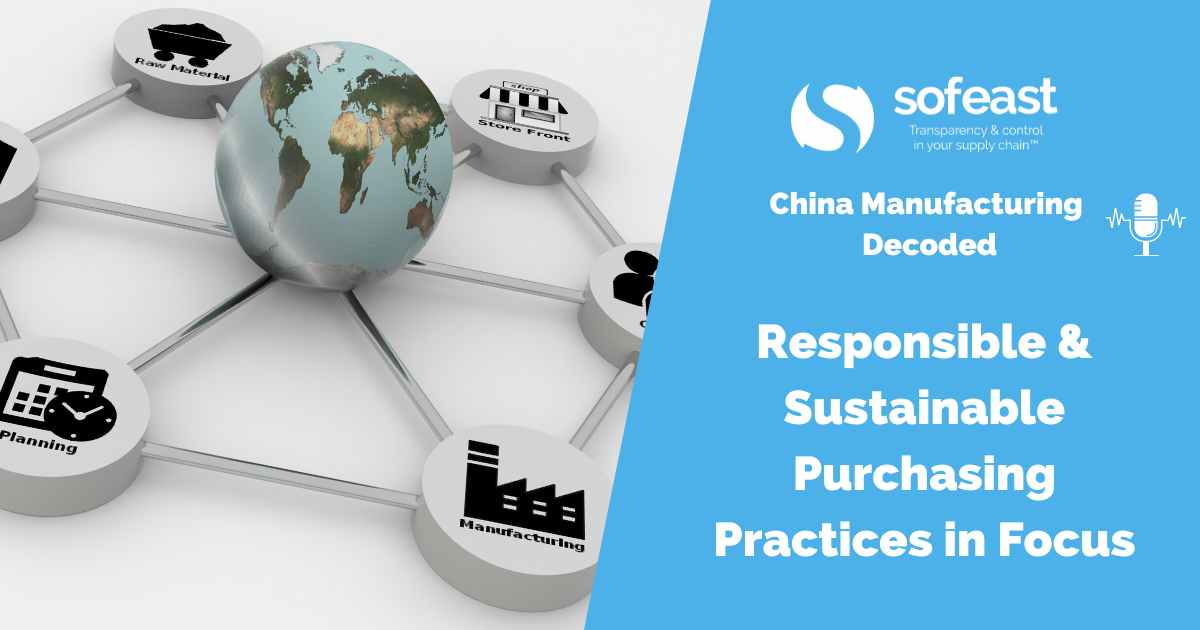
Responsible & Sustainable Purchasing Practices in Focus

Renaud and Adrian discuss both responsible and sustainable purchasing practices. It can be easy to overlook buyers’ role in their supply chains’ ESG performances, but those that do not purchase responsibly or go further and so sustainably, are damaging their own supply chain’s sustainability. You’ll learn why in this episode…


Listen to the episode here 👇

Listen: to the podcast episode

Watch: on Youtube


Episode sections

  • 00:00 – Introduction.
  • 02:44 – What is responsible purchasing? (+ 3 examples)
  • 14:34 – Responsible product design practices are a linked topic.
  • 16:29 – What is sustainable purchasing?
  • 18:55 – How sustainable procurement affects the supply chain.
  • 25:50 – ‘Big buyers’ are in a position to make positive changes. Small buyers, less so, but you still have options.
  • 30:30 – Forthcoming EU regulations will demand buyers to purchase more responsibly and sustainably.
  • 35:06 – The good news: You will save money!
  • 36:51 – Wrapping up.


Related content…


Listen, rate, & subscribe to the ‘China Manufacturing Decoded’ podcast on your favorite provider

More episodes are coming, so remember to rate us and subscribe! You can find us on:

If you enjoyed this episode, don’t forget to give us a 5* rating and share it with your network if you enjoy listening!

How To Comply With The EU Ecodesign Regulation? [Podcast part 2]

How To Comply With The EU Ecodesign Regulation (Part 2)

This is a crucial listen to anyone currently importing products into the EU! The new EU Ecodesign for Sustainable Products Regulation is coming soon, meaning that you will be legally obliged to comply with its demands for more sustainable products, a transparent supply chain, and clear control over how environmentally friendly the production of your materials, components, and products are!

If that sounds like a lot of information to obtain and, potentially, changes to your product design and suppliers, that’s probably because it is in many cases!

In part 1 on this topic, we discussed what the regulation is: The EU Ecodesign Regulation Is Coming, But Are You Prepared? [Podcast part1]

Now, let’s take a deep dive into what you will need to do to comply with the regulation as our CEO Renaud and compliance expert Clive Greenwood talk you through it.


Listen here!

Listen: How To Comply With The EU Ecodesign Regulation? (Part 2. Feat. Clive Greenwood)

Watch: on Youtube


Episode sections

  • 00:00 – Greetings & Introduction to today’s topic: EU Ecodesign Regulation.
  • 02:26 – Why is product design important?
  • 08:07 – The role of ‘Repairability’ and ‘Maintainability.’
  • 10:12 – The need to document your approach.
  • 12:03 – How product designs will need to change according to the EU ESPR proposal [quotes].
  • 18:38 – Addressing ‘Greenwashing.’
  • 20:47 – Postmarket surveillance.
  • 25:01 – Calculating energy consumption throughout the product lifecycle.
  • 30:11 – Supply chain information will be transparent – suppliers who are more sustainable will be preferred.
  • 34:37 – The example of garments and their supply chain.
  • 37:58 – Detailed traceability & visibility over the supply chain – requirements.
  • 43:18 – ESPR will evolve over time and cause headaches for importers…
  • 46:23 – The key data you need to start collecting NOW.
  • 48:13 – Will ESPR negatively impact SMEs more than large businesses?
  • 52:36 – You have been warned!


A disclaimer…

We are not lawyers. What we discussed above is based only on our understanding of the regulatory requirements. We do not present this information as a basis for you to make decisions, and we do not accept any liability if you do so. Please consult a lawyer before taking action.


Related content…

We’ve created some great resources on this topic – read them and get help here:


Listen, rate, & subscribe to the ‘China Manufacturing Decoded’ podcast on your favorite provider

There are more episodes to come, so remember to rate us and subscribe! You can find us on:

If you enjoyed this episode, don’t forget to give us a 5* rating and share it with your network if you enjoy listening!

The EU Ecodesign Regulation Is Coming, But Are You Prepared? [Podcast part1]

The EU Ecodesign Regulation Is Coming, But Are You PreparedSofeast CEO Renaud is joined again by friend of the show and product compliance expert, Clive Greenwood of SMC GLOBAL Manufacturing Consultants, to talk about the new ‘Ecodesign for sustainable products regulation’ set to become law in 2023 that will have a serious impact on importers of products into the EU, especially those made in Asia.

This regulation will require comprehensive supply chain information for all actors, assemblers, sub and sub-sub-suppliers, too. Do you know who they are?

It will also drive importers to produce more sustainable products with a focus on improving their circularity, energy performance and other environmental sustainability aspects. Again, are you ready to change course with all that entails (sourcing, new suppliers, certifications, etc)?


Listen here!

Listen: EU Ecodesign for Sustainable Products Regulation. How ready are YOU? (Feat. Clive Greenwood)

Watch: on Youtube


Episode sections

  • 00:00 – Greetings & Introduction to today’s topic
  • 01:19 – Some background.
  • 03:29 – What is the Ecodesign regulation going to be?
  • 07:12 – Verifying the supply chain
  • 17:12 – A LOT more due diligence will be required by buyers.
  • 21:00 – What’s the difference between an EU directive and an EU regulation?
  • 23:10 – Compliance with the Ecodesign for sustainable products regulation will be taxable.
  • 25:00 – Targeting ‘bad’ industries like Fast fashion.
  • 28:23 – How ready are YOU?
  • 33:01 – Traceability using a product passport.
  • 38:09 – The CSRD (EU Corporate Sustainability Reporting Directive) will replace the NFRD (EU Non-Financial Reporting Directive) reporting requirements starting in 2023.
  • 41:02 – What can YOU do to cope with these changes?
  • 44:40 – Summary of what the EU Ecodesign regulation focuses on. 
  • 45:40 – Wrapping up. 


A disclaimer…

We at Sofeast are not lawyers. What we discussed above is based only on our understanding of the regulatory requirements. We do not present this information as a basis for you to make decisions, and we do not accept any liability if you do so. Please consult a lawyer before taking action.


Related content

Next…jump straight into part 2 on this topic: How To Comply With The EU Ecodesign Regulation?

We’ve created some great resources on this topic – read them and get help here:


Listen, rate, & subscribe to the ‘China Manufacturing Decoded’ podcast on your favorite provider

There are more episodes to come, so remember to rate us and subscribe! You can find us on:

If you enjoyed this episode, don’t forget to give us a 5* rating and share it with your network if you enjoy listening!