QC During NPI: Build Quality In Before Mass Production [Podcast]

Quality control should not start when finished products come off the line.

By that point, the design may already be frozen, suppliers selected, components approved, tooling made, work instructions written, and the production process set up. A final inspection can still catch defects before shipment, but it cannot undo all the decisions that created those defects in the first place.

That is why quality control during NPI is so important.

In episode 330 of China Manufacturing Decoded, Adrian and Renaud discuss what QC should look like before mass production begins. They explain why product requirements need to be clear, why supplier and component qualification matter, how inspection and testing processes should be prepared, and how mistake-proofing, jigs, fixtures, and pilot runs can reduce the risk of costly production problems.

The key point is simple: final inspection is reactive. Good NPI quality control is preventive. It helps you build quality into the product and manufacturing process while there is still time to make changes.

Listen here

Listen to the episode or watch on YouTube

Podcast sections

  • 00:01:14 Why many companies treat quality control as an end-of-line activity
  • 00:02:08 Why final inspection is reactive, not preventive
  • 00:04:01 How to build quality into the product and process earlier
  • 00:04:44 Why everything in product development can affect quality
  • 00:06:08 Product requirements as the foundation of NPI quality control
  • 00:07:09 Supplier qualification, design risks, inspection, and testing
  • 00:08:29 Quality gates, validation, reliability, compliance, and performance
  • 00:09:36 Manufacturing process controls and why they need to be planned
  • 00:12:02 Using AI to help document product requirements
  • 00:13:00 Examples of turning user needs into measurable specifications
  • 00:15:41 Cosmetic standards, boundary samples, and critical measurements
  • 00:18:21 Qualifying suppliers, components, and materials
  • 00:19:53 Turning requirements into inspection and testing processes
  • 00:22:18 Applying QC controls during prototype and pilot batches
  • 00:23:04 Work instructions, jigs, fixtures, and process risk reviews
  • 00:25:05 Mistake proofing example: preventing drilling errors
  • 00:26:28 Eliminating risks where possible, controlling them where not
  • 00:27:12 Why prevention is stronger than end-of-line inspection
  • 00:28:04 Final takeaway: quality-forward NPI reduces production risk

Further content

🎧 Listen, rate, & subscribe to the ‘China Manufacturing Decoded’ podcast on your favorite provider

More episodes are on the way, so remember to rate us and subscribe! You can find us on:

Sofeast QA Program: Reduce Your Risks When Launching New Products

We support lots of companies to develop their own new electrical/electronic products and bring them into production. Over 90% of those projects are in China.
But how do we support you to go from product early prototypes to mass-produced products with minimized risks of quality problems and more?

Continue reading “Sofeast QA Program: Reduce Your Risks When Launching New Products”

QA Strategy in China: 10 Elements You Should Include

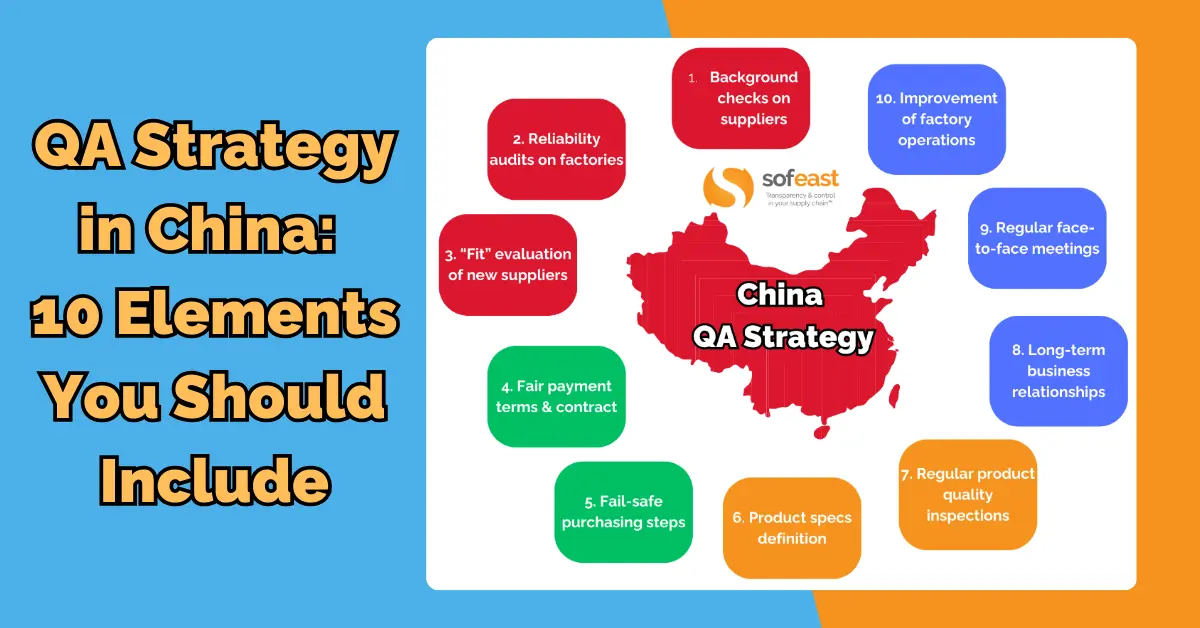
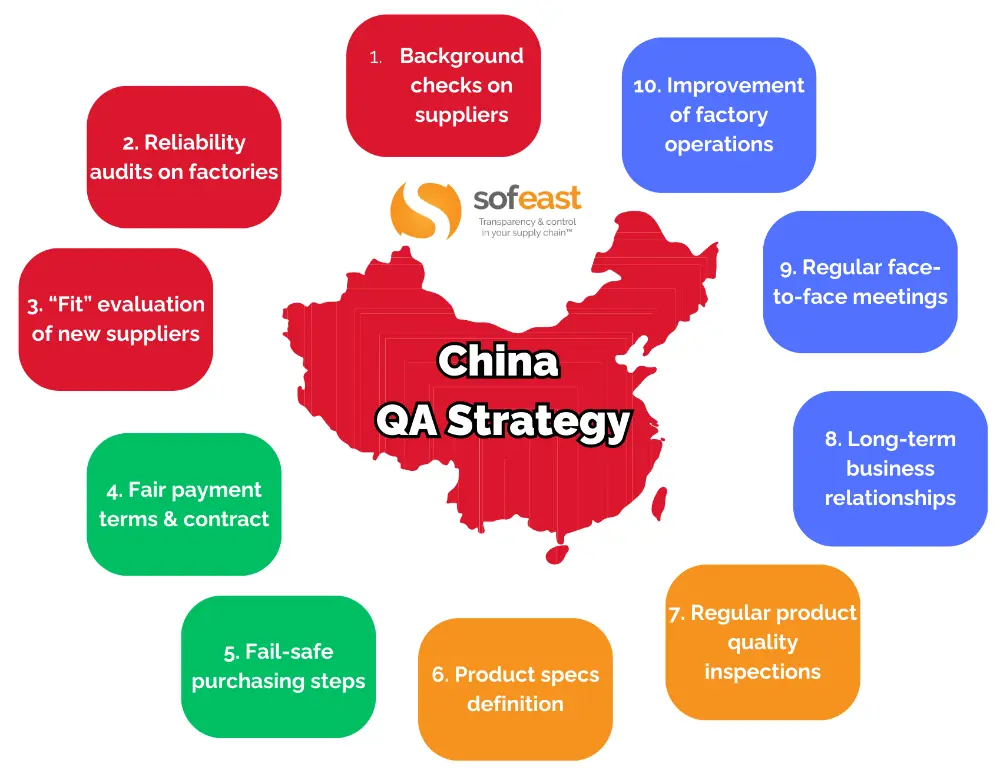
A good QA strategy in China will contain the following 10 elements:

qa strategy in china 10 elements

We’ve split these into 4 different sections:

  1. Qualification of new suppliers
  2. Purchasing method
  3. Quality Control
  4. Buyer-supplier relationship

Let’s go through them in order so you understand the makeup of a good QA strategy in China.

[ez-toc]


1: Qualification of new suppliers

1. Run background checks on suppliers

Some trading companies pretend they are a manufacturer with a factory, but in fact, they’re outsourcing your production to who-knows-where. To ensure that you are working with a real manufacturer, run a background check on the companies you’ve found. For example, go for an affordable ‘supplier legal records check.’

You will need full information about the factory (including their company name & address in the local language) and their written guarantee that they will not place production anywhere else without your written authorization (which you can include as a part of your manufacturing contract with the supplier).

2. Reliability audits on factories

Do you want to place orders in a factory that you don’t know? If you can evaluate its capacity and its quality system, go and visit it. If you can’t, appoint a QA agency to do a quality system audit. Ask for an example of a report before you book the service, to make sure you get what you need.

3. “Fit” evaluation of new suppliers

Factory audits tend to give a higher score to larger manufacturers, simply because they have a more mature organization and more written procedures. However, for smaller order volumes you might be better served by small factories as your order is likely more important to them. In this case, a visit from your staff is necessary. You will evaluate the owner’s personal motivation to take your order and keep an eye on it every single day. When necessary, a trading company might be a good fit for you.


2: purchasing method

4. Fair payment terms and contract

Once you have paid 100%, you have no more leverage. Don’t think Chinese suppliers are motivated by your next orders. Most of them aren’t, at least not to the point where it pushed them to prioritize your orders over their other customers’. Here are some tips:

  • Try to pay by letter of credit if your total order amount is 50,000 USD or more, at least for the first 1 or 2 orders with a new factory.
  • Always limit your first payment (if you can’t pay by letter of credit) to 30%.
  • Do NOT wire the balance before shipment or before quality was confirmed by a final inspection.

For large orders, use a manufacturing contract drafted by a lawyer specializing in Chinese law. This must be very detail-oriented, pre-defining each penalty’s amount and ensuring that the contract is enforceable in a local court of law.

5. Fail-safe purchasing steps

How do you make sure your purchasers follow the right buying procedure? They must have and be trained to follow a buying procedure that incorporates all the QA steps. For example, they should not forget any important step when qualifying new suppliers or regarding payments.

And this is even more important when developing a new product. For example, make sure you validate fully the product design before allowing the factory to go into tooling and manufacturing!


Theme 3: quality control

6. Product specifications definition

Before issuing an order, your quality department or QA service provider should define your expected product specifications very precisely. This should include:

  • Product description
  • Performance/resistance requirements
  • Packaging
  • Labeling
  • Limits and tolerances.

Get the supplier to accept the spec sheet (after discussions and revisions if necessary). And make them a part of the manufacturing contract, typically as an appendix.

7. Regular product quality inspections

Especially when manufacturing new products, check the product quality during production, and again before shipment.

For re-orders, final (pre-shipment) quality control is usually enough. And, for proven suppliers experienced at making your product, you might not need to check every shipment if things are pretty stable.


Theme 4: buyer-supplier relationship

8. Long-term business relationships

Building mutually respectful and beneficial relationships with suppliers is an important part of your QA strategy in China. Some importers want to “partner” with one factory, by trading regular orders against low pricing and good quality. Be warned, this approach generally doesn’t work.

It is effective to make and keep to your promises with a Chinese supplier, and to stay with them if you have a good relationship, rather than abandoning them at the first opportunity you have to save a few pennies elsewhere. But if a supplier lets you down, don’t hesitate to “punish” them by giving orders for certain products to another supplier, at least for some time.

9. Regular face-to-face meetings

In China, face-to-face meetings usually provide the best results. Book that plane ticket and make sure your suppliers know you. Meet their salespeople, but also their managers. You will know who you should call when you run into trouble. Listen to this podcast about How To Develop Your Chinese Supplier for more details on why getting to know them is a great idea.

10. Improvement of factory operations

Chinese factory owners can be quite stubborn. However, when their major customer pushes them to improve and sends them warning letters, they listen.

If you have worked with a good supplier for years and if they listen to you, why don’t you pay a manufacturing consulting firm to improve their processes and their organization? That’s especially important if you see they haven’t hired industrial engineers to improve their processes.

Their labor productivity can probably be increased by 20% on a given process, their cycle time reduced by 30%, and their defects reduced by half, all without making deep changes in the factory’s organization. That level of improvement may well be worth an investment from your side and you’ll have an even better relationship with the supplier, too.


Next step

If you are developing and manufacturing new products and want to set up a reliable supply chain, implementing a QA program makes a lot of sense. We can help you do this.


Editor’s note: This post is based on the 2012 post: A Good Quality Assurance Strategy in China [10 Components] on QualityInspection.org and has been edited for Sofeast readers.

“What Quality Inspections & Factory Audits Do Sofeast Offer?”

What Quality Inspections & Factory Audits Do Sofeast Offer?

For anyone who needs to organise inspections soon and is interested in learning more about our range of product quality inspections, I wrote this description along with some key points:

Continue reading ““What Quality Inspections & Factory Audits Do Sofeast Offer?””

Why Checking Quality During Loading Is A Bad Idea

Why Checking Quality During Loading Is A Bad Idea

In this post, I’m going to address whether checking quality during loading, if it’s even possible to do it at that time, is a good idea. I don’t think so, and here’s why…

Continue reading “Why Checking Quality During Loading Is A Bad Idea”

What is an inspection level in ISO 2859-1 and ANSI/ASQ Z1.4?

What is an inspection level in ISO 2859-1 and ANSI_ASQ Z1.4_

This article introduces the different options available to buyers when it comes to the representation of product inspection findings. Inspection level II (under “normal severity”) is appropriate for most random quality inspections. But it is sometimes necessary to increase–or reduce–the number of samples to check.

Continue reading “What is an inspection level in ISO 2859-1 and ANSI/ASQ Z1.4?”

Quality Control Plan: Defining Expectations Before Production

Quality Control Plan: Defining Expectations Before ProductionA quality control plan is the document that lists all the quality-related checkpoints to be passed during/after a production run.

Depending on the situation, it can include process, product, or legal checkpoints. Getting this document approved is an essential step before production is allowed to start.

Continue reading “Quality Control Plan: Defining Expectations Before Production”

How to Arrange Supplier Self Inspections for QC

How to Arrange Supplier Self Inspections for QCSupplier self inspections, rather than sending in external quality inspectors, are becoming increasingly important for today’s buyers.

In certain cases, it makes a lot of sense to stop sending employees to check if a supplier has done a good job.

However, it is not just a case of saying “oh, by the way, starting next month we’ll only check 20% of your shipments”, or “good job — we’ll trust you entirely from now on”.

Don’t play Santa Claus. Your suppliers VERY MUCH want you to stop sending inspectors to their facility, and in exchange, you can extract a few concessions…which will reduce your risks further.

But first, let’s look at the type of things you want to avoid…

Continue reading “How to Arrange Supplier Self Inspections for QC”

How Much Does a Quality Inspection in China cost?

How Much Does a Quality Inspection in China cost_Understanding the cost of QC inspections in China

Some importers get to talk about their project for some time, see where we would help them, and finally (almost as an afterthought) ask: “How much does a quality inspection in China cost?”

When quoted: “299 USD per day of work”, I can nearly hear them thinking “wow these guys are cheap”.

They compare this fee to the costs of professional services in their country, or maybe to the total amount of the order, or to the cost of their best alternative (taking a flight to China). So it sounds really low.

***

Breaking down how much quality inspections cost in China

1 man-day of work (which is sufficient for a good number of random inspections) costs 299 USD.

Travel expenses might apply, on top of the cost of labor, if the factory is far away from the closest importer. Let’s take 3 typical examples:

  • If the trip is only 60 km, it is included in the price.
  • If the trip is 120 km, an extra 50 USD might be charged.
  • If the trip is 400 km, an extra man-day might be charged (at half price) and an extra 100 USD might apply.

(Exact costs are quoted on a case-by-case basis, depending on transportation options available. Contact us if you’d like to discuss quality inspections now.)

***

I am always surprised by the expectations of some other importers regarding the cost of quality inspections in a Chinese factory. In their minds, even 100 USD would be a rip-off.

They compare it to the salary of a typical English-speaking employee in China (6,000 RMB), they divide it by 30 days, and they think we make an insane margin.

These buyers seem to forget about the main costs of a company that has set up a network in the main regions:

  • Training/supervisory/internal control overheads
  • Travel expenses to factories
  • Client communication
  • Taxes and social security
  • And more….

The buyers who value better service and reliability

The first category is ready to pay more for better service and higher reliability. They tend to be medium- or large-scale companies, or they have developed their own product and getting all the details rights is what helps them charge a premium. These buyers allow quality assurance firms like ours (Sofeast) to exist.

They want to make sure they are paying fees within the market band (i.e. not twice as much as their competitors). They are looking for convenience, reliability, and speed, more than a ‘great deal’.

The buyers who prefer the lowest possible cost

I learned that the second category of buyers, unless they absolutely have to, will never accept to pay the market price for quality control inspections. They prefer to roll the dice and let the factory ship out. In some cases, if they work with a ‘sourcing agent‘ who spends 20 min looking at a few products and taking a few photos, it is already plenty.

Is it rational? Not always. Are they worse off? Sometimes. If they buy off-the-shelf products that are purely decorative (or to be given away as part of a marketing campaign), that might make sense!


Conclusion

What is our conclusion, knowing all this?

Our main target is companies who have developed their own product. In the QA department, we help them get better organized, specify what their QC checklist is, and take better advantage of QC inspections.

And those buyers who always look for the best deal? We let them choose the cheapest suppliers and run the highest risks. They are not a part of our client base … We are just not a good fit.

Editor’s note – this post originally appeared here on QualityInspection.org in 2010 and was updated in 2019.

Are you looking for help with quality inspections?

Now that you have a better idea about quality inspection in China cost, we have 3 options for you.

  1. Check our product inspection solutions and choose which is most relevant to your needs to discuss it and get a quotation.
  2. Explore our ‘preventative production monitoring program‘ which consolidates some of the key inspections and processes for importers into one lower-cost package.
  3. Get a FREE quality assurance consultation – We know that QA is not ‘one-size-fits-all.’ Every business has unique requirements, so speak with us today for a ‘no-strings’ discussion about your needs and situation, and we’ll advise how we can best help you improve and assure quality and provide you with a quotation.

Beware! QC inspections based on AQL & random sampling have limits

Limits of QC inspections based on AQL & random samplingI wrote many times that QC inspections before shipment are a good way of keeping quality problems where they belong: In the factory.

Quality control inspections are a good tool. But pointing out their limits is important. Misinterpreting their reliability is very easy.

Continue reading “Beware! QC inspections based on AQL & random sampling have limits”