

When hardware moves from prototype to production, one of the hardest questions founders and engineering teams face is this: how do you maintain firmware protection in manufacturing when someone else is building your product?
For many electronic products, firmware is where most of the value lives. It contains proprietary algorithms, control logic, calibration data, and product intelligence that competitors would love to copy. Yet scaling manufacturing almost always means handing some level of access to external partners. The challenge is finding a setup that delivers strong protection without slowing production or driving costs through the roof.
There is no single “perfect” solution. The best approaches combine secure chip programming, smart supply chain design, and enforceable contracts. Sofeast has written more broadly about this tension in its guide on protecting IP when manufacturing in Asia.
What Is Firmware Protection in Manufacturing?
Firmware protection in manufacturing is the set of technical and contractual measures used to prevent unauthorized access, copying, or extraction of firmware when products are built by third-party manufacturers. The objective is to protect your core intellectual property while still allowing efficient, scalable production.
Common approaches to firmware protection in manufacturing
Here are a few common approaches.
Supply chain compartmentalization: separate programming from final assembly
A common model for protecting firmware in China manufacturing is to split responsibilities between two parties.
In this approach, a specialist vendor programs blank chips in bulk. They handle secure chip programming, traceability, and labeling, then ship the pre-programmed components to your contract manufacturer (CM) for final board assembly.
This keeps your firmware out of the hands of the factory building your hardware, while still allowing high-volume production. The tradeoff is logistics: you must carefully reconcile how many programmed chips you send versus how many boards are built, and manage scrap, rework, and yield.
Some companies take this one step further by shipping fully assembled boards back to a domestic fulfillment house for final firmware flashing in local factories (or in a warehouse) before products reach customers. This is especially useful when firmware is still evolving late in the process or when you want tight control over software releases.
The most secure version of this model is simple: program chips yourself and keep final assembly in-house. That gives maximum control, but it rarely scales economically for large volumes.
If you are thinking about how these decisions fit into a broader production strategy, Sofeast’s guide on managing risk during New Product Introduction (NPI) is relevant.
Using chip security in the most appropriate way
Most modern microcontrollers include built-in protections such as readout locks, secure boot, and encrypted firmware loading. These features make it technically difficult to extract usable code from a device.
However, chip-level protection does not solve the trust problem. If you hand your raw firmware file to a factory you do not trust, you are still exposing your core asset.
For that reason, many teams pair chip security with structural separation. One partner installs blank chips on boards, and a different partner performs secure chip programming afterwards using in-system programming (ISP).
A more advanced version uses a minimal bootloader burned at the factory, then loads the real application firmware later through a secure wired connection or even over-the-air (OTA). This keeps you in control of the final image until the very last stage.
At very high volumes, some chip manufacturers will even embed your firmware directly into silicon and assign you a unique part number. They operate strict security protocols, but this only makes sense once your design is stable and volumes are large.
Selecting & managing your manufacturer properly so you can rely on them
Technology alone cannot guarantee IP-safe contract manufacturing. Relationships, processes, and contracts matter just as much.
If you cannot trust your CM with firmware, you may have large problems. What about your components, or your intellectual property, such as tooling, test data, process know-how, and supplier relationships?
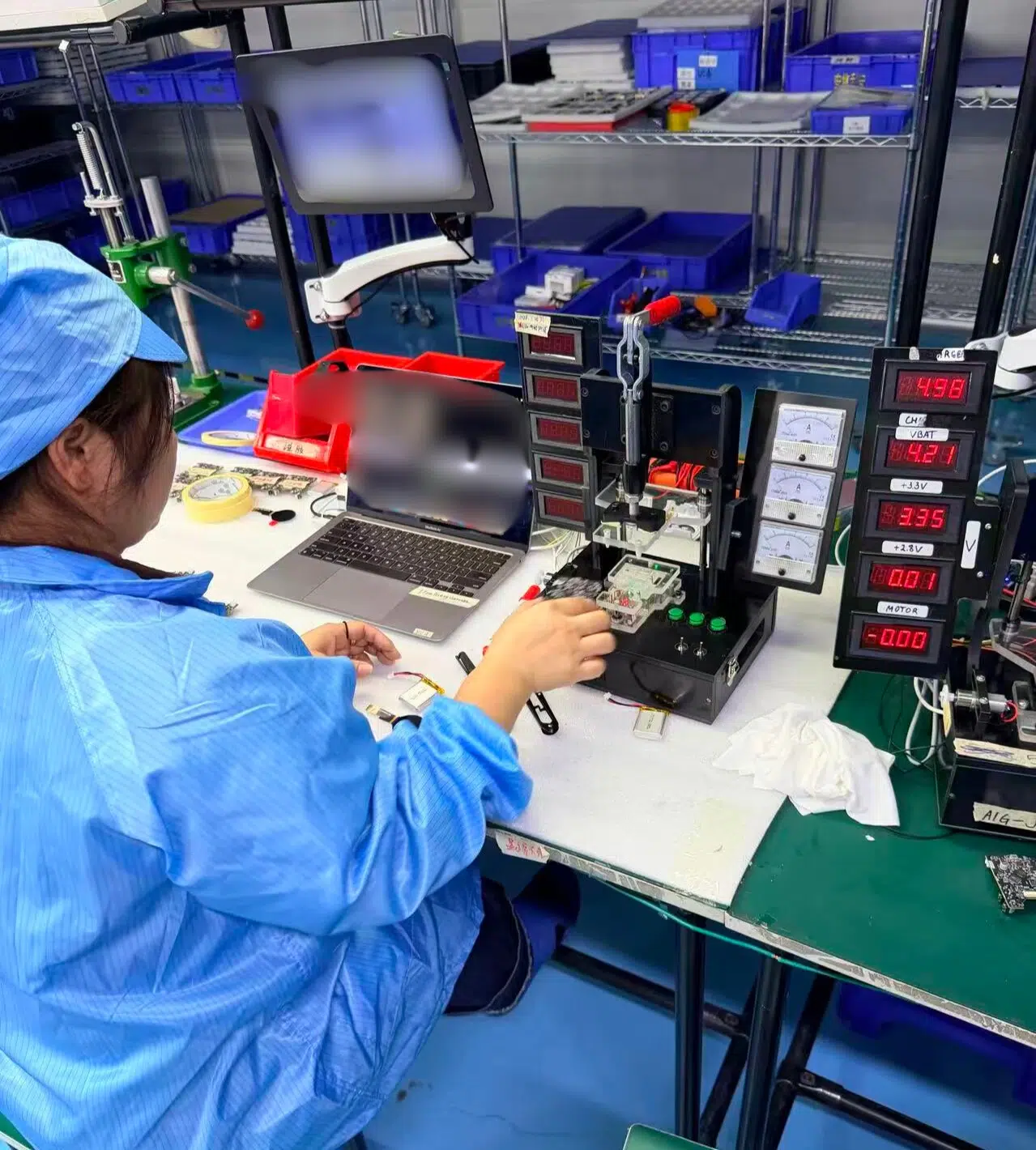
Setting up a dedicated flashing and functional test jig on the assembly line is quite common. The computer receives firmware from your server directly. It may make sense to have your engineers work on that and provide your CM with the testing firmware and a test bench.
Here is such a firmware flashing and functional test jig setup being used for customer products in our own contract manufacturing subsidiary, Agilian:
Now, what if there are issues and you need to rely on your supplier to look into the design files and fix the issues? You will probably need to share those design files with them. In many cases, the buyer realizes it is a necessity.
A practical approach is to formalize expectations in your Manufacturing/Product Development Agreements. Define who owns the firmware, who can access it, how it is stored, and what audit rights you have. Sofeast has a helpful discussion on how importers should structure product development agreements here.
If you are evaluating partners, QualityInspection.org also has a practical guide on how to choose a trustworthy electronics contract manufacturer.
Hiding what others can see on the hardware
Firmware protection in manufacturing is only half the story. Many teams also try to obscure which electronic components they use to slow reverse engineering.
Common tactics include:
- Using unmarked components
- Grinding off component markings
- Applying epoxy over sensitive areas
- Designing boards with internal layers so that critical routing is not visible
For example, here you can see a Huawei motherboard where the chips are disguised with tape and coolers, which obscure its suppliers’ names:

(Image credit: Jay Goldberg/Twitter)
However, Agilian’s CEO Fabien Gaussorgues makes a clear point about this:
“Epoxy can be removed via thermal shocks. I did it myself.”
For that reason, grinding markings off is often more effective than epoxy. Similarly, moving key traces to inner PCB layers makes copying harder, especially compared with simple two-layer boards.
These steps do not make imitation impossible, but they significantly raise the time, cost, and expertise required to copy your product.
Security versus transparency for you
Here is an important balance. While you may want to hide design details from competitors, you still need full visibility as the product owner.
You must know exactly what components are used, how the product is built, and how firmware interacts with hardware. This is essential for:
- CE compliance
- UL or ETL certification
- Quality control
- Future redesigns
- Supplier changes
Obfuscation should face outward toward competitors, not inward toward yourself.
If certifications are part of your plan, Sofeast’s guide on electronics certifications like CE, UL, and ETL is directly relevant.
Adding extra layers of protection
Sofeast’s CEO, Renaud Anjoran, frames software protection as one more barrier, not a magic shield:
“Firmware is programmed code. There are ways to hide (or rather to obfuscate) the source code. It is not 100% reliable, of course, but that’s like adding an extra lock on a door. It will be harder to open that door.”
And on the relationship side, he adds a practical reminder:
“Trust in a CM is good, but trust with an enforceable contract is even better.”
What this looks like in practice
For many companies, a sensible approach to firmware protection in manufacturing combines several elements:
- Use secure chips with readout protection
- Keep the firmware file out of the main factory
- Program chips via a controlled station
- Lock down access with clear contracts
- Obscure sensitive hardware details
- Maintain full transparency for your own team
This is what effective IP-safe contract manufacturing looks like in real life. It is not about paranoia; it is about building a system that protects your core assets while still allowing you to scale.
The bigger picture about protecting firmware
The goal is not absolute secrecy. The goal is to raise the bar high enough that copying your product becomes expensive, slow, and risky, while keeping manufacturing efficient and reliable.
In the end, your strongest advantage will still be your ability to improve your product faster than anyone can copy it.
![Which Manufacturing Processes Will You Come Across In Asia, And What Are They? [Podcast]](https://artbyraksha.sofeast.com/wp-content/uploads/2024/10/Which-Manufacturing-Processes-Will-You-Come-Across-In-Asia-And-What-Are-They.webp)
![3 “Must-Follow” Product Design Optimizations & Best Practices [Podcast]](https://artbyraksha.sofeast.com/wp-content/uploads/2024/08/3-Must-Follow-Product-Design-Optimizations-Best-Practices-Podcast.webp)
![PCBA Protection: How to Care for the Heart of your Electronic Product [Podcast]](https://artbyraksha.sofeast.com/wp-content/uploads/2024/04/PCBA-Protection-How-to-Care-for-the-Heart-of-your-Electronic-Product-Podcast.webp)